




Greg Manning explains how he made a bridle to ensure his Fairey Atalanta remains safe in a storm while on a swinging mooring
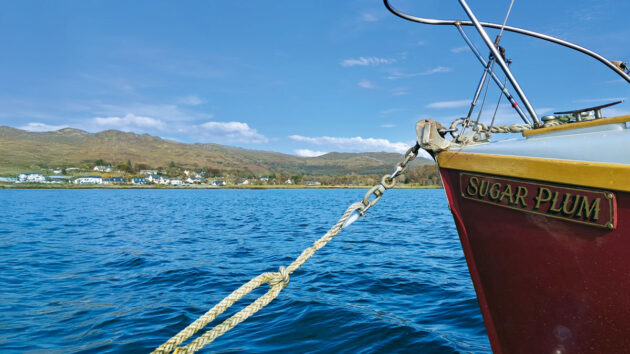
Swinging on a fairly exposed mooring at Arisaig on the west coast of Scotland, my Fairey Atalanta A142 Sugar Plum rode out Storm Floris. Despite 80mph winds, I slept soundly with no concern for her security.
I did expect some damage, and in the past I’ve lost my octahedral radar reflector in such conditions. The mooring’s ground tackle was laid by Arisaig Marine, so I had no concern on that score. The reason for my lack of concern was that I was satisfied the tackle I’d used to secure the boat to the riser was more than adequate and fit for purpose.
For the benefit of readers, I wanted to share how I have configured the bridle so I can confidently leave my boat on the swinging mooring. It is necessary to make a bridle that best fits the bollard, cleat, Samson post or whatever strong point is fitted to the boat; it also has to be compatible with both the stemhead fitting and the ground tackle riser.
Every aspect of this mooring bridle has to be made so it cannot fail, even if it is subjected to hours or maybe days of a boat violently pitching, heaving and yawing. Remember, it may also be overloaded should some flotsam, maybe as large as a tree or another vessel that has broken from its mooring, collide with the boat.
The ground tackle riser provided with a mooring will undoubtedly be of a specification to take the largest vessel possible. This will not be compatible with the fittings of a smaller vessel. To overcome this, a bridle of a specification that will be compatible with the boat’s fittings has to be made; a swivel is needed between the riser and the stemhead; all loops or eyes in the bridle should be formed around a thimble, and where the bridle passes over the stemhead fitting, a short length of chain is needed. Anything else can chafe.
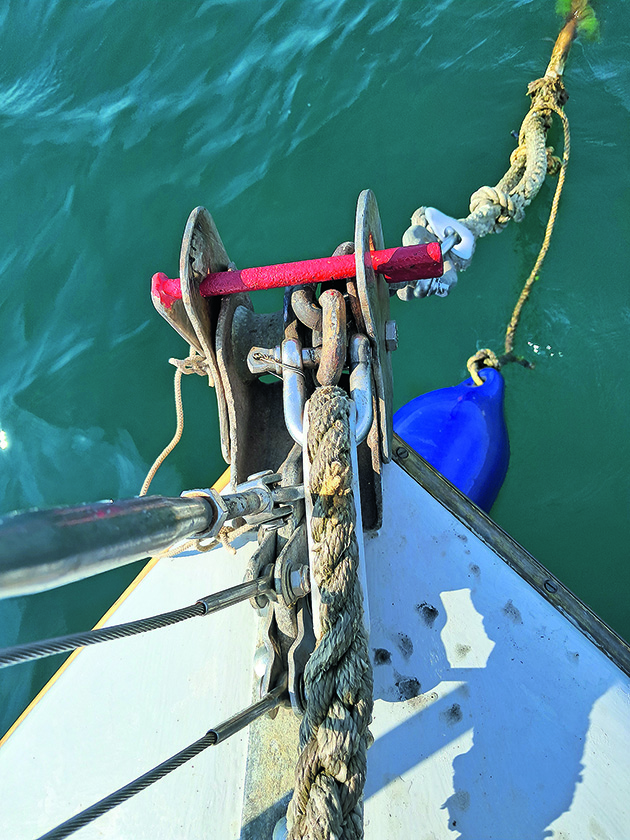
The bridle secured to Sugar Plum’s stemhead roller. Credit: Greg Manning
As can be seen in the picture above, a keeper (the red pin in the photo) must be fitted to stop the bridle from coming out of the stemhead roller. The keeper must be self-locking. This keeper cannot be removed without lifting the latch on the port side through 180° to allow the hit-and-miss keyhole fitting on the starboard side, that locks the pin in place, to be released.
On Sugar Plum, extension cheek plates were added to allow for the keeper. On a vessel where the cheek plates are not high enough to accept a keeper, a modification will be required.
A two-piece shackle must also be wire locked. A three-piece shackle, which has a plain pin secured with a nut, must be secured with a split pin. The bridle then has to be fitted tightly over the bollard or fitting. But this alone is not secure.
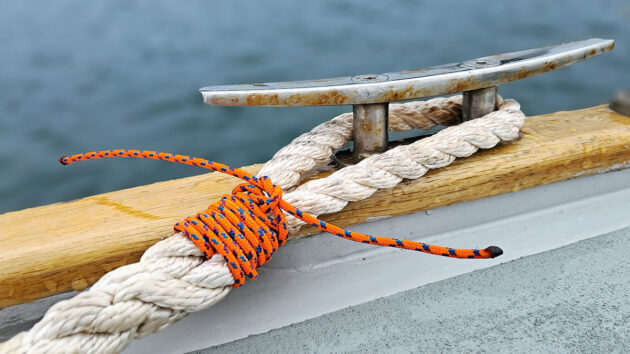
A seizing is used to reduce the loop so the bridle can’t come off. The picture is for illustration only and not an actual mooring. Credit: Greg Manning
To ensure the mooring bridle is secure, it is necessary to mouse off the bollard so that no amount of fretting can displace it. If the bridle has to be secured over a cleat or Samson post, the loop must be reduced in size with a seizing (see photo above) so it cannot accidentally come off.
The first turn of the seizing must be through the loop so the seizing cannot slip off the loop.
Strengthening the mooring bridle connections
The bollard, cleat or whatever strong point is fitted to the boat must be strong enough to cope with a storm. Simply bolting a fitting through the deck is unlikely to be strong enough if a vessel is on a swinging mooring in extreme weather.
On Sugar Plum, not only have I fitted an enlarged backing plate, but it has then been braced to a second backing plate bolted to the stemhead fitting.
For convenience many vessels stow their anchor on the stemhead fitting.
Such stowage must have a keeper so the anchor cannot come off. In reality, this is still not a satisfactory situation as the anchor can still foul the mooring riser or the bridle, even possibly cutting through them.
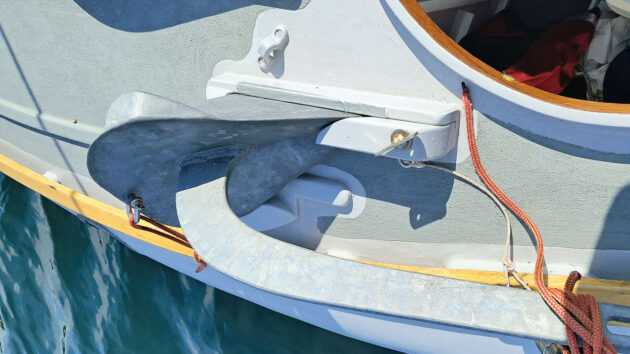
The anchor stowage on Sugar Plum, well away from the mooring bridle. Credit: Greg Manning
If an anchor cannot be stowed below deck then it must be stowed in a purpose-made cradle away from the mooring tackle, which is what I do on Sugar Plum. Not only is there a purpose-made cradle, but the fluke is held in place in the cradle with a solid screw-down block as well as two lashings.
When Storm Floris had abated, I was able to visit Sugar Plum and, to my amazement, the octahedral radar reflector was still in place and undamaged. It was my third one, so the modifications I’d made after the loss of the previous two had worked.
A bungee that had been in place to steady the main sheet had parted, and it looked like the boatyard staff had kindly been on board as two sail cover ties had been retied.
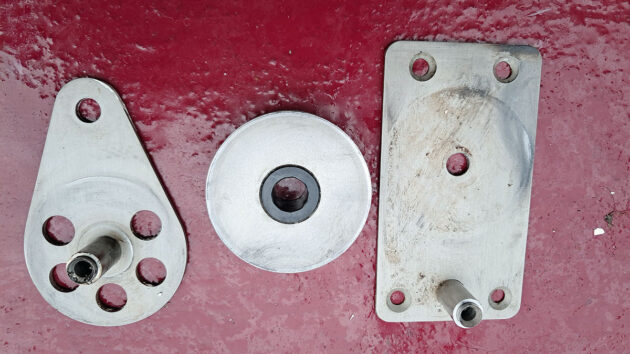
The damaged steering cheek block, how this broke in a storm is a mystery, but Greg sourced a like-for-like replacement. Credit: Greg Manning
The Fairey Atalanta has a central cockpit so there are cables connecting the whipstaff (tiller) to the rudder. These pass around 63mm aluminium cheek blocks at the corners of the aft cabin, and one of these had failed. The pulley and top plate had been catapulted to the opposite corner of the cabin.
How this happened remains a mystery, but I managed to find a like-for-like replacement.
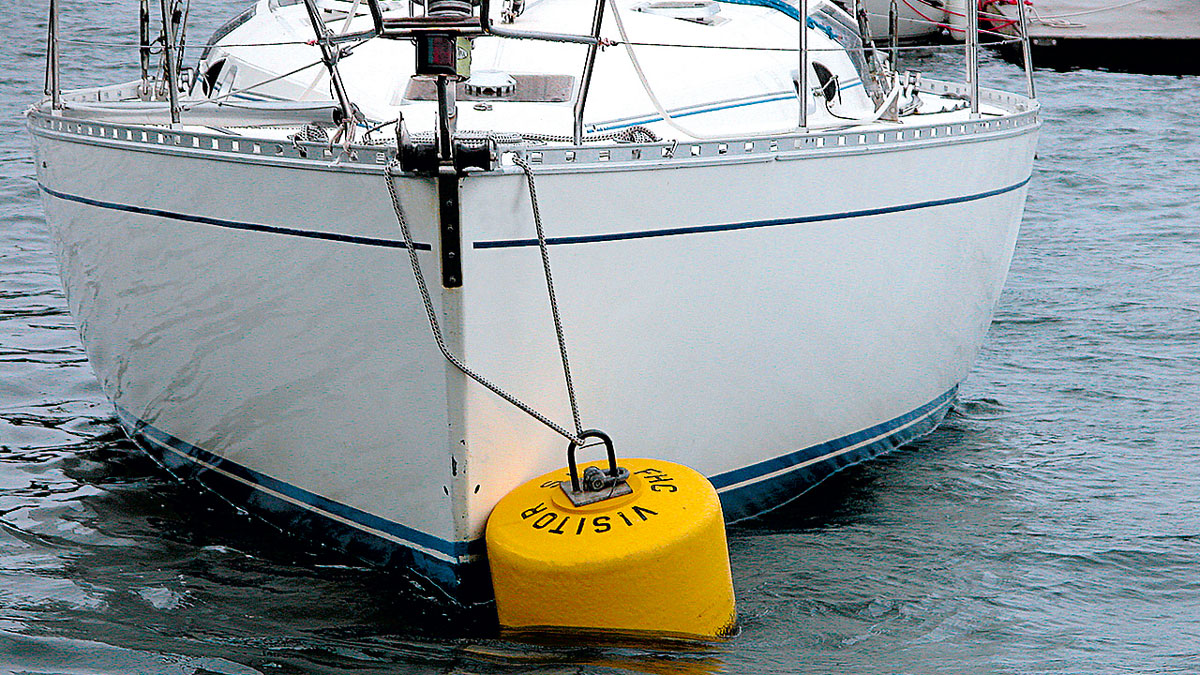
The simple mooring mistake that can chafe through your rope in 20 minutes
By following a few simple mooring guidelines, you can avoid the common pitfalls and make the process of securing your…
Can I trust this boat mooring?
Most sailors use traditional moorings without knowing about their condition or how they are made. Ben Sutcliffe-Davies explains
How to master fore and aft trot moorings
Fore-and-aft trot moorings are cheaper than marinas and have many advantages - but they can be tricky to pick up.…
Buoycatcher-Max: We test the next generation boat hook
Gilbert Park tests the new Buoycatcher-Max, the next generation boat hook
What to read more practical articles like How to make a mooring bridle to secure your boat?
A subscription to Practical Boat Owner magazine costs around 40% less than the cover price.
Print and digital editions are available through Magazines Direct – where you can also find the latest deals.
PBO is packed with information to help you get the most from boat ownership – whether sail or power.
-
-
-
- Take your DIY skills to the next level with trusted advice on boat maintenance and repairs
- Impartial, in-depth gear reviews
- Practical cruising tips for making the most of your time afloat
-
-
Follow us on Facebook, Instagram, TikTok and X