



Chris and Veronica Mardon were at anchor in the Isles of Scilly when Veronica suffered a stroke. A timely response and extraction by the RNLI stopped a precarious situation from precipitating further.
Early July 2025 found my wife, Veronica, and I sailing in our Dufour 40, Spook from Falmouth in Cornwall to the Isles of Scilly, blissfully unaware of the dramatic rescue we were soon to be involved in.
The small archipelago in the Atlantic Ocean is about 25 miles south west of Land’s End, the most south westerly tip of the English mainland.
Sailing in the Isles of Scilly
The Isles of Scilly are a popular tourist destination and boat owners flock there each summer to enjoy the big open skies, green islands, friendly locals and white sandy beaches lapped by clear water that changes colour from pale turquoise to indigo blue as it deepens.
We sailed into a remote bay and anchored for a couple of nights before motoring round to Hugh Town, the capital of St Mary’s, the biggest island, to enjoy its hospitality, walks, and stock up on food.
We were blessed with several hot spells in the British isles that summer.
This would not have deterred wise boat owners from keeping an eye on the weather, as there is not one anchorage or mooring that is safe in all winds in the Isles of Scilly.
However, there are many places to shelter provided the wind direction remains as forecast.
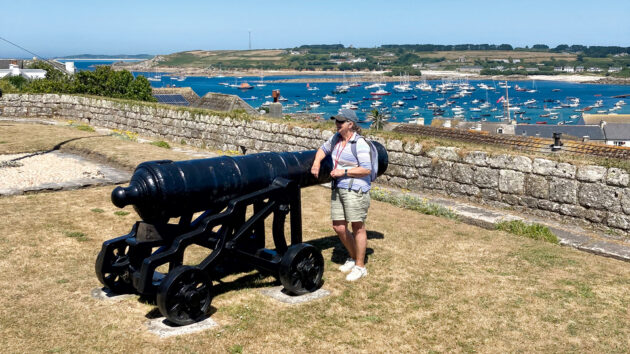
Veronica at Star Castle on St. Mary’s, Hugh Town Harbour Behind. Photo by Chris Mardon
Veronica is more vigilant than I am where weather watching is concerned so she was the first to point out that strong winds up to Force 7 (west-south-westerly, 25-33 knots) would be upon us in the next day or two.
Hugh Town harbour is exposed to the west with no land between it and America resulting in plenty of fetch across the ocean to build high seas.
Clearly, it was time to find ourselves a more sheltered anchorage.
Taking shelter off the Isles of Scilly
To the north west of St Mary’s are the inhabited islands of Bryher and Tresco, separated by a stretch of water known as New Grimsby Sound and the Tresco Channel.
This has reasonably sheltered moorings in westerly winds so we weighed anchor and set off.
There is a shortcut across St Mary’s Road, a three-mile stretch of water between St Mary’s and Tresco, but it is not possible to enter the Tresco Channel via this route from the south at low water.
As the tide was ebbing, we motored out around the west side of Bryher instead.
The sea was building ahead of the approaching gale, but with hardly any wind we used the engine to pilot our way past the numerous rocks off the west coast, including the big Mincarlo and Scilly Rock, until we reached the channel entrance at the north-west of the archipelago.
Disappointingly, all the visitor moorings were taken, so we dropped hook north of Hangman Island in 12m with four times scope.
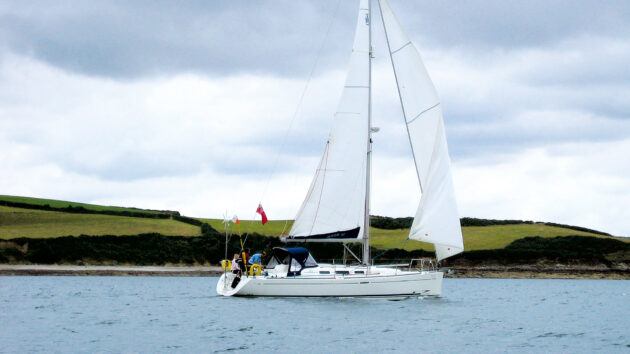
The 999 call operator was told the location was ‘a white yacht in the Tresco Channel between Cromwell Castle and Hangman’s Island’. Photo by Chris Mardon of Spook sailing to the Isles of Scilly.
We dug our Rocna anchor in and were relieved to find the holding so good that 2,500rpm astern would not budge us an inch.
The only downside to our spot was its distance from New Grimsby, a village on Tresco with its excellent New Inn and a pricey but good supermarket.
We have a Torqeedo electric outboard which creates the common range anxiety.
The two way trip from Spook to New Grimsby and back relieved the outboard’s battery of 20% of its capacity, so I took its battery charger along and found a wall socket in the New Inn after acquiring the bar steward’s permission.
The mains charge rate is about 10% per hour so we had time to enjoy lunch and go for a walk before heading back to Spook.
Spook happily rode her anchor for the next two days while the near gale built impressive seas and crashing surf against the channel entrance about half a mile north-west of us.
The swell rolling in was tolerable and we spent time ashore exploring the island’s many delights.
The northern end of Tresco is wild and barren where explorers can find Cromwell Castle, the ruins of King Charles Castle and a ‘secret’ cave.
The southern end is far more developed with farms, time-share and self-catering accommodation in cottages old and new.
The Dorrien-Smith family, long time Tresco lessees, live in The Abbey next to their sub-tropical gardens and the Valhalla Museum, full of figureheads from the many ships wrecked over past centuries. Crime is minimal here and visitors get about on foot or bicycle.
Making the emergency call
In the morning of our third day at anchor Veronica was getting out of bed when she said she could not feel her right leg and she thought she was having a stroke.
That’s ridiculous, I thought. Strokes happen to other people.
But she was a nurse and clearly recognised the symptoms. I dialled 999.
It did not have time to ring before the operator picked up and asked which service I required.
I told her I thought my wife was having a stroke.
She asked if she could raise both arms which Veronica did before her right arm started to drop.
I relayed this to the operator who said she would call the emergency services and asked for our postcode or What3Words location.
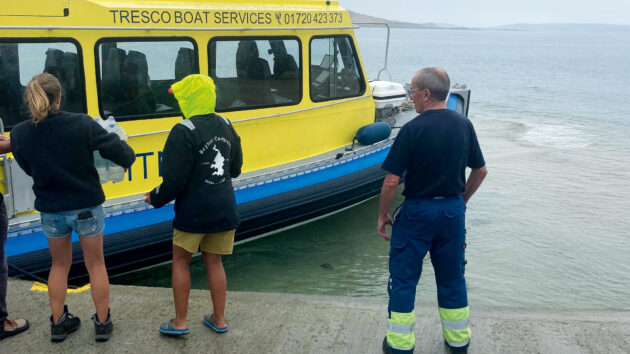
Tresco harbour master Rob kindly sorted out Chris’s journey back to Spook aboard the jet ferry Lightning. Photo: Chris Mardon
I had no idea, so I told her we were anchored on a white yacht in the Tresco Channel between Cromwell Castle on Tresco Island and Hangman’s Island, Isles of Scilly, which she accepted and rang off.
I tried to make Veronica comfortable on the saloon sole. 10 minutes later there was a knock on the deck.
I came into the cockpit ready to tell whoever it was to go away when I saw Rob Featherstone, the harbourmaster, in his launch with two men, one a South Western Ambulance Service Trust (SWAST) paramedic who introduced himself as Henry.
He asked if I had made the emergency call. He was soon down below attending to Veronica.
I have no idea how they got to Spook so quickly. We may not have received such a response at home in Somerset.
Medical attention and extraction
After Henry had attended to Veronica for a few minutes the three men began discussing how best to get her to hospital.
They decided Spook was not suitable for a helicopter evacuation so St Mary’s lifeboat was called.
The tide was too low for the St Mary’s Road shortcut so the RNLI crew came around the west side of Bryher.
Despite the rough seas, it only took the Severn Class Lifeboat (which can do 25 knots) about 20 minutes, a lot quicker than it had taken Spook at 7 knots.
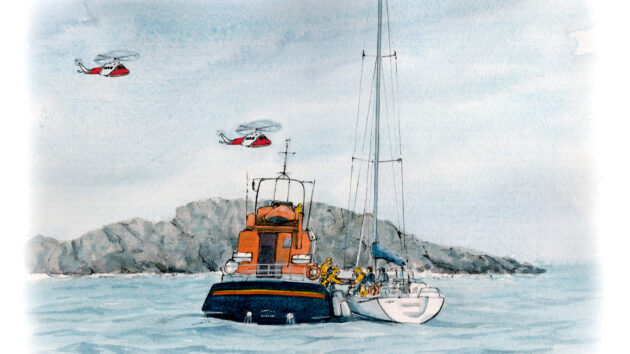
Once in the Tresco Channel, the lifeboat came alongside Spook. A broadside swell caused both vessels to roll, but the lifeboat coxswain showed his considerable prowess at the helm ensuring his 41-tonne vessel did not damage to our 8-tonne yacht. The crew placed large fenders and surged their lines to avoid damage.
Veronica was strapped into a firm stretcher down below and carried up the companionway, through Spook’s narrow main hatch into the cockpit and across the 2ft gap between the rolling vessels and into the lifeboat’s cabin.
Henry boarded the lifeboat. I followed and was invited to sit in a chair inside the cabin door, which they closed behind me. We made to sea without delay.
The lifeboat rolled, dipped and climbed over the large waves. I could see the red and white search and rescue (SAR) helicopter out of the window as we left the Tresco Channel.
Airlift
The lifeboat found calmer waters in the Great Bay north of St Martin’s island before a R924 helicopter paramedic came down on a wire and landed on her aft deck. He removed his helmet and came into the cabin to talk to Henry.
Veronica was carried outside, unstrapped from her stretcher, put into a harness and hoisted aloft with the R924 paramedic.
I’ll never forget the image of my darling wife of 55 years hanging from that wire in a near gale with her long hair flying in the 130mph rotor’s down-draught.
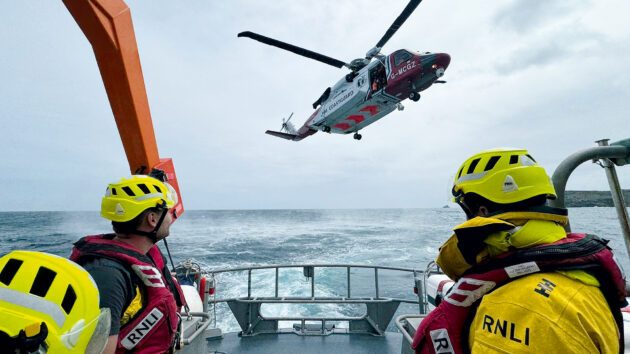
Helicopter operations in Great Bay, St Martin’s – St Mary’s RNLI Lifeboat crew evacuated Veronica from the yacht for a helicopter airlift in calmer waters. Photo by St Mary’s RNLI Lifeboat
She looked petrified and I was numb with grief; I had no idea how serious her stroke would be nor whether I would even see her again.
Henry told me that provided the right treatment is administered within a golden period of a few hours, it will greatly improve the patient’s chances of a good recovery.
I hung onto that glimmer of hope while Veronica was taken to Derriford Hospital, Plymouth’s high dependency acute stroke unit.
The lifeboat took the calmer way back to Hugh Town via the leeward eastern side of the islands of St Martin’s and St Mary’s. They dropped me off on the quay where the Scillonian III ferry was disembarking its passengers from the mainland.
Seeing the visiting yachts in the harbour rolling around convinced me we’d made the right decision to move Spook two days earlier.
I made my way to the Atlantic Hotel to collect my thoughts in a quiet corner of its bar. I sent a message to our son and daughter and they immediately made plans to be there that evening involving car journeys of several hours each.
Rob, the Tresco harbourmaster, kindly arranged for the jet boat ferry Lightning to take me from Hugh Town back to Spook that afternoon, and helped me to put her on an empty commercial mooring the next morning and to secure my dinghy and outboard in his yard before I took The Firethorn back to St Mary’s to catch the Scillonian III to Penzance.
From there I took the train to Plymouth where I was collected by my son and daughter and taken to the local Derriford Travelodge ready to visit Veronica in hospital the next day.
Her neurologist told us a bleed on the brain which, along with other complications, had paralysed Veronica’s right arm and leg and affected her speech centre. She was also suffering from extreme fatigue, a common symptom of stroke.
After three weeks in the amazing Merrivale stroke unit at Derriford, Veronica was moved to a dedicated stroke rehabilitation unit at Weston General Hospital, North Somerset, closer to our home.
Condition update
Three weeks after leaving Spook on a Tresco mooring, I returned with my daughter, Nicola, and her 18-year-old son William to victual Spook and take her back to Plymouth from the Isles of Scilly.
When I asked Rob how much I owed for the Lightning jet ferry and the mooring he told me they don’t charge visitors who’ve had to be medically evacuated.
I cannot over-emphasise the admiration and thanks I owe to the RNLI, its lifeboat crew, Henry the paramedic, Rob the harbourmaster, the R924 helicopter crew and all the others who were involved in rescuing Veronica and helping me on that day and since. Their performance was of the highest standards.
After 14 weeks in hospital, Veronica returned to the comforts of home to continue her rehabilitation.
We’re pleased to say she is making a recovery – but there’s still a long way to go.
Lessons Learned from our medical emergency in the Isles of Scilly
- Check your DSC VHF radio daily to ensure it is in working order even if you’d not normally switch it on. You never know when an emergency will arise nor whether you’ll have a mobile phone signal when it’s needed.
- Brush up on your Mayday procedures and check that you are familiar with the correct operation of the DSC VHF emergency button. At the moment an emergency arises, you are unlikely to be functioning clearly enough to remember emergency procedures that you learnt years ago. Precious minutes could be lost.
- Consider what you’d do if one of your crew had a heart attack, or your prop is fouled by netting, or you hit an unidentified submerged object and there’s suddenly knee-deep water in the saloon. If you’ve thought scenarios through, your boat and crew will have a much better chance of survival.
- If one of your loved ones has to be disembarked from your boat think carefully before you decide to go with them. I asked the helicopter medic if I could go with my wife on the helicopter. I’m pleased he gave me a firm refusal as I had much to do to secure Spook before leaving the islands, and I could not do anything to help my wife until long after she’d been admitted to hospital anyway.
- Tell a friend or family ashore as soon as possible if you suffer a disaster at sea. They may be able to organise help in whatever form it is needed, (transport, accommodation etc) much more easily than might be possible from your distressed situation.
Remember Act FAST: every minute is critical in minimising brain damage.
- Facial weakness: can the person smile? Has their mouth or eye drooped?
- Arm weakness: can the person raise both arms?
- Speech problems: can the person speak clearly and understand what you say?
- Time to call 999: stroke is a serious medical emergency.
Expert comments
Camilla Herrmann is the Cruising Association’s magazine editor. Her husband, Sam, suffered a stroke.
There may not be any indications in the person’s medical history that a stroke might happen. From personal experience, you can’t tell from the initial stroke symptoms how bad the long-term impact might be.
In fact, it might look like a stroke but not be – one in four admissions to hyper-acute stroke units is a ‘mimic’.
Nevertheless, the system is set up to respond as rapidly as possible and admit everyone, because speedy treatment can make the difference between returning to a normal life (using ‘clotbuster’ drugs or surgical thrombectomy) and lifelong impairment.
Boyd Goldie, a retired orthopaedic surgeon, a member of the CA’s Regulatory & Technical Services (RATS) Group, comments:
The incident presents a valuable opportunity to reflect on wider onboard safety considerations.
It occurred at anchor in UK waters, and the casualty was not the skipper. How might the outcome have differed if the skipper had been affected?
And how would the situation have unfolded had it taken place in foreign waters, while under way, or offshore?
Pre-cruise, ask all guests/crew about allergies, medication, and pre-existing medical conditions.
Write a safety briefing for your vessel and give it to all crew before they arrive, including: how to turn on the engine; how to use the VHF; Where VHF Mayday instructions are; and man overboard procedure.
Consider what crew would do if the skipper becomes injured, unwell or overboard. Ensure they know how to: start the engine; drop the sails; use the VHF on Ch16 to send a Mayday; the VHF should always be on and watching Ch16 when on board, both when under way and also at anchor.
Know your own mobile phone number in case Coastguard wish to call you back rather than use VHF – or write it down somewhere accessible.
Load What3Words onto your phone and learn how to use it: what3words.com
Chris Mardon and his wife, Veronica, bought their first yacht, a Kelt 8.50, in 1989. Since then they have owned a Sadler 34 and now a Dufour 40, visiting most ports from La Rochelle to Kinsale and the Isles of Scilly to Cherbourg.
Want to read more articles about sailing in the Isles of Scilly?

A subscription to Practical Boat Owner magazine costs around 40% less than the cover price.
Print and digital editions are available through Magazines Direct – where you can also find the latest deals.
PBO is packed with information to help you get the most from boat ownership – whether sail or power.
-
-
-
- Take your DIY skills to the next level with trusted advice on boat maintenance and repairs
- Impartial, in-depth gear reviews
- Practical cruising tips for making the most of your time afloat
-
-
Follow us on Facebook, Instagram, TikTok and Twitter