


Viveka Herzum gets advice from seasoned sailors about offshore small-boat solo sailing at the inaugural Jester Challenge Symposium
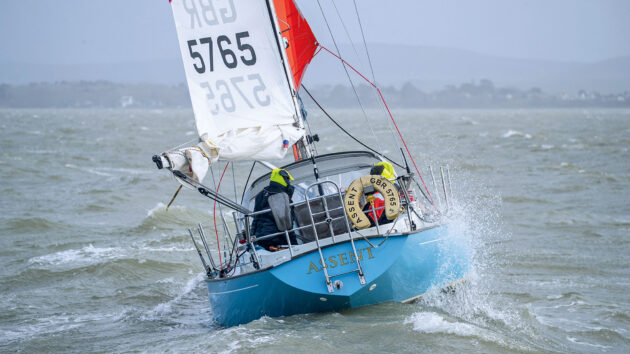
‘Rarely will you meet such a bunch of miscreants and misfits,’ event organiser David McDowall pronounced in the opening speech of the first-ever Jester Challenge Symposium.
Terms of endearment for the assembled small-boat solo sailors in attendance, many of whom gravitate towards the Jester Challenge – now in its 20th year – for its focus on independent seamanship, a DIY ethic, and good old-fashioned self-reliance.
A full programme of presentations highlighted key considerations for those looking to undertake a crossing, though as speakers were keen to remind attendees, ‘We are not experts!’
Rounding out the offering were presentations from rigger and sailmaker Alan Harris Guerrero of Sail Shape Rigging Ltd; offshore sailor, author, and advisor to the royals Stokey Woodall, who trained names like Sir Chay Blythe, Dame Ellen MacArthur, and Alex Thompson; and godfather of extreme adventures Don McIntyre, as well as commercial presentations from Waypoint Liferafts and PredictWind.
While some topics may have been old news for seasoned sailors, the programme offered an ideal overview for anyone looking to get offshore and created ample opportunities for further discussion.
From heavy weather tactics to safety measures, communication options and onboard technology, here are the key takeaways from the Jester Symposium.
‘Heavy’ weather is relative
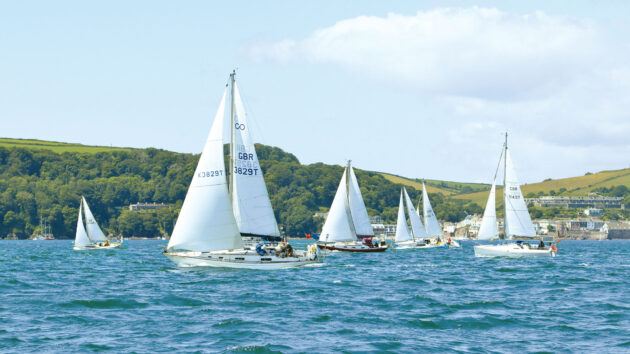
Jester Challenge skippers have to be completely self-reliant, which is why preparation for taking a small boat offshore is vital. Photo by Jake Kavanagh
What counts as ‘heavy’ weather depends on each skipper’s personal risk threshold.
As Jester Helm member George Arnison noted, it’s important to avoid the temptation to default to someone else’s tactics and instead “Do your own thinking.”
Overall heavy weather readiness is determined by the boat’s fixed elements, the equipment already on board, the boat’s overall state, the sea state, and the projected forecast.
Most importantly, it also depends on the individual skipper’s capability and physical and mental state.
A diverse range of issues including seasickness, sleep, nutrition, clothing, first aid, and mental health can affect a sailor’s responses and resilience during a passage.
Presenters advised stress tactics that can change incrementally, and identified three top priorities in heavy weather:
- minimising the risk of knockdown and avoiding capsizing or pitchpoling
- maintaining control of the boat
- retaining the skipper’s full functional capacity, with consideration for the sustainability of helming in heavy weather alone
On his own vessel, Arnison has three available reefs in the main, a storm jib and trysail with dedicated sheets, blocks, and halyards and a separate track for the trysail, and a removable inner forestay.
Planning ahead is also key to preventing water ingress, particularly from washboards and the sliding hatch.
Keep heavy items like batteries lashed down in lockers and locking compartments.
Other suggestions for useful modifications included:
- An easy-to-fold-down sprayhood and removable dodgers
- Cockpit lockers as close to waterproof as possible
- Cockpit drains
- washboards that can be tied down, latches on all lockers, and nets on all shelves
- Reefing from the cockpit
- Multiple bilge pumps
- Shut-off valves fitted on fuel tank breather pipes
- Extra grab rails inside the cabin
Your options in heavy weather
If you are bow-to the waves:
- Carry on, bow into weather
- Heave to: stop, drift downwind slowly, 50° to windward
- Lie to parachute anchor, similar to heaving to, but drifting more slowly
Beam to the waves:
- Lie ahull: drop all sails and batten down the hatches!
- Run at speed: stern to waves and downwind, accepting a high risk of pitchpoling
- Run with warps
- Run with a drogue (Jester skippers recommended the Jordan Series Drogue)
- Motoring
The Jordan Series Drogue
A Jordan Series Drogue (JSD) is like ‘putting in a fourth reef,’ according to Mike Atkins, the first finisher in the 2024 Jester Azores Challenge.
He sees it as essential gear for an offshore boat on the smaller end of the sail spectrum.
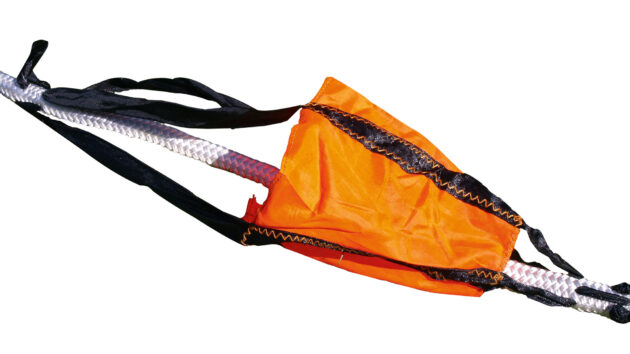
The JSD, invented after the Fastnet disaster of 1979 and since approved by the US Coast Guard, is essentially a series of small drogues in sequence.
The multiple smaller drogues distribute the risk of failure and act as a shock absorber, ensuring the drogue engages gradually.
When installing a JSD, Atkins recommends prioritising strong, spaced-out attachment points, having a dedicated chainplate, and ensuring there is sufficient weight on the tail.
Also consider anti-chafe options, such as including PVC piping on the bridle.
Make sure to use cow hitches over knots in your setup– a valuable lesson from Susie Goodall’s 2018 Golden Globe Race attempt.
While Goodall was using a drogue in the Southern Ocean, a manufactured Flemish loop on the rode failed, resulting in the drogue hawser snapping.
Propelled forward just as a rogue wave hit, the boat pitch-poled and dismasted, ending Goodall’s race.
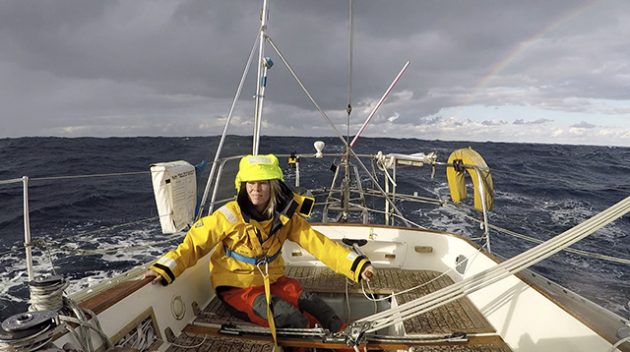
Susie Goodall pictured during her solo transatlantic training voyage to Antigua and back. Credit: Susie Goodall Racing/DHL/PPL
Storage options that allow easy access and minimise wear and tear should be considered, and different material options for their resistance and level of shock absorbency should also be evaluated. (Atkins had his JSD made in braid-on-braid Dyneema.)
The preferred method of deployment is also important.
Some skippers may prefer to throw the weight in first and ‘chuck in’ the series drogue afterwards. This is quicker, but can increase shock during deployment and risk the line getting caught.
Others might instead choose to pay out their JSD from the bridle, an option which takes longer but offers more control.
Regardless, it is recommended to test all equipment and practice deployment techniques in calm conditions before departure.
Staying on the boat
Bring together a group of sailors and there will always be lively contributions to time-old debates about safety lines, lifejackets, and what is actually the safest option to avoid going overboard.
Regardless of their individual preferences, all Jester skippers agreed on the need for a solid system to ensure remaining attached to the vessel, such as: a lifejacket with harness and tether lines, robust clip-on points around the boat, and jacklines and gear able to withstand the shock loads of a breaking wave, at least 2,000kg.
Veteran Jester sailor Tony Head, who has completed the Jester Challenge, Jester Azores Challenge and Jester Baltimore Challenge, recommends that solo sailors stay inside the guardrails.
“Jester single-handlers need to give more thought to clipping on than you might do in a crew race boat, where you’ve got the rest of the crew to pull you back on board if you fall overboard,” he said.
“Let’s be blunt, if a single-handler falls overboard, he’s dead as his boat sails on.”
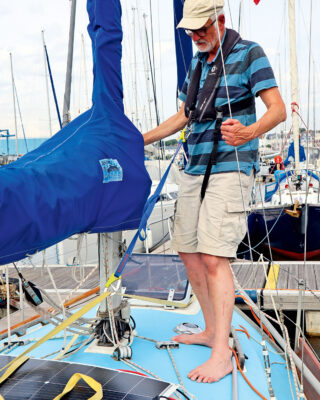
Tether lines need to be bespoke to the boat’s dimensions to ensure solo skippers are not swept overboard. Photo by Jake Kavanagh
Head suggested three-hook tether lines, which allow the wearer to work past obstructions, and an inboard jackline with a shorter tether as possible precautions, stressing that tether lines should be bespoke to match the actual dimensions of your vessel.
Other considerations include:
- having a short fixed line to clip into when working at the mast (alternatively, a tether that can go around it)
- installing low clip-on points in the cockpit and considering the necessary radius of motion for all possible tasks
- nonslip surfaces
- granny rails at the mast
- reliable guardrails and handrails for going forward, particularly on or around the sprayhood area
Keeping a safety knife in your lifejacket is also recommended for cutting lines in an emergency, and some skippers suggested trailing an emergency line to disconnect self-steering gear.
Skippers in the Mini Globe Race, a round-the-world solo race in 19ft yachts, have to make sure their boats have a gunner line from the bow to the stern of the boat, a footstrop line separate from the gunner line, and a boarding ladder at the back of the boat (Jester skippers also suggested steps up the rudder to get back on board).
Mini Globe founder Don McIntyre also shared that he preferred manual lifejackets over those which automatically inflate and a snapshackle on the chest of the lifejacket, both of which run contrary to World Sailing recommendations.
Other safety considerations from the Jester Challenge Symposium
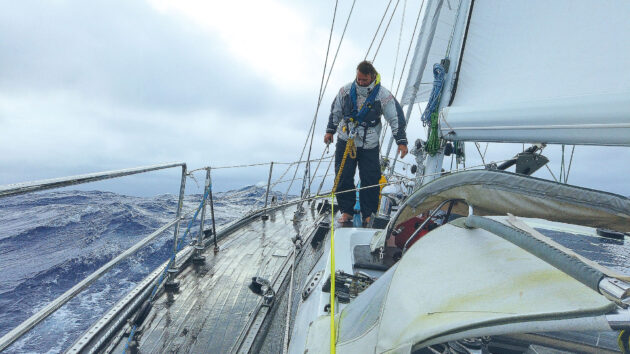
Jacklines need to be protected from chafe and sun exposure. Photo by Erin Carey
Harris Guerrero, whose rigging and sailmaking business also produces jacklines, highlighted the degradation of jacklines due to UV exposure as another key safety concern for solo sailors.
“It’s actually the stitching that will fail first over UV light than the two and a half ton jackline,” he explained.
To reduce the effect of abrasion and sun exposure on stitching, he suggests incorporating a protective sleeve over the jackline’s stitching.
Some skippers also discussed adapting harnesses designed for climbing and mountaineering for onboard use, though lightweight aluminium carabiners are unsuitable for marine environments due to saltwater corrosion.
Others suggested adopting kayak helmets, kite surfing helmets, or skiing helmets for marine use, and recommended seeking out retailers which supply trusted organisations like the Maritime and Coastguard Agency and the RNLI with head protection.
Rig setup
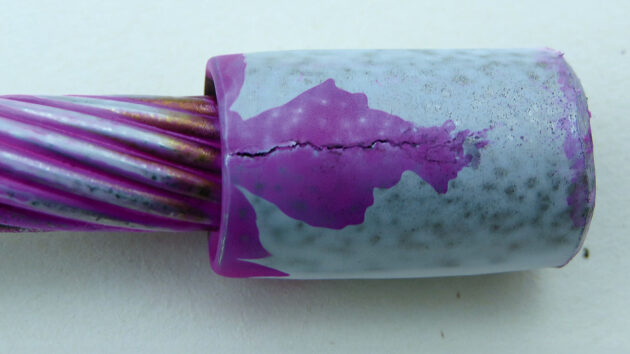
Dye testing can help you identify any cracks in the stainless steel of the rig. Photo by Vyv Cox
A single transatlantic trip equates to 6-8 seasons of use on the rig, which is why Harris Guerrero stresses the importance of monitoring the forestay for possible strain.
“People take it for granted, but it’s the most failed stay. If you have a furling system, it’s bearing a dynamic, torsional load on the foresail that translates up to the masthead.”
As a forestay unravelling at the top is a common failure, he recommends adopting a top bearing made of one piece if possible.
Skippers might also consider pre-bending the rig to take some of the aft loads off the mainsail.
As the shock load is amplified through a rig that is not correctly tensioned, Guerrero also recommends conducting regular professional rig checks and adopting non-destructive forms of DIY testing, such as dye or tap-testing in the interim.
Marine electronics
Jester veteran Ron Oliver provided a useful overview of the various options for receiving forecasts, communications, and other onboard electronics, including watermakers and the all-important fridge, “to avoid giving yourself food poisoning and, of equal importance, have milk for a proper cup of tea.”
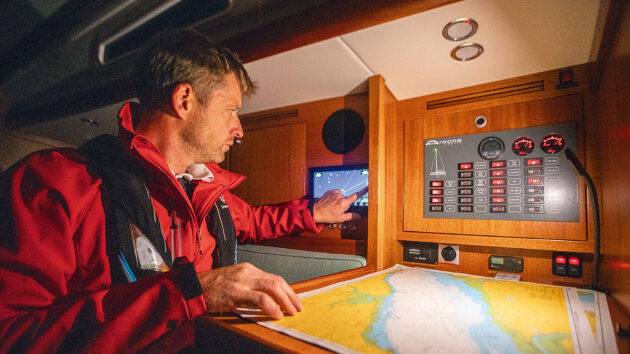
Have a combination of navigation options, like a chartplotter and paper charts. Photo by Richard Langdon/Ocean Images
Navigation options:
- Chartplotters
- Apps such as Navionics or Open CPN
- Charts and handheld GPS
- Phone or tablet with built-in GPS
- Traditional navigation
- Ideally, some combination of the above
Weather information options:
- VHF broadcast (14-40 mile range)
- Navtex (available worldwide) or RTTY (Europe) (250 mile range)
- Weatherfax (5 day forecasts available worldwide, 2,000 mile range)
- GRIB Files
- Via internet Starlink, Iridium Go!/Go!Exec), Web browser
- Via email single sideband (SSB) radio + modem, GRIB file viewer, and www.saildocs.com or sending an email to query@saildocs.com
- Via Garmin inReach/Messenger Raspberry Pi Computer, Android Phone or Tablet
- Weather Routing apps such as Windy or PredictWind, which also rely on GRIB files
Staying visible
Navigation lights
Lights can be either connected to your electrical system or battery-operated.
Ideally, offshore sailors would carry a combination of the two.
AIS
Receiving and transmitting options include AIS Class A, used by commercial ships (12.5W, 30-40 mile range); AIS B, most often used by leisure ships (2W, 7-10 mile range); and AIS B+, with a 10-12 mile range.
Ron Oliver noted that cargo ships have been known to filter out AIS B in trafficked areas like the Solent.
Solo sailors can also opt for an inexpensive receiving-only option to receive information from both Class A and B AIS to monitor other vessels’ positions without transmitting their own.
Radar
Active radar equipment like Echomax radar reflectors will depend on the availability of electricity.
While not dependent on power, passive equipment is less effective with performance ranging from poor (tube type) to modest (triangular type in rain catcher mode).
Offshore sailors should also be aware that sailboats are particularly invisible to radar and require additional mechanisms to make them visible.
Echomax
Don McIntyre recommended that solo sailors in particular should consider the Echomax Transponder, a yellow and red fishing buoy flashing light, and having three sets of navigation lights to mitigate potential failure.
Communication
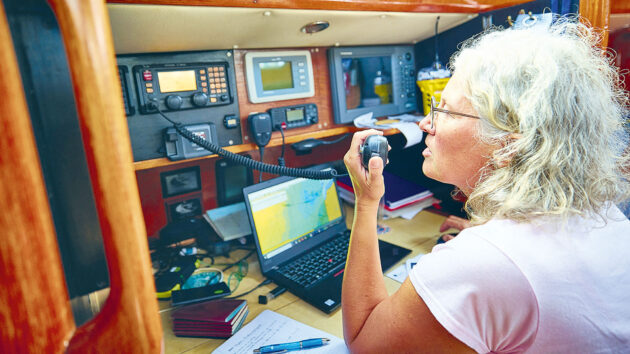
Depending on weather conditions, SSB radio has a range of up to 1,000 miles. Photo by James Mitchell/World Cruising Club
While SSB usage is declining with the advent of Starlink, it has an impressive 100-1,000 mile range depending on atmospheric conditions.
VHF only has a 15-40 mile range, while handheld radios will reach 1-5 miles.
A range of satellite options are recommended for emergency communications.
At the very least, a satellite phone for the grab bag, but sailors can also consider Starlink, Iridium Go!, or other grab-bag compatible options like Garmin inReach Mini/Messenger, Yellow Brick, or Spot X.
Don McIntyre recommends the YB3 text handheld tracker as battery life lasts 4-5 months, and suggested that across the McIntyre Adventures events, these have proved more important for survivors than even the Emergency Position Indicating Radio Beacon (EPIRB), which has a 3-5 day lifespan once activated, or the Personal Locator Beacon (PLB), which guarantees continuous operation for 24 hours.
Some skippers noted that iPhone models from the 14 onwards can also send satellite texts.
More tips from the Jester Challenge Symposium
Generating electricity from solar to water power, windvanes, and petrol generators, and helming options from autopilots to tiller pilots to wind-based sheet-to-tiller steering should also be considered.
Keep the liferaft behind the mast, and in case you ever find yourself actually boarding one, remember: no food for the first 24 hours!
What is the Jester Challenge?
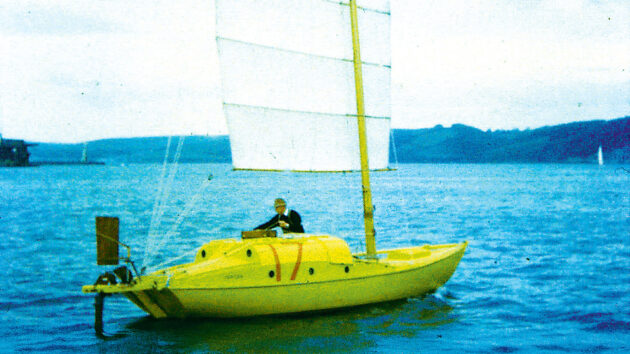
Blondie Hasler’s Jester. Photo by Ewen Southby-Tailyour
According to the founder, Ewen Southby-Tailyour, “The Jester Challenge– a modern experiment in old-fashioned self-reliance, self-sufficiency and personal responsibility– encourages ocean passages in small boats sailed by independent-minded yachtsmen, still able to exercise their individual freedoms at sea.”
It exists on the understanding that everyone has the right to sail across an ocean single-handed and ‘in company’’ without submitting to entrance fees and rules, other than those governing common sense and good seamanship.
Southby-Tailyour started the Challenge in 2006 in the spirit of Blondie Hasler’s solo Atlantic race on the 25ft junk-rigged folkboat Jester during the inaugural OSTAR in 1960, which was won by Sir Francis Chichester on Gypsy Moth III.
Every two years, an indefinitely-sized group of sailors sets off from Plymouth to sail the Atlantic, either to Newport, Rhode Island, or the Azores at their own peril, most often on their own yachts which they have modified, restored, or prepared themselves.
There is also the Jester Baltimore Challenge, held every two years, with skippers departing from Plymouth or from Pwllheli in Wales sailing to Baltimore, Ireland.
Viveka Herzum has worked as a skipper in the Mediterranean in both a commercial and a non-profit capacity. She now works full-time in marine media as a content creator and writer for Practical Boat Owner, Yachting Monthly and Yachting World.
20 Years of the Jester Challenge: Celebrating Low-Budget, Single-Handed Seamanship
Jester Challenge founder Ewen Southby-Tailyour and PBO’s Jake Kavanagh on the enduring appeal of this long-distance sailing event
Preparing a small boat for heavy weather with advice from the skippers of the Jester Challenge 2025
The Jester Challenge 2025 once again proved a fertile ground for examples of how a short-handed crew can prepare for…

Towing under sail for 232 miles: Impressive seamanship in the Jester Azores Challenge
"Some 400 miles from the finishing line, the Varne Folkboat Minke lost her rudder" – John Apps reports on impressive feats…
Pete Hill on sail repair, damaged steering and two lost drogues while battling storms in the Tasman Sea
Pete Hill faced damaged steering and lost two drogues while battling extreme conditions in the Tasman Sea. Graham Cox tells…
Want to read more articles about the Jester Challenge?
A subscription to Practical Boat Owner magazine costs around 40% less than the cover price.
Print and digital editions are available through Magazines Direct – where you can also find the latest deals.
PBO is packed with information to help you get the most from boat ownership – whether sail or power.
-
-
-
- Take your DIY skills to the next level with trusted advice on boat maintenance and repairs
- Impartial, in-depth gear reviews
- Practical cruising tips for making the most of your time afloat
-
-
Follow us on Facebook, Instagram, TikTok and Twitter