


Arthur Manning recalls his Starlight 35 being left high and dry on rocks off the Brittany coast
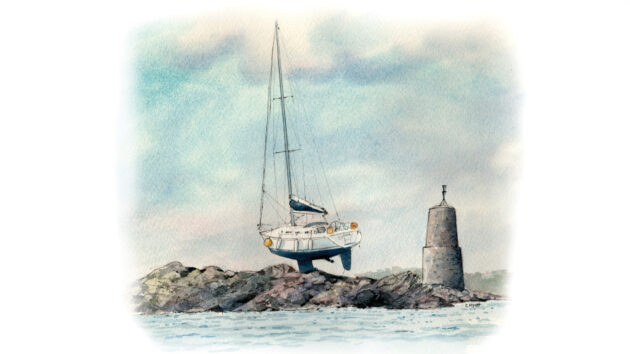
Heading for the start of the annual Waller–Harris two-handed race, an event in which Knight Star had proudly taken the class trophy for the previous two years, our spirits were high.
It was a clear July morning in 2009, with a fresh southerly breeze, when we eased Knight Star out of Binic marina – a quiet little harbour just south of Saint-Quay-Portrieux on the Brittany coast, bound for Jersey, 45 miles away.
We’d already completed the first two legs of the race, from Jersey to Granville, then on to Binic. Now we were taking on the third and final leg home.
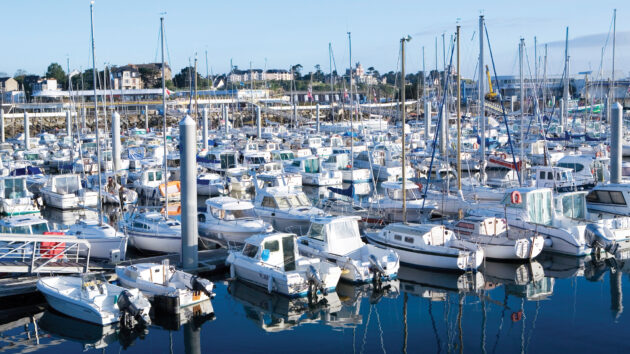
Sailors who do not wish to dry out at Saint-Quay-Portrieux can moor at Port d’Armor northern Brittany’s biggest deep-water harbour, accessible 24/7. Photo by Guido Schiefer / Alamy
Mid-race
I had competed in the Waller–Harris most years since 1984 and for the past two years Knight Star had won her class. So we were looking for the hat-trick.
The event is organised by Royal Channel Islands Yacht Club and I was racing with a friend who I’d sailed with on several occasions, but he was not a regular crew member for me.
It was about 0800 as we made an excellent downwind start under spinnaker.
While most of the fleet chose the conventional route, heading east toward the Caffa cardinal, I opted for a more direct line, leaving La Longue tower to starboard.
It was a slightly shorter course, but one requiring careful planning, with numerous rocks scattered across the area.
Two boats followed – one a bigger Beneteau 39 to my starboard side, slightly behind me which was shadowing my wind.
To keep clear of her, we hardened up and trimmed the sails.
New course
This new angle of course left me a little further windward than planned, and a bit closer than I would have liked to be to La Longue tower. It’s a South Cardinal tower situated on a rock.
Our French chart showed no obstructions to the north of the cardinal, and our monochrome plotter also indicated clear water.
With nothing to contradict the decision, we held the line.
Now running dead downwind for a short leg made it awkward to swing farther to port without a gybe, but we were pulling away from the Beneteau and settling into a confident rhythm.
Confidence lasted until roughly 400m past La Longue tower and to the north, when an unmistakable scraping sound travelled up through the hull.
Knight Star had found a rock – one that dries at 7.2m – and she came to an unhurried but undeniable stop. The Beneteau slipped past us within 10m on the port side.
Had we not altered course for clean air, the story that day might have been very different. My friend and I are both competent navigators normally.
My paper chart of the area had indicated a couple of rocks in front of it and then the tower, but didn’t show any rocks behind.
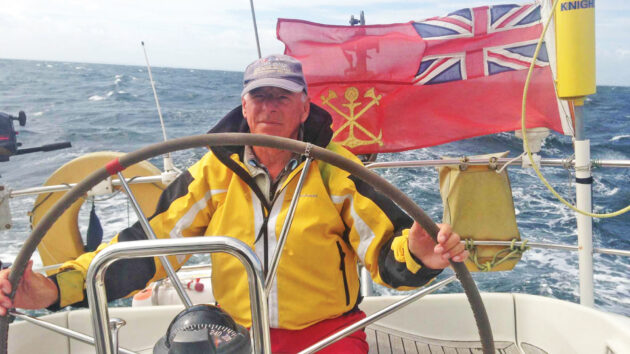
Arthur Manning was vying for a class trophy for the third time in the Waller–Harris two-handed race when his yacht Knight Star came to an abrupt halt. Photo by Arthur Manning
However, these were clearly marked on a larger chart which I saw at the lifeboat station later that day, where the coxswain told me to throw my French chart away.
But at the time, my chart reassured me we had water, and according to the monochrome plotter there was nothing behind the tower.
We were about 400m approximately behind the tower going in a northerly, slightly west, direction, when we came to a slow stop on the rock, which had about 1.5m of water over it – the draught of Knight Star.
We had the spinnaker up, making nice headway in a Force 4-5. We scraped the rock, rather than hit it, and then… stopped.
Unplanned stop
With the tide falling and no certainty about the boat’s stability on the rock beneath us, we immediately dropped all sails to steady the boat.
Concerned that we might end up perched at an angle – or worse, topple several metres as the tide ebbed – we prepared to disembark. I couldn’t see what was underneath, we didn’t know how stable the rock was.
The boat had slightly swivelled because it has a 6ft 6in wingspan on the wing keel.
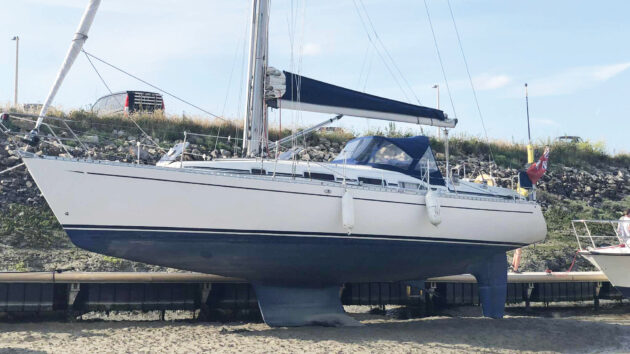
Knight Star has a wing keel, one overhung the rock and swivelled the boat while it was aground. Photo by Arthur Manning
A lot of people thought it was a fin keel as that is how it appears in the photographs, and it turned the boat, but she’s a wing keel which is ideal for the Channel Islands’ impressive 12m tidal range and, in my experience, has never compromised her sailing qualities.
My friend immediately grabbed the radio and called a Mayday and I said, ‘well hang on, we don’t know what damage we’ve got, we might be okay.’
Maybe Mayday
At the time I didn’t think a Mayday was necessary, but in hindsight it was the correct procedure, in case the situation suddenly worsened.
I couldn’t get Knight Star off the rock so, having dropped the mainsail and released the spinnaker, I checked below deck, lifted the floorboards and I said ‘well we’re not getting any water in so it doesn’t seem to be too much of a problem’.
I got the liferaft out of the aft locker, just in case Knight Star fell over. I pulled it out and laid it on the deck.
It was tethered to inside the locker in case we needed to throw it out quickly. We had everything on board that adhered to the safety regulations of the race.
We had our lifejackets on already, which was a good thing. I packed the sails and everything away in preparation to leave Knight Star.
I put the washboard in, closed the hatch, and then we waited. A French emergency aircraft flew over about three times, I think it might have been taking photographs as well, and the lifeboat was on its way.
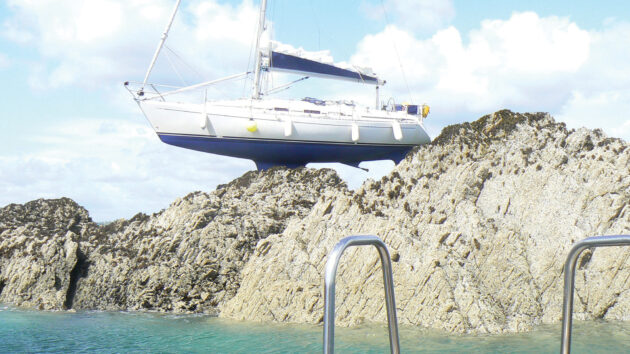
As pictured by the French lifeboat SNSM crew, who later stood by as Arthur recovered Knight Star
I’d put the fenders out in case we were picked up from alongside because a boat with under 1m draught could have come alongside quite easily, it was a flat surface; there was nothing else I think, we had hit the rock’s highest part.
Friendly fishers
A 19ft fishing boat came alongside.
We were at the edge of the rock and the skipper stayed there so he had about 20ft of water underneath him. He tethered his boat aft of Knight Star while we climbed on board.
He managed to leave his line on board. That’s why in photographs, which were published worldwide later, you can see a line hanging down from aft.
This fishing boat transferred us onto a larger fishing vessel, which was standing by, and we were taken into Saint-Quay-Portrieux to wait for the tide to return.
It was about 0930 when we got into Saint-Quay. We saw a couple of friends, and had breakfast.
And then we just waited around and had lunch with a single glass of wine to ensure we remained alert for the recovery of the boat later that afternoon.
Throughout the day, a steady procession of boats with curious crew visited Knight Star, now sitting proudly and somewhat majestically high and dry on her rocky throne.
Despite the dramatic sight, there appeared to be no immediate damage to the hull.
A friend of mine in another Starlight 35 realised we had a problem, abandoned the race and came into Saint-Quay to see if we needed anything.
And another competitor stood by until they were sure we were safe, then carried on with the race. They’re a good crowd at the yacht club.
At around 5pm, I phoned Pantaenius who I was insured with at the time and told them I’d arranged for the larger fishing boat, which had transported us ashore, to take us back to Knight Star as the tide rose and stand by in case the engine didn’t start. We’d agreed on a fee of €100.
But my contact at Pantaenius said: “Oh no, you can’t do that, the fisherman can’t do that, we need the lifeboat to stand by.”
I had to cancel the fisherman and arrange for the lifeboat to take us out instead.
We got onto the RIB, and were taken back to Knight Star. Many, many boats were around, crew taking photographs as we prepared for the refloat.
Once aboard we readied her, and then the sea lifted us free, rather like coming off a drying mooring.
We had started the engine and went astern to get off the edge of the rock, and made for the harbour. The lifeboat followed us back to Saint-Quay.
Minimal damage after running aground
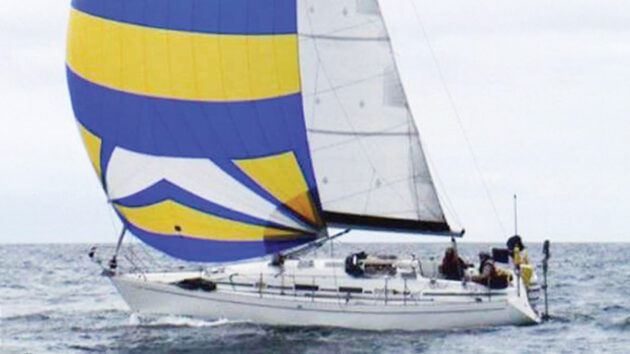
Knight Star is still regularly cruised and raced
Knight Star was lifted out that evening for a full inspection, and to our relief only superficial damage was found.
The next day I unbolted and removed the saloon table so we could have a thorough inside inspection too. There was no damage.
The way we’d touched down on the rock and grounded, there was very little damage done to the keel, just a few pits on the underside of the lead keel caused when the tide lifted and dropped her a couple of times.
The insurance assessor came over the next day from Jersey, inspected the boat, had a good look round and scraped things.
He said, “I can’t see any damage at all except for the little pits underneath the keel.” So he told us we could sail her back, and the next morning we did just that.
A week later I sailed Knight Star to Falmouth for a more thorough assessment and to have the slightly pitted lead removed and replaced. Since then she has continued to perform beautifully.
Lessons learned from running aground: Don’t trust charts totally
Both paper and electronic charts are a lot better now than in 2009.
The old black and white chart plotter we had wasn’t that clear and it took a long time to refresh if you wanted to zoom in or out.
It took about 30 seconds to come back to a decent picture.
So those things were a bit of problem. The paper chart just showed the tower with two little rocks in front of it, and it didn’t show any heights beyond that.
So we assumed that it was just sitting on a rock, but the rocks were actually also behind.
This would have been a quicker route for the race, had it not been for stopping and mooring up! Lesson learned was not to go beyond the marks you don’t know.
Ready heroes
Thank you to the fellow sailors who stayed by us and abandoned the race to assist, and the fishing boats who transported us ashore. You’re always grateful when you know help is not far away.
Infamous tale
The Daily Mail phoned me for a story, and it was the front page of our local Jersey Post.
I think a French lifeboat crew took the most dramatic photograph of Knight Star and it went on to ABC News and Sky News. I was told that it sold for a lot of money.
It’s bought me beers around the world, because occasionally we’ll go to a yacht club and the picture of it will be on the wall, and if we stay there for any length of time somebody finds out it was me who was the owner, and buys me a drink to ask about the story.
I’ve seen it in Barbados Yacht Club.
Unexpected membership
I was made a member of the South West Shingles Yacht Club, which includes Tony Bullimore and Pete Goss.
Whenever there’s an accident or something spectacular happens to a boat, you become a member of the South West Shingles Yacht Club. It’s been going for 20-30 years.
Standing Tall
Initially I was embarrassed about it all but people always want to hear the story, so I always explain that if you sit in an armchair you’re not going to have any problems sailing but if you race and you want to be competitive, you take chances.
And that was just one of those chances that didn’t pay off.
Don’t panic
When an incident occurs, always have emergency items in good order and stowed where all crew know the location and have been instructed on how to operate them.
These include liferaft, flares, fire extinguishers, first aid equipment, torches etc. This is something I’ve always been pedantic about and it paid off.
My liferaft was stowed in the aft locker but it was in a purpose-built cradle and the painter already attached; it took between 6-10 seconds to lift it into the cockpit ready for deployment, (I’ve since fitted it to the stern).
Prepare for the worst
We were wearing lifejackets and I got everything ready in case we needed to abandon the yacht before we were rescued.
I wasn’t sure how stable the boat was or if it would topple over.
There proved to be a 20ft drop on the side of the boat where the keel was overhanging the side of the rock.
Expert response – Marine surveyor Ben Sutcliffe-Davies comments
Arthur was fortunate his Sadler 35 escaped with just a pitted keel.
I know what it’s like to go aground. Many years ago I had the misfortune to hit Plymouth breakwater at night when my yacht lost its rudder!
My advice is never to underestimate the smallest of groundings.
At the very least, check properly in the bilges for any clues that there is a problem – even minor weeping around the fastenings is a clear giveaway.
And remember that gel coat stresses don’t always show immediately, so periodic checks are important.
If anything looks suspect, get the boat out of the water at once and contact your insurance company, which should have experienced staff to deal with this type of claim and in most cases will appoint an experienced qualified surveyor to report the extent of the damage.
Checklist for a GRP yacht after running aground:
Keel
Haul out and check for signs of stress crazing around the gel coat where the keel joins the hull.
Doing a tip test by trying to push the bottom of the keel sideways will sometimes evidence issues, likewise when setting down if the internal framing has been damaged you will see the hull slightly slump over the keel.
A lead keel will tend to absorb shocks and will often develop a bit of an S-shape to the trailing edges; this can be checked by laying a straight edge along the aft edge or a plumb bob.
Keel studs
Is there any evidence of fresh water ingress or external weeping around fastenings? That’s a sure sign of damage.
Remove the sole boards
This will require careful work with a screwdriver, but you can then check for stress cracks and any detachment of items bonded in. Using a small pein hammer to check for laminate damage is prudent.
Mast
If the boat was sailed with full canvas off the wind at the time, the mast, rig and deck moulding would have been subjected to an enormous load.
On deck-stepped craft, look for crazing in the GRP at the base and around the rig’s deck fastenings.
A compression post will also be subject to a heavy load and can become detached.
Separation
Grounding a twin-skinned hull could result in the detachment of the inner skin moulding from the outer hull.
This again can be identified with lightly tapping around with a ball pein hammer.
Bulkheads
If the bulkhead has been bonded in tightly, it can detach, or produce a line of stress on both sides of the craft.
Often where a mastic has been used the sealant can be seen stretched or detached.
Rudder
Look for gel coat crazing around the fittings. If the rudder stock is within a tube, check the bonding or method of sealing.
Arthur Manning is based in St Helier, Jersey, and has been sailing since he was 16. His first boat was a Leisure 23, followed by a project Folkboat, which he restored with his son who was 16 at the time. Wanting something more comfortable, he bought the Sadler 35 Knight Star as new in 1998. He retired at 52, took up commercial skippering at 53, and has since sailed a Swan 46 halfway around the world.
Want to read more articles about running aground?

A subscription to Practical Boat Owner magazine costs around 40% less than the cover price.
Print and digital editions are available through Magazines Direct – where you can also find the latest deals.
PBO is packed with information to help you get the most from boat ownership – whether sail or power.
-
-
-
- Take your DIY skills to the next level with trusted advice on boat maintenance and repairs
- Impartial, in-depth gear reviews
- Practical cruising tips for making the most of your time afloat
-
-
Follow us on Facebook, Instagram, TikTok and Twitter