



What makes your life easier on board? Atlantic Rally for Cruisers sailors share their top 24 tips and game-changing gear for blue-water sailing with Laura Hodgetts
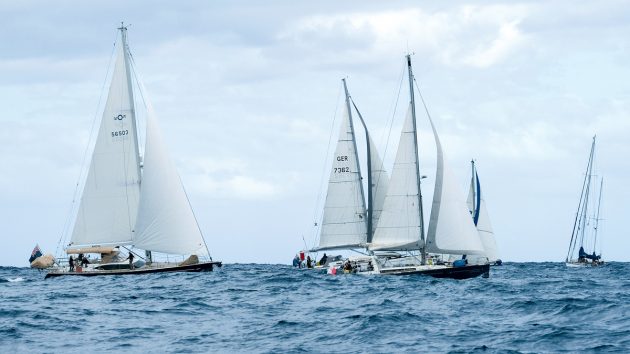
Laura Hodgetts caught up with the Atlantic Rally for Cruisers sailors for their best blue-water sailing hacks for everything from maintenance to lifejackets to lifestyle.
1. Winch upgrade
Skipper Henrik Teichmann has made many improvements to 45 South II, a 50-year-old Bruce Farr 11.04 racer-turned-cruising yacht, which looks as good as new.
But the stainless steel self-tailing Anderson winch is his ‘best upgrade’. “It doesn’t need lots of turns, doesn’t eat the line and is easy maintenance.”
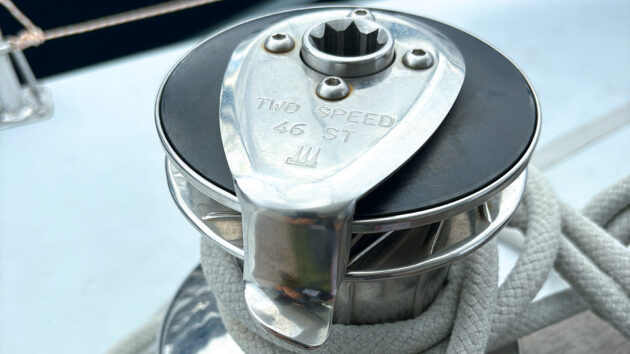
Priced from £615, these Anderson winches are Henrik Teichmann’s ‘best boat upgrade’ for blue-water sailing. Photo by Laura Hodgetts
2. DIY extended water pump
Southerly 38 Arabella skipper Andy Ardron ‘cobbled together’ a plastic tube and dinghy bilge pump to tackle a hard to reach water leak under the berth.
The leak turned out to be in the seal of the rudder stock.
Andy found that while spare parts can be hard to get without long delays in Las Palmas de Gran Canaria, they can be made more easily by marine professionals.
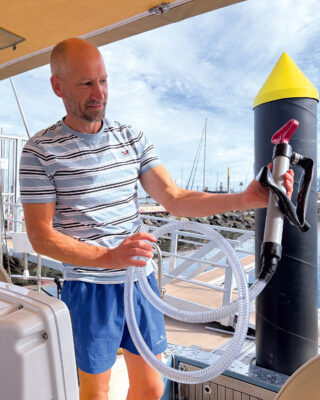
A DIY solution for a hard-to-reach water leak. Photo by Laura Hodgetts
3. Anti-chafe solutions
Scott Chalmers, crew of Finngulf 41 Shenavall, went up the mast to put bubblewrap and foam around the spreaders and spreader rings as a temporary solution to prevent chafe of the mainsail.
He said: “We’re trying to prevent the mainsail from wearing holes through itself. Because the ARC is predominantly downwind sailing, the mainsail is pushed out against the metal spreaders.”
Bowman 57 Ninja Penguin’s skipper Giles Ridyard used rubber hose for the guardrail and sheets.
“We pulled it out of the skip at a boatyard in Dartmouth before we left, thinking it might come in useful, and it did! We cut a length off and cable tied it to the guardwire, and used it on the mainsheet where it was touching the cockpit when sailing downwind.”
Giles also recommends: “Take a spare halyard and Dyneema the length of your mast so you can replace your stay.
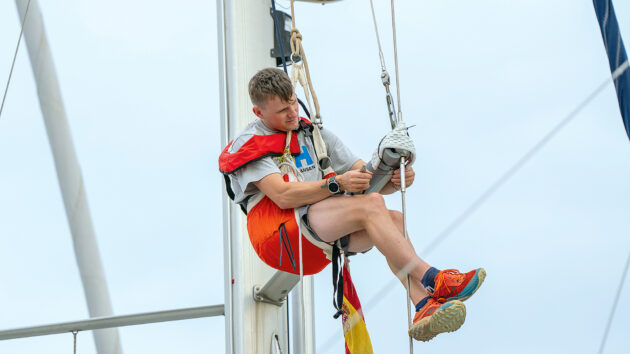
Bubblewrap around the spreaders for DIY chafe prevention before a blue-water sailing trip. Photo by James Mitchell/World Cruising Club
4. MOB recovery aid
Skipper Karsten Becker, of the Ovni 44 Micado ‘really recommends’ the Catch and Lift rescue system.
He said: “It deploys like a parachute, reels you in and lifts you up. It worked very well during a practice.”
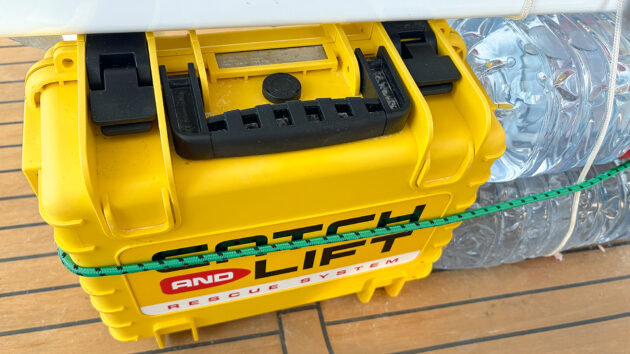
Priced at €649, this MOB recovery device ‘deploys like a parachute’. Photo by Laura Hodgetts
5. Wider bimini
Extending their Southerly 38’s stainless steelwork for a wider bimini meant Andy and Heidi could easily walk down their side decks.
Andy said: “We saw a lot of boats where the biminis came down then blocked the walkway, so you have to step around it.
Being able to walk down the sides easily is important. Getting the stainless steelwork extended forward and then the bimini right on the outside meant we can still step from anywhere around the cockpit.”
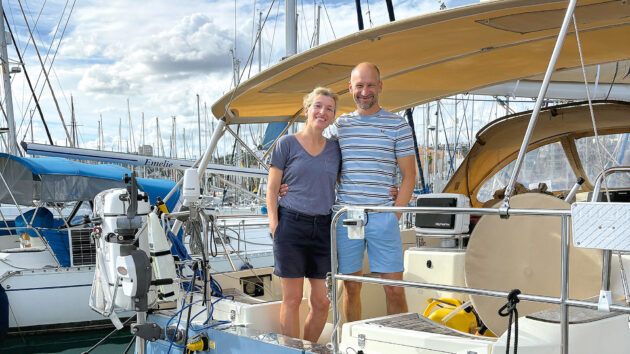
Having the stainless steelwork extended and a wider bimini fitted worked well on board Arabella. Photo by Laura Hodgetts
6. Windvane wonder
An ‘old-fashioned windvane Wind Pilot’ served David and Sonja Dullaway well during their Atlantic crossing aboard Rustler 36 Gannet.
Skipper David said: “Our insurance had a requirement that we needed to fit windvane self-steering if we were a double-handed boat. The windvane steering system is considered a third crew member, and it was brilliant.
The only thing to cause it a problem was the Sargassum weed in the last 36 hours. Then we put the autopilot on. If we’d just had an autopilot, keeping batteries charged would have been a nightmare.”
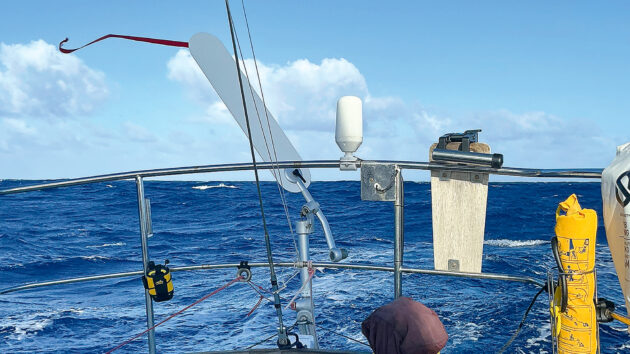
Unstoppable – until the Sargassum weed struck towards the end of the crossing. Photo by David Dullaway
7. Heavy weather sails
Rather than using a spinnaker or Parasailor for the transatlantic crossing, David and Sonja had the 1990-built Gannet fitted with a new working jib, which ‘just filled the foretriangle without flapping when poled out’.
In a year of enhanced trade winds when the fleet saw multiple breakages, Gannet suffered only minor chafe.
The couple from Beaulieu, Hampshire, completed ARC 2015 as crew, and attempted it in their own boat in 2005, but had to divert to Cape Verde due to a tropical storm.
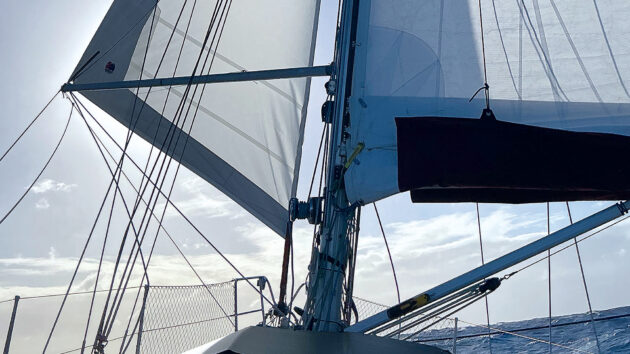
Peter Sanders of Sanders Sails made this heavy weather furling sail for Gannet. Photo by David Dullaway
David said: “We knew we were going to be poling the sail out a lot, and we knew that with the genoa, even with the pole fully out, the sail just flaps around.
With a slightly smaller jib, you can triangulate it nicely, it’s solidly in place and basically we ran under that for 99% of the time we were crossing the Atlantic.”
Blue-water sailing veteran Paul Chedd of Moody Grenadier 134 Kelebek, who has undertaken five crossings, advises: “Be conservative with sails – if you blow your sail in the first few days it’s very hard to repair.”
Skipper Tony Bracegirdle, of Dehler 46 SQ Raider, added: “You may think your sails are good, but ask the sailmaker what wind strength they can cope with. Our staysail was only good for 30 knots – we’d have sailed differently if we’d known.”
8. Onboard connectivity while blue-water sailing
Venetia Kenney-Herbert was among many ARC sailors to praise Starlink for its onboard connectivity, although it needed a DIY tweak to work offshore on the 1996-built Starlight 39, Diamond Blue.
Venetia, 74, who sailed with skipper Richard Close-Smith, 74, and David Briggs, 76, told PBO:
“The Starlink worked perfectly in the marina, we plugged it into the cigarette holder [for the passage] and it didn’t like it. The electric dipped, so someone lent us a booster.
Then the wires melted together – lucky we noticed it before anything else happened. So then David, who is an electrical engineer, connected Starlink directly to the battery to avoid risk to other wiring, especially to the chartplotter.”
Gannet’s David recommends Iridium Certus 100 Skylink: “It was great for weather/phone calls and emails. It takes 30 seconds – once connected. It cleverly filters things out, so you can select just emails or weather [to receive].”
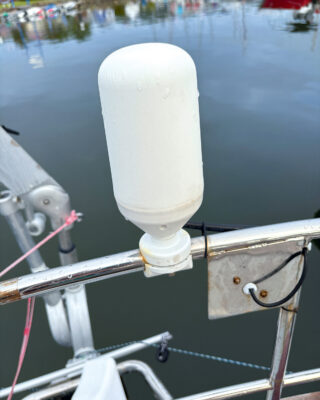
David was impressed with Iridium Certus 100 Skylink’s filtering capacity. Photo by Laura Hodgetts
9. Cut up rubbish
Six people aboard the Swedish-flagged Baltic 67 Manyelti ended up with just one bag of rubbish as they washed, then cut up all their plastic waste into small pieces.
ARC provisioning guru Clare Pengelly advises binning cardboard before blue-water sailing – to reduce waste and infestation risk.
The crew of Kelebek also rinsed their rubbish in saltwater, chopped up large plastic and cut both the top and bottom off tins to squash them more easily.
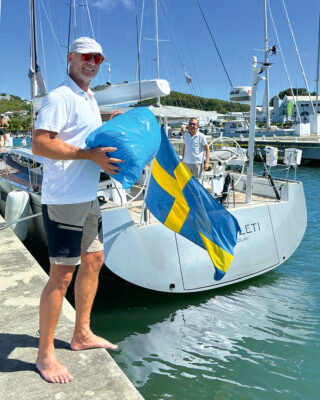
Hardly any rubbish from six people aboard Baltic 67 Manyelti, thanks to their washing and chopping method. Photo by Peter Gilmore/World Cruising Club
10. Locking block
Time spent cruising their Southerly 38 Arabella before the Atlantic crossing made Andy and Heidi realise that the only way to lock off the genoa sheets for the twin headsail was to put them on a winch.
Replacing a nearby block with a Seldén locking block provided a solution.
Andy said: “Getting this block replaced with a block that we could lock off meant we could free up the winch for spinnaker sheets or furling lines.”
11. Seasickness remedy while blue-water sailing
Gannet’s Sonja is prone to seasickness but a Scopaderm patch behind the ear (prescription required) “worked very well.”
Joseph Sage of Moody 44, Ocean Strider advises to “keep busy and don’t go down below unless it’s to lie down.
12. Watchkeeping for two
Double-handed sailors Sonja and David keep a watch routine of 8pm-2am or 2am-8am, “a long watch, but it allows the off-watch to really get to sleep. Then we have shorter naps throughout the day.”
The Ultimate Insulation Thermos helps the off-watch to remain undisturbed. Sonja said: “We fill up a large Thermos with boiling water, so you can make any hot drink in the cockpit and not disturb the off-watch in the saloon.”
Coffee bags and fun-size Mars bars are also must-haves.
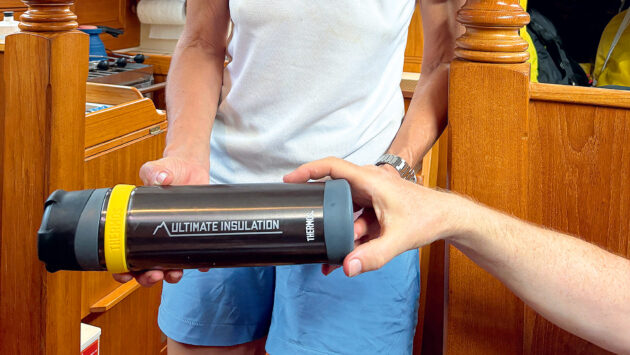
This helps both the sailor on and off watch!. Photo by Laura Hodgetts
13. Most useful item while blue-water sailing
“I brought a lot of equipment I didn’t need”, said Dan Power, the crew of a 53ft ketch, “The thing I used most was a headlamp.”
Hanse 575 owner Clive Yarwood, of Shawe Thing, advised: “Don’t forget the fundamental stubby screwdriver.”
Skipper Mike Neave, of 38ft Najad Falken, said: “One thing I didn’t appreciate until this crossing was how useful radar is for spotting squalls.
Particularly at night, to be able to see where the squall was going was invaluable. We could make course corrections to move away and only got hit directly by one squall during the passage.”
14. Easy laundry
The Scrubba Wash bag worked well for Kelebek crew Rob Hewitt.
He said: “It’s a glorified dry bag really, it gives a visual indication of the maximum amount (two T-shirts, four socks and two underpants).
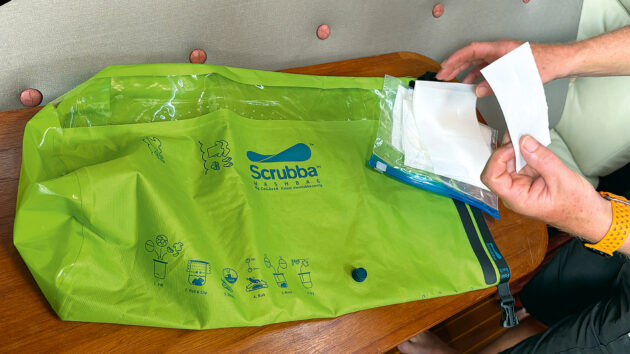
‘Very effective’ for small amounts of washing at a time. Photo by Laura Hodgetts
Put the laundry inside with water up to the guide line, and half a serrated laundry sheet.
Fold the bag down, lock it off, and bleed out the air using the valve. Rub the contents against the internal washboard nodules for a few minutes, then rinse and hang out to dry. It’s very effective.”
15. Take a hacksaw
Kelebek’s crew used a hacksaw rather than their angle-grinder to carry out a pole repair mid-Atlantic, saying, “It felt safer to use a hacksaw given the sea state, than to have a whirling wheel of death.”
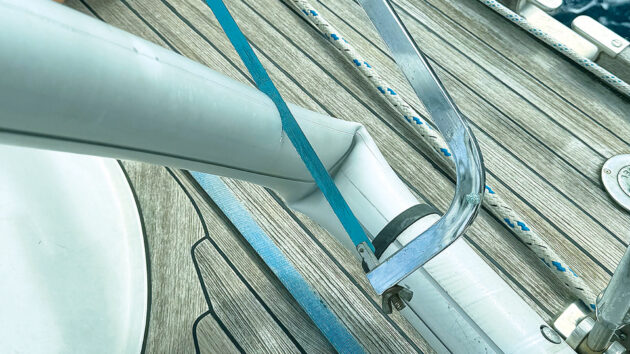
Mid-Atlantic pole repair aboard Kelebek. Photo by Rob Hewitt
16. Fouled prop tools
While cutting rope from an entangled prop mid ocean, Micado skipper Karsten and crew found:
“We were only able to clear it because we had scuba diving gear on board. Our dive knife was too dull to work; the sharper sailor’s Victorinox pocket knife worked. Scuba kit is better than free diver gear as adding air to your vest helps stay above the waves.”
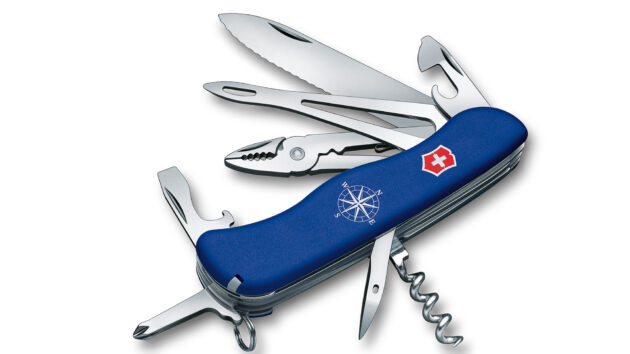
The Victorinox cleared Micado’s prop entanglement mid Atlantic. Photob by Victorinox
17. Caribbean kit
Lexi Fisher, of Doyle Guides, recommends this gear for Eastern Caribbean cruising:
- Polarized sunglasses for reef spotting
- A snorkel to check anchor or moorings
- A safety float for snorkelling in bays
- A dinghy lock
- Large flashlight in the dinghy at night.
18. Rust remover
Wichinox “works like magic at getting rust off stainless steel,” said Henrik Teichmann.
Scott Chalmers, crew of Finngulf 41 Shenavall, believes Y-10 Fibreglass Stain Remover is “the best stuff for removing rusty marks on glassfibre.”
19. Lifejacket PLD
With hindsight, Dan Power would have brought his own lifejacket “as it’s a pain to install a personal locator device (PLD) on a borrowed lifejacket and remove again – they’re much easier left on.”
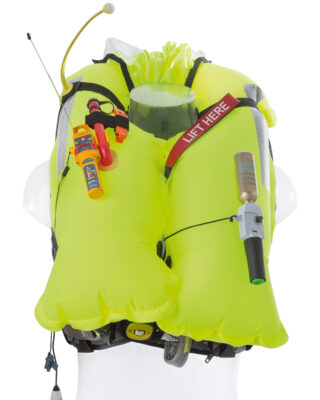
PLDs can be transferred between lifejackets but it’s easier to install and leave. Photo by Spinlock
20. Galley-free boat
Skipper Marlene Brudek, sailing the smallest ARC 2025 boat, the 34ft Heartbeat2, kept provisions to a minimum with dried food and a Jetboil.
But Marlene enjoyed the food and recommends Real Turmat’s Thai red curry and squash; Firepot’s dal and rice with spinach, and chicken keema curry.
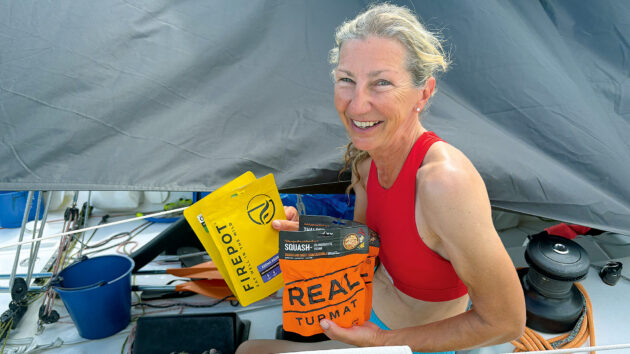
This helps both the sailor on and off watch!. Photo by Laura Hodgetts
In addition to sharing one bunk with her two crew and taking turns to sleep, Marlene’s JPK 10.30 did not have a galley.
Instead, she drilled a hole in her chart table so she could attach an O-ring accessory from her former boat (a Seascape 27), which secured the Jetboil while in use. Marlene said: “It works very nicely, even in big waves.”
21. Provisioning tips for blue-water sailing
If sailing from Las Palma de Gran Canaria, Sonja advises pre-ordering meat from butcher J P Rosper, where staff portion up, vacuum pack and freeze meat: “We stuck it in the fridge and it gradually defrosted.”
The Diamond Blue crew also did this, and Venetia Kenney-Herbert used a pressure cooker for stews and a gammon joint, which they cooked in beer.
Sonja made yoghurt as advised by ARC provisioning guru Clare: “it worked, and kept us going until nearly the end. We ate it with granola and tinned or fresh fruit.”
Clare’s guide: Add 1/5 milk powder, 1/5 natural yoghurt and 3/5 warm water to a pot with a lid and stir. Leave somewhere warm (You’re aiming for 27-35°C for 6-12 hours) until it has turned into yoghurt, then refrigerate. Don’t make yoghurt cultures compete with other bacteria! If using milk, sterilise it first.
Skipper Kai Palm on Comfortina 42 Antares said a cooked-from-scratch spaghetti carbonara “was the absolute highlight” of his crew’s meals at sea.
Bowman 57 Ninja Penguin’s Aly Ridyard advises: risotto rice is adaptable – paella, risotto, rice pudding. While chorizo and dried meat last longest.
Large plastic mugs worked well for main meals on Gannet – to hold with one hand and eat with a fork.
Store water bottles in hung-up wet socks as an evaporating fridge says ARC guru Clare, of the World Cruising Club team; it saves opening the fridge too often and letting unnecessary heat in.
22. Hydro power your blue-water sailing trip
Ninja Penguin’s Aly Ridyard said: “Our Remoran Oy Wave 3 worked day and night with no issues for 17 full days!”
J130 skipper Gill Duncan, of Adrenalina, said his 20-year-old Mk1 DuoGen hydro-generator (which uses the same alternator as the newest Mk3 DuoGen) “met all our power demands” transatlantic and “has come into its own at anchor in the Caribbean as it flips into wind generator mode and pumps in loads of energy too.”
Diamond Blue skipper Richard praised his Hydrovane.
“So many wind-driven self-steering devices are actually through chains or wires or ropes, operating on the ship’s rudder.
But the Hydrovane is independent from the ship’s rudder, so you lock your wheel, with a little bit of helm dialled in to balance the boat against the push and pull of the sails, and you’ve got effectively a spare rudder.”
23. Solar boost
Henrik recommends Eco-Flow solar panels.
He said: “We have a fixed solar panel and a foldable panel which we can move wherever the sun goes. It’s reliable.”
24. Team-building while blue-water sailing
Adrenalina skipper Gill recommends Diary of a CEO conversation cards – “we got to know each other well– too well!”
Want to read more articles about blue-water sailing?

A subscription to Practical Boat Owner magazine costs around 40% less than the cover price.
Print and digital editions are available through Magazines Direct – where you can also find the latest deals.
PBO is packed with information to help you get the most from boat ownership – whether sail or power.
-
-
-
- Take your DIY skills to the next level with trusted advice on boat maintenance and repairs
- Impartial, in-depth gear reviews
- Practical cruising tips for making the most of your time afloat
-
-
Follow us on Facebook, Instagram, TikTok and Twitter