



Sir Robin Knox-Johnston talks to Ali Wood about self-steering, plum duff and why he was told to ‘slow down’ for his round the world finish
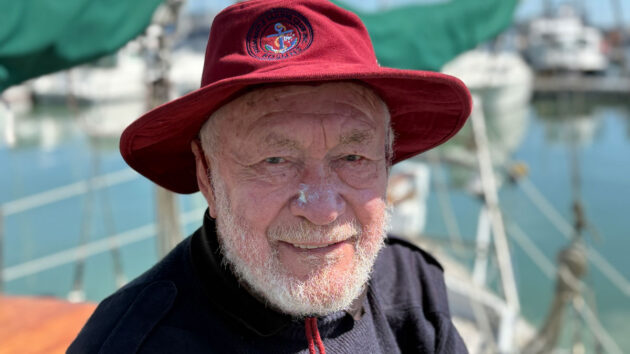
“They told me to slow down. I could have finished at 9 o’clock in the morning,” Sir Robin Knox-Johnston says of his record-breaking solo circumnavigation back in 1969.
It’s a warm spring day and we’re tacking in the Solent, not on his famous ketch Suhaili (though he’s promised me a tour later), but a Jeanneau Sun Odyssey 410. Together with novice sailors from the Little Ship Club, we’re returning from Cowes after our own circumnavigation – around the Isle of Wight – where yesterday Sir Robin Knox-Johnston raced against Mike Golding OBE and two other yachts in the club’s inaugural Conquer the Island challenge.
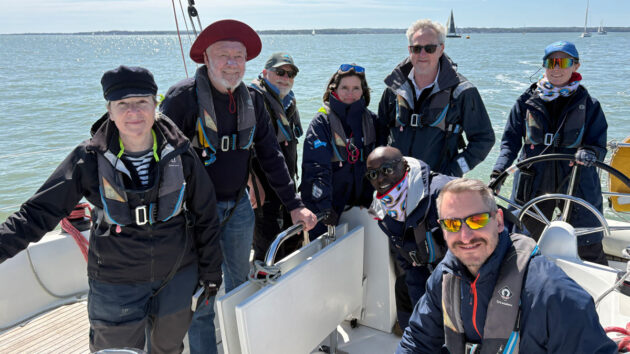
Sir Robin Knox-Johnston with the Little Ship Club crew. Credit: Ali Wood
Yesterday I had the honour of racing with Mike Golding, and now I’m cruising with Sir Robin Knox-Johnston. In between pinching myself, I’m receiving an education on everything from plum duff to astronavigation and the maintenance of wooden boats.
The funny thing is, Sir Robin and I actually met last night on Cowes High Street, when neither of us could read the key code for the Island Sailing Club rooms. I didn’t realise, as I emptied my 40lt dry bag on the pavement in search of reading glasses, that I’d be sailing with him today. Did I prepare notes? Nope. Does he mind? No, it seems he has infinite patience for my non-stop questions, and those of my excited crewmates.
Slow it down!
Straight-backed and cross-legged in jeans and woollen jumper, Sir Robin recalls why it was, in 1969, he was told to delay the finish of his Golden Globe Race.
“I’d been at sea for 312 bloody days. All I wanted was a pint of beer, a steak, and then a bath. They said the Mayor and Mayoress are going to greet you but the Mayoress has a hair appointment.
“So I slowed down, the wind changed and I didn’t get home till 3.20 in the afternoon, by which time the hairstyle was ruined anyway!”
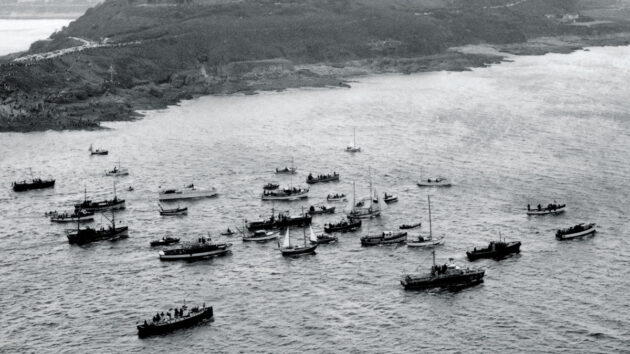
An armada of small boats greeted Robin Knox-Johnston as he sailed into Falnouth. Credit: PA Images/Alamy
Escorted by a Royal Navy minesweeper and the harbourmasters of Truro and Falmouth, Knox-Johnston was met by a flotilla of small boats. His brothers were put on board at the finish line to share some Navy rum, and celebrate the momentous win.
Having lost radio communication two months into his voyage, he’d only learned 10 days earlier he was the remaining competitor, most of the nine having retired due to breakages and medical issues.
“A boat approached me and told me I was the winner, but I said, ‘Go away, thank you. Not with all these boats around.’ He was telling the truth but I didn’t realise it. A few days later I kept picking up these messages that all these boats were looking for me. There had been no news for four and a half months. No one knew where I was. A lady came up to me when I got back and said, ‘weren’t you worried when you were missing?’ I said, ‘Madam, I wasn’t missing, I knew where I was’.”
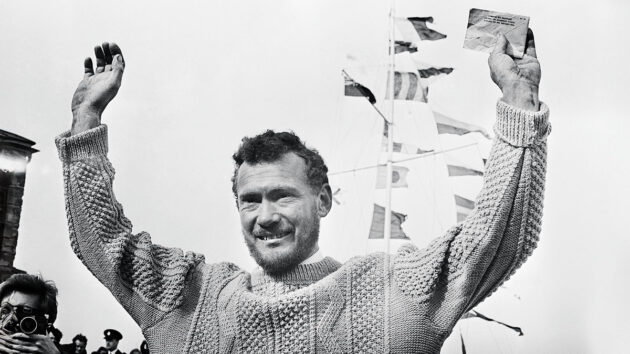
Robin Knox-Johnston arrives back at Falmouth on 23 April 1969 after his single-handed non-stop circumnavigation of the globe in his yacht, Suhaili. Credit: Express/Hutton Archive/Getty
Bernard Moitessier, in a strong position to circumnavigate the fastest, abandoned the race in the Atlantic and continued to Tahiti, while Nigel Tetley, who then took the lead, sank just 1,100 miles from the finish. Tragically, Donald Crowhurst – faced with financial ruin – reported fake positions and suffered a mental breakdown. His boat was found three months later adrift in the North Atlantic.
“I never met Crowhurst but I was one of the few people that knew the truth and I wanted it kept quiet because of the children,” says Sir Robin. “But the press started to reveal it so we had to announce it. I was thinking of those four children under 12. Imagine being told that your daddy killed himself?
“He should never have gone. He wasn’t ready. He wasn’t mentally right to do it. These days it wouldn’t happen because every race has a qualifier, and that’s when people get sorted out.”
Generous spirit
Knox-Johnston gave his £5,000 prize money to a fund for Crowhurst’s family, but Tetley was in his thoughts too.
“He really suffered [from the deception]. He should have finished but he was listening to Crowhurst’s inaccurate reports and pushed his boat too hard in the Azores,” he says.
In 2017 Crowhurst’s voyage was made into a film called The Mercy starring Colin Firth as Crowhurst and Rachel Weisz as his widow Clare. Sir Robin went to the premiere. Would he say it was accurate?
“Actually I think they did a pretty good job. There were parts of it which were very exaggerated but it was very close to the truth. Rachel Weisz was gorgeous!”
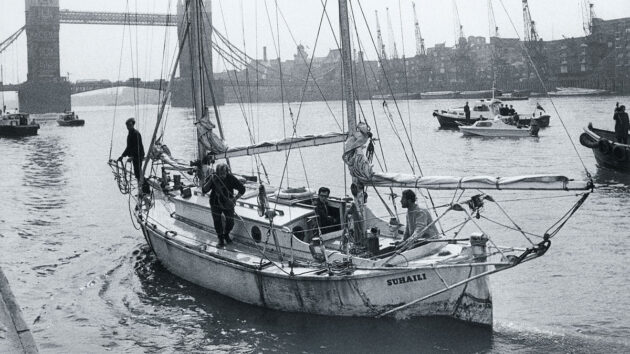
Suhaili on the Thames following her victory in Falmouth. Credit: Keystone-France/Gamma-Keystone/Getty
Sir Robin Knox-Johnston is such an engaging story-teller that it’s easy to forget we’re at sea, and there are jobs to be done. But he doesn’t miss a thing. While all but the helm and first mate are gathered around him in the cockpit, he leaps to his feet and shouts at a passing vessel in a voice I’m sure could be heard from Portsmouth.
“Sir, rule 13! You are the overtaking vessel.”
Shaking his head, he sits back down and addresses the crew. “Do you know that? Rule 13, COLREGs? Overtaking vessel gives way. It doesn’t matter if it’s overtaking a powerboat, it gives way if it’s the overtaking vessel.”
A Master Mariner – the highest grade of command – Sir Robin is an enthusiastic teacher.
“If collision cannot be avoided by the action of the giveaway vessel alone we have to take action to avoid collision,” he explains. He cites the tragic case of luxury Italian liner SS Andrea Doria which collided with Swedish passenger ship MS Stockholm off New York in 1951 in heavy fog. Fifty one people died.
“One was definitely in the wrong but the other one hadn’t slowed up and the insurance paid out 70/30,” he says. “You weren’t behaving properly. You didn’t slow down in fog so you are also at fault. A very interesting case.”
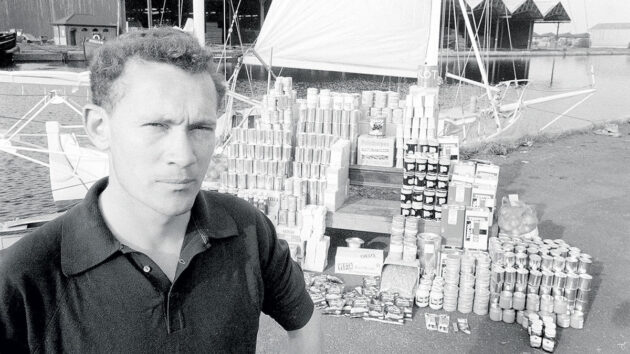
Robin Knox-Johnston with his provisions (presumably including plum duff) ahead of the Golden Globe Race. Credit: Carl Bruin/Daily Mirror/Mirrorpix/Getty
I wonder if the skipper who has sailed too close to us just now knows he’s been reprimanded by Sir Robin Knox-Johnston? The co-founder of the Clipper Round the World Race, Sir Robin is warm and funny, but also formidable. I’d not like to cross him. As he tells the story of one of his professional skippers who ran aground, I get the uncanny sensation I’m sailing with Lord Alan Sugar!
“I’ve got very high standards because you have to. If you put your boat on Ryde Sands on a Saturday don’t wait until the Tuesday to tell me. He’s surprised I sack him? I’ve got to report that. I’m breaking the law if I’m not reporting that. What are you doing tacking training on Ryde Sands? Don’t be so daft. You’re out! ‘But…’. No buts.”
Knot challenge
In port, Sir Robin will take a piece of rope with him around the Clipper yachts (apparently nothing clears the dock quicker!) and makes sure the crews can tie 10 consecutive knots. If they fail, they have to go back to the beginning. If they continue to fail, they’re not up to the job, no matter how good they think they are at sailing.
But with novice sailors, such as the crew today, who have studied their RYA theory courses but not had a great deal of experience on the water, Sir Robin could not be more gentle.
For example, when Timothy Omacar, a financier from London, asks how a sextant works, adding a little nervously, ‘I know that’s like me asking what’s left from right,’ Sir Robin assures him that in fact it’s a perfectly sensible question and explains, with dictionary clarity, how and when he uses one.
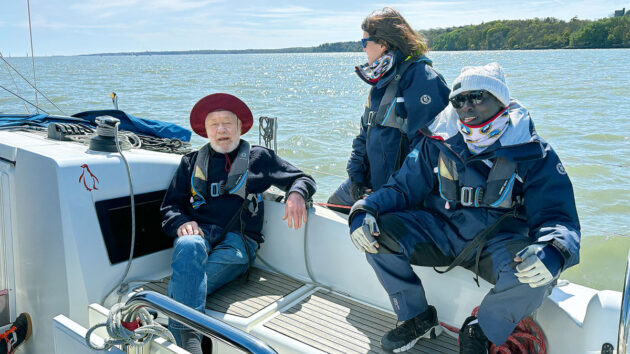
Sir Robin Knox-Johnston chats with crew from the Little Ship Club. Credit: Ali Wood
“You’ve got to get it right. A second out can be a mile, and then you do a calculation. It’s spherical trigonometry… it sounds very posh but it’s just a formula.”
He acknowledges that it’s not easy for beginners, and his navigation skills are hard-earned from rigorous practice, both in the merchant navy and offshore sailing.
It’s clear that Sir Robin loves being around amateur sailors. He wants to share his sport and his passion with newcomers.
“Novice crew are clay wanting to be formed,” he says. “They wouldn’t be here if they didn’t want to be, which is great. You’ve got to be patient with them, don’t shout at them, don’t frighten them.”
He doesn’t believe there’s such a thing as a stupid question: “Remember, if you don’t understand something you are stupid if you don’t ask. Don’t think you can sit there and figure it out. If it’s worrying you then it’s worrying me and I want you to tell me about it.”
Safety
Understandably, safety is paramount in ocean sailing, and this is why Sir Robin won’t take any chances with professional skippers, whom he employs to take amateur sailors around the world in the Clipper race. In fact, he’s planning to hold a symposium next year with a group of elite ocean sailors including Stan Honey, Skip Novak and Jean-Luc Van Den Heede – all members of the International Association of Cape Horners (IACH) of which he is president.
Association membership is open to anyone who’s rounded Cape Horn as part of a non-stop passage under sail of at least 3,000 miles, which passes above the latitude of 52° South in both the Pacific and Atlantic Oceans.
“We want to pass on our experience,” explains Sir Robin Knox-Johnston. “We can have talks that will be written down and used for future generations of amateur cruising yachtsmen.”
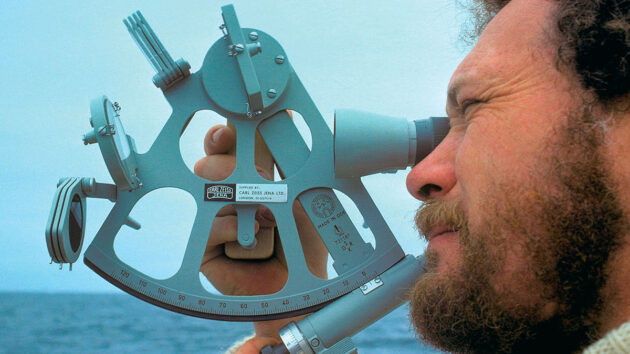
Using a sextant was second nature to Sir Robin, who had trained in the merchant navy. Credit: Jonathan Eastland/Ajax News/Alamy
Does he think we’ve lost our appreciation of safety, I wonder, with the advent of digital charts and low-cost internet at sea?
“I think sailors have lost the basic skills. If your GPS breaks, what are you going to do?” he says. “Well, first thing you need a good position to work from. I will look at my logbooks. Every two hours, a position goes in when crossing an ocean. Because I’ve only got to go back two hours I can get my dead reckoning back from that, and then I’ll get my sextant out and work out where I am, but most people wouldn’t know how to use a sextant. Therefore, they’ve got to be able to plot, and that means they need to have somewhere to start from and be able to work out what the course and speed are, and what the current’s doing, so they’ve got a good dead reckoning.”
Sir Robin relied entirely on celestial navigation during his Golden Globe race, using a sextant, paper charts, and a chronometer (there were no satellites, so no GPS). He sailed roughly 100 miles a day, but it depended on the wind. One day he did just seven miles; another day, 140. When crew William Jenkins asks him what was the hardest part of the voyage, suggesting, ‘too much me time?’ Sir Robin seems almost baffled by the question.
Keeping busy
“Because you’re busy, there’s always things to do. Morning longitude, noon latitude, evening longitude: that’s probably an hour and a half of calculation. Then you’re writing a diary, you’ve got to cook for yourself, walk the deck looking for chafe. Last thing you do before it goes dark is check the boat. First thing in the morning, check the boat.”
“And what did you eat?” I ask.
“Tins. Lots of them. 1,720 of them. On my 30th birthday I got the whisky out. I probably made myself a plum duff.”
Sir Robin appears astounded when I ask, a little sheepishly, “Er … what is that?”
“A plum duff! You’ve never sailed on ships have you? It was always a treat in the old days of sailing ships. Suet pudding made from currants, flour, water, sugar… oh lovely but it was awfully bad for indigestion.”
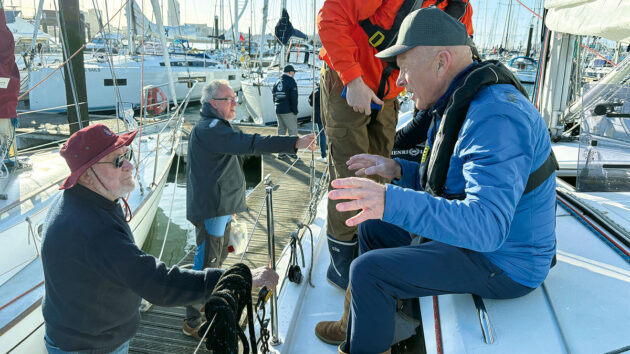
Mike Golding discusses tactics with Sir Robin Knox-Johnston ahead of the race. Credit: Ali Wood
And what of watches and sleeping? Sir Robin had no AIS or even radar back in the 1960s (and in fact, still doesn’t). No alarm to wake him if a ship was in the vicinity. Radar at that time was too heavy and power-hungry to be fitted to small boats.
“I slept as much as I could,” he says. “You know, I watch so many of these races like the Vendée Globe, where they pull out when something goes wrong. That’s because they’re tired. Their determination has been sapped. I don’t believe in this business of sleeping for 20 minutes. It’s rubbish. I told Alex Thomson. I said, Alex, how’s this 20 minutes sleeping, going?’
‘Muh’.
‘It strikes me, all it’s doing is making you grumpy’.”
Sir Robin’s advice is to sleep as much as you can: “You can’t do much at night, you can’t see much. You might as well sleep. You know if the boat changes motion, it’ll wake you up.”
This is what happened when his self-steering broke and he was knocked down on his Golden Globe race. The Southern Ocean being unsuitable for ‘playing around with a large lump of plywood’, he switched to the Knox-Johnston Mark II: ‘my left and right arms’, balancing the mizzen and jib to stay on course, and lashing the tiller when he needed to leave the helm.
No regrets
We are getting into the swing of ‘Quiz Sir Robin’ now. The wind has dropped, and the first mate Leigh admits defeat and puts the engine on. William boldly asks Sir Robin not only to sign a copy of his autobiography, but his brand new logbook. What a result! Imagine having Sir Robin Knox-Johnston sign off your very first sea miles.
William, looking like the cat that got the cream, asks, “So how did you decide to do a circumnavigation?”
“Oh, quite simple,” says Sir Robin. “I built my boat in India – I was based out there for four years – then I sailed it over with my brother. Francis Chichester was nearing the end of his one-stop circumnavigation, and going non-stop around the world was all that was left to be done in the sailing marathons.”
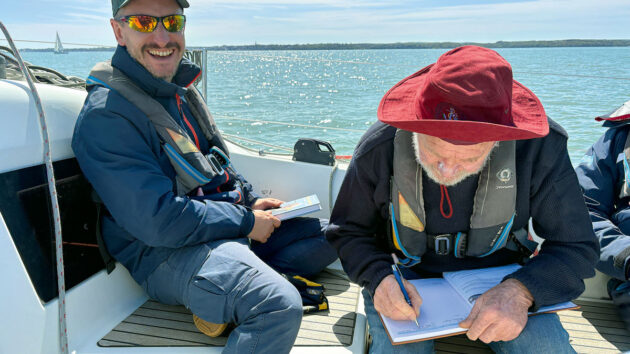
The cat that got the cream! William is delighted that Sir Robin signs his new logbook. Credit: Ali Wood
While working as first officer with the British India Steam Navigation Co, young Robin wrote off for sponsorship and received a hundred cans of beer and a £5 voucher for Cadburys. Otherwise he had to pay for everything, “slightly on an overdraft without telling the bank what I was up to”.
“I just felt at this stage of my life, 28, I was fit as a fiddle. I could hold my breath under the water for maybe four minutes, I’d been a captain by then. I’d built my boat, I felt I understood it. I’m ready for a challenge. I thought, you know, I’ll never forgive myself if I don’t try. Do I want to get to 90 and look in the shaving mirror and say I wish I’d done that?”
The 1968 Sunday Times Golden Globe Race was to be a voyage that would change his life. He was appointed a CBE in the 1969 Birthday Honours and left the merchant navy to develop marinas, including St Katharine Docks in London. In 1970 and 1974 he won the two-handed Round Britain Race, and in 1994 set a new world record with Sir Peter Blake for the fastest circumnavigation – just 74 days. A year later he was knighted for services to yachting. At 68, while competing in the 2007 Velux 5 Oceans, Sir Robin became the oldest solo circumnavigator, and in 2014, at the age of 75, finished third in his Open 60 in the Route du Rhum.
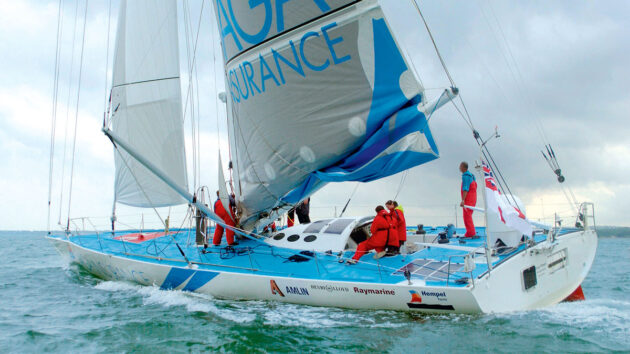
Sir Robin came out of retirement at the age of 67 to compete in the 2006 Velux 5 Oceans solo race with the yacht Saga Insurance (pictured here with crew in Gosport ahead of the start in Bilbao). Credit: Jonathan Eastland/Ajax News/Alamy
It’s quite a CV – and yet these are only a handful of his accomplishments. Did he know, when he returned to Falmouth after the Golden Globe Race, that he’d become a professional racer, I ask? His answer surprises me.
“I never understood that. No-one ever paid me so I wasn’t sure I was a professional. I sometimes got sponsored but that all went on the boat anyway.”
Is it different these days, I wonder? Do professional sailors get a decent salary?
“I haven’t a clue. I’m not interested. If they want to make a living out of sailing, good luck to them,” he says. “Peter Blake and I used to talk about it. He was a good bloke – we met in 1971 on the Cape Town to Rio race [the pair taking line honours]. Both of us went in different directions to the rest of them. We’d say: how many of these great, enthusiastic 20-year-olds will you still see sailing at 50, being too old to jump around the foredeck? What are they going to do with their lives then?”
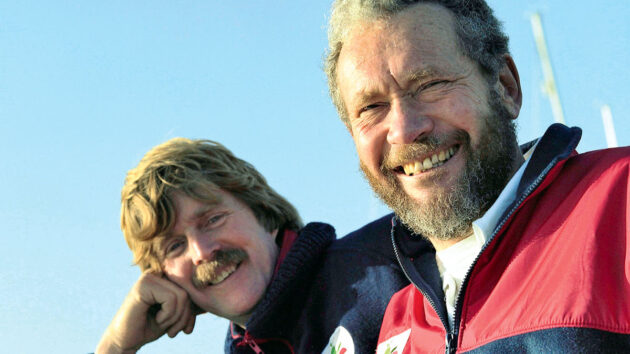
Sir Robin with Sir Peter Blake in 1993. Credit: Jonathan Eastland/Ajax News/Alamy
We’re approaching Portsmouth, and there is still so much to talk about. Sir Robin is a passionate advocate for the return of sailing to the Paralympic Games, and we share our love of grassroots sailing clubs. I tell him about mine in Dorset, and he tells me about Hayling Island in Hampshire, with its fantastic youth programme, which he helped to access a lottery grant. Inclusivity is important to him.
“When I was a kid we couldn’t have afforded a yacht, not even a dinghy. I saved up for three years. I finally had enough money but by then the price had gone up and so I didn’t buy it. I think what Hayling Island is doing is absolutely spot on. Any child can come along, they don’t have to be members’ children, and for the cost of a pound they can learn to sail.”
Sadly it’s not the same at all sailing clubs, I comment. There’s no doubt some can be quite elitist.
“Elitism damages sailing so much,” says Sir Robin. “Some clubs are elite, we’re a big enough church to have elite clubs but we also need the sailing clubs where the membership costs next to nothing… the strength of British sailing is in those clubs.”
Sir Robin Knox-Johnston doesn’t sit for long. He’s frequently on his feet, tweaking sails, instructing crew and pointing out landmarks as we approach Portsmouth: the Square Tower built in the reign of Henry VII to protect the naval port. The Round Tower, built by Henry V to protect the harbour entrance.
“Leigh, don’t hit that building. MI6 do all their training there,” he jokes with the first mate.
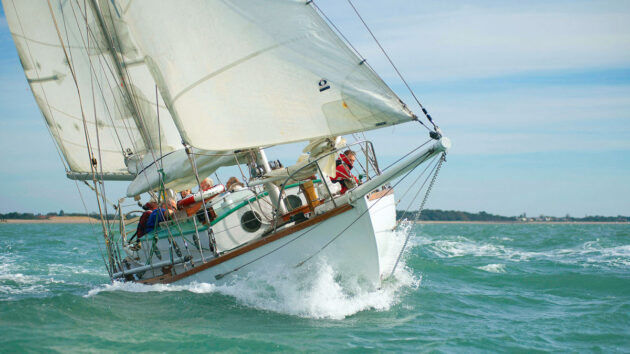
Suhaili racing at Hamble Classics. Nic Compton/Alamy
Indeed, Portsmouth is an important city to Sir Robin Knox-Johnston. We motor past his house on the seafront, and finally come alongside in Gosport Marina, the home of another yachting legend… his 32ft ketch Suhaili.
It’s been a wonderful sail, but sadly it’s time for goodbyes.
Sir Robin is on first-name terms with the crew from the Little Ship Club – ‘just call me Robin’ – and congratulates them all on their achievement. Knowing he must be inundated with requests, I ask him why he chose to support the Little Ship Club, which this year celebrates its centenary.
“I was president for 15 or 20 years, and am a strong supporter of their philosophy,” he says. “They’re a very friendly group and are making a big effort to encourage people to take up sailing. Yesterday was a lighthearted race but we all wanted to sail well. It wasn’t rough but it was bouncy and it’s good to see that a boat will go through that and it will give them more confidence for next time. That’s how you encourage people to be in our sport.”
Approaching 90
It strikes me that Sir Robin Knox-Johnston is 87; just three years short of being the 90-year-old man he imagined looking into the shaving mirror and reflecting on his life.
I think he can safely say he’s ‘done it’! He’s an elite athlete, a record-breaker, has sailed solo round the world and been knighted by the Queen. And yet here he is, sharing his passion with grassroots sailors. In my book, that’s what really makes him a legend.
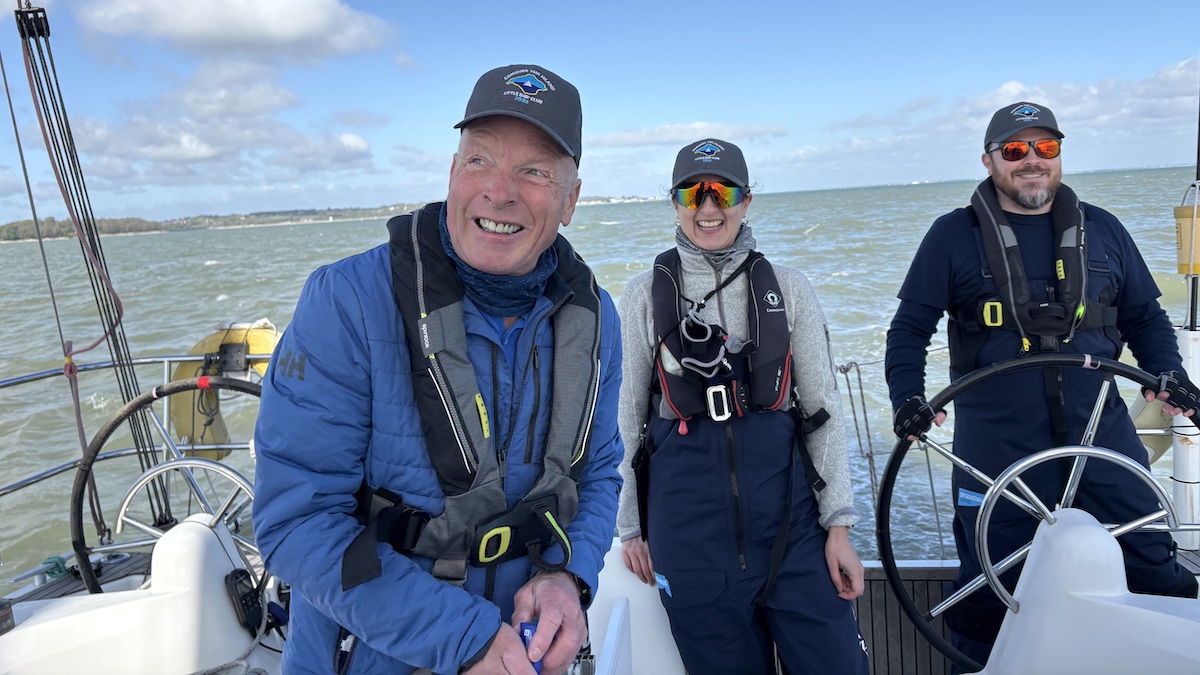
PBO Conquers the Island with Mike Golding and Sir Robin Knox-Johnston
The inaugural Conquer the Island challenge, a 10-hour clockwise circumnavigation of the Isle of Wight, was organised by the historic…
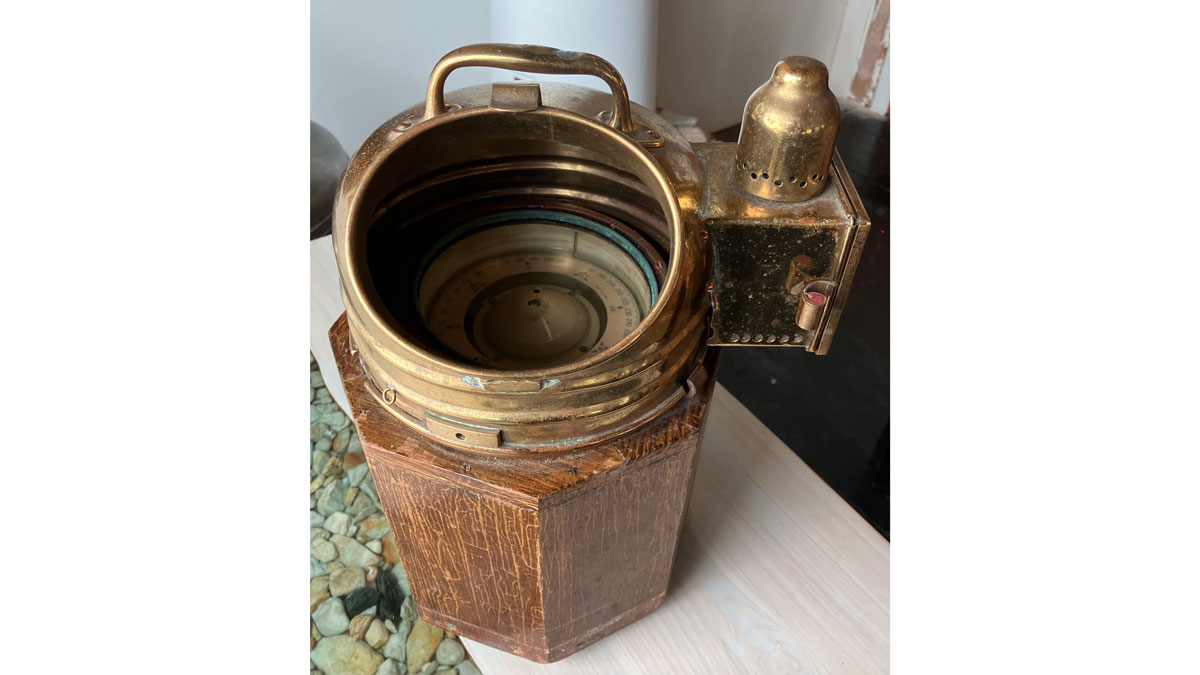
Sir Robin Knox-Johnston’s compass mystery solved – 53 years after it was stolen
Sir Robin Knox-Johnston has been reunited with a compass that went missing off his boat in 1969 by the widow…

Crashed bow repair: how Abhilash Tomy & his team fixed the boat in time for the 2022 Golden Globe Race
What to do if your boat is damaged just days before a non-stop global circumnavigation? Rupert Holmes reports on how…
Want to read more articles like Sir Robin Knox-Johnston: sailing with a legend?
A subscription to Practical Boat Owner magazine costs around 40% less than the cover price.
Print and digital editions are available through Magazines Direct – where you can also find the latest deals.
PBO is packed with information to help you get the most from boat ownership – whether sail or power.
-
-
-
- Take your DIY skills to the next level with trusted advice on boat maintenance and repairs
- Impartial, in-depth gear reviews
- Practical cruising tips for making the most of your time afloat
-
-
Follow us on Facebook, Instagram, TikTok and X