


The Starlink Mini is changing how offshore sailors communicate, offering high-speed internet for a surprisingly small hardware cost, but how effective is it? Stephanie Jones speaks to the Mini Globe Race skippers to find out
How good is the Starlink Mini for staying in contact offshore?
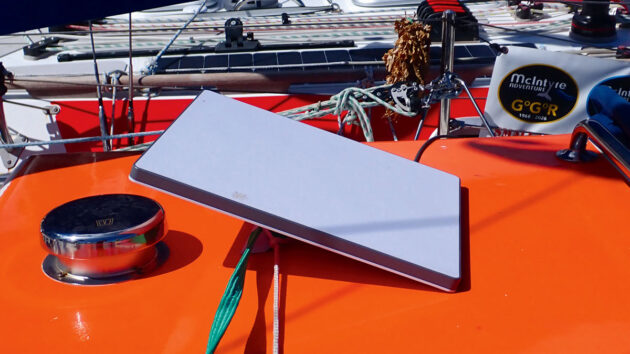
Most of the sailors taking part in the 2025-26 Mini Globe Race have installed the new Starlink Mini.
This portable, compact satellite internet kit promises high-speed internet with minimum delays, and should, in theory, allow skippers to easily access all the communication channels they need while offshore, including WhatsApp for messages and phone calls, weather forecasts, GRIB files, emails, social media, and even video.
The Starlink Mini is a small, square, flat white unit, measuring 430 x 334 x 79mm (17 x 13½ x 3½in). It has integrated wifi, and is both the antenna and the router.
It comes with a kickstand to be able to adjust the unit to pick up a satellite signal (a hex key locks it into place), a 15m DC power cable, plug, a Starlink plug (for connecting wired devices or a separate router), a pipe adapter and a flat mount for mounting almost anywhere, such as the stern or coachroof.
Starlink Mini: Easy Installation
Mounting requires only three 6mm screws or bolts, although all the skippers recommend securing the unit with extra lines when in use. Everyone found the installation easy, and more than within the capabilities of a DIY-er.
One skipper, Christian Sauer, has glued a loop of Dyneema to the back of his Starlink Mini, and then he ties it to the guardrail with 5mm lines. All of the race entrants recommend removing the Mini and storing it below when not in use. It has a release tab on the mount.
All of the entrants reported that getting set up was relatively straightforward. Download the Starlink App, click on the QR code, and plug the Mini into a power outlet.
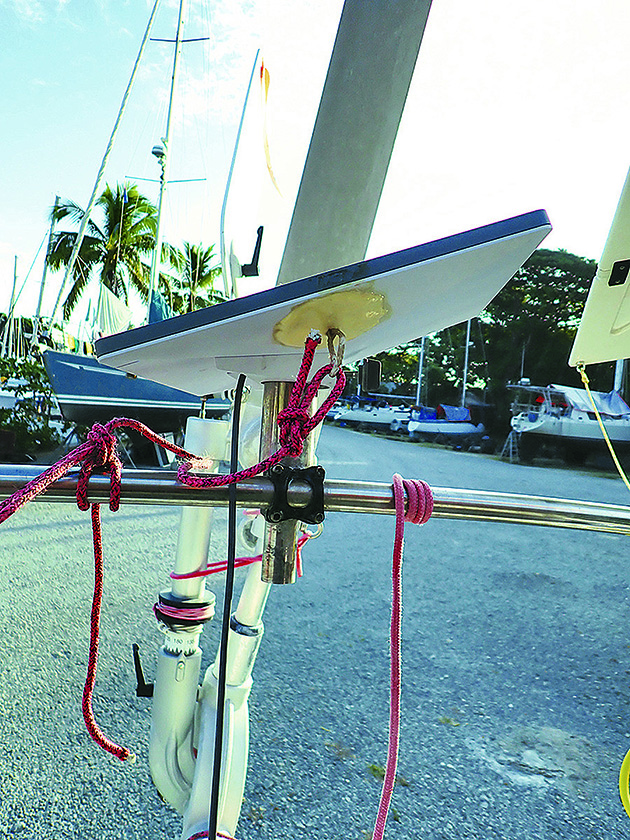
Christian Sauer has added a Dyneema loop to his Starlink Mini so he can tie it to the guardrails when in use. Credit: Kelly Blundell
You can then use your smartphone to connect to the Starlink wifi network (up to 128 devices can be connected to one Mini), and then you just need to align it to get the best signal. An alert on the app lets you know if the Mini needs aligning or if there are any outages or obstructions.
The Mini does need a clear view of the sky to connect to the satellites and has a 110° field of view. The skippers reported that adjusting the Mini was easy; the app has a compass display and shows the current angle of the antenna/router; if the sails or solar panels are in the way, the angle of the unit can be moved (especially if mounted on a ball-joint) to get a better connection, and the adjustment shows up immediately.
Performance
The system can be operated in wind speeds of up to 60mph, but skippers said performance depended on the apps being used, as well as the weather forecast and the boat’s position. Calls were generally very clear, and the connection was good, although calls did drop out.
Download speeds (advertised at over 100Mbps) were also reported as good, and can easily handle GRIB and other files.
Dan Turk says the Mini is “a game changer, because you can video call. It is probably faster internet than I have at home.
I use it every four hours, check out the tracker, check out the weather and get updates from family and friends. It is really good.”
Christian Sauer reported that the Starlink Mini “is 10 times faster” than other portable satellite wifi hotspot devices, although there is no built-in battery. And that is one of the issues.
Power consumption is 25-40W, so most skippers use it sparingly (twice a day for half an hour, or four times per day for 15 minutes) to avoid draining the batteries. Some skippers also reported that the DC power cable can become hot when in use, another reason to turn it off.
Price is also a factor. While the Starlink Mini hardware is cheap (RRP £399), the packages vary, with Christian Sauer disclosing that he’s paying €400 (£344) a month for his plan, plus €2.28 (£1.97) per gigabyte offshore, making an average cost of €600-€700 (£517-£603) per month on passage.
In the UK, a Roam Unlimited service plan starts from £96, although this is limited to within 12 miles of the coast.
[NOTE: Update 16 September 2026: Starlink has cancelled the popular Global Roam plan and placed a 30-day international roaming limit on its Roam Unlimited plan. It has also introduced a higher-priced Global Priority Plan. A new personal maritime plan is also available]

Satellite communication at sea: staying connected from your boat
With Starlink’s high-speed internet, do sailors still need satellite phones on board while at sea? Ali Wood looks at the…

Can a phone with satellite connectivity replace an EPIRB?
Is a phone with satellite connectivity a good replacement for the EPIRB? PBO expert Rupert Holmes answers the question

Cheaper satellite communications: a buyers guide
Rupert Holmes looks at the advances of sat comms and how they are becoming more affordable for the average boater

SSB radio explained: The budget rival to satellite phone connectivity
These days it’s relatively easy to maintain phone contact almost anywhere in the world – but to do so from…
Want to read more gear reviews?
A subscription to Practical Boat Owner magazine costs around 40% less than the cover price.
Print and digital editions are available through Magazines Direct – where you can also find the latest deals.
PBO is packed with information to help you get the most from boat ownership – whether sail or power.
-
-
-
- Take your DIY skills to the next level with trusted advice on boat maintenance and repairs
- Impartial, in-depth gear reviews
- Practical cruising tips for making the most of your time afloat
-
-
Follow us on Facebook, Instagram, TikTok and Twitter