


Alex Carter survives a medical emergency at sea, only to suffer rudder failure during a recovery sail.
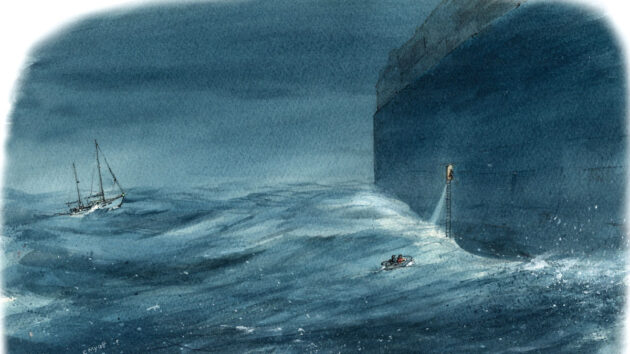
Built in South Africa, Acid Rain is a 38ft steel-hull sailing ketch that made history in the 1990 Cape to Rio Race when blind crew completed the race, along with a deaf skipper, writes Alex Carter.
I knew she was special the moment my brother and I stepped aboard. At this point, she was abandoned in a boatyard, in a state of disrepair but there was something really homely and cosy about her. I wanted this to be my home.
My love for sailing began in my 20s, when I joined a friend on inflatable dinghy adventures in the Channel Islands.
We made a pact to sail to Asia. Time marched on and while my friend started a family and realised that sailing to Asia in a small boat wasn’t for him, I held on to the dream.
Aged 25, I bought a yacht and began sailing it around the UK.
I longed for a larger boat and found Acid Rain. The name was chosen by her previous owners due to acid rain being a climate change issue, to raise awareness during the race.
I worked hard to get Acid Rain back on the water, welding and patching up all the rusted holes and rebuilding the engine, helped by my brother.
Initially people were sceptical that I’d ever get this boat out of the yard. I was working as a baker and then in the evenings and on my days off I would repair Acid Rain.
Eventually the same people who’d been sceptical began helping me to restore her.
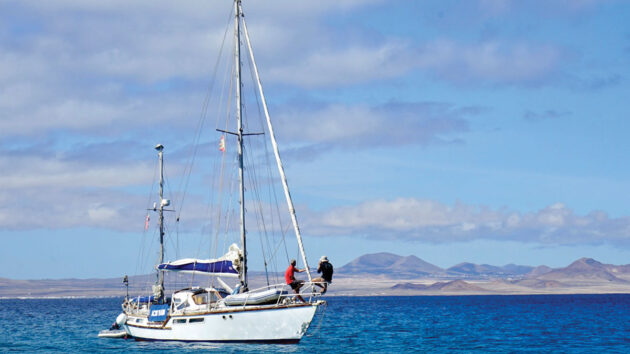
Acid Rain yacht broke down barriers in the 1990 Cape to Rio Race – the first time a blind person completed the race. Credit: Alex Carter
Alex Carter on making it happen
After six months, I was able to sail Acid Rain from the boatyard in Torpoint to my hometown in Falmouth, Cornwall, where I continued to work on her for more than a year.
I then sailed her around Britain, up to Scotland and Ireland with my partner. This three-month trip was a proving ground for Acid Rain and myself and made me even more determined to sail to Asia.
When I lost my job during the Covid pandemic, it seemed like my time to go. I left Falmouth and spent two years cruising to Guatemala.
I took the route down the coast of Portugal to Gibraltar and then on to the Canary Islands, spending nine months exploring the islands before sailing on to Cape Verde and transatlantic to Martinque in the Caribbean.
There were many challenges to overcome, mostly within my own personal struggles trying to figure it all out.
On day two of the Atlantic crossing, I had to replace the head gasket of the engine while under sail.
Other challenges included being becalmed for three days and taken backwards in a counter current.
When the spinnaker pole mast joint snapped, I made a repair using a shoe, something I’d read about in PBO many years earlier.
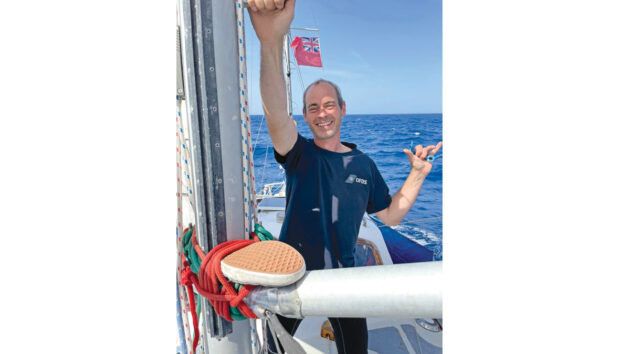
PBO-inspired spinnaker pole mast joint repair worked surprisingly well. Credit: Alex Carter
Often I was alone but when money ran low a friend advised me to join a sailboat hitchhiker’s group on Facebook where I invited crew to stay on the boat and learn about sailing, spearfishing and more, for €15 a day.
The fee just covered the cost of food and fuel so I could continue the adventure.
I was running the boat on €50 a month at times, catching fish or finding clams and mussels at low tide.
Sometimes people would stay for days, sometimes months.
Many were struggling with life for whatever reason, and they enjoyed finding the disconnect they needed at sea.
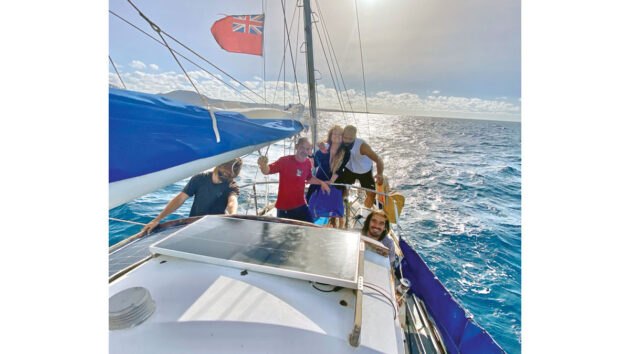
Happier times cruising Cape Verde. Credit: Alex Carter
Brain haemorrhage
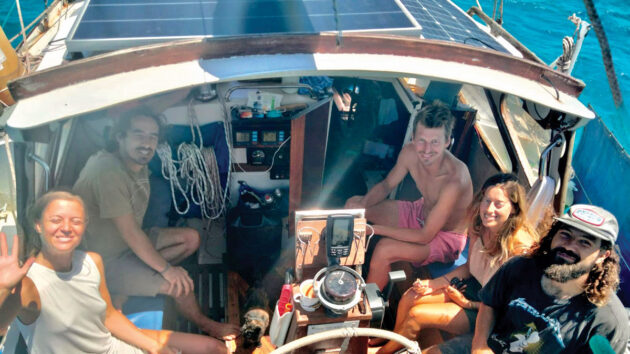
Dinner with the crew aboard Acid Rain. Credit: Alex Carter
In January 2024 while in Guatemala I was on board, about to begin a passage to Honduras, when I sneezed and that was it: my brain haemorrhaged and I had a stroke that started with incredible pain in my head.
It was so bad I begged the doctors to let me die. Medical help was a long time coming and my brain was swelling inside my skull.
My crewmate found me naked and confused, and got me to land, where the fire brigade transferred me to a local hospital.
The first week, the doctors just didn’t have the equipment or expertise to figure out what had happened.
I was sent back to my boat to rest and a friend kept an eye on me, but things quickly deteriorated.
It wasn’t until a week later that my brother arrived.
He had been delayed as he had been crossing the Atlantic on his own boat.
He got me to an intensive care unit (ICU) in Guatemala City. After the worst two weeks of my life in ICU, I was flown to University College London Hospitals.
During that time I suffered additional strokes and a massive blood clot in the brain.
Once I had recovered somewhat, I decided to get back to Acid Rain and live a shorter, interesting life, than a longer one filled with doctors’ appointments.
Acid Rain was still in Guatemala. Here I picked up two new crew members – Anastasia and her cat, Simba, from Russia, and Ibai from Spain.
The four of us set sail on 8 March 2025, heading to Havana, Cuba, bound for Carricou when we lost the rudder in turbulent waters.
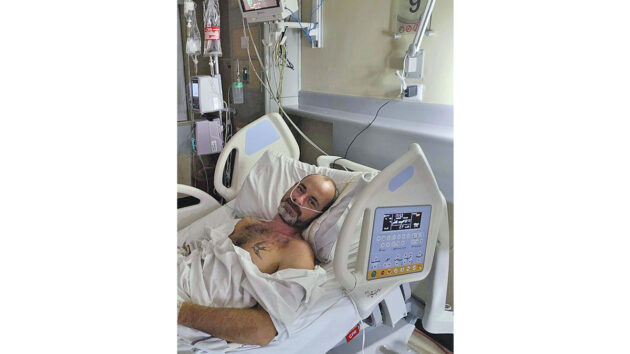
In an intensive care unit in Guatemala City. Credit: Alex Carter
Rudder failure
Ibai was at the helm when two sickening bangs made the hull shudder and sent my nervous system into overdrive.
“What was that?” I asked him.
My mind raced through possibilities – something loose or broken, had we hit a container, or a whale?
We altered course slightly. I saw a flash of blue beneath the surface, the same colour as my own antifoul.
The realisation slapped me in the face like a rogue jib sheet. It was our rudder.
Dangling 2m below the boat like a grotesque broken limb, it was attached by a thin cable I’d installed years before to deflect debris.
The stainless steel rudder stock had snapped off. I sat, stunned.
Without a rudder, we had no steering. Worse, water was likely entering through the rudder post.
I checked below. The stock plugged the hole, for now.
Ibai asked: “What do you think, Captain?”
I looked at him. “That blue thing down there? That’s our rudder.”
His expression shifted as it sank in.
I told him to wake Nastya while I considered the options.
Could we rig an emergency rudder? Unlikely in the Gulf Stream. And sail control alone wouldn’t overcome the current; frustratingly the wind had dropped too.
The current made returning to Mexico impossible. Florida was days away and full of reefs.
A strong northerly wind was due in the next 12 hours.
I hadn’t been looking forward to the wind over current scenario. Now we’d be facing it without a rudder.
Then I heard the bilge pump kick in. We were taking on water.
We were drifting north; at the most powerful section of the Yucatan Channel where the Gulf Stream funnelled between Mexico and Cuba.
I did what any Englishman would do and made a cup of tea, forcing myself to slow down, to think clearly.
I had two crew members and a cat to consider. I recalled the RNLI advice to call concerns in early and prevent a situation of searching for casualties, as I scanned the AIS for nearby shipping. There was no RNLI here!
For all the misfortune of the situation, at least we were in a route busy with shipping from Panama to the Southern US. There was a container ship 20 miles to the south.
I hailed them on the radio to relay a message to the Mexican Navy. “It’s not our jurisdiction,” came the response, so they relayed a message to the US Coast Guard, which said “It’s not our jurisdiction.”
The ship, bound for Houston, kindly agreed to take us anyway.
We had to abandon ship.
Abandoning ship
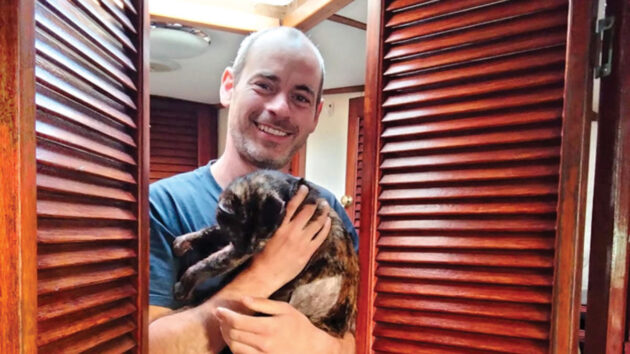
Alex and his cat, Patches, in Portugal. Credit: Alex Carter
Reducing your entire life to what fits in a bag is a brutal exercise. We gathered documents, medication and a few mementos.
We coiled ropes, packed sails and cleaned the cockpit, wanting to leave Acid Rain tidy, even if she was going down.
The 400m container ship appeared on the horizon.
But getting alongside proved impossible.
We spun in the current. When the ship stopped, she began to spin too.
The crew did their best to manoeuvre close to us, but the gulf stream made that impossible.
Nervous, frustrating hours passed. Darkness fell and conditions deteriorated.
We needed a new plan.
“I’ll bring them over in the dinghy,” I told the officer.
We launched it into the swell. The fragile inflatable could only take one crew at a time.
It slammed against Acid Rain, filling with water, threatening to tear.
I took Nastya and Simba first. The approach was terrifying. The towering ship was rising and falling metres with the swell.
A rope ladder hung down, swaying. Timing was everything.
Nastya tried and missed. Panic flickered in her eyes. “You can do this,” I told her.
She was a few rungs up when she fell, landing back in the dinghy. She tried again and managed the climb.
I sent up her bags and Simba in his travel box tied to a rope.
Then I turned back – alone in the dark. Finding Acid Rain again was disorienting.
Everything spun in the current.
The ship had turned too; her unlit side looked like another vessel miles away.
I found Ibai waiting. He threw his rucksack into the dinghy and the hiking sticks strapped to it almost caused a puncture.
We pushed off leaving Acid Rain behind. The return was worse.
A mass of seaweed fouled the prop. We were drifting toward thousands of tons of rising and falling steel.
I prayed my struggling 2hp Mariner outboard wouldn’t die or we’d be crushed by the hull or swept into the dark.
My tense body willed us forward. “Please,” I whispered. “Not now.”
Ibai reached for the ladder and finally caught it. I held him steady as he climbed. He made it.
Looking back, Acid Rain’s lights were low in the water. I had an urge to go back but then I grabbed the ladder and climbed.
Safe on board the container ship, the crew treated us with kindness – food, warmth, a cabin. They marvelled at Simba.
We looked like castaways rescued after weeks, not hours.
But I couldn’t process the loss. I stared out the porthole, imagining the creak of fittings, the clink of cups in the sink, the slow ingress of water.
I had rebuilt her with my own hands, lived aboard for over two years, suffered a near-fatal brain haemorrhage, barely recovered and now I’d lost everything.
Acid Rain wasn’t the only one who’d lost her rudder that night.
And now she was gone, succumbed to the wind and waves.
We reached Houston. Customs processed us with surprising warmth – especially once they saw Simba.
From there, we went our separate ways.
Surprising twist
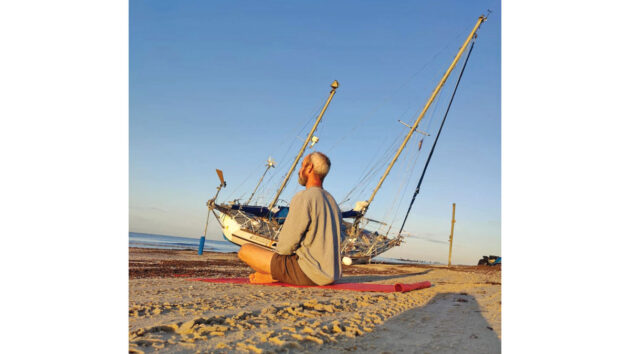
Acid Rain wrecked on Holly Beach in Louisiana. Credit: Alex Carter
Six weeks after the rescue, I was back in Cornwall feeling lost and empty, when I got a call from Cameron Parish Sheriff’s Office in Southwest Louisiana.
A freak storm had brought Acid Rain in through all the shipping lanes, the oil field platforms and a narrow passage between coastal defences and left her high and dry on the only bit of the coast for miles with road access.
She was 600 miles as the crow flies from the rescue coordinates.
The cost of recovery was astronomical and not something I could even consider; but with the last of my finances, I flew out to see her one last time and to clear up the mess.
I flew into Lake Charles, rented a car and drove to Johnson Bayou.
When I got to Acid Rain. all bashed up on the beach, I fell to my knees, in tears.
I slept there in the rental car.
I had begun cleaning up Acid Rain when I met Cynthia LeBlanc, a Johnson Bayou resident, while she was walking the beach looking for shark teeth.
She invited me to use her home internet and asked around for a place for me to stay.
Bill and Lila Terry invited me into their home and I’ve been there ever since.
I wrote a book, The Edge of Life – A Risk Worth Taking about the voyage that led up to the rescue, in the hope of funding the recovery of Acid Rain.
I’m determined to get her sailing again; she’s a remarkable vessel with a remarkable story.
Lessons learned
- Be aware of the risks of getting ill in a developing country and the costs or feasibility for insurance.
As a sailor it’s hard to find a policy to cover every country you sail to.
Facilities may be basic. Share medical history with crew. - Preservation of life over all else.
After losing everything including my health, I’m fully aware that life can be taken in a moment.
We’re never ready. I was fortunate enough to find my peace sailing.
Anytime I felt devastated by the loss of Acid Rain, I had only to think of the lives of the young crew to know I’d made the right choice. - Crew training is essential.
I’d done the safety talk and shown where the Mayday details were but told the crew they probably wouldn’t need to.
Try to impress the urgency of reporting anything out of the ordinary promptly. - Coastguard jurisdiction.
Both the US Coast Guard and the Mexican Navy refused to assist, each saying the other had jurisdiction (get help early before the situation escalates). - Boarding a container ship.
Trying to come alongside in a small yacht in challenging conditions proved impossible – transfer by dinghy was safer for both vessels.
Sharp hiking sticks strapped to a backpack thrown in the RIB could have ended things quicker than the deteriorating conditions. - We suspect the rudder failed due to metal fatigue which is difficult to spot.
Do regular inspections by dropping the rudder to check the weak area where it enters the hull.
Carry a spare rudder where possible (windvane steering like Hydrovane has an option to work as an emergency rudder).
About Alex Carter
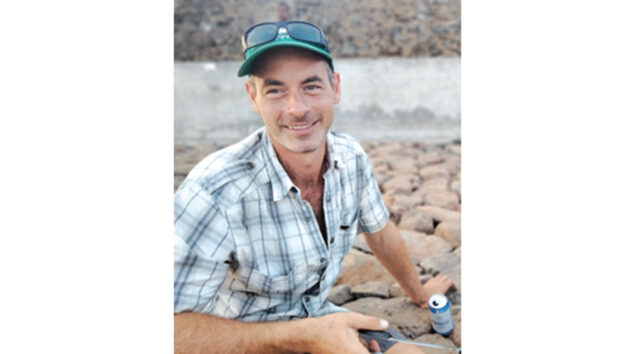
Alex Carter of Falmouth, Cornwall, suffered a near-fatal brain haemorrhage while sailing in Guatemala.
After recovery, he continued life afloat but experienced rudder loss in the Gulf of Mexico.
He was rescued by a container ship and is now rebuilding Acid Rain after she washed ashore.
His book The Edge of Life – A Risk Worth Taking is available on Amazon.
Expert comment
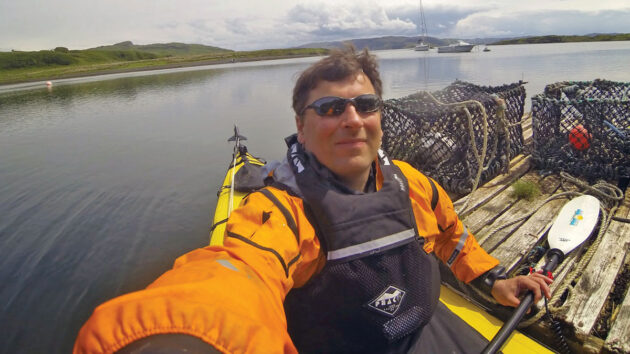
Simon Currin, past commodore of the Ocean Cruising Club
Simon Currin, past commodore of the Ocean Cruising Club, comments:
Coping with adversity is very much part of sailing but Alex Carter does seem to have had more than his fair share.
A brain haemorrhage when on a yacht with novice crew in Central America is a nightmare scenario and Alex was brave to resume his cruising life after surviving such a medical calamity.
Sadly rudder failure is becoming one of the more common causes of offshore disaster and often this does lead to the abandonment of the boat.
It’s distressing to hear that a robust, solid, stainless steel rudder shaft can snap without warning.
In recent years I’ve heard of several similar failures in both alloy and carbon shafts and those breakages prompted us to drop our rudder for full inspection after crossing the Pacific last year.
Alex was faced with the daunting task of either sailing hundreds of miles to safety with a jury-rigged rudder or to seek assistance from the RCC’s.
Once the leak was discovered then preparing for abandonment was the only realistic option.
Alex’s description of getting his crew and cat safely onboard a massive cargo ship will give any sailor pause for thought.
Rescue Coordination Centres are tasked to preserve life and are not concerned with saving the vessel.
Indeed, large commercial vessels cannot render meaningful assistance to a disabled yacht in mid-ocean.
Last season an almost identical scenario happened to a sailing boat on passage from Tonga to New Zealand.
The stricken yacht was not leaking and the RCC were on standby when a Pan-pan went out via WhatsApp to vessels in the vicinity.
Remarkably, a powerful motor-yacht responded and motored 300 miles from their anchorage in New Zealand to tow the rudderless boat and its crew to safety.
This wonderful story of cruisers helping fellow cruisers is told in an Ocean Cruising Club webinar.
It’s great that Alex has been reunited with S/V Acid Rain and, given his determination and tenacity, I’m sure they will soon be cruising again.
200 miles offshore with no rudder: How four sailors built a jury rudder from cabin doors
Stranded 200 miles offshore in big seas without a rudder is every sailor’s nightmare. The crew of Quokka found a…

What to pack in a grab bag
No one wants to abandon ship, but a grab bag of essentials can make a short stay in a liferaft…
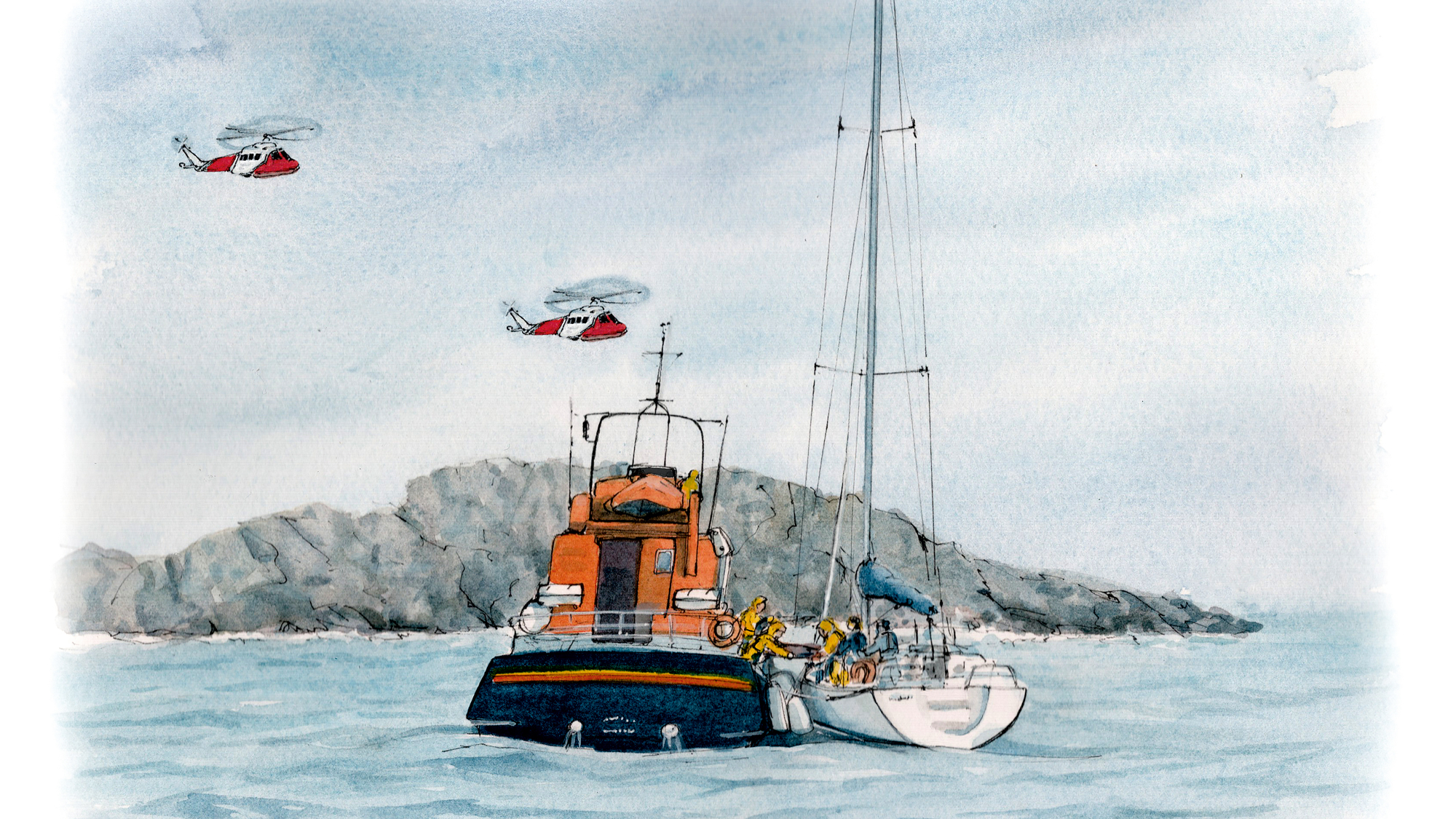
A stroke off the Isles of Scilly: How a medical emergency left this skipper’s wife “hanging from a wire in a near gale”
Early July 2025 found my wife, Veronica, and I sailing in our Dufour 40, Spook from Falmouth in Cornwall to…
Want to read more practical articles like Brain haemorrhage and rudder loss: two lessons in seamanship?
A subscription to Practical Boat Owner magazine costs around 40% less than the cover price.
Print and digital editions are available through Magazines Direct – where you can also find the latest deals.
PBO is packed with information to help you get the most from boat ownership – whether sail or power.
-
-
-
- Take your DIY skills to the next level with trusted advice on boat maintenance and repairs
- Impartial, in-depth gear reviews
- Practical cruising tips for making the most of your time afloat
-
-
Follow us on Facebook, Instagram, TikTok and X