


Leo Heaney’s regular yacht club race night quickly turns dangerous after an unexpected boat collision. After seven months of repairs and frustration, here are the lessons learned.
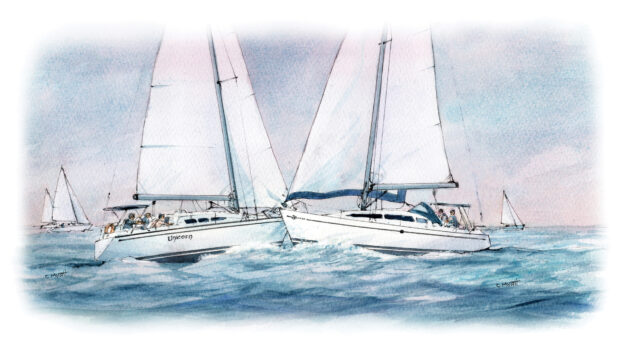
The thing I remember most about the initial boat collision was the noise.
The seconds before impact, the whole crew had gone silent. No more yelling of ‘starboard’ or expletives, just acceptance that we were about to sustain a hit. Not a glancing blow, but a full-on crash.
What followed was a cacophony of tearing fibreglass and stainless steel as the anchor flukes of the Bavaria 40 locked onto the pulpit of our UFO 34 Unicorn and proceeded to, almost hungrily, tear down the starboard side of the boat hull, ripping and gouging at the gelcoat and devouring the uprooted safety rail stanchions from the deck.
Upon reaching midships of our vessel, the Bavaria rose high over the toe rail, almost as if she was attempting to get into the centre cockpit and turn her malevolence on the hapless crew.
In one final act to satisfy her appetite, the Bavaria’s anchor tore off our newly fitted bimini, leaving a semblance of twisted stainless steel tubes and canvas as a parting gift.
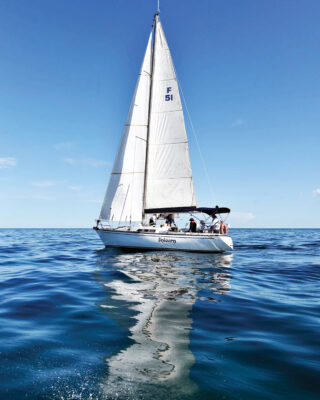
Leo and Mari’s UFO 34 Unicorn sailing in happier times. Photo: Leo Heany.
Quick change
So, from what had started as a composed twilight sail, held every Wednesday evening during summer, turned into something potentially catastrophic with the boat collision having the makings to cause injury or death to the crew.
On board Unicorn that night was a collection of club members, all with varying degrees of competence in offshore and inshore solo sailing, one having done the Rolex Sydney Hobart race and numerous other offshore races on the west coast of Australia.
Only my partner Mari was a novice sailor. The rest of the crew, including myself, raced regularly on an Adams 13e during the summer inshore series.
The boat was owned by Annie and Ole Otness.
Ole was from Norway, and had named his yacht the Longboat – what better name for a long, sleek Adams-designed boat.
The Longboat still races on Saturdays, and regularly wins races, especially when the sea breeze begins to freshen. We also still manage to crew on her for the Saturday inshore races.
Ownership of Unicorn began in 2022 when Mari and I decided to take the big step and buy our own boat.
Previous sailing experience
I’d crewed on the Longboat for five years, and had promised myself that one day I would have my own boat, so it was now or never.
I’d never owned a boat before, apart from a small sailing cruising dinghy when I was a child.
Aside from sailing from Fremantle to Dampier in 1980 and several shorter coastal trips, my sailing experience had been confined to the Swan River on boats around the 8m mark.
I always enjoy the fun of river sailing, but there is nothing like the exuberance of being at sea.
As I didn’t have my own boat, my experience at skippering a yacht was negligible, so helming a boat 34ft-long seemed a daunting prospect.
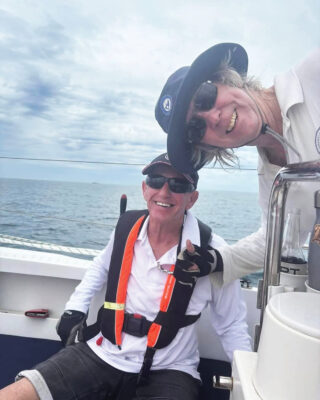
Crew Mark and Tom. Photo: Leo Heany.
The thought of crashing against a concrete jetty while getting in and out of a boat pen (slip), in front of a group of onlookers, is something every boat owner dreads.
My helming skills have improved sufficiently to keep the boat off the concrete jetty so far.
Crewing on racing yachts has been an invaluable experience in developing my sailing ability.
Racing sharpens your skills as you’re constantly looking at sail shape and anything that will improve boat speed. This, in turn, makes you think about the whole concept of sailing and how you can become a better sailor.
Things happen fast when you are racing, including boats coming together, often unceremoniously, and the ubiquitous arguments on boat collision regulations and rule violations that follow can become heated.
The crew must be ever aware of the possibility of a boat collision.
Obscured vision
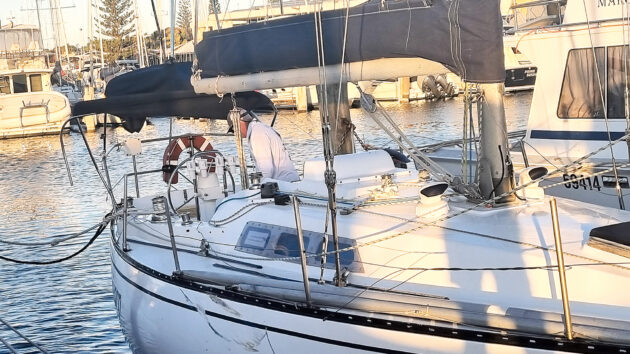
The safety rail stanchions were uprooted from the deck aboard UFO 34 Unicorn after being in collision with a Bavaria 40 on a club race night. Photo: Leo Heany.
During summer, twilight sailing at Fremantle Sailing Club is very popular, and even though it is a social sail and racing tactics are strongly discouraged, once you are out there on the starting line the animal spirits can take over, as all the crews involved want to beat the boats lining up next to them.
I’m sure we have all been guilty of this, no matter how hard we try to refrain from it.
What is probably worse than this over-exuberance is when skipper and crew become oblivious to what is going on around them.
Good company, and a red wine can easily lull a sailor into a calm and tranquil state of mind that does not always correspond with the convention on the international regulations for preventing boat collisions at sea, 1972 (Colregs) definition of keeping a ‘good lookout’.
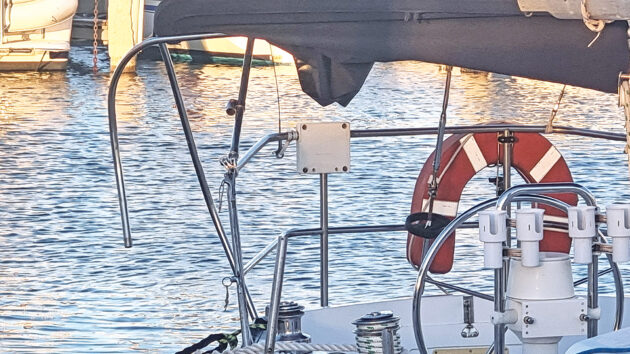
Unicorn’s newly fitted bimini was torn off, leaving twisted stainless steel tubes and canvas. Photo: Leo Heany.
On the temperate evening of our collision, visibility was good with winds around 12 knots from the south-west.
The twilight sailing fleet had a clear start and was heading for the first mark Y.
As we approached the mark, Unicorn was on starboard right, therefore she was the stand on vessel, and the Bavaria was the give way vessel on port tack.
We’d realised even from a distance of 100m that the Bavaria may present a problem, but felt that this was nothing to be concerned about, as generally the skipper of the Bavaria would have seen us and eventually turn to starboard and duck under the Unicorn’s stern as is the norm in port/starboard meetings.
However, as the two vessels closed in distance, the Bavaria held her course.
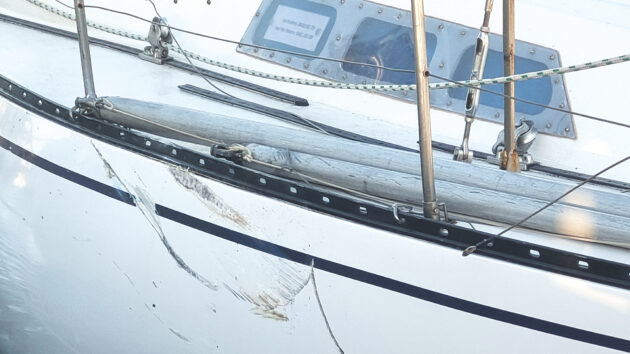
Gouged glassfibre on Unicorn’s starboard side. Photo: Leo Heany.
No crew could be sighted on the approaching vessel as she not only had a bimini and spray dodger, but a canvas link that joins these two.
This design virtually encapsulates the cockpit and those inside, including the skipper. It is great for keeping the weather off the crew, but it results in poor visibility for the skipper and anyone on watch.
To compound the problem further, the Bavaria had a large self-tacking jib set.
This is always a danger as it stops the skipper or crew from seeing any vessels or objects that may be hidden by the headsail.
The boat collision
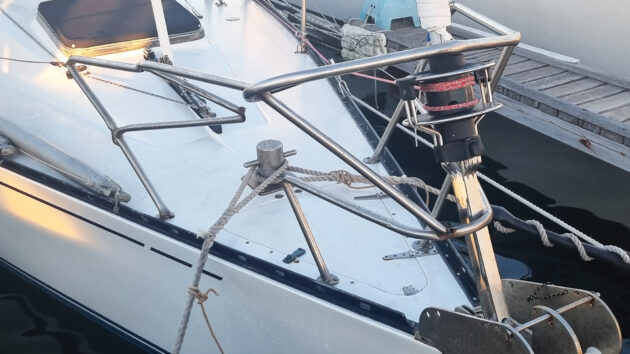
The UFO 34’s pulpit was the first collision point when the anchor flukes of the Bavaria 40 locked on. Photo: Leo Heany.
As the distance between us shortened to some 30m, it was obvious that those on the Bavaria had not seen our vessel.
Attempting to avoid the collision, I turned the unicorn hard to port, hoping to pass starboard to starboard.
As the boat straightened from her turn, it became obvious to me that we would pass the oncoming Bavaria with a safety margin of about 3m… close, but enough just to slip past her safely.
Unfortunately, as the boats drew closer and I was sure the danger had passed, the Bavaria then inexplicably turned hard to starboard and instead ploughed into Unicorn’s bow.
I can remember watching it unfold as if it had been perfectly choreographed in some bizarre way. The whole crew seemed hypnotised as they watched the collision until the force and noise of the impact jolted us back to reality.
The other half of the boat collision
Unbeknownst to those of us on Unicorn, who were watching the approaching vessel with trepidation, other crew in the fleet close by were also observing what was playing out.
About five boat crews were close enough to see the whole thing unfold.
Those who were closest say the Bavaria rose out of the water at one stage as it tore down the side of the UFO; others recount sparks shooting into the air as metal upon metal ripped into each other.
My partner, Mari, was headsail trimmer on the starboard side and actually stood before the Bavaria’s rising bow staring at the pulpit-mounted navigation sealants.
Another of the crew, Steve, was so sure the Bavaria was going to end up in our centre cockpit that he had prepared himself to jump over the side.
The whole movement of the Bavaria down the side of the ufo was almost macabre in its manner; luckily, no one was hurt, as any injury that resulted in heavy blood loss could have been fatal, as it would have taken time to get back to the pen to get help.
The fall-out from our boat collision
The most disturbing factor in the whole sorry mess was not the actual boat collision itself, but the fact that the owner of the Bavaria never stopped to render assistance; he simply sailed on to complete the course.
Although he admitted he was in the wrong for insurance matters, he showed no remorse for his actions and was only concerned about how much his insurance excess would be.
We, on the other hand, were faced with the threat that our insurance company would deem our boat a write-off, which is exactly what happened.
This forced us onto the front foot, and we fired off a letter of demand to his insurance company stipulating that it was responsible for all repairs to our boat.
The insurance company deemed that we were the third party and would not act on our behalf in organising repairs to our boat.
That was up to us, we were told.
Getting anyone willing to do the work turned into a frustrating job.
It took seven months for all the problems to be resolved and the repairs to be completed.
I would like to take this opportunity to thank the people of Fremantle Sailing Club who helped Mari and me with advice and support during this tough time.
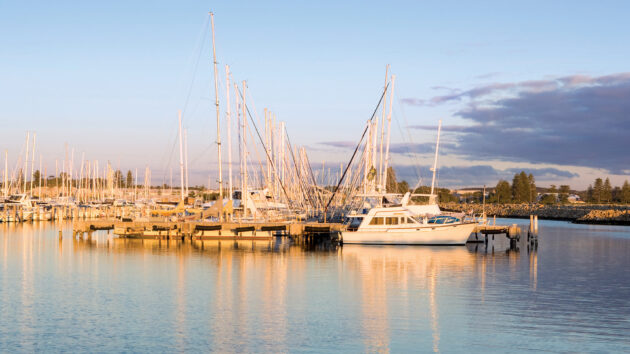
Leo has praised Fremantle Sailing Club in Perth, Western Australia, for helping him deal with the aftermath of the boat collision. Photo: Michael Willis / Alamy.
Lessons Learned from our boat collision accident
1: Never assume that another boat has actually seen you.
2: I now assume that the boating public have little understanding of the rules of the road and even less understanding of the collision regulations.
3: Beware of other vessels hidden behind the headsail.
4: No vessel has the right of way.
5: You are either the stand on vessel or the give way vessel.
6: Always be prepared to extricate your boat from a position in close quarters.
7: It is folly to steer blindly into a boat collision just because you are the stand on vessel.
Expert response: Boat collisions
Niall Mcleod, Royal Yachting Association (RYA) head of competition and technical services, comments:
“Leo’s article does highlight some points relating to situations with boats with limited visibility, which all racers and cruising boats alike might find useful.
We advise that all crews on the water, regardless of whether they are racing, cruising, give way or not, are required to maintain a proper lookout such that they are aware of their surroundings and any other vessels they may interact with.
The fact that the design of a boat or its sails may restrict the crew of a boat in fulfilling their obligation to keep a proper lookout does not in any way relieve them of their responsibilities for so doing.
When two vessels are approaching each other, both vessels will have obligations under either the racing rules of sailing or the international regulations for the prevention of collisions at sea, and it is important that everyone understands and fulfils their obligations in order to avoid dangerous situations or collisions from occurring.
There is some more detailed information which offers some clarity and guidance around this topic at: pbo.co.uk/rya_racing_guidance”.
Leo Heaney lives in Fremantle, Western Australia, together with his partner, Mari. They purchased their UFO 34 Unicorn in 2022. They are members of Fremantle Sailing Club and currently sail in the Inshore Racing Series run by the club. They hope to win some races, and explore the Houtman Abrolhos Islands.
Avoiding boat collisions: understanding COLREGS
If you’re at the helm, can you spot a risk of collision with another boat? Do you know when to…
“I was on Lyme Bay harbour wall in only my soggy underpants”: how a test voyage became a crash-course in seamanship
My first test voyage onboard my boat Draken was, to say the least, quite a rude awakening. After years of dinghy…

Crashed bow repair: how Abhilash Tomy & his team fixed the boat in time for the 2022 Golden Globe Race
What to do if your boat is damaged just days before a non-stop global circumnavigation? Rupert Holmes reports on how…
No killcord or lifejackets were worn during a powerboat crash which killed a woman and child
An investigation into the deaths of a woman and a child following a powerboat accident has found that killcords and…
Want to read more articles about boat collisions?
A subscription to Practical Boat Owner magazine costs around 40% less than the cover price.
Print and digital editions are available through Magazines Direct – where you can also find the latest deals.
PBO is packed with information to help you get the most from boat ownership – whether sail or power.
-
-
-
- Take your DIY skills to the next level with trusted advice on boat maintenance and repairs
- Impartial, in-depth gear reviews
- Practical cruising tips for making the most of your time afloat
-
-
Follow us on Facebook, Instagram, TikTok and Twitter