



Built to mark the cultural Olympiad in 2012, Collective Spirit is a unique boat built due to a collaboration between artists and the sailing world. David Harding went to see and sail her
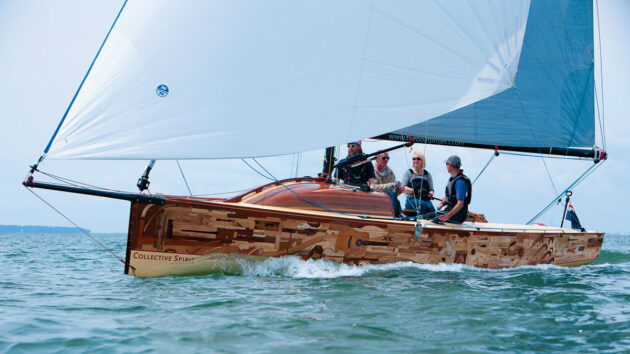
Collective Spirit is one of the most unusual boats you are ever likely to see. Her topsides and cockpit amaze the eye, being a jigsw of wooden shapes – here a guitar, there a coat hanger, a helicopter, a violin, a picture frame.
‘What kind of boat is it,’ one of the gathered crowd asked. Luckily, artist Gary Winters was there to explain.
Every piece of wood on the boat has a history, from the nationally important – decorative flooring rescued from the Windsor Castle fire, pieces from HMS Victory and the Mary Rose – to the personal; a child’s wooden horse, a treasured box top, a holiday souvenir.
As part of the 2012 Cultural Olympiad, the Arts Council put up prize funding in each of its 12 regions for the project that would fire the public imagination and somewhow link sport, art and local communities.
Winners of the South East commission were Gary and his art partner Gregg Whelan, who call themselves Lone Twin. Neither is a sailor: previous art ‘happenings’ have been mainly in art galleries or on streets. A call-out for people’s wooden objects with which to make a seaborne archive of memories resulted in more than 1,000 donated treasures; everything from old drawer fronts to toy animals and a shaving of Jimi Hendrix’s guitar.
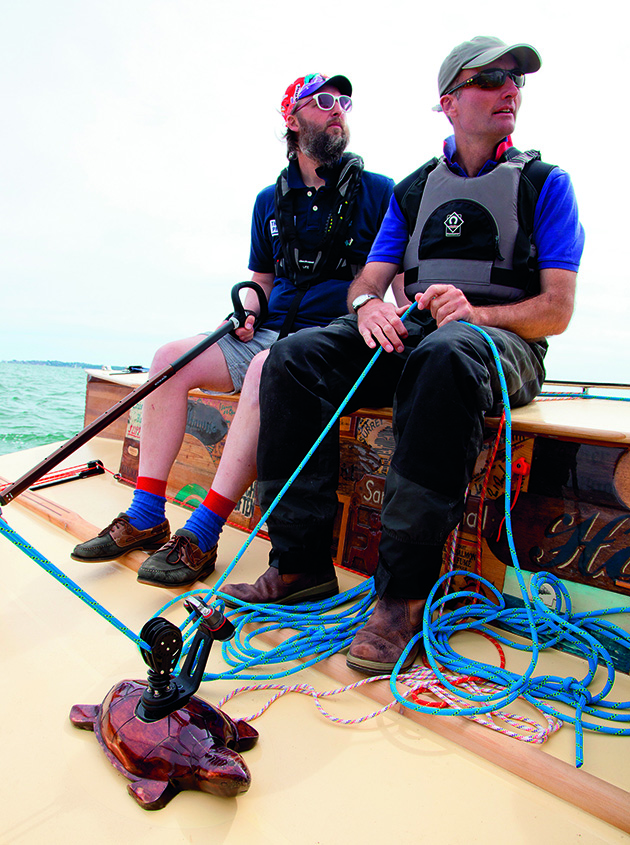
Artist Gary Winters at the helm, and skipper Mike Barham with the mainsheet turtle. Credit: David Harding
As the objects were collected at the building shed in Thronham Marinas at the top of Chichester Harbour, some in the sailing community envisaged a boat along the lines of an art or limped raft.
However, Lone Twin commissioned yacht designer Simon Rogers and project manager Mark Covell, both steeped in very fast boats. While Rogers drew his ‘boat of its time – to represent 2012 many decades from now’, Covell was puzzling over how to incorporate a mountain of wood into a light, fast sportsboat.
He came up with a process of taking slices of the objects, piecing them together like a jigsaw and encapsulating them in epoxy.
Collective Spirit is more than a boat; it is a project. Lone Twin set the yacht off on a journey, skippered by volunteer Mike Barham and crewed by novice sailors nominated from within the region by family and friends, to visit ports around the South-East region, and inland towns by road trailer.
At each stopover, people whose treasures are in the boat came along and took a look.
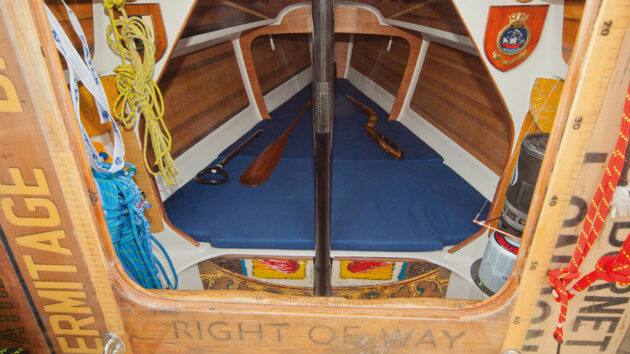
Collective Spirit is a day-sailer, but there’s a small cabin with two berths. Credit: David Harding
For a boat-tester who, on the whole, is more interested in sailing than in the art world, I wondered quite how performing artists might contribute anything useful to a boat beyond an initial idea.
After all, the best yacht designers and builders are artists in their own way and are more than capable of producing objects of both function and beauty. Some of the most highly respected names in yacht design start with sketches or models that they tweak and refine aesthetically long before starting up their computers.
Similarly, sailing itself is as much an art as a science. You can’t sail by numbers alone; you have to have the feel and instinct, and some very bright people are appalling sailors.
Thankfully, things started to sound more promising once the names Rogers and Covell were mentioned. Simon Rogers is responsible for designing a string of highly successful performance yachts from Mini Transats and the Whitbread 30 (Sticky Fingers is a name that will ring a bell with many people) to Class 40s, carbon 82-footers and superyachts.
Mark Covell, who introduced Rogers to the project, won a silver medal in the Star with Ian Walker at the 2000 Olympics in Sydney. He was joined for the project by a team of four other highly experienced builders and shipwrights.
Collective Spirit: Performance pedigree
With people like this behind Collective Spirit, there was no way the boat wasn’t going to sail. As Simon Rogers explained when the yacht was launched: ‘Mark and I were both adamant that we didn’t want something from the 1948 games. It incorporates many features of today’s yacht design, such as the swept-spreader rig with no backstay, the square-top mainsail, the short-chord low-cg keel and the chine in the hull. It has to have sparkle and get up and perform, yet not be so radical as to be unusable by the general public; we were fairly sure that the project would be led by volunteers, so we needed to make sure it wasn’t a family-frightener!’
Designing a boat to achieve this is one thing, but what about having to incorporate all of those bits of wood? Surely they must have imposed constraints and compromised the design?
Simon conceded that they did to some extent: of the 350kg (771lb) of donated timber, around 150kg (330lb) has been used to form part of the structure, such as the sides of the cockpit, leaving around 200kg (440lb) to find a home elsewhere.
Mark adds: ‘Very little is dead weight as all the timber adds to the sandwich/wall strength. Because we built with West System, the epoxy could bind the donated timbers together as though they were one piece. Cedar strip has a lot of longitudinal strength as well as being the filler in the sandwich.’
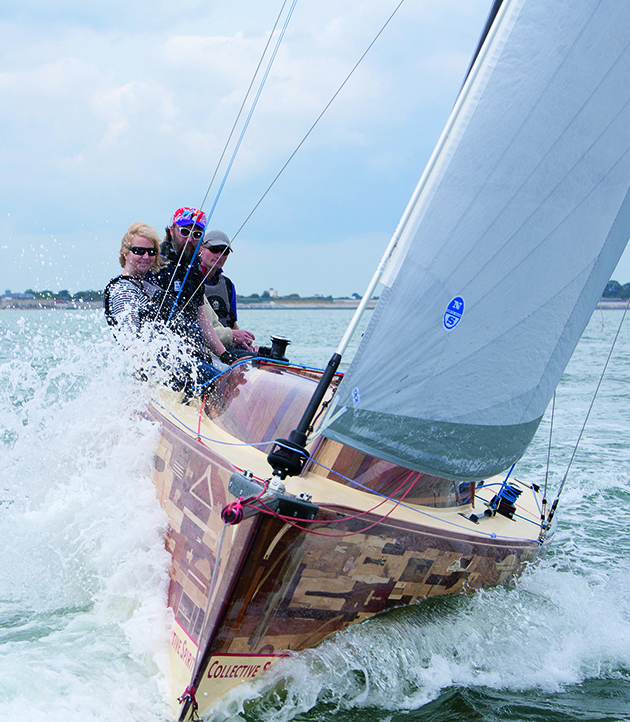
Gleaming woodwork contrasts with the carbon spars and laminate sails. Credit: David Harding
Because of the way the boat is built, in unloaded form it tips the scales at a mere 1,900kg (4,189lb). With 43.6sq m (469sq ft) of sail, that gives her a sail area/displacement ratio of just under 29.
By race boat standards that’s far from extreme, but when you consider that anything over 20 is getty sporty for a performance cruising yacht it’s clear that Collective Spirit has plenty of horsepower.
Similarly, her displacement/length ratio of 89 shows that she’s light for her length compared with most boats that Practical Boat Owner covers.

Boatbuilder’s corner: this was Mark Covell’s dog. Credit: David Harding
Fast and powerful though she undoubtedly is, her designer was mindful that his creation would have to be capable of rounding exposed headlines on her travels so anything ‘too aggressive’ was out of the question.
Because the hull is slim and the wetted area modest, the rig doesn’t need to be large to drive it and the square-top mainsail keeps the centre of effort relatively low. Downwind fizz is ensured by a masthead asymmetric flown from the fixed carbon bowsprit, with a Code O on a furling drum providing the power at lower wind angles.
Keeping everything sunny side up is 550kg (1,212lb) of ballast in the form of a lead bulb keel at the bottom of a high aspect-ratio steel keel shaft that gives a draught of 1.8m (5ft 11in). It’s lifted through the cockpit for trailing and the rudder is mounted in a retractable cassette.
A transport of delight
Since the whole idea of the project was that the boat should be taken to different parts of the country, including landlocked towns, relatively simple road transport was essential. That dictated the lifting foils and also, more importantly, the beam – which in turn determined the length.
With the maximum beam for trailing being 2.55m (8ft 4in), Simon reckoned the length should be no more than 8.93m (29ft 4in).
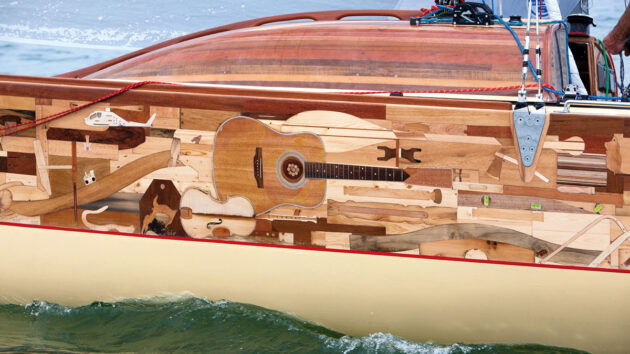
Every part of Collective Spirit‘s hull is an intricate mosaic. Credit: David Harding
‘I had to keep it in proportion and wanted the boat to sail sweetly,’ he said. ‘so narrow beam works well. An inshore boat tends to benefit from modest beam and wetted area. It’s different for offshore racing, where you need power for reaching speeds and high daily averages. Besides, wide beam tends to mean bow-down trim, and that’s not pretty.’
Apart from the maximum dimensions and the weight of the donated timber, Simon was working with few constraints – and that suited him well, as he’s used to designing open classes where the rules are minimal and it’s all about making boats as fast as possible.
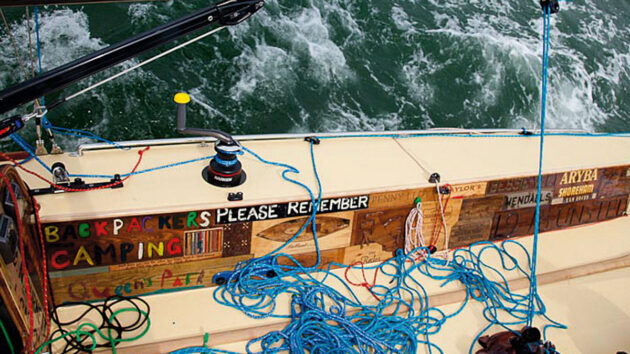
Foot-rests run the length of the cockpit each side but there are no toe-straps. Credit: David Harding
Fortunately for both Simon and Mark, the artistic side of the project gave them a free hand when it came to the design and construction and Mark was able to choose what wood went where. The hull is built from cedar strip sheathed in glass and epoxy, with the topsides recessed by 8mm to accommodate the planed-down veneers of donated timber that form an eye-catching mosaic.
Inside the cockpit, which runs all the way aft from the mast to the transom and will easily accommodate a crew of seven, are some of the chunkier items. Annotated in many instances by a few lines of text, they’re guaranteed to keep even the most easily-bored crewmember entertaining during a long and windless passage.
The art of sailing Collective Spirit
Whatever the theory, the practical test is the one that really matters, so we headed to Portsmouth to meet the boat.
Not many 30ft monohulls are powered by a 4hp outboard engine, but this one is. It is mounted on the transom for simplicity and is one of the few parts that’s not sheathed in decorative timber or otherwise made to look as though it belongs.
Because the tiller is several feet forward of the transom, manoeuvring under power calls for one person controlling the outboard and one on the tiller, so that is clearly not a boat for short-handed manoeuvres in confined spaces.
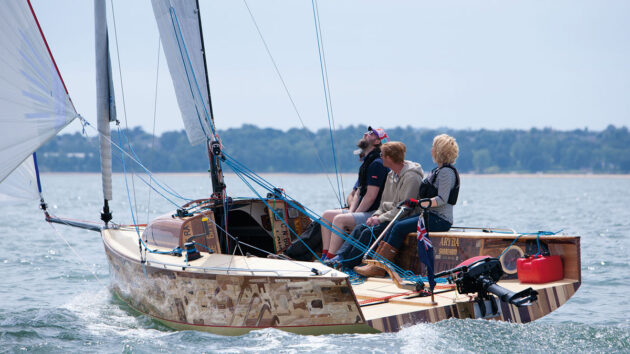
The long, open cockpit will accommodate plenty of crew. Credit: David Harding
On the other hand, she spins on a sixpence and, as we found, is so efficient under sail that most of the time the engine is only needed for the few yards into and out of her berth.
With such a large, open cockpit, moving around is easy – and there are surprisingly few lines and rig controls to trip over. Mark and his team were in charge of the fit-out and chose to keep things as simple as possible. All the essentials are there; nothing more.
The mainsail is controlled by a traveller abaft the rudder stock, a double-ended mainsheet with coarse and fine tune taken to a central block mounted on a wooden decorative turtle, a rod kicker with an 8:1 purchase, a clew outhaul and a Cunningham.
The jib, set on a furling system (from Harken, like the rest of the hardware), sheets to short tracks on the decks with plunger cars and has no extras such as barber-haulers.
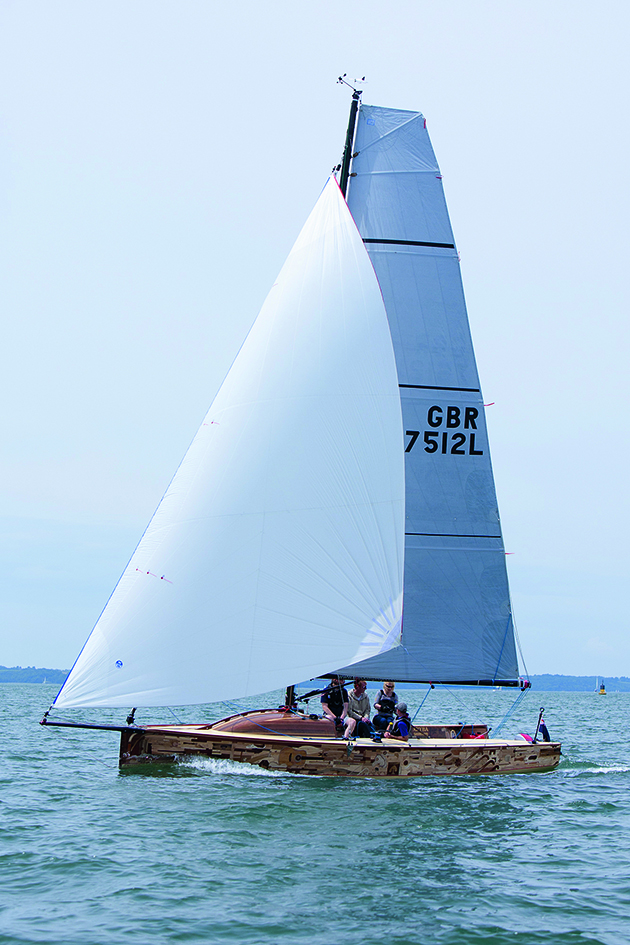
A Code O provides the reaching power. Credit: David Harding
It’s like a simple one-design dinghy or keelboat: you’re given the essentials for pulling the sails into the right shape, but it is no string-city like a Merlin Rocket or Flying Dutchman.
High-tech elements are used where they make sense, such as in the carbon spars by Selden to minimise weight, heel and pitching.
With the sails up and setting outside Portsmouth, Collective Spirit set off on a fetch, clocking around 6.5 knots in 10 knots of wind. The sensation was of smooth, controllable, effortless power and taut, instant response. It was noticeable how the water flowed cleanly from the transom so we were dragging no turbulence.
Hardening up on the wind we continued to clock speeds in the mid-5s, picking up to 6-plus when the breeze increased to the low teens later in the day. With five of us on the high side it was easy to keep the boat reasonably flat even though there is no backstay to help de-power the mainsail; the D2 (intermediates) are relatively slack to encourage sufficient bend in the upper section of the mast.
Balancing act
Narrow boats tend to remain lighter on the helm than their beamier counterparts when heeled. Add a fully balanced rudder, and a lead between the centre of lateral resistance and the rig’s centre of effort that is designed to minimise any rounding-up tendency, and the result is a finger-light helm. Some people like more feel but it wouldn’t be hard to get used to this sort of lightness.
Minimal helm movement was probably part of the plan, so as not to upset Sarah-Jane Blake’s little wooden mouse, given to her by her late father, Sir Peter, that peeks out from the end of the tiller. If you’re a fan of Jimi Hendrix, you might be drawn to the case at the other end of the tiller containing a sliver of wood from his guitar – but to my mind it is the mouse that steals the show.
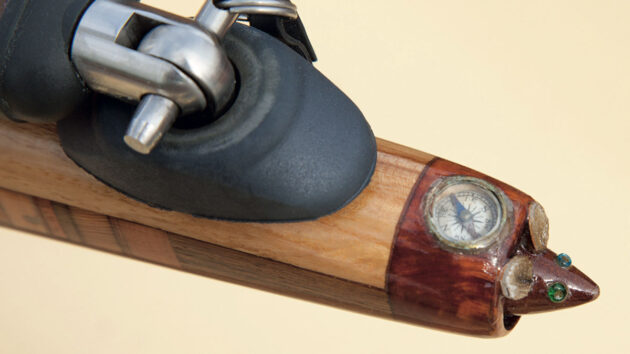
The wooden mouse given to Sarah-Jane Blake by her late father, the yachtsman Sir Peter Blake, peeks out from the end of the tiller
The rudder grips well, as I found when provoking the boat by bearing away with the sheets pinned in: it only lost grip when the gunwale was awash. Punishment would be swifter and more severe on a typical sportsboat.
It was sheer grin-inducing fun upwind, downwind and on all points in between.
Such good upwind speeds and a tacking angle of little over 70° produce VMG figures that are going to leave most 30-footers well astern.
Given the short chord of the keel, something I really needed to try was the stall test: keels like this tend to stall much more readily than longer alternatives, so how manoeuvrable would the boat be at low speeds?
Would a dagger-like T-bulb really make sense? Surprisingly, it kept working as I pinched the boat mercilessly and brought the speed down to less than 2 knots. Only then did the laminar flow break down and the boat start to crab. Getting going again meant easing the sheets and putting the bow down to re-build speed; everything then returned to normal with no drama.
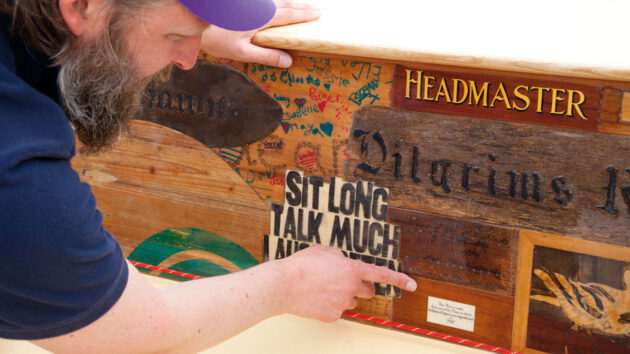
This box is made from one of the piles on which the Bank of England was originally built. Credit: David Harding
In the relatively light conditions, the best part of the day was when we hoisted the masthead asymmetric and slithered downwind at 8-9 knots, wishing the breeze would pick up to 20 knots so we could have a proper sleigh ride.
Handling is straightforward. It’s tempting for the helmsman to sit too far forward; best if he or she stays roughly in line with the tiller and leaves the mainsail (sheet and traveller) to the mainsheet man.
A pair of winches handles the jib, which can be replaced by a smaller and heavier alternative in a blow. I found Collective Spirit so engaging to sail that it was easy to ignore the details of the construction until we returned to the dock. Some might find their attention wandering, however.
As Simon Rogers says, ‘it’s like sailing a Cubist painting and you can easily get distracted by the details and the jokes’. Jokes? Yes, jokes: a line of ice-lolly sticks runs up both sides of the mast to the spreaders, each bearing what used to pass for a joke in ice-lolly land. They get better as you go up, where little eyes can’t see.
Details galore
Back in our berth it was time to savour the exquisite marquetry. It’s not only in the hull, deck and coachroof that the donated items are found: there’s also a small cabin, with a double berth in the bow and the odd cricket bat set into a bulkhead. Turn around and you really could be in an art gallery: on the series of white-painted cut-away bulkheads running aft beneath the decks each side to the transom is a series of wooden masks and voodoo-like artefacts from individual donors, but that could have come straight out of Live and Let Die.
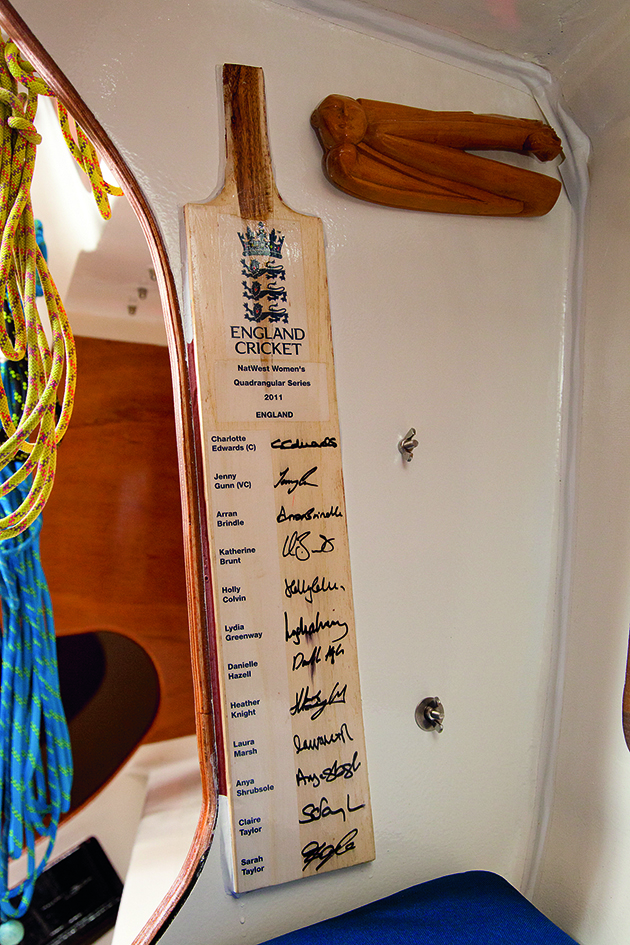
A bat on the bulkhead – signed by England Ladies’ team of 2011. Credit: David Harding
Facilities are basic: this is a day-sailer and there’s no heads – just a bucket. For brewing a cuppa, a pocket-size cooker, powered by a mini gas cylinder and incorporating an upper
canister with a photochromic skin to indicate its temperature, can be strung ‘twixt cabin sole and deckhead. Now that’s practical.
Otherwise, it’s more than a bit surreal down here.
Collective Spirit tech spec
LOA: 8.98m (29ft 4in)
LWL: 8.30m (27ft 3in)
Beam: 2.53m (8ft 4in)
Draught: 1.80m (5ft 11in)
Displacement (lightship): 1,900kg (4,189lb)
Displacement (loaded): 2,250kg (4,960lb)
Ballast: 550kg (1,212lb)
Sail area (mainsail & jib): 43.6 sq m (469 sq ft)
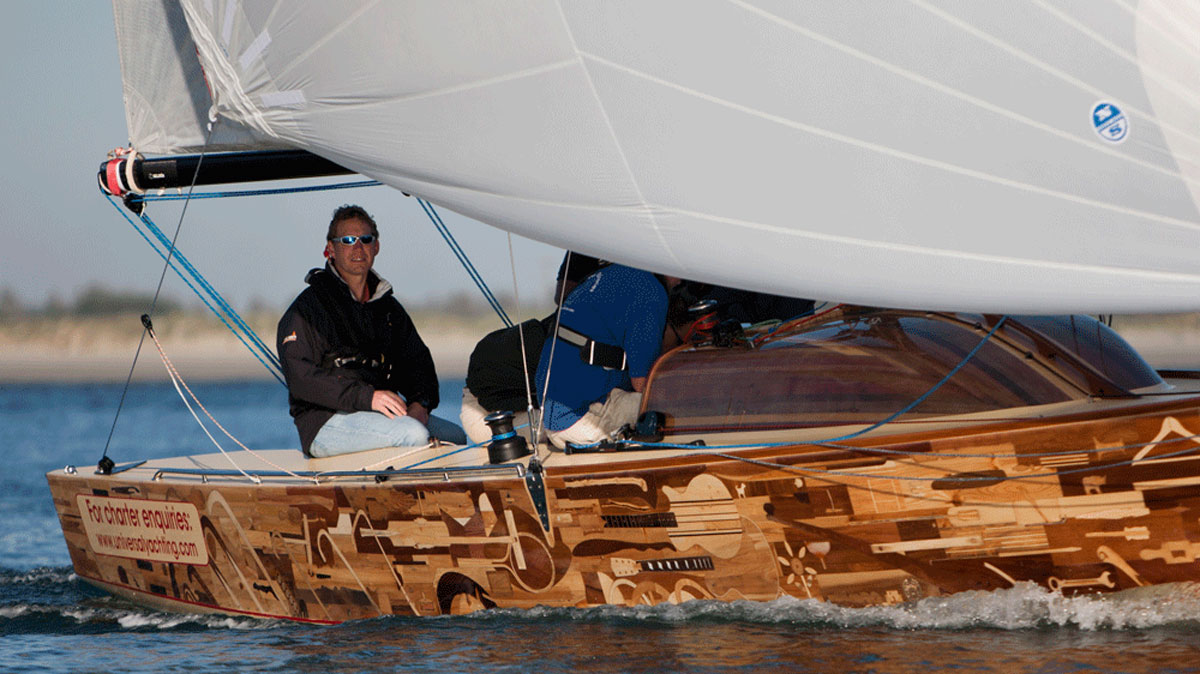
Collective Spirit – made out of 1,200 wooden items – finds a new home
Collective Spirit, which has been built using 1,200 items of wood, will be moving to the river Hamble
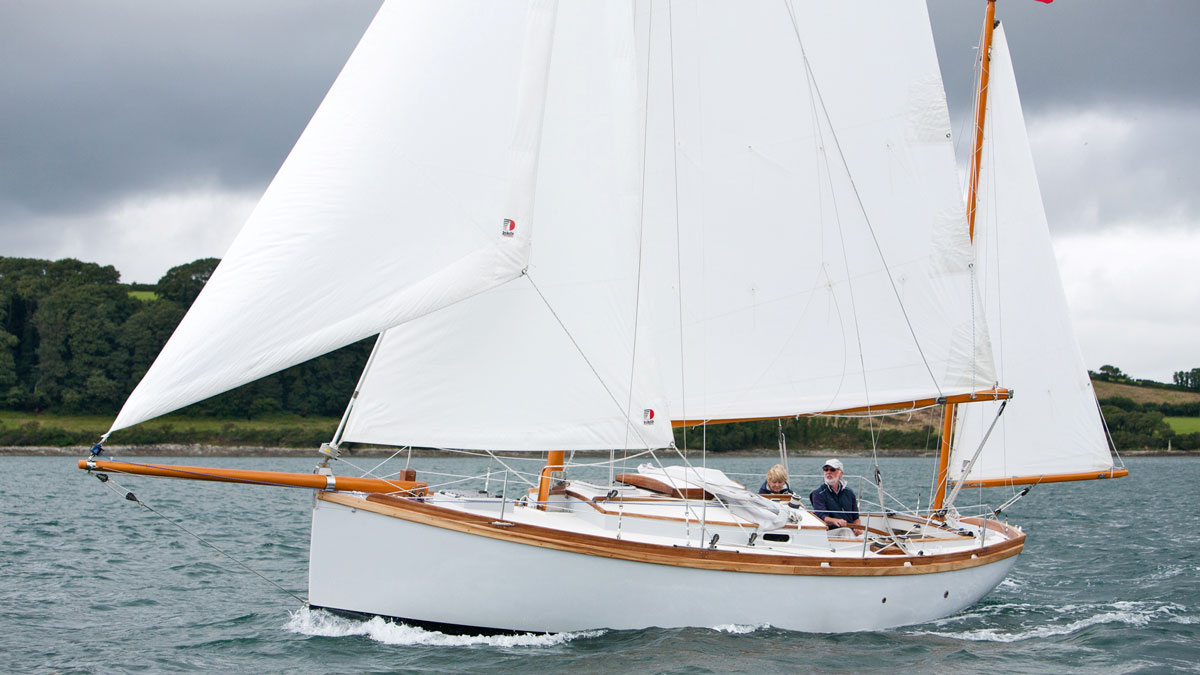
Golant Yawl: a practical modern gaffer
As the man responsible for the ubiquitous Cornish Shrimper and a host of other small gaffers, Roger Dongray is a…
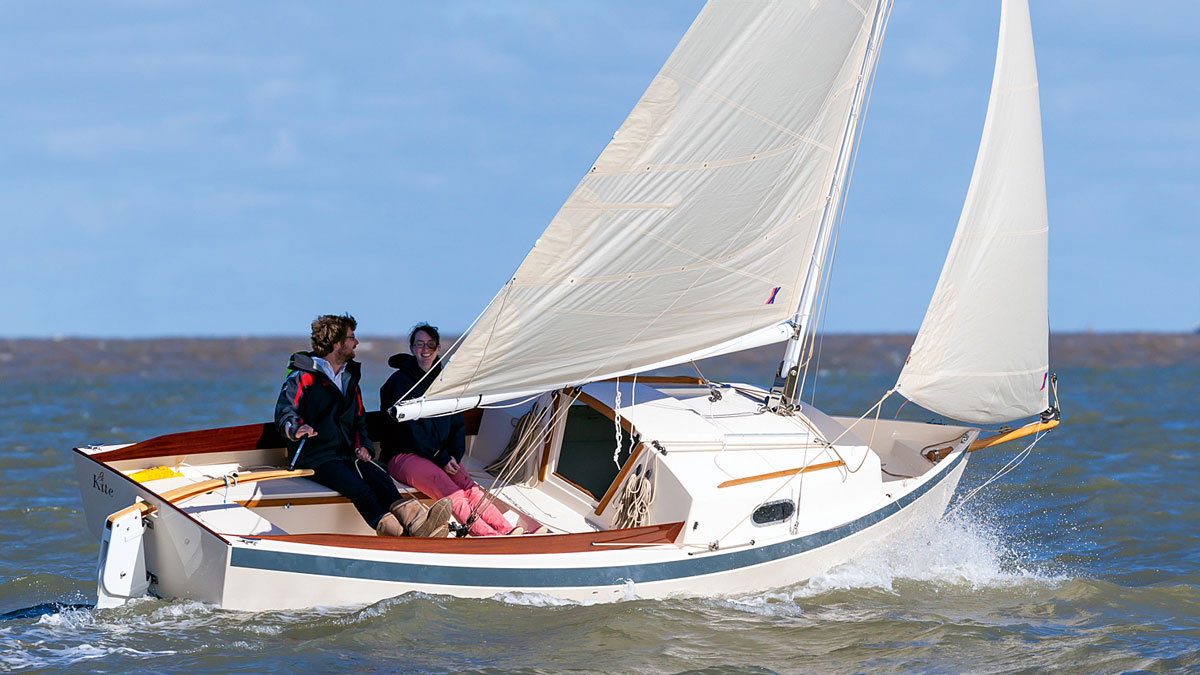
Kite: the lightweight trailer-sailer with heart
David Harding tests this simple and efficient trailer-sailer gaffer which doesn't hang around
6,000 miles solo in a £1 boat: lessons learned from an Atlantic Circuit
The wind was coming on like my brother Alex had warned me it would, as I approached the north side…
What to read more boat articles like Collective Spirit: a boat of a thousand pieces?
A subscription to Practical Boat Owner magazine costs around 40% less than the cover price.
Print and digital editions are available through Magazines Direct – where you can also find the latest deals.
PBO is packed with information to help you get the most from boat ownership – whether sail or power.
-
-
-
- Take your DIY skills to the next level with trusted advice on boat maintenance and repairs
- Impartial, in-depth gear reviews
- Practical cruising tips for making the most of your time afloat
-
-
Follow us on Facebook, Instagram, TikTok and X