



Ali Wood compiles a list of easy ideas to make life better on board
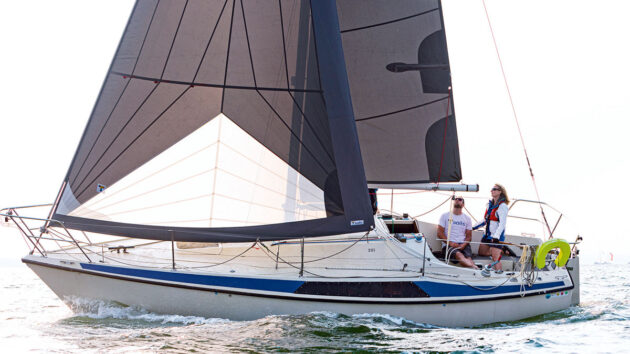
Sometimes it’s the small boat improvements that make a big difference to your cruising; whether that’s a filleting table that takes the mess out of fishing, a slow cooker that makes dinner while you sail or a boat hook that rolls into the palm of your hand. Here are a few boat improvement ideas to make time onboard better.
Mooring and boarding boat improvements
Are your mooring lines letting you down? Why not treat yourself to some new ones from Jimmy Green Marine or Marlow Ropes. As any seasoned sailor or rigger will tell you, a splice is by far the best method for securing lines. Jimmy Green Marine explains: “Whether it is for mooring, anchoring, or rigging, a splice creates a smooth, tapered joint that minimises wear and extends the lifespan of your rope.”
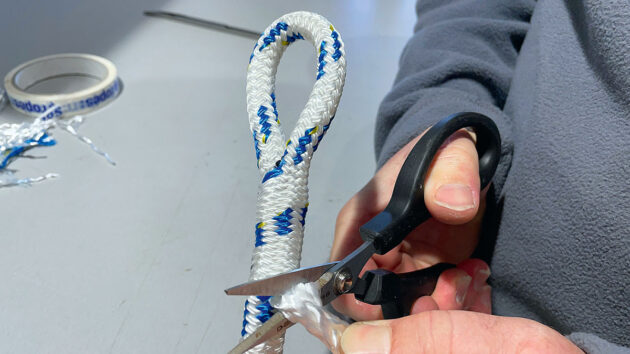
Creating a perfect eye splice
You can build your own system online at JimmyGreen.com, as well as buy essential items such as fids, tools and hot knives. Marlow Ropes also sells a handy Splicing Guide for sailors.
It’s useful to have a boat hook to hand for grabbing mooring lines. The Lalizas Telescopic Boat Hook has two ends and extends up to 2m. It’s useful not only for hooking a line from a pontoon, but for pulling down sticky sail slides.
Handy for boats with high freeboard is the 3.2m Hook and Moor. Just loop your line onto the end of it, slide it through a mooring ring or a cleat and release.
PBO gear tester Fox Morgan found it to be a useful gadget as long as you have a good aim. “If you spend a fair bit of time going on and off buoys, it can make life a bit quicker and means less time at the bow on your belly, feeding a line through the mooring buoy ring.”
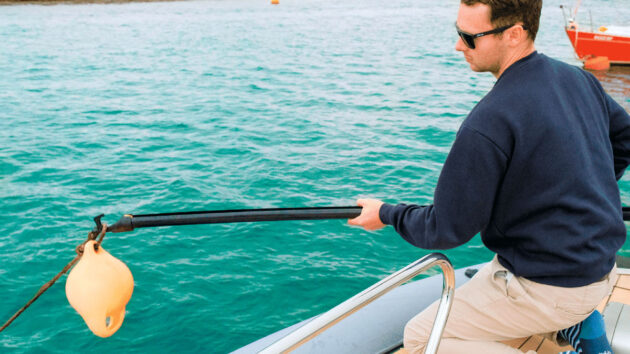
The Revolve boat hook rolls away into a compact size
Morgan also tested the innovative Revolve boat hook, available from Seaview Progress, which she describes as “a marvel” due to its compact size. “It could live in a pocket or on a shelf or in a small cockpit stowage bin,” she says. Made of a rollable polypropylene composite material, it simply unravels and becomes a 1.9m boat hook. Flatten it and roll back up after use.
Seaview Progress also sells Fendertex fenders. Unlike standard PVC ones, these ultra lightweight inflatable textile fenders can be rolled away after use, saving precious locker space Fenders get grubby quickly but a makeover with matching fender covers and lanyards from Jimmy Green Marine will soon spruce them up.
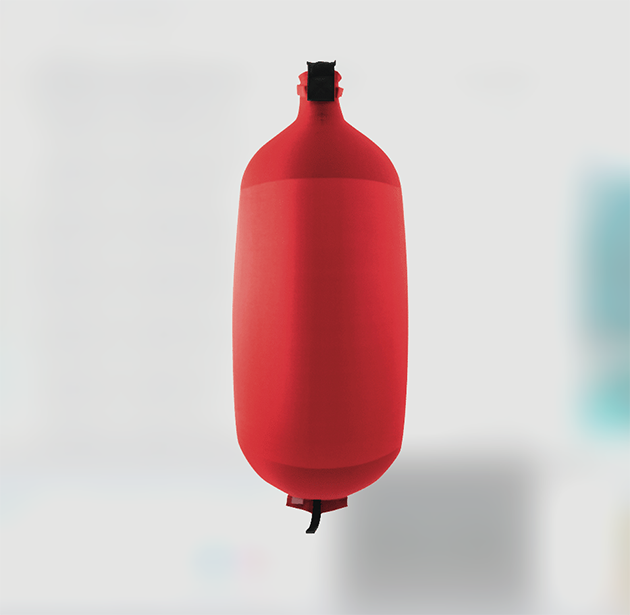
Ultra lightweight inflatable textile fender from Fendertex
If your mooring line rubbing strakes are damaged or missing, avoid mooring line chafe to the deck by fitting a length of Osculati stainless steel rubbing strake.
For the final touch, how about a smart new ensign? Printed or hand-sewn ones are available from Jimmy Green Marine with fade-resistant fabric.
If you end up in the water, deliberately or otherwise, a boarding ladder is an essential piece of kit. Jimmy Green’s rigging team produces a selection of ladders, from an entry-level one with solid beech hardwood rungs, ranging to a neat ladder deployed from a satchel, which can be opened from the water via a release strap. When not in use on the boat, they also make a pretty fun accessory for kids who want to climb trees!
Boat improvements: Easier trimming
Are your clutches and winches giving you a headache? If they are seizing up or your lines are slipping, perhaps it is time to service them or even treat yourself to some new ones.
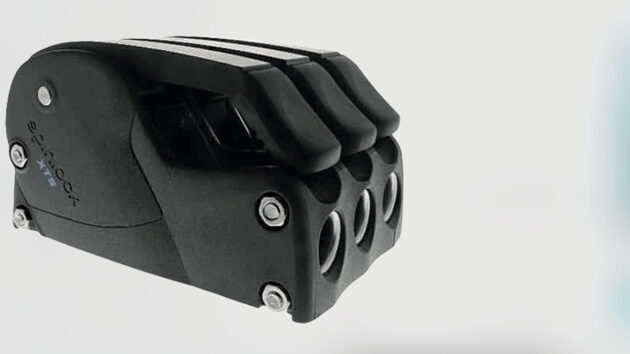
Spinlock clutches can be serviced by a practical boat owner
UK company Spinlock was the first marine manufacturer to sign up to the New Plastics Economy Global Commitment. Its range of cleats, clutches and jammers holds lines from 2mm to 32mm and can withstand loads up to 12,000kg.
Winches should be serviced annually, or even bi-annually if they have heavy competitive use. This prevents failure and corrosion and ensures smooth operation. The good news is that it is a job you can do yourself. Among others, Jimmy Green Marine supplies service kits for Spinlock clutches and Harken and Lewmar winches.
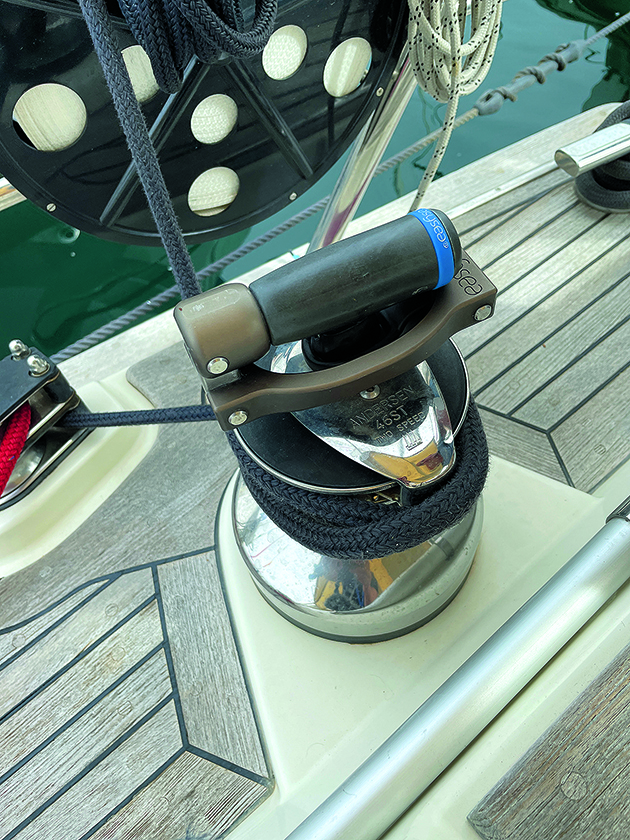
Flipper foldable winch handle can be left in place rather than lost overboard! Credit: Ali Wood
Winch handles are notorious for flying overboard and are costly to replace. One solution we spotted on an ARC+ yacht was the Flipper foldable winch handle from Easysea which allows you to leave the handle locked in-situ when not in use, reducing the risk of losing it overboard.
Boat improvements: Electric outboards
Are you still struggling with a heavy, dirty outboard engine that requires a significant amount of grunt to get it started?
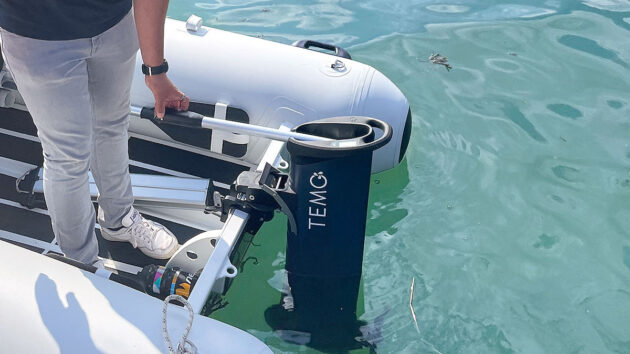
Light and easy to handle: the Temo electric outboard
Outboards have improved immensely in recent years, and the development of lithium batteries has made lightweight electric outboards a very tempting alternative to petrol. Torqeedo, Temo, Remego and ePropulsion are popular brands.
Boat improvements: Cockpit comfort
Cockpit comfort is a top priority for most skippers. After all, it is where you’ll be spending most of your time on the water. If you don’t have a cockpit table, West Marine’s small folding teak design attaches to the steering pedestal. If you like a spot of fishing, why not buy a Bait & Filleting Table with rod holder mount?
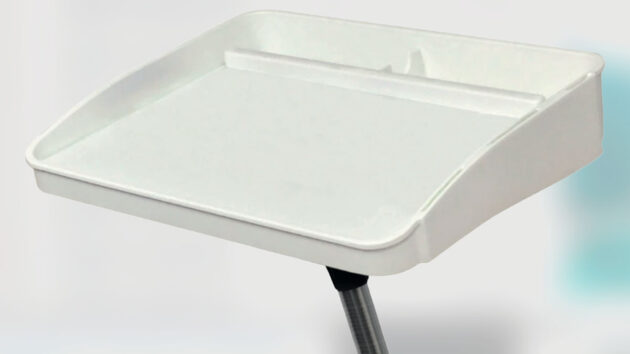
Force 4 Bait & Filleting table. Credit: Force 4
Cockpit cushions add to creature comforts and can be made to order or bought off the shelf. Compass24, for example, sells a seat cushion with a backrest, which clips onto the guardrail. Or treat yourself to a Plastimo Folding Helmsman Seat from Gael Force Marine with a wipe-clean vinyl cover.
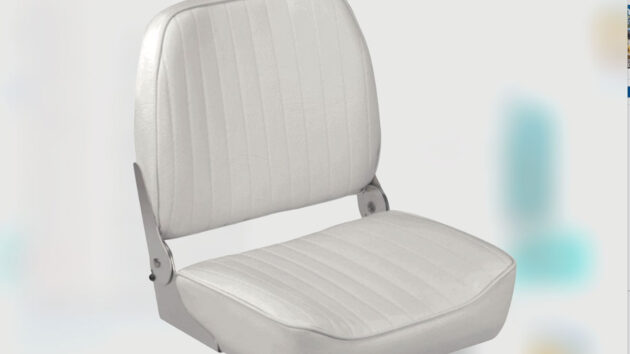
Plastimo folding seat. Credit: Plastimo
Jimmy Green Marine’s halyard bags are great for rope tails, winch handles and binoculars, and the Storage and Portage Bag is handy for bigger items to be kept in the locker.
Beanbags take up a fair bit of space, but they’re comfy and easy to move around the cockpit and cabin. Also popular with liveaboards and long-distance cruisers are hammocks. Ticket to the Moon hammocks are free of PFCs and other harmful chemicals, are ethically made and pack into a tiny pouch.
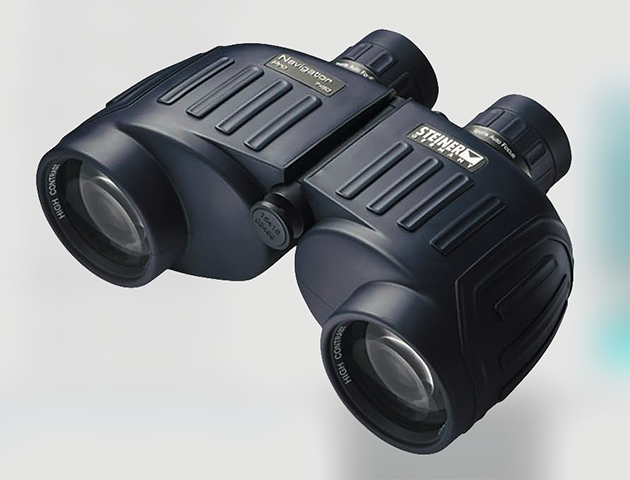
Steiner Navigator Pro binoculars. Credit: Steiner
A decent pair of binoculars takes the guesswork out of spotting navigation markers, and is also handy for identifying sea birds. Steiner Navigator Pro binoculars have great optics and a built-in compass with compass light.
Boat improvements: Keeping cool
A cool cabin is the key to a comfortable night. Bluewater sailer James Kenning recommends installing cabin fans. “The key is to chill the air while trying to get to sleep,” he says.
Force 4’s basic Clip-on Fan has a 5m lead and plugs into a cigarette lighter socket. More sophisticated designs offer timer switches and multiple speed controls to save on battery drain.
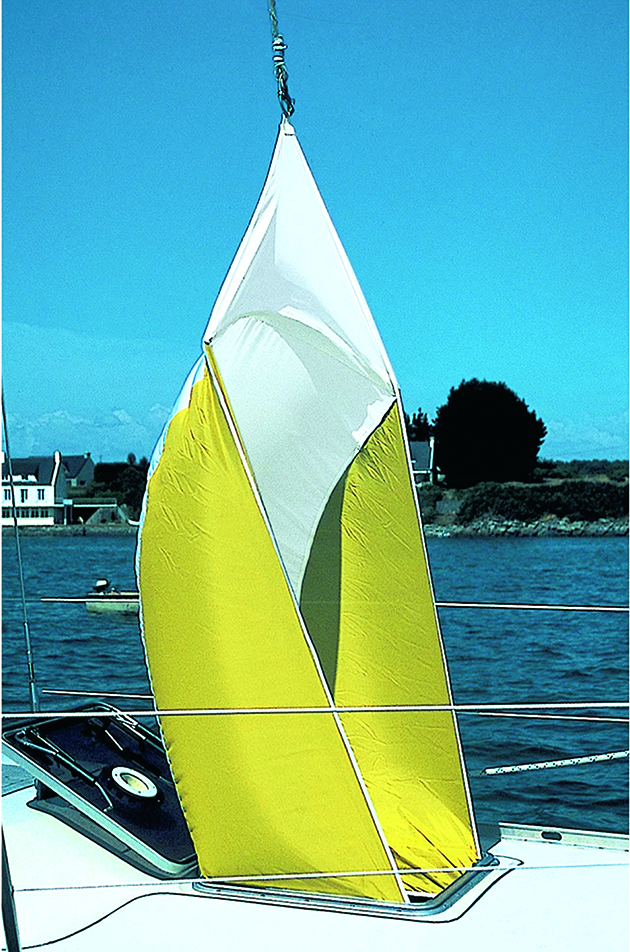
Plastimo wind scoop funnels moving air down through the boat. Credit: Plastimo
Another option is Plastimo’s Omni-Directional Wind Scoop, which is rigged over the hatch from a halyard, and directs air into the cabin (£95). It also does a smaller basic model.
Tools
Are you continually taking tools from the workshop to the boat? PBO’s Stu Davies has written an excellent article about what you need on board; from pliers, screwdrivers and spanners to a power drill, multimeter and hacksaw.
You could buy your own boat set or instead use your money for a new tool bag such as the Stanley Fatmax Tool Backpack from Machine Mart (£55). With 50 tool holders, this is handy for hands-free boarding and climbing ladders.
Leaky windows
How are your boat’s window seals? Leaky windows can be a pain to replace, but a quick temporary measure, popular with sailors and canal-boaters, is Captain Tolley’s Creeping Crack Cure.
Make sure the windows are dry when you apply it. It’s a penetrating sealant for bonding and sealing hairline cracks, which uses capillary action to travel into the tiniest of spaces.
Rig-tune
When your mast is re-stepped after a winter in the boatyard, don’t assume your rig is correctly tensioned. While the number one reason to have your rig tuned is safety, it will also significantly improve cruising and performance, advises rigger Chris Evans of XP Rigging.
If you want to know how much tension to apply for different wind strengths, why not ask your sailmaker or rigger to whip some twine and mark the backstay for you? An hour of their time will take away all the guesswork and will considerably improve the way the boat handles for the season ahead.
Get-you-home repairs
A small repair kit to get you home could prove extremely valuable for sails. The Wm Smith & Son Repair Kit has an adjustable sailmaker’s palm, tube of 10 needles, waxed sewing thread and a block of beeswax. Team this with a roll of Jimmy Green Marine’s PSP Heavy Duty Sail Repair Tape for quick patching.
But be sure to get the sail fixed properly when you make landfall, as patching can create reinforcement in some places, weakening others, and a sailmaker will be able to correct this.
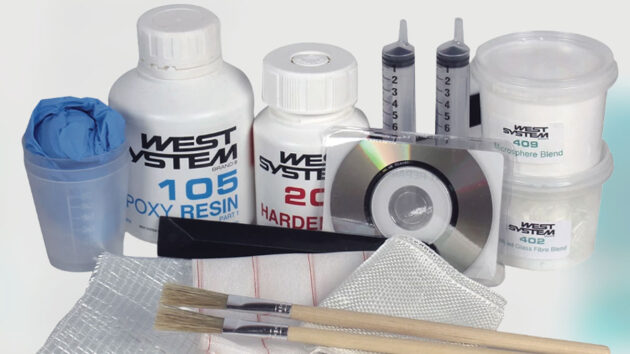
Components found in a West System Glass Fibre Repair Kit. Credit: West System
For hull repairs on the fly, the West System Glass Fibre Repair Kit is just the job, containing epoxy resin, hardener and mixing materials.
Maintenance and first aid
Viv Herzum is a commercial skipper and drawing on her experience of sailing other people’s boats, she has some top tips for packing essential maintenance tools and first aid kits. “I keep a pouch stocked with extra INOX carabiners and shackles, circle cotter rings, electrical tape, nail clippers, a pocket mirror for those hard-to-reach bolts, and scraps of fine synthetic line for quick repairs and hanging personal items. If you’ve got any tap connectors for filling your water up at the marina, you’ll want those too.
“Your boat should have its own first aid kit, but I prefer to have a personal stash with ibuprofen, aspirin, basic disinfectant, anti-seasickness tablets, and simple bandaging on hand. You might also want an after-bite containing ammonia for jellyfish stings.”
Clean bilges
Hopefully you’ve antifouled and are ready to launch, but have you thought about bilges, lockers and bulkheads? To protect these from moisture penetration, International sells Danboline a paint which resists oil and fuel spillage.
It’s important to start with a clean bilge so you can identify any leaks that follow, and of course, because it’s just nice! A dose of AquaMarine bilge cleaner will give it a lovely fresh smell.
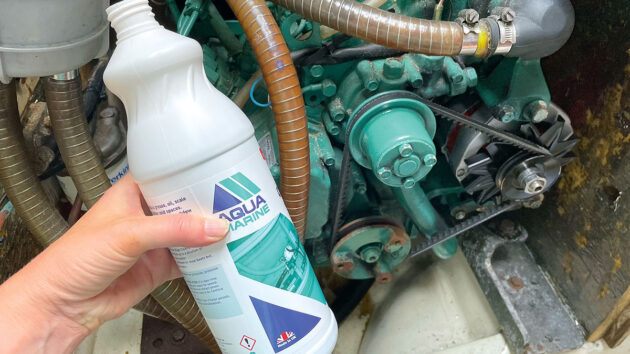
AquaMarine bilge cleaner will leave a fresh smell
When we had a fuel leak in our PBO Project Boat, we removed the fuel from the bilge using an old syphon, but dreaded the prospect of accidentally swallowing the stuff! These days you needn’t suck the end. Gael Force Marine, for example, sells the Liquifix Siphon Pump, which requires a vigorous shake to get it started.
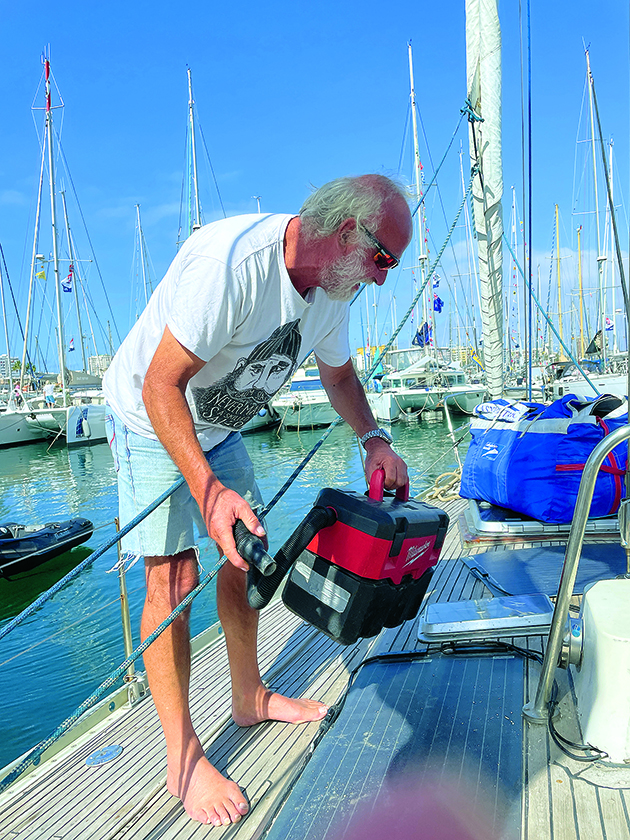
Bluewater sailors Simon Ridley swears by his Milwaukee wet and dry vacuum. Credit: Ali Wood
For a clean boat inside and out, bluewater sailor Simon Ridley swears by his cordless Milwaukee wet and dry vacuum. When we met him at the start of the ARC+ rally in Gran Canaria he told us he wouldn’t go cruising without it.
Anchoring
Do you lose track of how much anchor chain you have deployed? The Anchoright anchor chain link markers will stay put whether passing through a windlass, dragging on the seabed floor or piling up in the anchor locker.
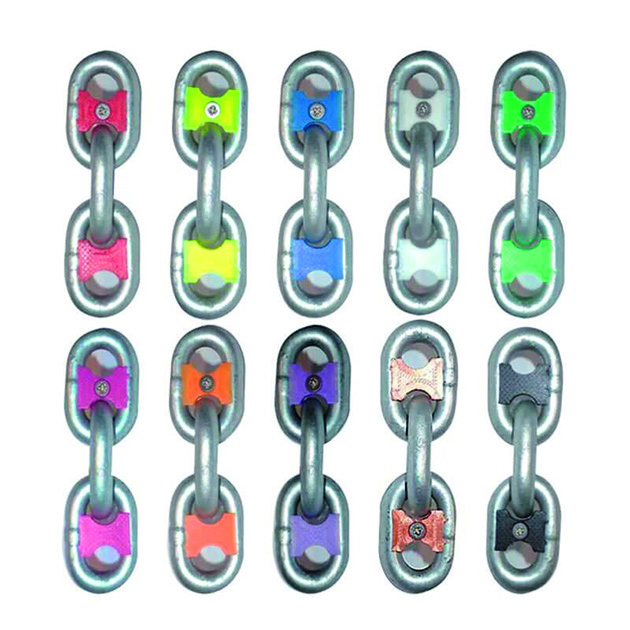
Anchoright anchor link chain markers are available in a variety of sizes. Credit: Anchoright
Much has changed in anchor design in the past two decades, so if you’ve an older boat there may be better options available now. PBO’s Rupert Holmes advises that the best anchors tend to have a shovel-like profile and high tip weight (around 35-45% of the anchor itself). Beware of cheap unbranded copies which may be badly cast or unable to give adequate holding power.
In a test by PBO’s sister magazine Yachting Monthly, the four top anchors were the Rocna galvanised anchor (for digging in quickly), Lewmar stainless steel Epsilon anchor (for ease of handling), Fortress FX-11 (great for catamarans) and Jimmy Green Marine’s Spade anchor (for racing boat stowage).
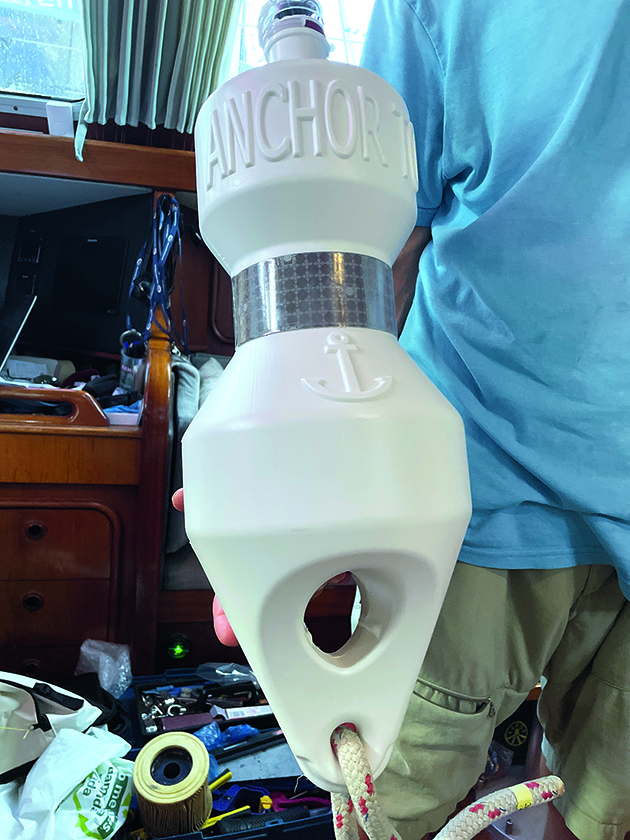
Ocean Anchor mooring buoy
An Ocean Anchor Mooring Buoy is a handy item for marking the exact position of the anchor in the water, and it adjusts the line length automatically between 4m and 10m. An LED flashlight and reflective tape help you locate the buoy at night. It also helps you retrieve a fouled anchor by lifting it from the crown.
Getting around
E-Scooters are legal in most of Europe, even if not on UK roads. If you’re sailing abroad, they’re a great way to get to and from the shops. “My e-scooter has been a revelation,” says bluewater cruiser James Kenning. “It cost me €150 in Valencia and has changed my life in terms of getting to and from the chandlery and the toilet blocks.”
In the UK, a Decathlon adult kick scooter is an excellent alternative, whether for getting around the marina or excursions to see more of the port. If you prefer cycling, Decathlon’s folding bikes are more expensive, or if your budget will stretch further, you could consider an electric folding bike.
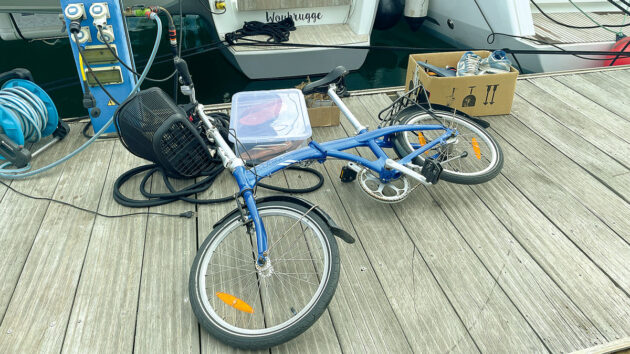
A folding bicycle can be a real boon for getting around marinas or further afield
Note, one of the key things to look for is battery capacity. A bike with an 8Ah battery will have a range of about 30 miles, whereas you could expect around 40 miles from a 10Ah one. This will, of course, vary depending on rider weight and terrain. Most e-bikes will have a control unit with a battery status indicator to help you avoid getting caught out without power.
Cooking innovations
If your gas installation and LPG cooker are reaching the end of their serviceable life, you could consider going gas-free. UK galley specialist GN Espace, for example, sells built-in boat induction hobs with a range of useful features such as a 2.5kW boost function, auto-simmer, dual-zone bridge for fish-kettle cooking, as well as melt and simmer settings. It’s not a low-cost item, but compared to a gas-safe locker, installation and new LPG oven, you could be saving money.
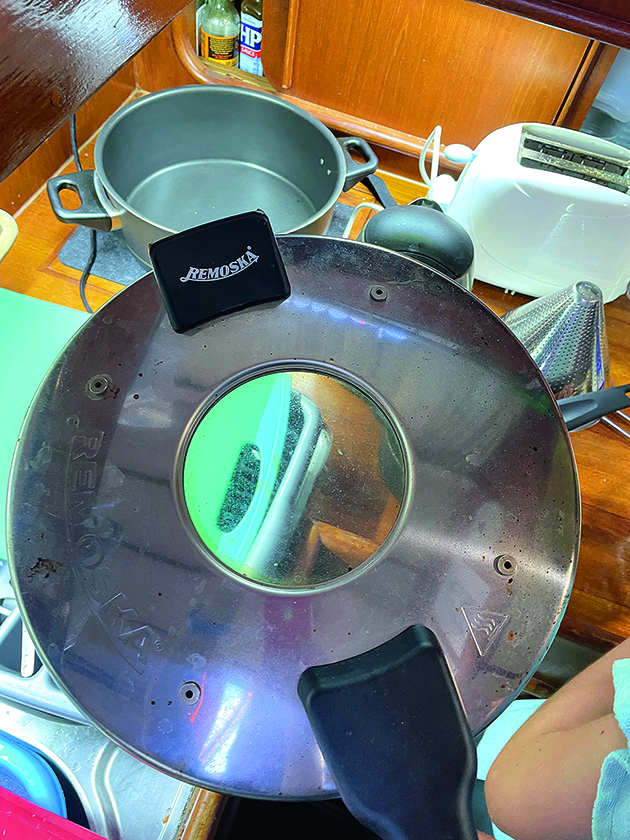
Remoska electric tabletop cooker
Low-energy boat cookers are another great way to save on gas, power and time spent below. For example, the Remoska corded electric 2lt cooker has an element in the lid and can handle anything from bread to roast chicken. The Mr D’s thermal cooker is a popular choice amongst cruisers. Boil it for 15 minutes on the hob and it will finish cooking all by itself, and the GoSun solar oven uses the sun to cook everything from gingerbread to casserole.
For keeping provisions fresh, the FoodSaver vacuum sealer heat-seals food in plastic bags. You can also get a small cordless machine with a charging dock to suck the air out of bags and containers.
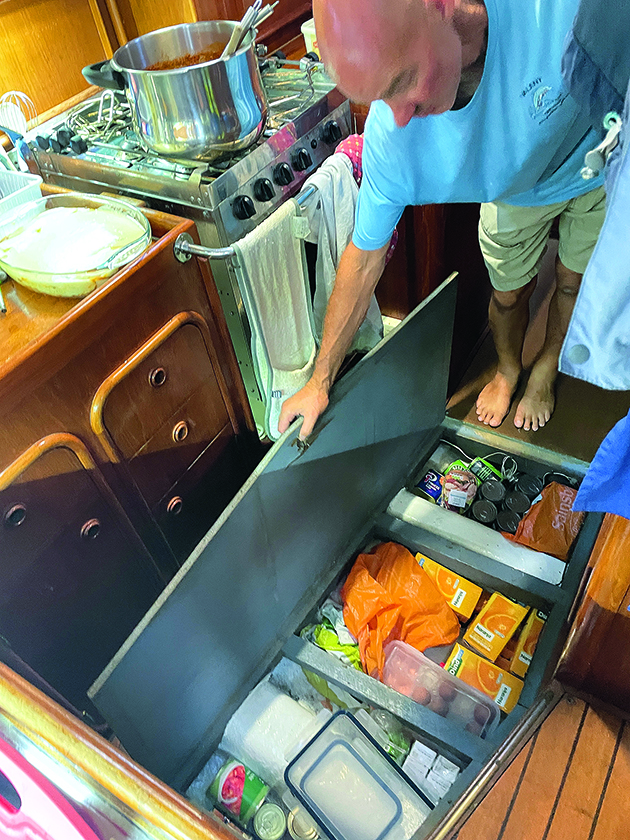
Under the floor can be a cool place to stow some foodstuffs
Nothing beats a boat barbecue, especially with your own freshly caught fish. The award-winning Cobb can roast, bake, fry, boil and smoke food too. It has an insulated surround guard which means it is cool to the touch and won’t damage sensitive surfaces. Just a few charcoal briquettes will give a cooking time of up to three hours.
Creature comforts
It’s so hard to keep kids off screens these days, but long passages can be tough for little people, especially when the grown-ups are busy looking after the boat. A device we’ve heard cruising families rave about is the Yoto Mini. No microphone, no camera, no ads; this screen-free audio player allows kids aged 3 to 12 to listen to stories, music and educational content by inserting cards and controlling two large knobs.
For a reading lamp or deck light that keeps the ambience, the BioLite lantern can be switched between amber and a bright white light. Shake the lantern and it will switch over to a flickering candle effect. It’s waterproof, comes with a hanging hook, has a long battery life and is USB charged. It even has two USB slots so it can act as a small powerbank.
Other ‘must-have’ creature comforts cited by transatlantic sailors include flannels for keeping cool, solar showers, Kindles and noise-cancelling headphones.
Safety kit
Good safety kit will definitely improve your boating experience if you or your pet falls overboard! Lifejackets need servicing, and you might consider fitting a personal locator beacon (PLB) and/or automatic identification system (AIS) beacon. Sea dye, LED strobe lights, horseshoe buoys and danbuoys help mark your position in the water, while throwlines, emergency ladders and recovery systems will help you get back on board. You can buy tags for people and pets which trigger an MOB alarm on the boat and people’s phones when the wearer becomes separated.
An EPIRB (emergency position-indicating radio beacon) can be mounted on a bulkhead. Activated by water (for example, if the vessel sinks), or manually by the ‘on’ switch, this sends a continuous maritime distress signal to a search and rescue centre for 48 hours or longer. For offshore passages, where you’re likely to be out of radio contact with other vessels, many sailors carry a satellite phone or tracking/texting device, which requires a monthly subscription.
Electronic visual distress flares (EVDs) are not an internationally recognised means of distress signalling, but are sometimes carried by sailors as an alternative to handheld pyrotechnics, which must be disposed of at certified disposal service providers. Starting at less than £100 these multi-use, rechargeable LED flares are easy to carry and could save your life. Note, however, that EVDs are not listed as a distress alerting device in the International Regulations for Preventing Collisions at Sea (COLREGs). Having a safety knife close to hand is essential for tangles, and the Gerber EZ-Out (£51) is one of our favourites; it scythed through Dyneema halyard, webbing or polypropylene line in seconds.
PBO regularly updates its pre-season checklist and, though it can feel daunting ticking off so many boxes, once done it becomes easier year after year. Free MCA/RNLI/RYA checklists are also available.
Readers’ top boat improvements
In PBO September 2025 we wrote about cockpit improvements. Tips included keeping rope bags near winches to tidy loose lines, anti-slip patches, additional harness attachments and jackstays, installing mug holders and partitioning lockers.
On Facebook, we asked what improvements you’d made to your boats, and were delighted to hear these ideas:
Tim Millea: My new Oceanis 30.1 will have roller-reefing, self-tacking headsail and in-mast furling main with a single cockpit winch. I elected for the tiller version to reduce complexity and improve steering feedback. I’ll have a compass, binoculars and paper charts.
Gordon Craig: Unfurl and loosely throw all control lines that lead back to the cockpit down the companionway when sailing. It keeps the cockpit clear and they always come back up untangled.
Ian Cameron: I’ve added many of the upgrades mentioned in the article to my 1980 Cal 39 cockpit.
Others included…
- Circular hatches to access unused space behind seat backs
- Cockpit shower
- Cheap but sturdy hardwood slats from Ikea for cockpit floor
- Stern-tying line stowed on garden hose reel
- Silicone rubber straps to secure lines
- Captain’s chair behind the wheel
- Glassfibre box off the stern holding two propane tanks
- Two extra winches for redundancy and line management
Russ Camp: I relocated the mid cockpit traveller to the front of the transom. Not quite as effective but a hell of a lot easier to solo sail.
Thanks to all our PBO readers and Facebook community. We love hearing from you!
Expert advice
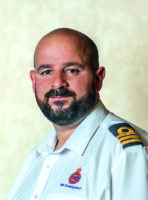
Tom Barnett, Network Commander for HM Coastguard
Advice from Tom Barnett, Network Commander for HM Coastguard
There are plenty of small, affordable items that can make life on the water easier and safer, and they don’t have to cost the earth. A simple waterproof pouch for your mobile, for example, is inexpensive, hard‑wearing and offers valuable protection against salt water. Look after it, and it’ll look after your phone.
A basic toolkit is another worthwhile addition. Paired with an entry-level RYA engine course, it becomes one of the most cost-effective investments you can make. Being able to change an impeller or bleed your engine isn’t just a confidence booster; it’s a skill that may well get you out of a sticky situation one day.
Before heading out, I always recommend checking the local tide times, weather, and sea state, and sharing your passage plan with a dependable shore contact, including when you expect to be ashore. I’ve seen the same scenario unfold too often: loved ones, unable to make contact, fearing someone is still at sea, only for us to later learn they’re safe and well, phone flat, enjoying refreshments at the sailing club.
Experience can be invaluable, so when going somewhere new I make a point of having a chat with a local to understand unique nuances. Harbourmasters, marina staff and local sailing or yacht club members are a great place to start.
It’s rare to find me afloat on my keelboat, dinghy, or kayak, without my Personal Locator Beacon (PLB), my DSC‑capable handheld VHF radio, and a whistle clipped to my buoyancy aid or lifejacket. Whistles are, in my view, underrated. I can think of numerous incidents where, had the casualty had a whistle to hand (or remembered the one already on their lifejacket), passers-by could have raised the alarm far sooner.
Don’t wait until it’s too late. Make your investments where they matter most: the safety of you and your crew. Even items that seem expensive at first, like a PLB, often work out to be the same price as a shop-bought coffee per month over their lifespan. In my book, that’s a small price to pay for peace of mind on the water.
What boat kit has impressed you the most?
Follow Practical Boat Owner on Facebook, Instagram, TikTok and X