



Inspiration for Clive Marsh's sailing club when Ian Hayward visits as part of his solo and unsupported circumnavigation of mainland Britain by sea kayak.
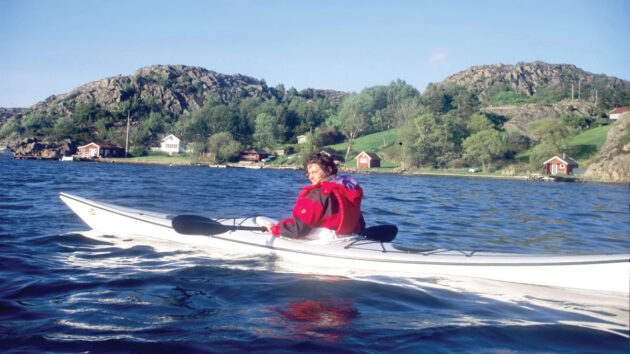
The idea of just being able to pull a boat up on any beach like a Viking without the need for a harbour, marina or slipway appeals to me.
It’s the sort of freedom that can only be offered by a boat that can take the ground.
A boat that can’t take the ground is surely no better than an aircraft without landing gear. Even Captain Cook’s globe- trotting HMS Endeavour could do so.
The smallest vessels that can be hauled up a beach are canoes and in this regard I was most impressed by the people of all ages up the Orinoco and its delta who went about their business in ancient dugout canoes with such ease it seemed as though they were attached to them.
I gave it a go, but I wasn’t a natural.
It wasn’t until sometime later when working for NatWest Bank in New Zealand (don’t ask) that I was given the opportunity to learn kayaking.
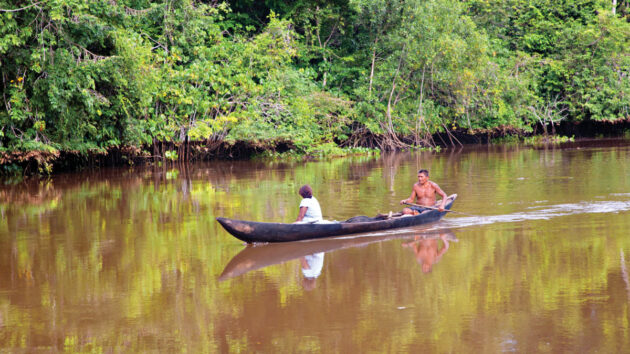
Dugout canoes are one of the earliest types of waterborne transport. Credit: Jane Sweeney/Jon Arnold Images/Alamy
Our human resources manager arranged for us all to spend a week on an army camp, to do some bonding and try to get fit.
We did enough bonding to last a lifetime.
As for fitness, well I naturally took to the water activities which included white water rafting, without the raft, and kayaking.
The problem for me was that the poly carbon sit-on sea kayaks had yet to be invented so they put me in one of those glassfibre canoes that you get zipped into.
My army tutors explained the theory of a kayak roll; it involved a flick of the hips.
When I tried it in practice, I found myself hanging upside down under water and fast running out of air.
I was rescued on a few occasions until I learned how to release myself.
Always gasping for breath, I tried a few more times before deciding that I performed better on the surface and took up other, easier sports.
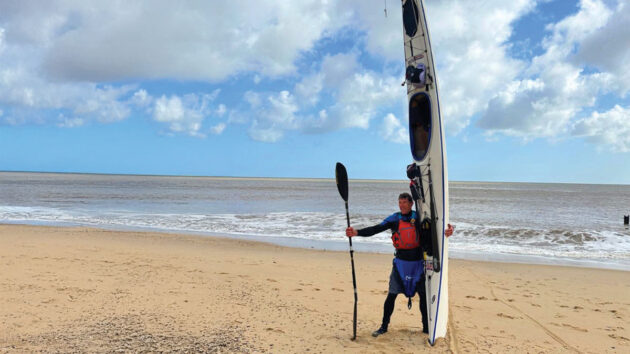
Such a shallow and light craft, can pull up on most beaches. Credit: timbrookphotography.pixieset.com
Gaining proficiency in a sea kayak
Not long after this experience, sit-on-top-type kayaks appeared on the market and I was quick to buy one.
Pembrokeshire, Dorset, Sussex and Kent beaches were all tried and I managed to capsize at all of them, either when launching in the surf or with a wave side on.
But at least I was not left hanging upside down and I could launch just about anywhere. I could also slide back onto the kayak with relative ease.
Given this background, I’m always impressed by those who manage sit-on kayaks in rough sea conditions, especially those who take sit- in and zip-up kayaks on long passages.
The other day, one of these ‘sit-in’ experts arrived at Rye Harbour Sailing Club.
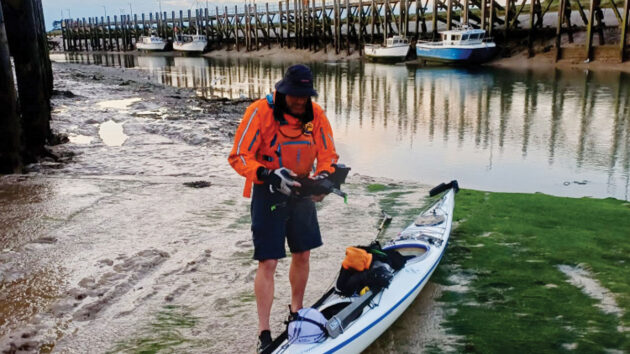
Ian Hayward arrives at muddy Rye. Credit: Ali Short
It was Ian Hayward, a retired teacher from Norfolk, who is kayaking all around our coast.
Not only can he do kayak rolls whenever, but he can perform other impressive safety moves with his long sea kayak.
We let him camp in the clubhouse overnight and shower the salt off.
Ian, a lifelong kayaker, is navigating Goosejuice for 4,000km (2,100 miles) all around our island coast, clockwise.
It will take a while, depending on the weather, but he is determined to do so while raising money for the charities Surfers Against Sewage and Movember.
Circumnavigating our stunning coast by sea kayak will give Ian an intimate perspective on our maritime heritage, beaches, headlands and harbours.
Useful pilotage notes too if Ian finds the time to write it up –and what an interesting book it would be.
Washing the salt off
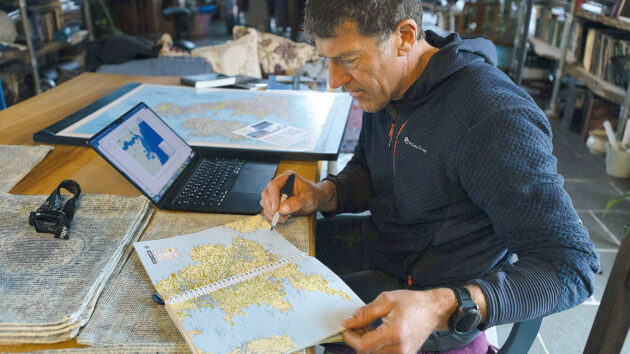
Part of Ian’s challenge is passage planning and waiting for weather windows. Credit: timbrookphotography.pixieset.com
With such a shallow and light craft Ian can pull up on most beaches and camp, or call at a club to see if they can accommodate him and enable a fresh shower.
Much as I like a dip in the sea, one does increasingly need to ‘look before you leap’ to avoid the nasties and, in any case, seawater can leave you feeling a bit sticky.
Ian’s pre-voyage training included psychological, physical, medical and detailed planning.
On top of that, of course, was selecting the right navigational and safety equipment, clothing and provisions.
So many things to consider and like so many voyagers it is often just a case of getting on with it, then coping with unexpected events calmly.
Ian had departed from the Royal Norfolk & Suffolk Yacht Club in Lowestoft on 26 April and arrived up our muddy creek with his paddles late in the evening on 5 May. That’s a very good time.
The tide had gone out leaving much of the river dry and giving Ian a first-hand experience that our Rye mud is at least as good as the mud of the East Coast.
To get to us on the South Coast, Ian had had to cross the Thames Estuary, which was a daunting task at his low speed. But his advantage was the shallow draught.
The wide estuary with its shallow swatchways, drying sands and traffic is a worrying place for sailors with a deep keel.
Even though it is well marked, careful planning is needed. It can be busy and I remember that in poor visibility, before the days of modern navigational devices, there were shipping accidents every month.
Not my idea of fun, but Ian seems to have taken this in his stride and will no doubt have more challenges as he paddles around the UK in stages.
There are many types of kayaks, and I suspect most people wanting to travel far along the coast would choose a sea kayak.
These are usually 16ft to 18ft long and may be narrow at only 22in – so not that stable – but fast.
These boats will have a skeg to help keep a straight line or maybe even a rudder.
They’ll have dry compartments for stowing provisions and equipment.
As a sit-in and zip-up type boat you’d need to be comfortable with a kayak roll and be trained how to do this as easily as I have seen Ian do it.
Maybe I should have tried a bit harder?
As my granddaughter tells me: “It’s never too late to learn, Granddad.” I might have another go!
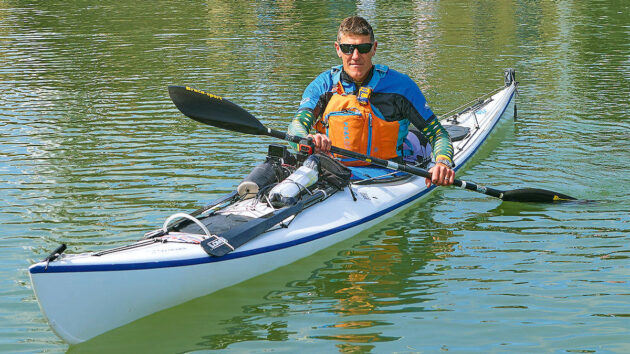
Ian Hayward departed from his home port of Lowestoft in April 2026. Credit: timbrookphotography.pixieset.com
Ian told PBO: “I’ve received brilliant support from sailing clubs on my trip, so far: Royal Norfolk and Suffolk Yacht Club, Slaughden SC (Aldeburgh), Rye Harbour SC, Thorpe Bay SC, Hamble SC and Pentland Firth SC.
“I’m also thankful for the support of Brighton Kayak Club, Ibex Canoe Club (Brixham) and St Ives Board-Riders Club.
“Interestingly, Rye Harbour SC also supported the very first kayak circumnavigation of Britain and Ireland in 1986 by Bill Taylor, Mick Wibrew and Richard Elliott.
“It’s nice that they are maintaining their helpfulness!”

Moderate Becoming Good Later: kayaking around the Shipping Forecast
Katie Carr talks to Laura Hodgetts about how she took up her brother's challenge to kayak in every sea area…

How to make a kayak: This £300 custom design has lasted our family 30 years
Building your own boat is an absorbing pastime leading, hopefully, to an enjoyable result. Kayaks are about the simplest boats…

Best inflatable kayaks for families and beginners
Inflatable kayaks are the ultimate way to have fun with family and friends. No boating experience needed, no faffing around…
Want to read more articles like Cruising around Britain in a sea kayak?
A subscription to Practical Boat Owner magazine costs around 40% less than the cover price.
Print and digital editions are available through Magazines Direct – where you can also find the latest deals.
PBO is packed with information to help you get the most from boat ownership – whether sail or power.
-
-
-
- Take your DIY skills to the next level with trusted advice on boat maintenance and repairs
- Impartial, in-depth gear reviews
- Practical cruising tips for making the most of your time afloat
-
-
Follow us on Facebook, Instagram, TikTok and X