




Sir Robin Knox-Johnston shares some hard-won tips on caring for his world famous record-breaking 63-year-old ketch Suhaili
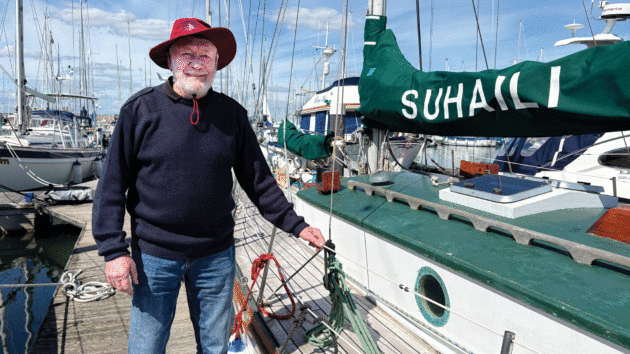
There’s a very special boat in Gosport Marina, and her owner – Sir Robin Knox-Johnston – has offered to introduce us.
It’s the day after the Conquer the Island challenge, a 50-mile sprint around the Isle of Wight, where Sir Robin raced against Mike Golding OBE on yachts crewed by novice sailors.
PBO was invited to sail aboard Golding’s yacht, and now I had the honour of sailing back from Cowes with Sir Robin himself.
This was on a charter yacht, a Jeanneau Sun Odyssey 410, but it’s Suhaili I want to hear all about.
On the voyage across the Solent we talked about Sir Robin’s famouse 32ft ketch, and how the teak boat built by Indian carpenters took him around the globe.
As we approached his home city of Portsmouth, he said casually, “Suhaili’s in the marina if you want to see her?”
Do I want to see the most famous boat in living history? The one that won the 1968/69 Sunday Times Golden Globe Race?
Yes please!
We say goodbye to the crew of the Little Ship Club – the event’s organisers – and Sir Robin bounds off at such a pace, huge bag slung over his shoulder, I have to skip to keep up with him.
We pause to look at his brightly painted Clipper yachts – the training vessels for the round-the-world race he co-founded in 1996. They couldn’t contrast more with the wooden boat I’m about to see.
Meeting Suhaili
Suhaili is a few pontoons down.
I don’t know what I’m expecting – a blue plaque perhaps, gold-plated cleats?
In fact, I nearly miss her, moored quietly alongside a large Fairline motorboat.
“Hello Robin!” call the couple on the Hallberg-Rassy opposite.
Their spaniel gives us a tail wag, and the three of them launch into an enthusiastic conversation about Coppercoat.
No book signings or selfies here. In his home marina, Sir Robin is a regular boat owner.
In fact, one who is impressed with his antifouling.
“When I took Suhaili out recently she was a bit weedy,” he says. “We only went as far as Ryde and we had a lovely reach coming back and she really got going. Got in and she was clean!”
Keeping Suhaili young
Sir Robin’s diligence is paying off. Suhaili is resplendent.
He explains that soap powder works a treat on Suhaili’s decks. “Sprinkle it on the decks, leave a day or two, and then wash it off with a hard brush.”
A Bermudan ketch, her white hull is so pristine it reflects the ripples of the water.
Three sail covers in British racing green match the coachroof and the trim around the portholes.
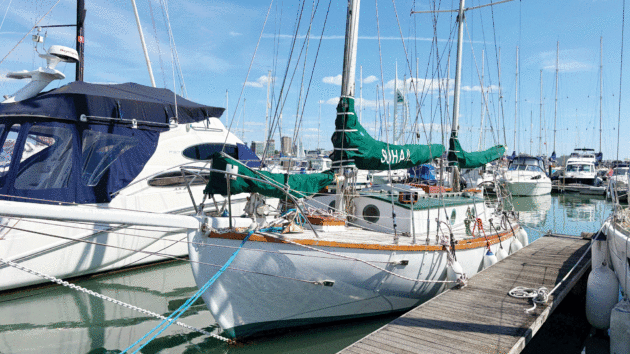
Suhaili’s rig is the one she was fitted with after being dismasted in 1990, when Knox-Johnston was rolled mid-Atlantic, and sailed to the Azores under jury rig. Photo by Ali Wood
Her cockpit is small, with a coaming to protect against waves. A steel-framed pushpit extends beyond the rudder to provide a sheeting point for the mizzen boom.
It was from here that the original windvane self-steering system was hung, which Sir Robin nicknamed ‘The Admiral’.
Down below, the layout is simple: bunks, a chart table, galley and a heads.
The doors, planking and cupboards are a rich honey, contrasting with smart white bulkheads, a brass oil lamp and heater.
It feels homely and warm, the kind of boat where you could hunker down and lose yourself in stories of seafaring and derring-do while she sails herself across a lonely ocean.
A star is born
Sir Robin was working for the British India Steam Navigation Company in 1963 when he built Suhaili.
“A chap called William Atkins designed her in 1923,” says Sir Robin. “There are still a few of them around.”
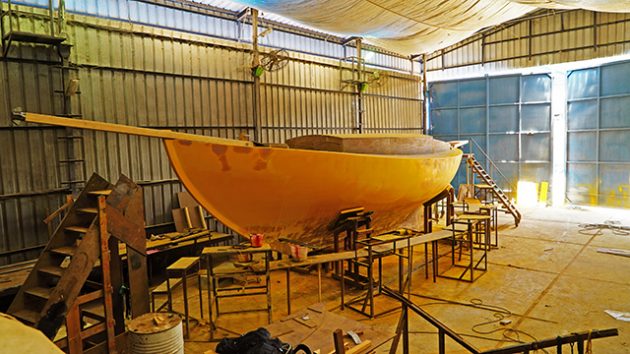
Indian skipper Abhilash Tomy raced on a replica of Sir Robin Knox-Johnston’s Suhaili in the Golden Globe Race. Credit: Abhilash Tomy/PPL Photo Agency
Living in Bombay (now Mumbai), he took advantage of the local skilled labour, and used iron-fastened teak throughout: in the keelson, planking, frames, deck and cabin top.
In Sir Robin’s book A World of My Own, he recalls his fascination at the Indian craftsmen’s work; how casually they handled traditional tools such as an adze, bow drill and hand saw.
Suhaili’s keelson is hewn from a 25ft log, and the iron keel weighs two and a quarter tons.
Cast in two sections, it’s held by fourteen 2in keelbolts. The stringers are 6in x 6in and the planking 1¼in thick.
When launched on 19 December 1964, Suhaili floated two inches below her projected waterline.
Sir Robin, together with his brother and a colleague, sailed Suhaili home to Kent, completing the final leg from Cape Town non-stop in 74 days, averaging 112 miles a day.
The Golden Globe Race
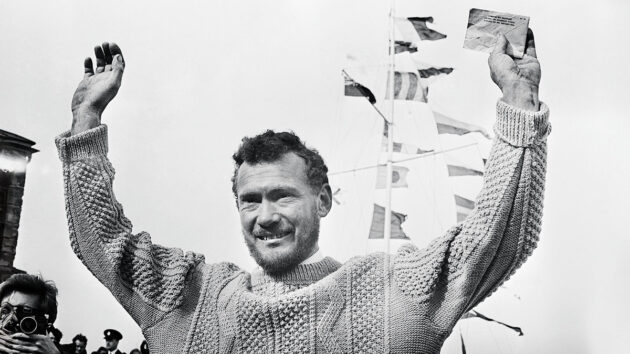
Robin Knox-Jhonston arrives back at Falmouth on 23 April 1969 after his single-handed non-stop circumnavigation of the globe in his yacht, Suhaili. Credit: Express/Hutton Archive/Getty
It was this intimate knowledge of the boat, combined with his experience as a merchant seaman, that was to give him the edge in the Golden Globe.
In preparation for the very first solo round-the-world race, he replaced the standing rigging and swapped the pine mizzen for an alloy one.
Suhaili was treated to new sails and the elaborate wind vane self-steering system, which was later swept away.
In June 1968, the then 29-year-old departed Falmouth in his heavily laden boat, returning 312 days later.
Of the nine contestants to enter the Sunday Times Golden Globe (including the ill-fated Donald Crowhurst), Knox-Johnston was the only one to finish.
Not a museum piece
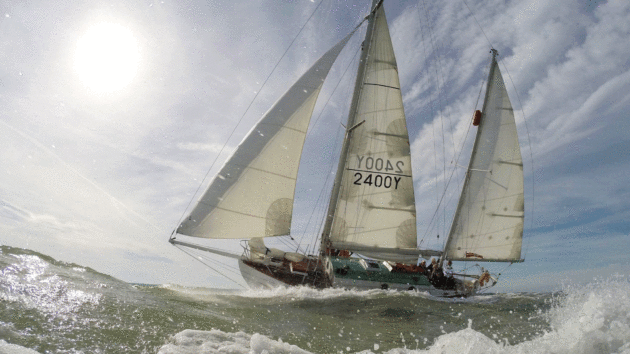
Suhaili sailing at Hamble Classics in 2013. Photo by Nic Compton/Alamy
Suhaili, named after the south-east wind of the Persian Gulf, proved herself to be incredibly seaworthy during the race, staying perfectly balanced upwind for long spells without attention.
“She doesn’t like going to windward, but neither do I,” says Sir Robin. “She’s a great little sea boat. Not complicated. Needs a bit of a breeze to go but doesn’t like too much of it, which suits me.”
In 1997 Suhaili went to the National Maritime Museum at Greenwich as an exhibit, but the controlled atmosphere shrunk her planking.
Unwilling to see her deteriorate in this way, Sir Robin removed Suhaili in 2002 and refitted her.
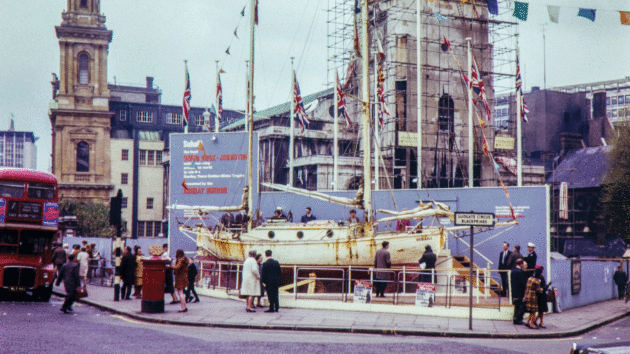
Suhaili on show at Ludgate Circus, London, in 1969. Later, Sir Robin would pull Suhaili out of exhibits to prevent deterioration. Photo by Simon Webster/Alamy
He’s maintained his historic yacht ever since and frequently sails her across the Channel.
“I keep her in commission. I mean, I could sail her in 20 minutes if I wanted to,” he says. “I like to anchor somewhere such as Osborne Bay on the Isle of Wight and return the next day. Sailing is the only way to keep a wooden boat in condition.”
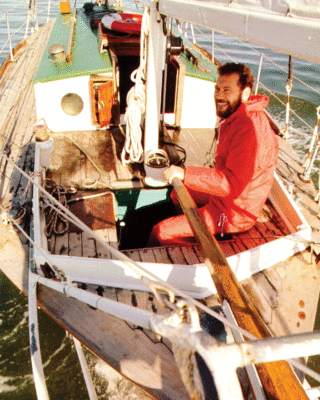
Robin Knox-Johnston on Suhaili in the Solent in 1976. Photo by Ajax News/Alamy
Re-fastening the hull
During Suhaili’s refit in 2017, the hull required a significant amount of work.
“I took out 1,400 bolts and put in bronze because the old Indian ones were rusty. We eventually found a way of getting rusty iron bolts out, but at first it took us a weekend to remove eight!
Once we developed the system, using two hammer drills, one each side, we got so many out, I said, ‘Stop! We better put some back before the old girl falls apart.’
The grandchildren helped too. Once we did that, we sanded her down, had to re-dowel the holes and then built up a decent finish.”
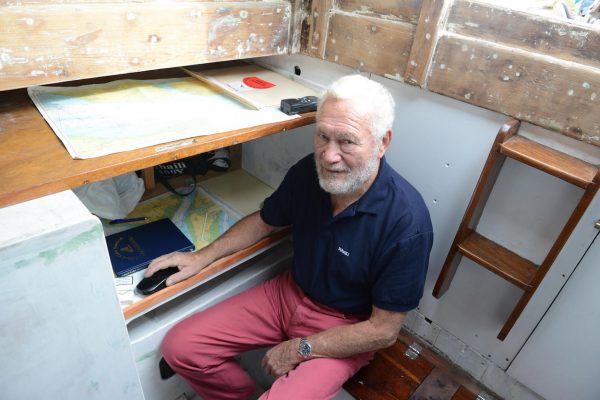
Sir Robin Knox-Johnston on Suhaili. Photo from Alamy
He makes it sound easy, but in reality, even with the help of friends, family and a retired shipwright, Suhaili’s restoration took three years.
“We thought it would never end. The timber was all good, hull and deck, apart from a thick coating of green slime.
The real problem was the Indian iron. Some of the fastenings were corroded to just 1mm thick.”
Sir Robin stripped the interior, sanded the deckhead and hull to bare wood again and painted it.
He also replaced the keelbolts, using vinegar as penetrating oil to remove the original ones.
In fact, he did such a good job of Suhaili’s restoration that when he sailed her to France they refused to believe she was the original.
“‘This is a copy. A fibreglass copy,’ they said. I said, ‘look inside!’ ‘Mon dieu, yes, this is the original!’ That’s because I really work hard to get a nice finish. That’s having pride in your boat!”
When to varnish
Sir Robin recently varnished Suhaili’s hatch, but hasn’t decided whether or not to varnish the rest of the brightwork.
“You have to wait for the right weather,” he says. “I’ll look at the forecast, and if I’ve got three days that’s great.
I’ll sand on the first day, clean it off ready on the second day and varnish on the third. After that I just need a day to put extra coats of varnish on. You need about six coats to make it ready.”
He was planning to sail Suhaili down to Les Sables d’Olonne for the start of the Golden Globe Race in September, but just missed the race start due to unfavourable weather conditions.
The GGR, a revival of the original race Knox-Johnston won in 1969, forbids modern technology.
Starting from Les Sables-d’Olonne, competitors race 32-36ft vintage production boats, relying on sextants and paper charts rather than GPS or satellite aids.
Sir Robin’s daughter, Sara, quite often joins him on cruises. ‘She’s good on board,’ he says.
However, he was planning to sail to Les Sables-d’Olonne with two of his oldest friends: Chris Blake, with whom he sailed on the liner Kenya in 1967 and Michael Vlasto, former operations director at the RNLI. Three master mariners!
“We’re just very relaxed with each other; these are people I can leave on watch and know I can sleep.”
A ‘Scruffy little boat’
It’s such a treat to see this beautiful boat.
I can’t understand how anyone would dismiss Suhaili’s pedigree, but Sir Robin tells me the Sunday Times was scathing at the start of the Golden Globe.
“When I’d set sail, the front page news was: ‘Robin Knox-Johnston and his scruffy little boat set sail from Falmouth yesterday’.
“I didn’t find out until I got home. It upset me then but if I’d known they’d said that when I left it wouldn’t have worried me. I don’t worry about these people. I know what I’m doing.”
Suhaili is a celebrity, arguably one of the most famous boats still sailing.
Yet Sir Robin’s connection to her is very personal. He won’t let anyone else borrow her, and seldom lets anyone else take the helm!
A very special boat, I comment.
“Special to me,” he says.
A piece of history.
“Well, a part of my life. A very big part of my life.”
Suhaili Specifications
LOA: 13.41m 44ft
Hull length: 9.88m 32ft 5in
LWL: 8.53m 28ft
Beam: 3.37m 11ft 1in
Draught: 1.67m 5ft 6in
Displacement: 9,876kg 9.72 tons
Sail area: 61.8m2 666ft2
Ali Wood is PBO’s features editor and has been passionate about sailing and watersports since she raced Mirror dinghies as a child in Wales. She has sailed everything from a glassfibre trimaran to a 100-year-old wooden gaffer.

Golden Globe Race 50-year anniversary parade of sail in pictures
Dateline Falmouth UK: 14th June 2018 A 200-strong armada and spectators on every headland witnessed a celebratory parade of sail…
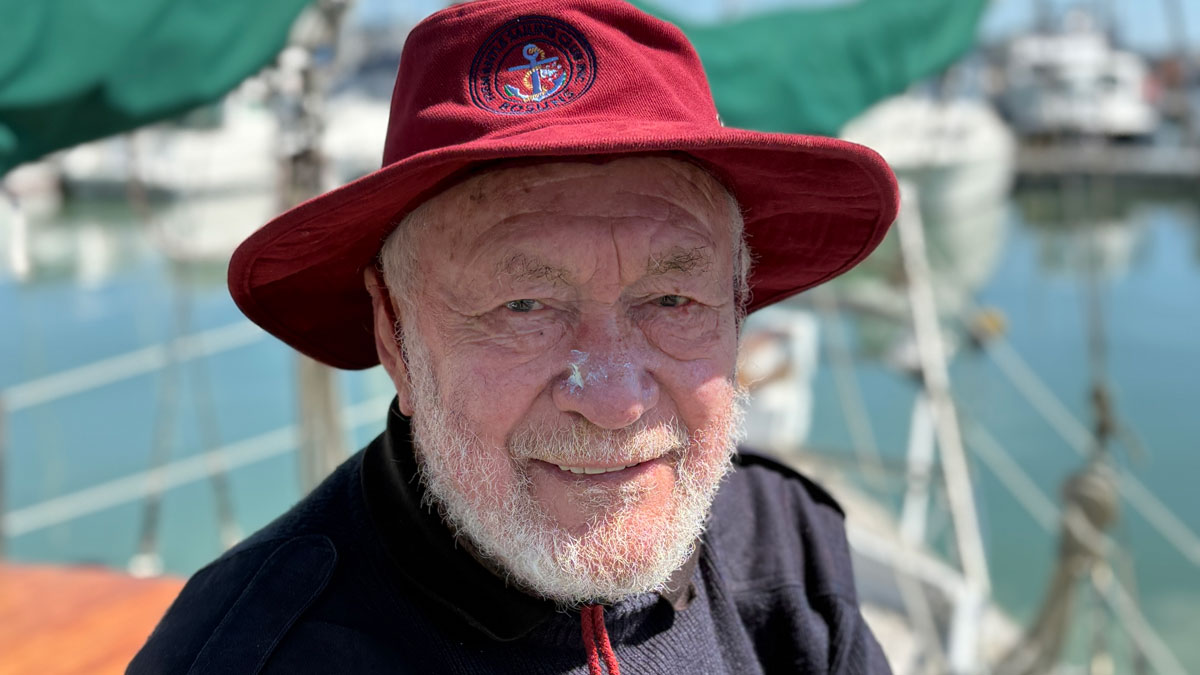
Sir Robin Knox-Johnston: sailing with a legend
Sir Robin Knox-Johnston talks to Ali Wood about self-steering, plum duff and why he was told to ‘slow down’ for…

Famous boat restorations – when is it time to give up?
A boat restoration is an emotive topic. Those who sail regularly develop a strong affection for their vessel. They might…
Want to read more articles like this?
A subscription to Practical Boat Owner magazine costs around 40% less than the cover price.
Print and digital editions are available through Magazines Direct – where you can also find the latest deals.
PBO is packed with information to help you get the most from boat ownership – whether sail or power.
-
-
-
- Take your DIY skills to the next level with trusted advice on boat maintenance and repairs
- Impartial, in-depth gear reviews
- Practical cruising tips for making the most of your time afloat
-
-
Follow us on Facebook, Instagram, TikTok and Twitter
PBO web categories