


Phil Clandillon looks at the most suitable sub-45ft second-hand yachts for sailing the Mediterranean. Models: Beneteau Oceanis 311 | Bavaria 32 Cruiser | Elan Impression 344 | Jeanneau Sun Odyssey 36i | Elan 40 | Dufour 45 Classic
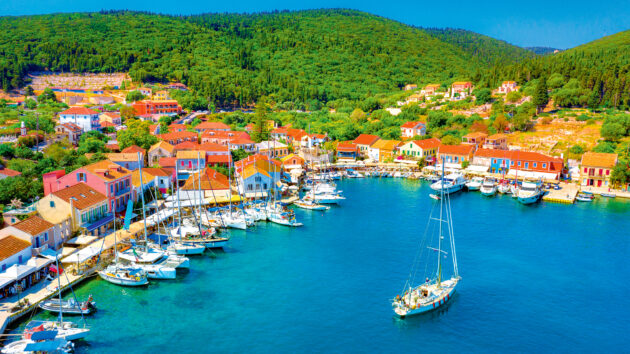
Famous for its azure waters, hot weather, and diverse culture, the Mediterranean is one of the best places for exploring by boat.
Stretching 2,300 miles from the rock of Gibraltar to Iskenderun in south-east Turkey, this inland sea is bordered by 22 countries across three continents.
Sailors can visit ancient ruins, quiet islands, glamorous beaches, and remote anchorages, and see major European cities along the way.
From Spain’s Costa Brava and the Balearics to the French Riviera, Tuscany, Greece, Turkey and Croatia, you could explore for a decade and still find something new each season.
Most passages can be completed in a day’s sail, with occasional longer trips of 100-200 miles between major cruising areas.
There are effectively no tides, which hugely simplifies navigation, and seasonal strong winds like the Meltemi or Levante are predictable once you learn their patterns.
The harshness of Mediterranean winters can surprise new visitors. Many cruisers opt to lay up their boats in October, returning in April for the following season.
If you do want to over-winter, the weather is milder in the Eastern Mediterranean, and Turkey, Greece and Malta are solid options.
Suitability
Stern-to mooring is the local norm, so all the boats I’ve chosen are aft cockpit designs with a bathing platform, and many have a walk-through transom.
Most of your living will be outside under the shade of a bimini, so the cockpit needs to be big enough for lounging, and it should be possible to rig a table.
July and August get very hot, so good ventilation below is important.
A robust anchor arrangement is also a must, both for Med-style mooring and for the countless beautiful anchorages.
The Greek TEPAI cruising tax applies to all vessels above 7m/22.9ft, but makes a sudden jump in cost above 12m/39.3ft, so the majority of boats I’ve selected are under that length.
Beneteau Oceanis 311
This compact cruiser by Group Finot was based on the Figaro 1 race boat hull, used for several Beneteau models in 2000-2001.
The Oceanis 311 is fast and fun to sail, with a tall fractional rig, but she does need reefing early and is more suited to the Med than the Atlantic.
The standard configuration was a 1.42m fin and bulb keel and single spade rudder.
There was also a swinging centreplate version with twin rudders, which can dry out flat.
Her beam is carried aft, creating a wide cockpit and a voluminous interior.
Tiller steering was an option, but most came with a wheel. Lines are led aft to winches on either side of the main hatch.
The mainsheet traveller is on the coachroof, and headsail winches are on the cockpit coaming.
Cockpit benches are long enough for comfortable lounging, and there’s room to fit a large bimini.
There’s a deep locker to starboard, and the helm seat drops for access to the swim platform, ideal for stern-to mooring.
Her side decks are wide, and access forward is unobstructed.
There’s a self-draining anchor locker, a single bow roller, and room on the foredeck to inflate a dinghy.
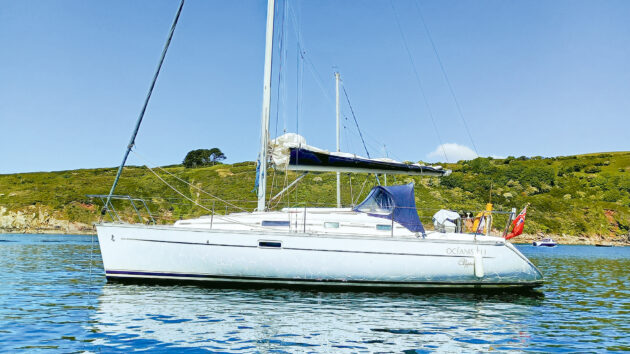
Tiller steering was an option, but most Beneteau Oceanis 311s came with a wheel. Photo by Timbow001
Below, portlights in the hull provide additional light. She has 1.93m/6ft 4in settees on each side, and a central drop-leaf table.
A small L-shaped galley to port has the entrance to the aft cabin behind, where there’s a 2m-wide double berth.
The section under the cockpit floor doesn’t have much headroom, but two people can sleep sideways, with their heads under the side deck.
The heads is aft to starboard, with a hanging area for wet gear and a shower attachment.
The forecabin has a good-sized V-berth and adequate storage, but there’s nowhere to stand and dress once the infill is in place.
None of the coachroof windows can be opened, so a wind scoop would be a good idea to increase airflow.
The hull is solid GRP with a bonded structural liner; it is important to check for damage from severe grounding.
The deck is balsa-cored, and the keel is cast iron.
Boats with the Clipper suffix were comprehensively equipped, including hot water, a fridge, shore power and even a Beneteau crockery set.
Power is from an 18hp Volvo Penta MD2020, mated to a shaft drive.
It’s not possible to fit a below-deck autopilot as the quadrant isn’t accessible, so a tiller or wheel pilot must be used.
Otherwise, owners report few issues outside general maintenance.
Beneteau Oceanis 311 specifications
- LOA: 9.83m/32ft 3in
- LWL: 8.74m/28ft 8in
- Beam: 3.20m/10ft 6in
- Draught: 1.42m/4ft 8in (standard) 0.79m-2.16m/ 2ft 7in-7ft 1in (lifting)
- Displacement: 3,500kg/7,716lb
- Working sail area: 50m2/538ft2
- Built from: 1998-2002
- Typical asking prices: Prices start from around £20,000 for a boat in need of upgrades, and run to £49,000 for the best examples. It should be possible to get a nice boat for under £40,000.
Bavaria 32 Cruiser
Some yards are famous for quoting the maximum possible length when marketing a new model, including every appendage right down to the bow roller.
Bavaria went the other way, and the J&J-designed 32 Cruiser is actually almost 34ft long.
The 32 is one of those Goldilocks boats where her designers made all the right compromises. It’s difficult to think of a small cruiser from the early 2000s that’s more practical for our purposes.
Light weather performance is reported to be better than you might expect, as she sets a respectable amount of sail via an 11/12 fractional rig.
An in-mast furling main was available, but most boats I’ve seen have slab reefing.
The standard fin and bulb keel draws 1.8m/5ft 11in, and a shallow draught option draws 1.47m/4ft 10in.
Above deck, long benches in the cockpit are great for stretching out, but the single wheel can be tricky to squeeze past. Some owners have fitted a folding version.
There’s a deep cockpit locker to starboard, which can swallow a rolled-up dinghy.
A gap in the transom and a split backstay make it easy to access the swim platform when mooring stern-to.
The main is sheeted to a small traveller just ahead of the sprayhood, and primary winches for the genoa are forward on the cockpit coaming.
None of these controls are accessible from the wheel, meaning solo sailors will need to engage the autopilot when trimming.
Her side decks are just wide enough to get forward safely, with the shrouds mounted well inboard.
There’s no babystay, meaning the foredeck is clear for inflating a tender.
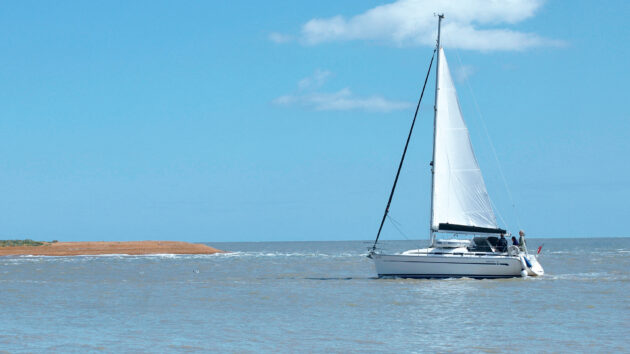
Slab reefing was standard on most boats, although an in-mast furling main was on the options list. Photo by Graham Snook/Future
Below, you’ll encounter a cosy, mahogany-trimmed interior, with good quality woodwork and plenty of storage.
There’s a compact L-shaped galley to port, with access to the aft cabin behind, where you’ll find good headroom at the entrance, and plenty of space above the double berth.
On starboard, there’s a forward-facing nav station, and access to the roomy head, with a watertight door to the cockpit locker.
Her saloon has a central drop-leaf table, and twin 1.9m/6ft 3in settees which double as sea berths.
She has a decent forecabin for her length, with space to dress, hanging wardrobes, lockers and shelves.
Ventilation is via opening coachroof windows, hatches, and a portlight in the aft cabin.
Power is from a 19hp Volvo Penta diesel, mated to a saildrive. The companionway steps can be lifted to provide good access to the top and side of the engine.
Bavaria’s build quality in-period was above average, and owners report few model-specific issues.
Through-hull fittings should have been replaced by now, and the steering and rudder should be inspected for play.
Otherwise, it’s the usual checks like sails, standing rigging and electronics.
Bavaria 32 Cruiser
- LOA: 10.29m/33ft 9in
- LWL: 8.48m/27ft 10in
- Beam: 3.33m/10ft 11in
- Draught: 1.80m/5ft 11in (standard) 1.47m/4ft 10in (shallow)
- Displacement: 3,900kg/8,598lb
- Working sail area: 59.27m2/638ft2
- Built from: 2000-2005
- Typical asking prices: Prices are as low as £26,000 for boats in need of upgrading, and rise to around £58,000 for the best examples.
Elan Impression 344
Elan and Humphreys Yacht Design created the Impression range as fast and comfortable cruising passage makers with no pretence toward racing.
This 344 was the smallest of the lineup, but still offers remarkable accommodation and respectable sailing performance.
There was one keel option, a fin and bulb drawing 1.6m/13ft 3in.
A 7/8 fractional rig with stack pack and single line reefing for the main was standard, along with a Seldén genoa furler for the roughly 20% overlap headsail.
Her cockpit has plenty of space for outdoor life, with a central folding table for al-fresco dining.
A cutout from the long benches makes it easier to pass the single wheel, and lifting the helm seat provides access to a swim platform with a drop-down ladder.
The three-cabin version has lazarettes on either side, where the two-cabin variant gets a deep locker to starboard, also accessible from inside.
Headsail winches are near the helm, and the mainsheet traveller is just forward of the sprayhood.
A large coachroof makes her side decks quite narrow, but once you reach the foredeck, anchoring is well thought out.
A stainless steel bowsprit projects the roller past the bow, and a large stainless plate protects the gel coat.
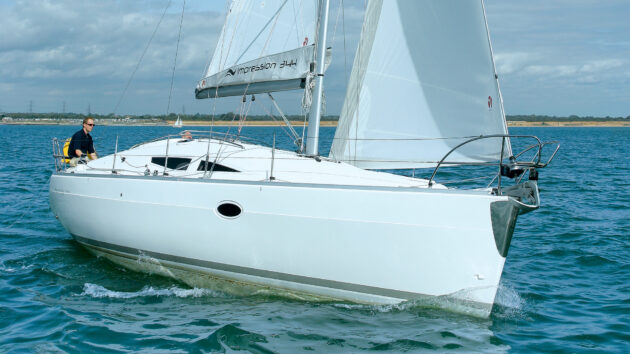
Hull and deck of the Elan 344 are vacuum bagged using woven rovings, vinylester resins and foam coring. This leads to a light but very stiff structure. Photo by Graham Snook/Future
Below, both the two- and three-cabin layouts are spacious for her 9.99m/34ft 4in length.
The three-cabin version has twin aft cabins and a smaller head aft to starboard, where the two-cabin boat gains a separate shower area in the heads.
Both have a bright saloon with an L-shaped galley to port of the companionway, and a dinette immediately forward.
Some boats have the port side split by a small nav table, but in the age of digital navigation, I prefer the version with a full-length settee.
The forecabin is the same in all versions, with a 2m x 1.9m V-berth (6ft 7in x 6ft 3in), hanging storage, shelves, and a small dressing area with 1.8m/6ft of headroom.
There’s a good standard of finish with lots of wood, plenty of storage, and integrated LED lighting.
For ventilation, there are opening hatches in the saloon and forecabin, two large dorade vents on the coachroof, opening ports in the aft cabins and deck hatches in the head and above the galley.
Power is from a 29hp Volvo Penta D1-30 mated to a saildrive. Access to the front isn’t brilliant as the unit is quite recessed.
Build quality from the Slovenian yard was good, and owners don’t report any model-specific problems, so it’s a matter of making sure the price reflects the status of any big-ticket items that may need renewing, such as standing rigging, sails and electronics.
Elan Impression 344 Specifications
- LOA: 10.46m/34ft 4in
- LWL: 9.99m/32ft 9in
- Beam: 3.49m/11ft 5in
- Draught: 1.60m/ 5ft 3in
- Displacement: 6,000kg/13,228lb
- Working sail area: 46.47m2/500ft2
- Built from: 2009-2011
- Typical asking price: Asking prices can be as low as £35,000 for yachts that need updating, rising to around £74,000 for later boats in turn-key condition.
Jeanneau Sun Odyssey 36i
Designed by Marc Lombard, the Sun Odyssey 36i is a neatly styled fast cruiser, with a gentle sheer, wedge-shaped coachroof, beam carried aft, and an almost plumb bow.
Her 11/12 fractional rig sets a high aspect mainsail, and a genoa with around 20% overlap.
Contemporary reviews praised her blend of performance, comfort and ease of handling, in particular the authoritative rudder that gives good control in a breeze.
The standard model had two keel options, a shallow fin and bulb drawing 1.47m/4ft 10in, and a deeper 1.94m/6ft 4in variant.
A performance version was also available, with a taller rig and a deeper 2.1m/6ft 11in keel.
In-mast furling for the mainsail was optional, but most were specified with slab reefing.
Her wide cockpit is T-shaped in plan, with an integrated folding table, and the benches cut short to make room for the wheel.
The three-cabin version has a single lazarette on the port side, whereas the two-cabin boat has additional internal storage volume behind the heads.
The headsail winches are close to the wheel, but the mainsheet is at the coachroof, meaning leaving the helm to trim it.
A walk-through stern makes it easy to disembark when mooring stern-to, and there’s a transom shower.
Wide side decks give good access forward, where there’s an anchor locker and electric windlass.
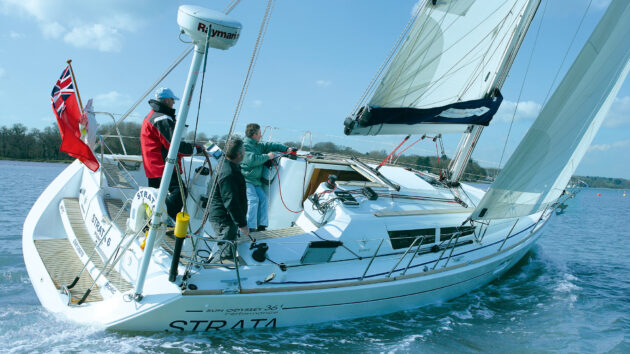
The 36i has wide side decks, providing good access forward. Photo by Graham Snook/Future
Two- and three-cabin layouts were available. The two-cabin boat has a bigger aft cabin on the starboard side, and a much larger heads with a separate shower.
The three-cabin version has two identical aft cabins and a smaller heads compartment.
The rest is common to both, with a spacious L-shaped galley to starboard, with lots of work surface, plenty of stowage, and a 185lt top-loading fridge with a freezer compartment.
Her saloon has a shallow dinette to starboard and a settee to port, where a small chart table slides aft over the nav seat when not in use.
The forecabin has a small amount of standing room for dressing, wardrobes on each side, and a 2m-long V-berth.
Power is from a 29hp Yanmar 3YM30, mated to a traditional shaft drive.
There’s good access to the front via the companionway steps, and to the side and rear via the starboard aft cabin.
Rudder bearings can wear, and some owners have swapped them for roller bearings from Jefa. The original seacocks should have been replaced by now.
Some boats were specified with only one coachroof winch on the port side, using a turning block to route lines from the starboard clutches.
Asking prices start around £68,500 for earlier boats with older equipment and run to around £98,000 for later examples in top condition.
Jeanneau Sun Odyssey 36i Specifications
- LOA: 10.94m/35ft 11in
- LWL: 9.84m/32ft 3in
- Beam: 3.59m/11ft 9in
- Draught: 1.47m/4ft 10in (shallow), 1.94m/6ft 4in (standard), 2.1m/6ft 11in (deep)
- Displacement: 5,950kg/13,118lb
- Working sail area: 63.7m2/686ft2
- Built from: 2007-2012
- Typical asking prices: £68,500-£98,000
Elan 40
The Rob Humphreys-designed Elan 40 was built from 2001 to 2006, and was a competitive IRC racer when new.
With her keel-stepped fractional rig, non-overlapping jib, ergonomic deck gear and comfortable interior, she now makes an excellent fast cruiser.
The standard keel is a 2m/6ft 7in iron fin with lead bulb, and the Performance version drew 2.4m/7ft 10in, and had a 1m taller mast. A lesser-seen shallow keel was also available, drawing 1.70m/5ft 7in.
On deck, her T-shaped cockpit works well for lounging or sailing. There’s no integrated table, but it’s possible to fit a removable one.
There are four winches on the coaming and two by the companionway, where halyards and spinnaker pole controls are clutched.
The traveller is just in front of the large wheel, and it’s easy to adjust the main from the helm. Twin lazarettes provide plenty of storage, and the aft seat tilts forward giving access to the swim platform.
Wide side decks make going forward easy, and she has a deep anchor locker with an internal electric windlass and a removable single bow roller.
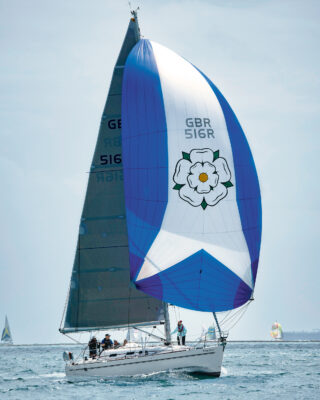
All lines are led aft to the cockpit, which adds to the Elan 40’s cruising appeal. Photo by Peter Brogden/Alamy
Below, her joinery is simple but well finished with pleasing curves and plenty of shelves and cabinets. There are identical double cabins aft, and a heads compartment to port of the companionway, with a shower seat that folds down over the toilet.
There’s a forward-facing nav station immediately in front, and a J-shaped galley opposite to starboard, with twin sinks, and a very large top-loading fridge.
In the main saloon, a dinette to starboard converts to an occasional double, and the port settee has a leeboard for use as a sea berth.
In the large forecabin, an en suite heads and shower was an option. There are four deck hatches, and all coachroof windows can be opened to maximise airflow.
The standard engine was a 39hp Yanmar 3JH3E, mated to a shaft drive, but some boats have a Volvo Penta MD-2040 and a saildrive.
Watch out for original standing rigging accompanied by claims of an inspection, as replacement will be a considerable expense.
Her deck is balsa-cored, and your surveyor should check it carefully for any water ingress.
Factory-fitted electronics will be dated, and some upgrading is likely to be required.
Elan 40 Specifications
- LOA: 11.90m/39ft 1in
- LWL: 10.24m/33ft 7in
- Beam: 3.83m/12ft 7in
- Draught: 1.70m/5ft 7in (shallow) 2.00m/6ft 7in (standard) 2.40m/7ft 10in (deep)
- Displacement: 7,200kg/15,873lb
- Working sail area: 72.46m2/780ft2
- Built from: 2001-2006
- Typical asking prices: I’ve seen prices as low as £39,000 for ex-charter vessels in need of work, rising to £100,000 for a turn-key example. It should be possible to pick up a solid boat for around £55,000.
Dufour 45 Classic
This elegant design by Olivier Poncin and J&J is a fast and seaworthy cruiser with plenty of accommodation for extended cruising.
A low-slung coachroof and tapered stern give her a sleek look, and she sets plenty of sail via a tall masthead rig, with a high aspect main and overlapping genoa.
Contemporary reviewers noted she was responsive on the helm, quick upwind, and handled choppy seas with aplomb – ideal for covering longer passages between the main Mediterranean cruising areas.
Standard draught was 2.34m/7ft 8in, but a shallower option was available at 1.95m/6ft 5in.
A Fastnet model was also offered with a taller triple-spreader rig, rod rigging, a German mainsheet and twin wheels.
Her hull is cored with PVC, and the deck with end-grain balsa.
Teak decks were an option, but are best avoided here, as the hot Mediterranean sun can melt the caulking, and white GRP is better for reflecting heat.
Her spacious teak-trimmed cockpit has long benches, a cut out for the single wheel, and a folding table for al-fresco dining.
There are lazarettes on each side, but she lacks a deep cockpit locker.
You step over, rather than walk through, to a small bathing platform in the stern.
Her mainsheet traveller is on the coachroof, and there’s integrated liferaft storage on the hatch garage.
There are sizeable primary winches on the coaming, necessary for the overlapping headsail.
On the foredeck, there’s a deep chain locker with an integrated electric windlass and a robust twin bow roller.
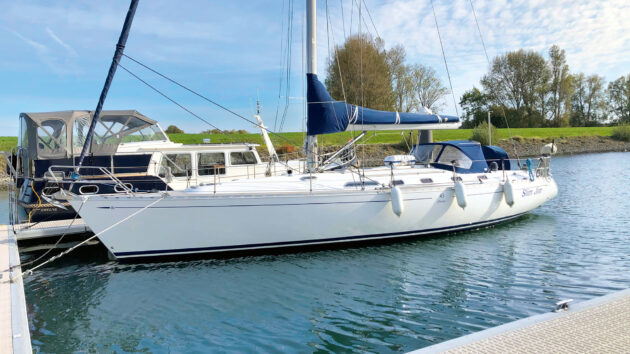
The Dufour 45 Classic’s PVC-cored hull has an excellent strength-to-weight ratio. Photo by Frans Jimkes
Below, three- or four-cabin versions of the cosy, mahogany-trimmed interior were available.
Each has two double cabins aft, and a heads to port of the companionway, with a separate shower area.
There’s a forward-facing nav station and a huge dinette to starboard, with a midships bench that’s useful for bracing while cooking in the port-side linear galley.
Forward, the three-cabin version has an enormous forecabin with dressing space, storage and an en suite heads and shower.
The four-cabin version has a smaller forecabin and a narrow, twin-bunk cabin to starboard, with both sharing a heads on the port side.
For ventilation, there are two dorades and plenty of opening ports and overhead hatches.
Power is from a 59hp Volvo Penta MD22, mated to a saildrive.
The balsa-cored deck should be inspected carefully for any soft spots, particularly if non-standard equipment has been installed.
Otherwise, be aware of the usual older boat items like standing rigging, sails and electronics.
Dufour 45 Classic
- LOA: 14.00m/45ft 11in
- LWL: 11.41m/37ft 5in
- Beam: 4.32m/14ft 2in
- Draught: 1.95m/6ft 5in (shallow), 2.34m/7ft 8in (standard)
- Displacement: 10,968kg/24,180lb
- Working sail area: 82.13m2/884 ft2
- Built from: 1988-2001
- Typical asking prices: Prices start around £65,000 for examples in need of updating, and rise to £85,000 for boats in the best condition.
Practicalities and reading
Most Mediterranean countries are in the Schengen Area, meaning UK citizens can stay for 90 out of every 180 days. Once those 90 days are up, you’ll need to go to a non-Schengen country to extend your stay.
In the Northern Mediterranean, that means Montenegro, Albania, Turkey, or the Turkish part of Cyprus.
In the Southern Med, options include Morocco, Tunisia and Egypt.
A cruise from Greece to Croatia could include stops in Albania and Montenegro, and each day spent out of Schengen gives you another day to spend there later in your trip.
A UK boat entering the EU typically gains Temporary Admission status.
To avoid your boat becoming an import, and EU VAT becoming due, it’s necessary to leave and re-enter the EU every 18 months, and to have evidence (such as a mooring receipt) that this has occurred.
On average, there’s more wind than in the UK, and when it picks up, a nasty short chop can occur.
Conditions can change quickly and it’s a good idea to have several alternative ports of refuge in mind.
Rod and Lucinda Heikell have been cruising the area for decades, and their many pilot books and almanacs are available from imray.com. Their Mediterranean Cruising Handbook is packed with sound advice on everything from where to go to how to equip your boat.
Best boats for crossing the North Sea: the Moody Eclipse 33 + 5 other models
Sailing north from Scotland takes you into a different world. Towering cliffs, remote islands, and empty, white-sand beaches await sailors…
The best boats for Scandinavian cruising, from the Albin Ballad to the Hallberg Rassy 36
There’s a lot to love about Scandinavian cruising. It’s said that Stockholm sailors rarely venture outside home waters themselves– and…

Baltic Sea sailing: the best boats under 40ft for cruising adventure
Duncan Kent picks the best second-hand sub-40ft sail and power boats for crossing the North Sea and exploring a Baltic…

Best boats for a family: sail and power
Duncan Kent chooses a selection of sail and power boats that are ideally suited to cruising with your children and…
Want to read more articles like this?

A subscription to Practical Boat Owner magazine costs around 40% less than the cover price.
Print and digital editions are available through Magazines Direct – where you can also find the latest deals.
PBO is packed with information to help you get the most from boat ownership – whether sail or power.
-
-
-
- Take your DIY skills to the next level with trusted advice on boat maintenance and repairs
- Impartial, in-depth gear reviews
- Practical cruising tips for making the most of your time afloat
-
-
Follow us on Facebook, Instagram, TikTok and Twitter