



Find out how BoatCV, beloved by crews of the ARC Rally, runs a trusted yacht servicing operation in the middle of the Atlantic with the efficiency of a Formula 1 pit-crew.
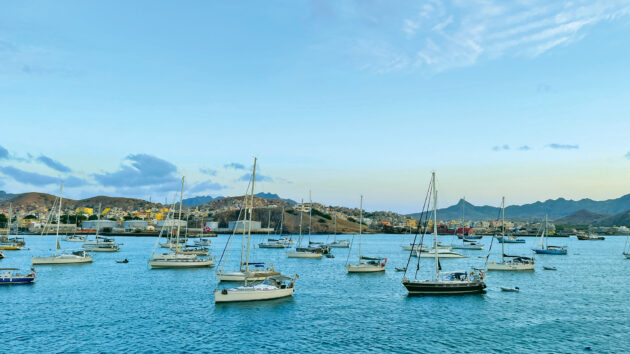
How do you fix a boat in the middle of the Atlantic? BoatCV, beloved by generations of ARC Rally cruisers, has the answer.
The workshop echoes with see-sawing files and spinning sanders. A radio plays softly in the background, and fans whirr above as young men polish rudder bearings and weld spinnaker blocks.
A grey tabby stretches on the office chair, while its owner, Kai Brossmann, talks me through the day’s jobs: a snapped boom on an Ovni 370 and a mast wedge for a Nauticat 43 – plus a dozen other ‘small things’ such as a broken toilet seat and glitchy autopilot.
boatCV could be any marine workshop… except that ‘CV’ stands for Cape Verde, and it’s in the middle of the Atlantic Ocean – over 300 miles from continental Africa – on an archipelago of arid and mountainous islands that have for centuries harboured weary sailors, fugitives and, more recently, yacht rallies.
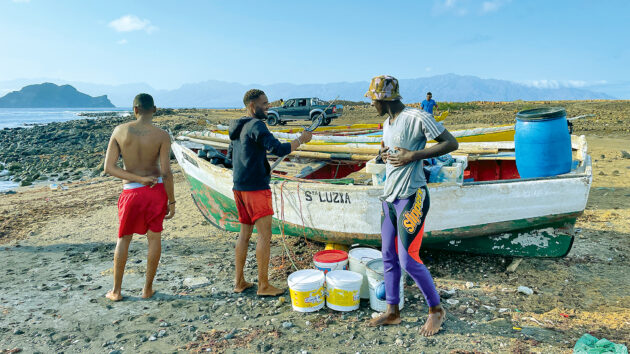
Cape Verdean fishing boat. Photo: Ali Wood / Future.
The ARC Rally’s (not so) secret solution
For the past 12 years, the popular ARC Rally + has stopped here en-route to the Caribbean from the Canary Islands.
After 750 miles, many boats arrive broken, and Brossmann’s crack team work like a Formula 1 pit-crew to get them repaired in the five-day window before they set sail again for Grenada.
On a windy passage this might be repairs to the rig – torn genoas and snapped forestays – on a calm one it will be engine repairs.
And while the engineers get to work, ARC Rally crews are free to hike lush volcanic craters, surf turtle-fringed beaches and listen to the soulful Morna music of the vibrant port city of Mindelo.

Photo: Ali Wood / Future.
Is this the ARC Rally’s favourite boatyard?
In the years I’ve been interviewing ARC rally crews, this boatyard has attained near-mystical status.
Skippers get misty eyed when they recall the moment they thought their dream was all over, only to find their hull could be repaired or their mast re-rigged.
For example, in 2023, I met Claire and Malcolm Wallace who snapped one of the two forestays on their Discovery 58, after over-zealous use of the electric winch.
They were exhausted and heartbroken, but still managed to save the sail, and had the foresight to order a new forestay, which boatCV fitted on arrival.
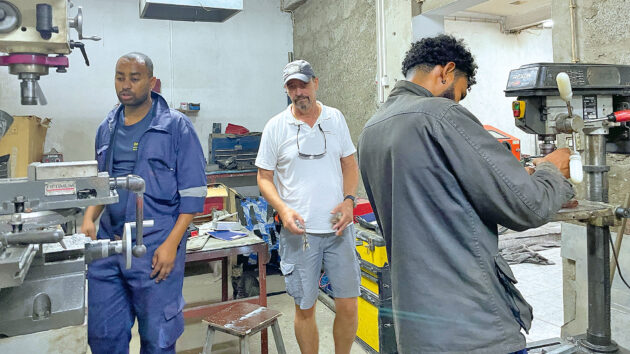
boatCV’s skilled technicians can repair most things on a yacht. Photo: Ali Wood / Future.
How, I ask, can such things be fixed in less time than it takes the Royal Mail to deliver a shackle in the UK?
Finally, I was given the opportunity to find out, when I was invited to Mindelo, on the beautiful island of São Vicente, to meet the ARC Rally + crews and the wonderful staff and shipwrights who look after them.
The ins and outs of marina service
Marina managers Jackie Gomes and Ivanice Estevão greet me warmly, and explain over a coffee in the floating bar that this ‘amazing boatyard’ is not in fact a yard, but a mobile yacht service with a chandlery and workshop.
The marina, too, is part of the same business, set up by Germans Kai Brossmann and Lutz Meyer.
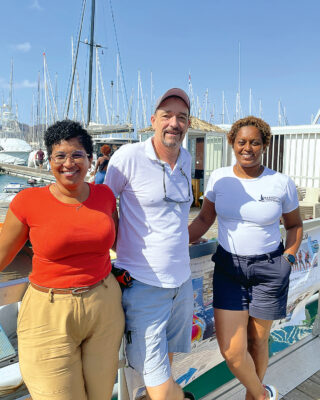
Ivanice, Kai and Jackie . Photo: Ali Wood / Future.
Twelve years ago, Jackie started as a receptionist and now, together with Ivanice, she runs the place, dealing with all manner of things from docking boats to liaising with crime agencies.
“Interpol sent us a picture of a Dutch boat recently,” says Gomes, who speaks French, English, Portuguese and Spanish. “We knew the boat. The men were always friendly. It turns out it was stolen! There was another one too, a big wooden yacht stolen from the US. When the owner tracked it to Mindelo, he fell in love with the place and bought an apartment here.”
Long before the ARC Rally, as the crossroads of three continents, Cape Verde was a trading post for vessels bound for South America, Asia and Europe, with visits recorded since the 15th century by navigators such as Vasco de Gama and Christopher Columbus.
Yet the 10 islands make up less than 1% of the country’s area; the rest is underwater.
The approach – through rugged volcanic landscapes – is not straightforward, and Jackie and Ivanice are often the first people sailors meet after a long and challenging passage.

Santo Antão, the westernmost point of Africa. Photo: Ali Wood / Future.
“We are always friendly, no matter what, and check they are okay,” says Gomes. “A lot of people are happy they made it, but some are a bit jumpy and stressy. Unfortunately, we get a lot of medical incidents too. We had someone arrive who’d smashed their head on the mast. Another man, a Russian, had died of diabetes.”
Tragically, they’ve also dealt with a Senegalese migrant boat.
“It was a sad story. Only six survived out of 60. They were so fragile they couldn’t walk. We took them to hospital and still, when they found out they were in Africa, not Europe, they wanted to get back on the boat. They’d gotten caught by the Trades in one of those long boats with an outboard.”
Like with marinas in the UK, abandoned and shipwrecked boats are also a challenge.
The marina can’t afford to keep them, but the staff look after them nonetheless, hoping one day when the courts allow, they can take ownership and reclaim their debts.
“We get a lot of that; people that leave their boats here, perhaps because they love the island, or they’re exhausted from sailing and they don’t want to continue. Sometimes the boats just aren’t seaworthy, and they can’t get anywhere else. It’s a big problem.”
Yacht tourism through the years
By the time Kai Brossmann joins us, I’ve learned much about this fascinating archipelago and why, for some sailors, the allure is so strong they never return home.
Brossmann, originally a sailing instructor in the Baltic, is one such person.
“Someone had this crazy idea to make a sailing school here,” he laughs. “I came over for the winter, and that was 28 years ago.”
At the time there was very little tourism. Mindelo was the only place where you could maintain boats, but there was no stainless steel or braided rope or any other materials to do such things, which is how boatCV came about.
Brossmann set up the business with Cape Verdean Cesar Muraís.
“I remember we started off with just Sikaflex, rope and shackles; that was it really. But people asked for things, and if they sounded interesting we’d import them and stock them the following season. We now have over 6,000 items!”
There was a small marina at the time, so Brossmann asked the cabinet minister if they could expand it.
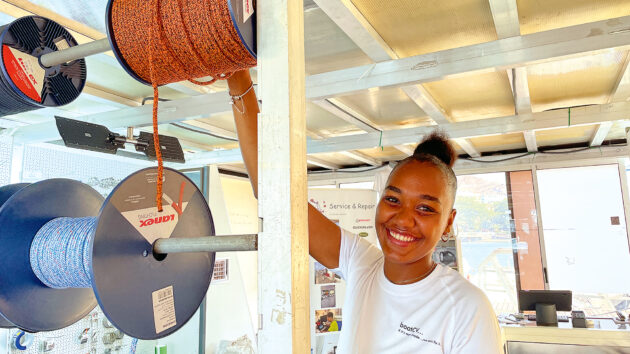
Photo: Ali Wood / Future.
Beyond the ARC Rally: early days of Cape Verde’s yacht tourism
However, ‘yachties’ back then had a bad reputation.
“Mindelo was like a pirate’s cove,” recalls Brossmann. “There were all kinds of weird sailors who were bringing in drugs, cigarettes and alcohol.”
Like anywhere else, Cape Verde has its share of social problems, and these shady characters were contributing to them.
“Some families here have to live off €50 a month,” says Brossmann. “If you have a job, you get social security and retirement payment, but if you don’t, you can’t afford to go to hospital. Tourism helps for sure, but the people who earn get richer and those without a job get left behind.”
The minister agreed to the expansion as long as they repaired the pier, which they did, and they signed the contract in 2003.
Yet the locals still took some convincing.
“The whole city was against the marina. There were demonstrations, and they blocked the workmen. Fortunately, though, about a year after the marina was built, they saw regular people arriving on boats with children, and realised it wasn’t so bad. The crazy sailors moved out to the anchorage.”
Building a marina might be a straightforward task on the continent, but in Cape Verde, Brossmann and his business partner Meyer had to focus on every single detail.
Initially, they imported the pontoons from Spain, but after paying customs tax, it turned out to be more cost-effective to import the decking and start a separate company to build the aluminium profiles and floats.
The first ARC rally comes to Cape Verde
In 2007, the first transatlantic ARC Rally found its way to Cape Verde.
There was very little wind that year, and being low on fuel, the yachts diverted to the crescent-shaped bay of Mindelo, a sunken caldera. Thrilled to find a modern marina and boat services, it became an annual stop.
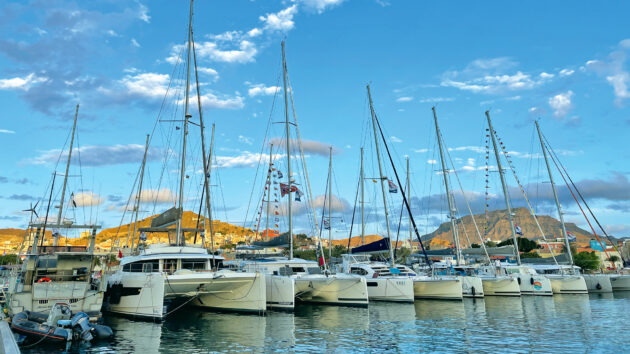
Photo: Ali Wood / Future.
Since then, Marina Mindelo has hosted many events beyond the ARC Rally, from regattas and rallies to sports fishing competitions, and has just opened a smart new hotel.
Visiting cruisers are catered for by restaurants and tour operators, a Saturday fish market and a market hall of fruit, vegetables and other provisions.
Small-boat owners are made welcome, but local resistance has transferred to the cruise terminal, where passengers are catered for on board their ships and, according to Brossmann, bring only refuse which cannot be treated on the island and is costly to deal with.
October through to February, when Cape Verde has its annual carnival, is the busiest time of year for visiting sailors. In summer it slows down, with marina capacity, and hence yacht services, dropping to 20%.
There are very few local sailors to make use of boatCV; almost all its custom comes from tourists.
What happened to the local sailing school?
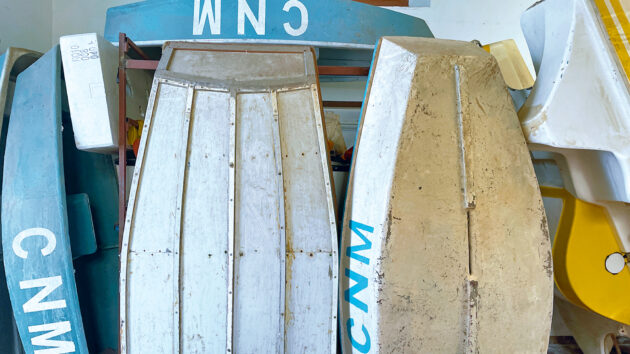
There was once a kids’ sailing school in Mindelo, and there’s hope it will one day re-open. Photo: Ali Wood / Future.
There was also once a sailing school. Its legacy – a handful of kayaks and Optimist dinghies piled against the theatre wall – can be found opposite the marina.
What happened, I ask Brossmann?
“For six months, there were island kids going up and down in the bay. It was lovely. Tragically, a child drowned, and that was the end of the sailing school,” he says.
“The truth is that a lot of people can’t swim,” adds Gomes. “We live close to the beach and our parents teach us, but we don’t have classes. We don’t have the culture to sail; we need a sailing school.”
“A lot of attempts have been made, by myself included,” says Brossmann. “It’s important, sailing is where I came from and how I came to be here. It’s not easy; we need government support, but we should do it.”
Touring the boatCV workshops
My much-anticipated tour of boatCV starts, to my surprise, in a houseboat moored next to the marina office, which is actually a nautical showroom.
“Don’t worry, they don’t get seasick,” says Brossmann, waving at the staff, Liliane and Noelene, who are serving a customer some rope.
He points to a screen, not unlike the kind you see at airline self-check-ins, which is used for scheduling repairs.
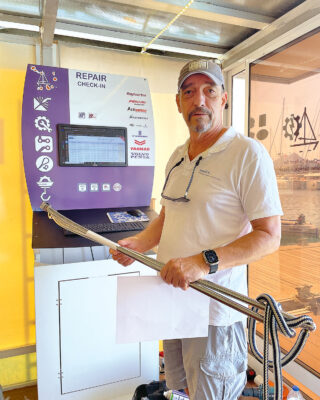
boatCV’s self-check-in means cruisers can book repairs as soon as they arrive in Mindelo (or even while at sea). Photo: Ali Wood / Future.
Any misconception I had that this is a grassroots affair is firmly quashed; sailors do not even have to leave the marina to get their boats fixed.
In fact many of them, now equipped with high-speed internet provider Starlink, book repairs mid-way between Gran Canaria and Cape Verde. They can upload photos and video from sea, describe the problem and what parts they need, and boatCV is ready for them when they make landfall.
“Starlink has really changed things. On previous editions of the ARC Rally, it was too expensive for people to email with a sat phone. Not anymore,” says Brossmann.
Brossmann has a kind of triage system where boat owners are prioritised not just according to scale of damage, but by the time they have available.
If they’re on a rally such as the ARC Rally +, they’re given three stars and dealt with immediately. If they’re in the anchorage, and here for some time, they may have to wait a bit longer.
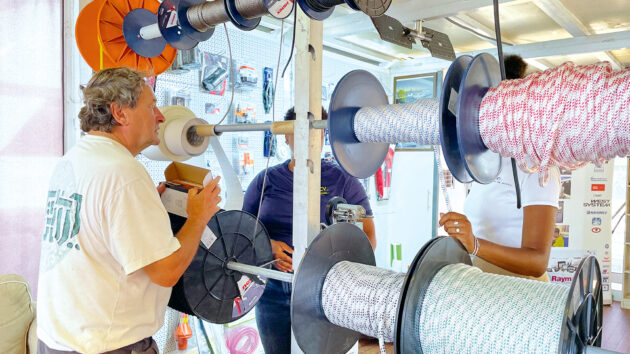
ARC+ cruisers can stock up on chandlery without leaving the marina. Photo: Ali Wood / Future.
Receiving over 100 emails a day during the ARC Rally + stopover, Brossmann acknowledges it’s a lot of work, but it is a well practised routine for his 13 staff, who between them manage over 250 jobs in a single week.
“When the boats set sail again, I sit down and think, ‘how did we do all that?’”
The houseboat is impressive – it displays everything a sailor could want, from lifejackets to bilge pumps – but actually the real magic, I’m told, takes place in the city.
City – as in the colonial Portuguese buildings full of shops, cafes and museums?
I’m surprised. I’d been expecting a dusty boatyard full of yachts on cradles, rigs lowered onto decks, and hulls scraped in preparation for antifouling.
Brossmann laughs. Those kinds of jobs are not his bread and butter. In fact, he doesn’t have any kind of yard at all; the marina doesn’t even have a crane.
“We do a lot of the stuff in the water as it’s hard to get to the boats any other way. We send divers down, do rudder replacements in situ; sometimes we put air bags under the hull and pump them up.”
Last year, after a particularly windy crossing, Brossmann was called to a catamaran that hit a container. It lost a rudder, smashed a bow and snapped a thru-hull fitting. Amazingly, the crew managed to keep it afloat long enough to limp into Mindelo, where boatCV managed the whole repair under water.
“This year it’s smaller jobs,” he confirms. “Rigging issues, electronics, spinnaker poles; that and the boom which has snapped in two.”
Works underway: how boatCV replaces a boom
The boom is laid out on the floor of boatCV HQ, a cavernous workshop spread over two whitewashed floors, packed with state-of-the art machinery.
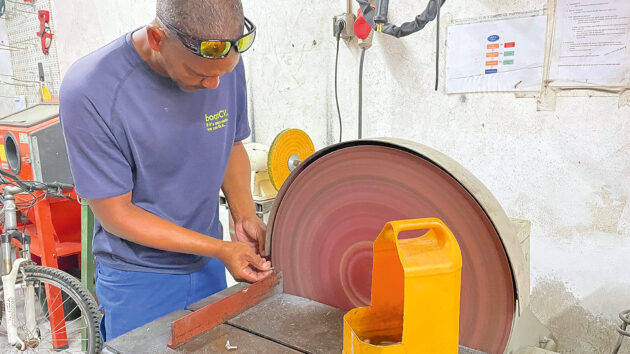
Photo: Ali Wood / Future.
“It’s a brand new boat, and they snapped the boom on the way down,” Brossmann says. “I only have a 7m boom, and he needs 5m, but we have to get him on his way. If he’s willing to pay for the 2m I don’t mind, but it’s heartbreaking to have to cut it.”
Getting parts is the biggest challenge for boatCV. It can take up to two weeks to receive an order, and nobody wants to wait that long, so instead the team makes their own.
With machinery such as the CNC milling machine, they can exactly recreate portholes and hatches to fit the space of those by original manufacturers such as Lewmar.
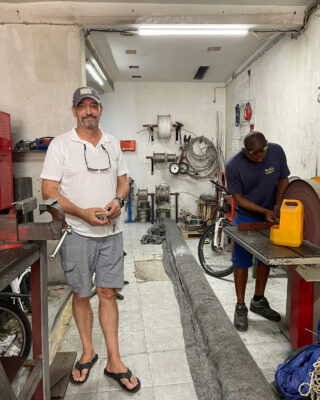
Photo: Ali Wood / Future.
As Brossmann walks me past the machines, he picks up objects – for example, a white plastic ring; something you might expect in a sewing or upholstery shop, which is, in fact, a rudder bearing. “Sometimes they get loose,” he says.
It’s like a game of ‘guess that part’. This could be Q’s workshop in a James Bond movie for all the mysterious boat bits being fashioned on futuristic machines. I fail miserably, not even recognising a spinnaker pole-end.
“We’ll fill it, weld it, work it on the milling machine so it looks like the original. It doesn’t take long.”
There are two swaging machines for shrouds and stays, a sand blaster which is used to clean parts before they’re painted or powder-coated, and a sander to give stainless steel its final polish after welding and electro-polishing.
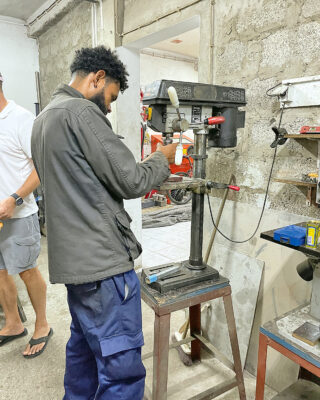
Photo: Ali Wood / Future.
Brossmann has big suppliers in Italy, Germany, Spain and Holland, as well as smaller ones in the US. He’s also a distributor for Raymarine and Furuno, Volvo, Yanmar and Mercury.
“Electronics is my native skill,” he tells me. “That was pretty much where I started: radars and sounders.”
Together with two partners Muraís and Maocha, they built up the business by acquiring mechanics and trainees from the technical school in Mindelo; experts in everything from engines and woodworking to electrics and rigging. Some are now even shareholders.
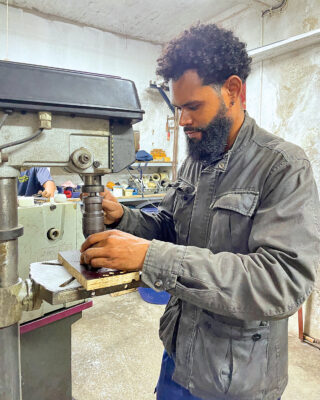
Photo: Ali Wood / Future.
“I’m so impressed by their knowledge,” says Brossmann. “They’re really well educated.”
Facing the future: solar demand
Upstairs is the chandlery, which sells everything from wind generators to dinghies; much bigger items than the houseboat in the marina, and not just to boat owners either.
“We’re seeing a local demand for solar panels now because our energy grid is not that great. We have blackouts three or four times a year, and so I’m looking forward to getting into this market.”
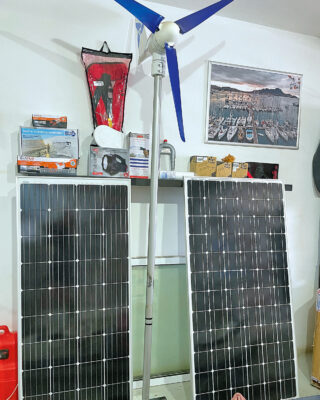
Solar is an emerging market in Cape Verde homes as well as boats. Photo: Ali Wood / Future.
Last but not least, Brossmann uncovers a machine I’ve always been curious about but have never seen in action: the 3D printer.
“In case we need an urgent part, we can print it here,” he says. “It’s expensive, far more so than if you buy the part in a chandlery, so it tends to be for prototypes or single parts that are difficult to source. It helps if we can scan the old part, rather than having to do it from scratch.”
Brossmann explains that it actually takes much more time to create the model than it does to print it.
First, they make a 3D drawing on the computer. Next, they do a test with a different material to check it prints okay.
If it does, they make the real thing, and the good news is they then have the design in the system, should it ever be needed again.
How boatCV makes a mast wedge
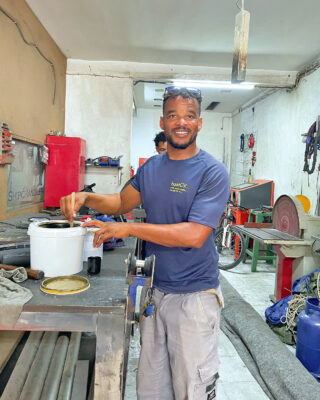
As we’re leaving the premises, I see one of the shipwrights stirring what looks like black treacle in a white tub.
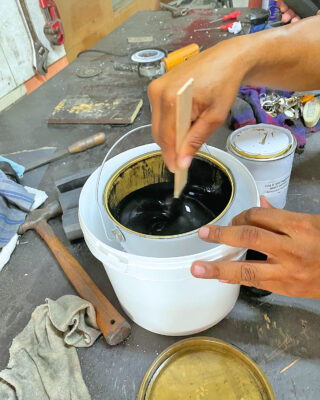
This mast wedge will solidify to help keep the keel-stepped mast from wobbling. Photo: Ali Wood / Future.
“This is mast wedge,” he explains. “I’m making a small sample to test the reaction.”
Confusingly, it doesn’t look ‘wedgy’, and I have no idea how it’s supposed to hold a mast in place, so he invites me to the boat later that afternoon to see how it will be applied.
This mast wedge will solidify to help keep the keel-stepped mast from wobbling. Photo: Ali Wood / Future.
It turns out that the skipper of yacht Frenesi noticed the mast was wobbling in his keel-stepped Nauticat 43. The rubber collar that supported the mast had degraded from the constant movement on the crossing from Gran Canaria.
Finally I understand from the conversation between the men that the mixture will be poured into the gap. It will then expand and solidify before being cut into shape and sealed, and will hopefully then lock the mast in place for the second leg to Grenada.
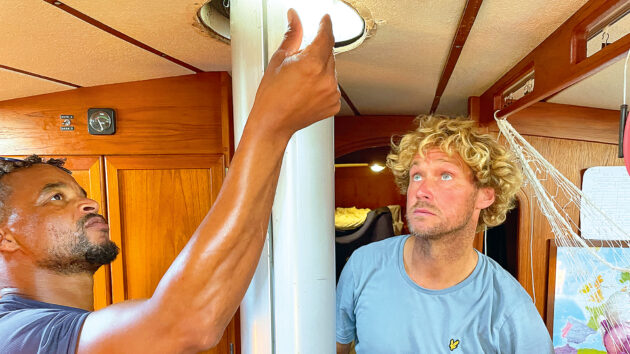
The mast wedge will fill the gap where the mast goes through the coachroof. Photo: Ali Wood / Future.
If ever there was a case of one’s reputation preceding them, it’s here. boatCV is every bit as impressive as I imagined, and more.
Their motto is, ‘if it’s man-made, we can fix it… and our ambition is to challenge ourselves every time.’
This is evident in the testimonies I’ve heard, and the work going on in front of me.
If they don’t have the part, they’ll make it, and if they don’t have the solution, by hook or by crook (and 3D printer) they’ll find it, and all in record time.
So next time you’re popping across the Atlantic, be sure to pay them a visit.
What to do while repairs are underway
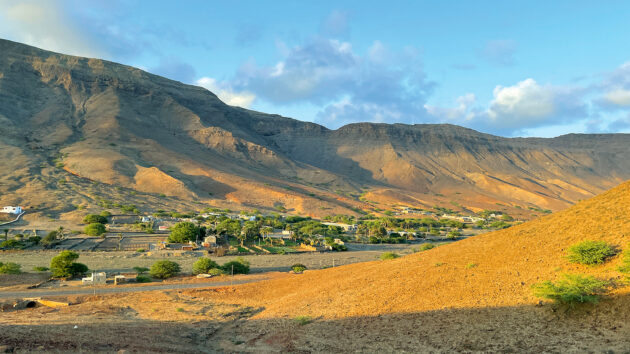
The dramatic landscape of Cape Verde. Photo: Ali Wood / Future.
While Kai Brossmann and team get on with repairs, the yacht crews are free to explore Cape Verde.
Many take a tour with Aventura Turismo to nearby Santo Antão, a staggeringly beautiful island at the north-westernmost tip of the archipelago (and the westernmost point of Africa).
Arid and desert-like at its base, it’s hard to imagine how this can be the major supplier of fruit and vegetables, until you drive 1,500m up its winding cobbled roads into national parkland, high above the clouds, where eucalyptus, cypress and pine trees grow, and cattle graze in extinct volcanic craters.
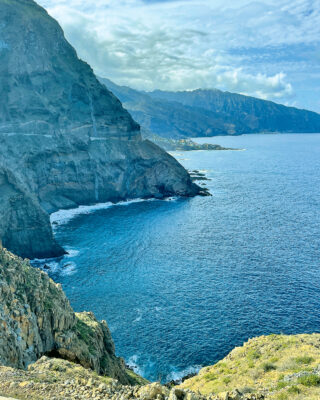
Photo: Ali Wood / Future.
After a short hike on the mountainous summit, the bus tour descends via terraced plantations – home to mangoes, sugar cane and bananas – with stops at rustic roadside cafes, a distillery where you can sample the local drink grogue, and a charming lighthouse.
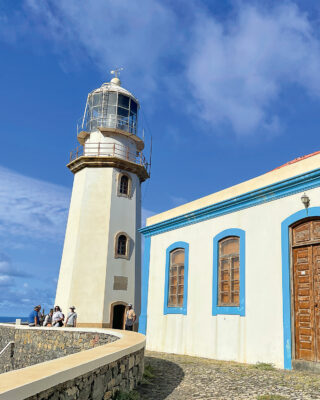
Lighthouse on Santo Antão. Photo: Ali Wood / Future.

And they’re off! ARC+ yachts leave Las Palmas for Cape Verde
Seventy yachts left Las Palmas, Gran Canaria, this afternoon in gusty 15-20 knot north-easterlies, headed for Cape Verde. The boats…

Satellite communication at sea: staying connected from your boat
With Starlink’s high-speed internet, do sailors still need satellite phones on board while at sea? Ali Wood looks at the…
Want to read more articles about the ARC Rally?

A subscription to Practical Boat Owner magazine costs around 40% less than the cover price.
Print and digital editions are available through Magazines Direct – where you can also find the latest deals.
PBO is packed with information to help you get the most from boat ownership – whether sail or power.
-
-
-
- Take your DIY skills to the next level with trusted advice on boat maintenance and repairs
- Impartial, in-depth gear reviews
- Practical cruising tips for making the most of your time afloat
-
-
Follow us on Facebook, Instagram, TikTok and Twitter