



If you're considering a boat you can trail and sail, why limit your options to just one hull? David Harding tests the Astus 20.2 trimaran
Astus 20.2 trimaran: The ultimate high-speed trailer-sailer?

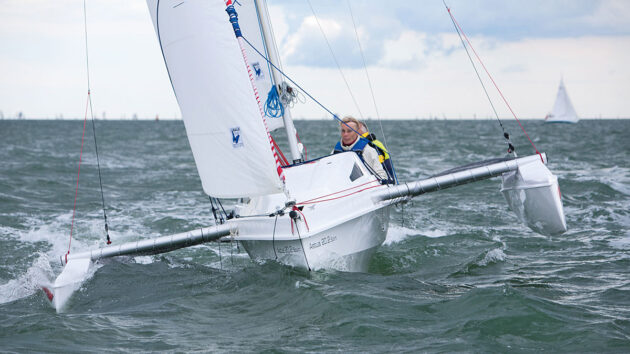
Daysailers and weekends of around 20ft (6m) – like the Astus 20.2 – can make great trailable-sailers. It’s sometimes seen as too much of a sweat to launch and recover anything bigger for a short outing, but 20ft is a good size: big enough to provide somewhere to sleep, yet small enough to keep in the drive and tow behind the family car.
When thinking of a trailer-sailer or trailable-sailer, most people never consider a multihull. For small boats they envisage open-trampoline beach-cats offering hairy sailing and no protection of any description, while cruising cats and tris are widely regarded as a different breed altogether. In between, however, are the multihull equivalents like the Astus range of trimarans from France.
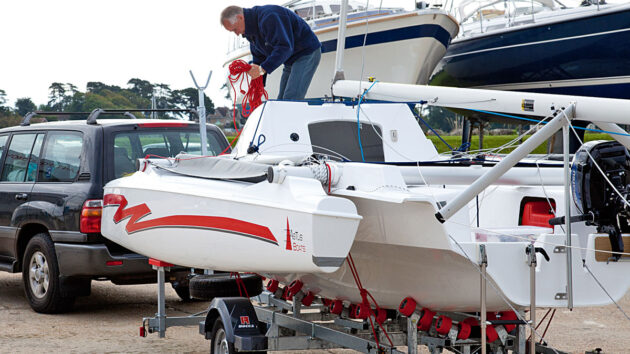
Just arrived: the hulls are still in their trailing position, but the mast is almost ready to raise. The Astus 20.2 can be rigged and launched in 30 minutes. Credit: David Harding
The Astus 20.2 is light and sprightly, with a cabin that would accommodate a companionable couple and a beam that reduces from 14ft (4.25m) under sail to less than 8ft (2.4m) for trailing. Sliding the hulls in and out takes minutes, the all-up weight is just 880lb (400kg) and you can be sailing past almost everything in sight within 45 minutes of driving up to the slipway. Even better, with a total trailing weight of 650kg (1,433lb), she sits on an unbraked trailer. Not having brakes can save an enormous amount of grief.
So, what’s not to like? That’s the question I wanted to answer when I sailed the Astus 20.2 in the Solent.
Getting the Astus 20.2 afloat
The Astus 20.2 arrived off the ferry from France, so I witnessed the whole rigging and launching operation as well as seeing it in reverse when we came back in. With me photographing, interrupting and asking questions, getting afloat took about 90 minutes. With two people who both knew what they were doing and got on with it, you’d need less than half an hour.
Everything goes together easily enough. The kit is simple: the forestay attaches to the stem with a Dyneema lashing, for example, and the furling jib zips over the forestay. Once the mast is raised and the hulls have been slid out on their aluminium cross-beams to their sailing position, the boat is still perfectly stable on her roller-trailer to back down a slipway and into the water. Then the fun starts, because the Astus 20.2 will crack along upwind in flat water at 6.5-7 knots while tacking through 80°. With a performance like that she would give a well-sailed 33ft (10m) performance-cruising monohull a run for her money. Her lack of length would hold her back upwind in a seaway, but crack the sheets, bear away a few degrees and enjoy the ride as the log goes straight into double figures.
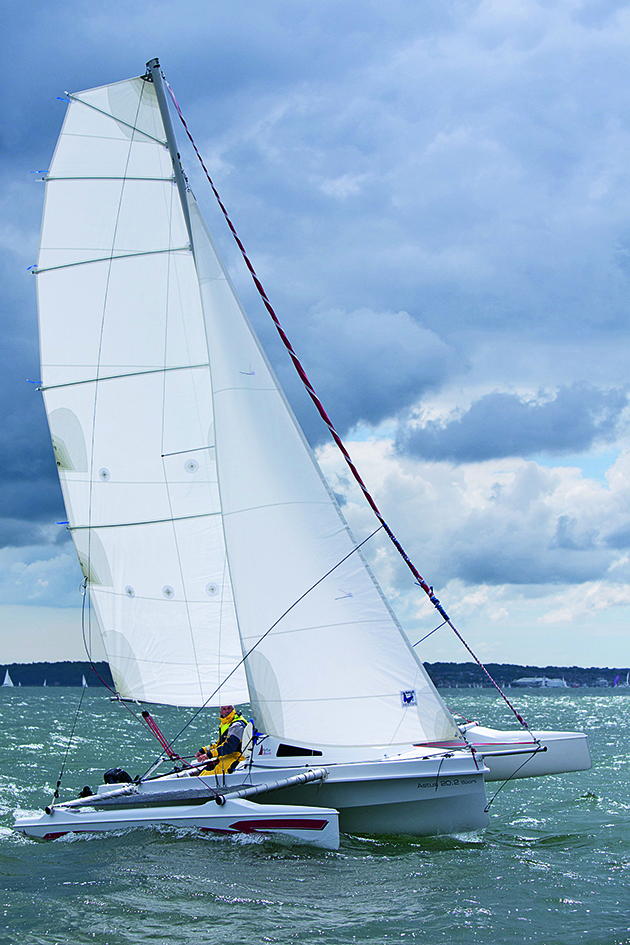
The sports version of the Astus 20.2 came with Pentex sails. Credit: David Harding
We headed out into a grey Solent on which a 15-knot westerly was kicking up the usual short chop. Bramblemet later showed a mean speed of 17 knots with gusts over 20. Upwind the Astus 20.2 skimmed along nicely with the weather hull clear of the water. You can helm from inside the cockpit or, for extra power, extend the tiller extension and move on to the windward trampoline. Take the crew with you if you can: weight out there makes a big difference.
Bearing away and unfurling the gennaker really brought the boat to life, but everything felt firmly under control even with the log nudging 15 knots – and you can always tuck a slab in the mainsail to calm things down a bit.
Fixtures and fittings on the Astus 20.2
We were sailing the Sport version of the Astus, complete with a bigger rig, Pentex sails, a mainsheet track and other go-fast goodies. Hardware, despite being kept to a minimum, is generally good and mostly from Harken. A 6:1 purchase provides ample power for the mainsheet, while the jib sheets are 2:1 to avoid the need for winches. Both sets of sheets serve a secondary purpose, helping raise and lower the mast.
Unusually for a performance multihull, the Astus 20.2 has a centreboard rather than a daggerboard. With the cabin being well forward, the case doesn’t really intrude and it’s also wider than strictly necessary, to reduce the chances of mud or debris jamming the board. The rudder pivots too, though more balance would reduce the weight: the helm did get heavy. That should be simple to resolve.
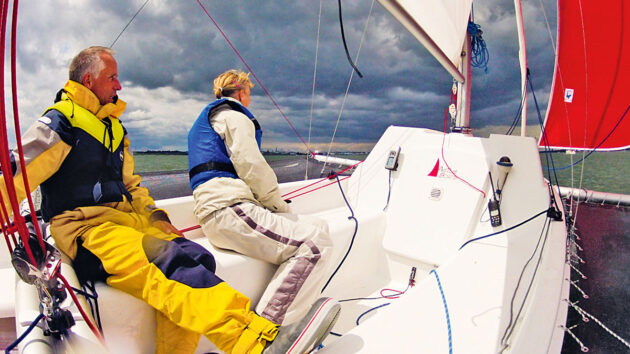
A cockpit over 2.5m (8ft) long provides plenty of space for day-sailing. Credit: David Harding
With a little slop from the centreboard in its wide case (plus the inevitable drag) and some movement in the aluminium cross-beams, the Astus doesn’t feel the tautest of trimarans but then she’s not a race boat: she was conceived to be light, economical and family-friendly. Sailing her is fun nonetheless, because she’s fast and responsive – and you can crank her up another notch with options such as a resin-infused hull and carbon rig if you want even more fun. Just don’t expect to spin on a sixpence, because this trimaran is not the fastest when it comes to turning corners.
If you’re used to sailing performance dinghies, a small tri like this will present no challenges – unless, as somebody once did just to prove that it could be done, you sail most of a race on one hull. Each float (‘ama’ in tri-speak) contains 650 litres of buoyancy, capable of supporting nigh on twice the weight of the boat. There’s no reason why anyone who can sail to a reasonable level even in sedate, ballasted monohulls should have difficulty switching into multi-mode – especially with the standard version of the Astus 20.2.
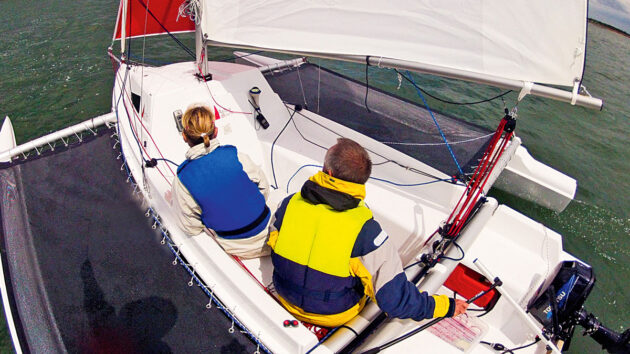
There is a good expanse of trampoline on each side. Credit: David Harding
Because sporty multihulls are such fun to sail fast, it can be hard to resist the temptation to push them just a little. As with most performance boats, however, fast doesn’t have to mean hairy: you can lift your foot off the throttle and go for a picnic. You’ll still get there before anyone else.
Sailed gently, small trailable tris make great family day-sailers, with lots of trampoline space for kids, and they’re ideal for anchoring off (or drying out on) a beach.
If the wind shuts right off, or for manoeuvring in confi ned spaces, you just tilt down the outboard. Our 5hp Tohatsu pushed us along at 7.5 knots, and that wasn’t even at full throttle because it was still being run in.
Accommodation
There’s not a lot to say about the under-cover area. It provides room for two people to stretch out, to sit down and to stow some kit under the bunk and the 8ft-long (2.5m) cockpit. That’s it: this is a boat for people who like day-sailing or camper-cruising. Most of the space is outside.
Verdict
A boat like the Astus 20.2 would make a great introduction to trimaran sailing because she’s as easy to trail, launch, recover and store ashore as an equivalent monohull. On a boat of this size you don’t expect much in the way of accommodation, so there are no surprises in that department either.
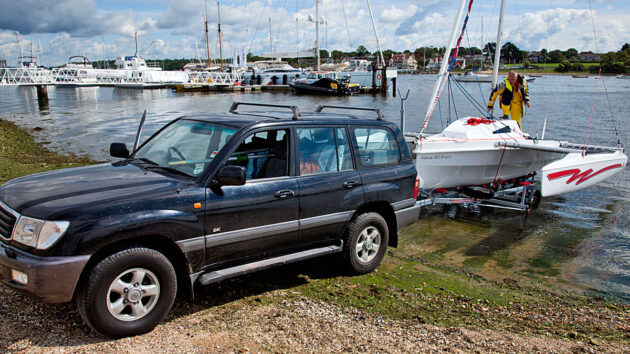
With an unbraked trailer, launching from a slipway shouldn’t lead to a need for frequent trailer maintenance. The total trailing weight is 650kg (1,433lb). Credit: David Harding
All you have to get used to is sailing twice as fast – and remembering to stop grinning when you get back ashore.
Details
Price when released:From £17,270
LOA:5.95m (19ft 6in)
Beam (sailing):4.25m (14ft 0in)
Beam (towing):2.40m (7ft 10in)
Draught - centreplate up:0.25m (0ft 10in)
Draught - centreplate down:1.25m (4ft 1in)
Weight:400kg (880lb)
Total trailing weight:650kg (1,432lb)
Sail area (main and headsail):24.00sq m (258sq ft)
Engine:2.5-6hp outboard
RCD Category: C
Designer:Jean-Hubert Pommois/ Perspective Yacht Design
Builder:Astus Boats, France
: