



Sporty and nicely finished, the Austrian-built Sunbeam 24.2 stands out among boats of this size, says David Harding
Sunbeam 24.2: The attractive coastal cruiser that is fun to sail

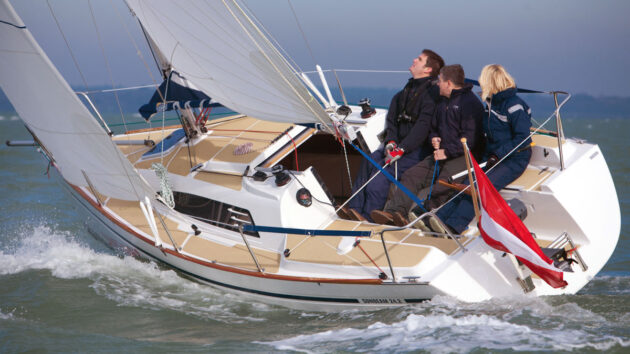
Being without a coastline doesn’t stop some countries from achieving sailing success. Take Austria, for example. Although the people of this mountainous nation are better known for their skill on water in its frozen rather than liquid form, some notable sailors have flown the Austrian flag.
Given the number of lakes, perhaps that’s not surprising. What you might not expect on the edge of a lake in a landlocked country, however, is a yard building seagoing yachts – but that’s what you find north of Salzburg. This is the home of Sunbeam Yachts, who build boats suitable for lake-sailing alongside larger models most definitely designed for salt water: they go up to the Sunbeam 53.2 (like many continental builders, Sunbeam thinks in imperial when it comes to naming boats).
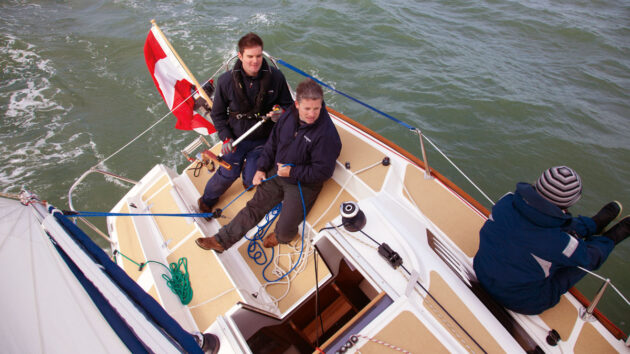
There’s just room for three to windward in the cockpit, but it’s more comfortable with two – and there’s plenty of space for hiking on the rail. Credit: David Harding
Sunbeam is a yard with a difference. Apart from being some distance from the sea, it has been owned by the same family since its inception and can trace the sailing history of its founders back to 1838. It produces a relatively small number of boats – typically between 40 and 80 a year depending on the mix of sizes – moulds its own hulls, offers customisation even on the smaller models, and has just introduced a brand-new 24-footer that’s also the smallest in the range.
Golden Sunbeam 24.2
At a glance, the most notable feature of the Sunbeam 24.2 is the golden colour of the non-slip finish on the deck and coachroof. Applied afterwards rather than moulded in, it’s distinctive, attractive and, as I later discovered, very effective. Nonetheless, the non-slip counts for little if the rest of the boat doesn’t add up – so what’s the Sunbeam 24.2 like?
In simple terms, she’s a sporty all-rounder: a ‘sports luxury cruiser’ in the words of the builder. Designed by Sunbeam’s in-house team in conjunction with Georg Nissen, whose production designs include the Sirius and Contest ranges, she has a hull that’s 7m (23ft) long and of reasonably high volume yet moderately proportioned by today’s standards.
Relatively modest freeboard, a slight sheer and a stem that’s a few degrees off the vertical contribute to the pleasing appearance, as does the nicely balanced coachroof and raked transom. Bolted to the hull is a bulbed fin keel in cast iron giving a draught of 1.4m (4ft 7in) and a ballast ratio – high by today’s standards – of 36%. Alternative keels include a shallow fin and a centreplate that retracts into a ballast stub with a broad bulb-cum-mini wing on the bottom.
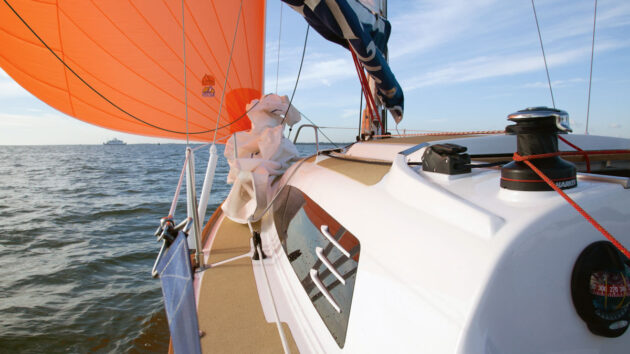
The quality of the mouldings, fit-out, hardware and detailing is good, as is the non-slip pattern, but the block for the headsail sheet on the deck is fixed. Credit: David Harding
There are choices with the sail plan, too. A fractional, sweptspreader, backstay-less rig supports a semi-battened conventional mainsail or, as on our test boat, a ‘high-tech’ option that gives an extra 4sq m (43sq ft) of sail. Putting all the figures into the number-crunching machine reveals a displacement/length ratio of 165 and a sail area/displacement ratio of 21.5 with the standard mainsail or just under 25 with the extra canvas. It all points towards a boat that’s quick but far from extreme.
Significantly, the brochure stresses two points that are usually ignored in promotional material and, all too often, in the design of the boat itself. One is that the immersed sections of the hull retain much of their symmetry when heeled, helping to maintain balance and control. The other is that, when the boat heels, the rudder stays in the water – a function of both its depth and the hull shape.
Further encouragement is given in references to structural rigidity in the hull, the application of an anti-osmosis primer, a seven-year guarantee against osmosis and a 10-yearguarantee against leaks in the hull-to-deck joint. The guarantees are only for the first owner, and words in promotional literature are no substitute for knowing exactly what goes into a boat (which can be hard to establish without witnessing every stage of the production process), but Sunbeam appears to have faith in the boats it builds and to have a sensible set of priorities.
Sailing a Sunbeam 24.2
Whatever its structural qualities, a boat can’t hide the way it sails – at least not in the conditions experienced on the day of the test. For ours we had a northerly breeze that started at 12-15 knots before decreasing. Combined with the big, square-top main, that was more than enough to allow us to push the boat most of the time. Although she possesses many attributes that should make her a thoroughly competent sea-boat for her size, one has to bear in mind that a lot of Sunbeam 24.2s will be sailed on lakes in Austria, Switzerland and Italy where the winds are often light.
On the other hand, conditions in mountainous regions can be boisterous at times and also change rapidly, so lake-sailers designed for this part of the world need to be able to cope with a breeze and a chop. To get ourselves downwind and away from the distinctly non-mountainous northern coastline of the western Solent, we set the asymmetric spinnaker from the short removable bowsprit that can double as a conventional spinnaker pole.
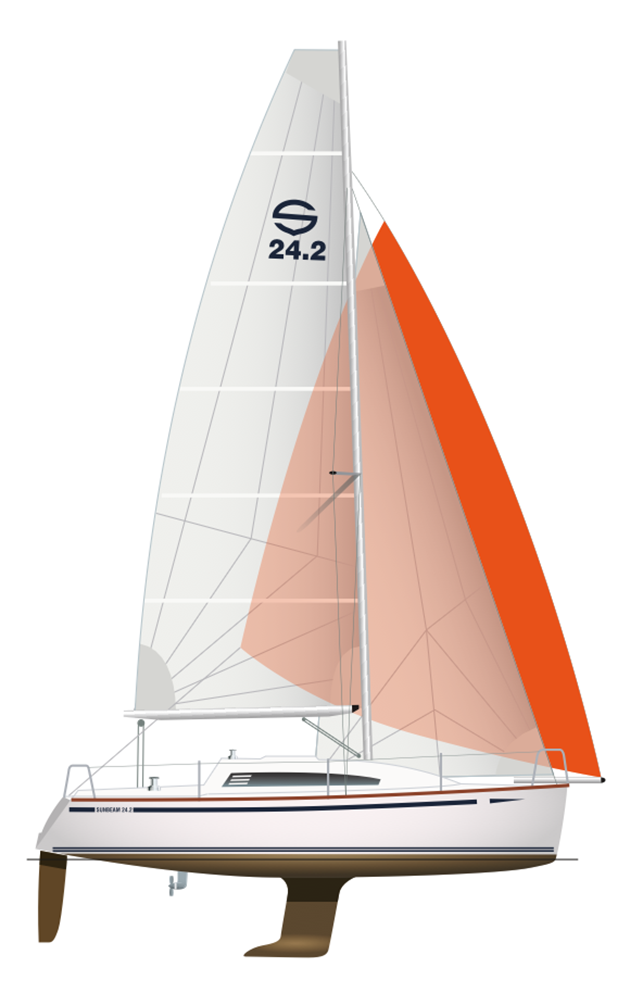
Sail plan of the Sunbeam 24.2
The Sunbeam 24.2 skipped along happily, looking for any excuse to start semi-surfing on the small waves, clocking 8-plus knots at times and showing remarkably little inclination to misbehave. With the kite dowsed and the white sails trimmed for upwind sailing, she slotted into an easy groove, made a respectable 5.5 knots with the weight of four crew on the high side and again did exactly what was asked of her. Having more than enough sail in those conditions we had to de-power as far as possible, though cap shrouds that had stretched resulted in a rather saggy forestay.
For UK waters, more of a pin-head mainsail with a backstay and a flicker might give more de-powering options, improving performance in a breeze in exchange for a slight loss of drive further down the wind range. It would be interesting to see how this little boat would fare in club racing and IRC competition.
Few capable, sporty all-rounders are currently built in this size range to take the place of boats from an earlier era like the GK24 and Achilles 24, so the Sunbeam 24.2 might find a ready market over here if she proves to be competitive. Competitive potential aside, she was responsive, obedient and well mannered. I make a point of testing the rudder’s grip as a matter of course on boat tests and in this case, the blade stayed in the water and kept her on track to a point well beyond that at which many others would have given up.
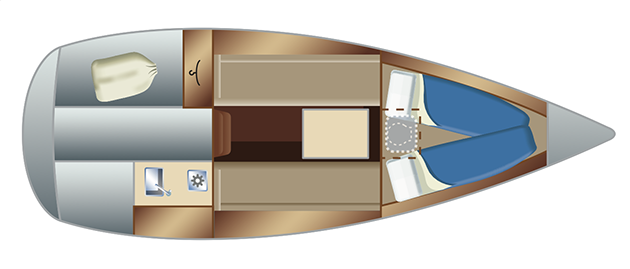
Accommodation plan of the Sunbeam 24.2
The gunwale was awash and the inclinometer on the compass showed 45° of heel before grip was lost and she rounded up gently into the wind. Other standard test procedures include heaving to. The Sunbeam 24.2 sat happily enough like this and, importantly, could be persuaded to gybe round and carry on sailing without the mainsheet being eased. It’s usually the simplest way to get going again.
Throwing a boat into a tight circle with the sheets pinned in is also a good way to test her reactions. Coming out of the spin she’ll normally be at a near standstill, and this is when the foils (keel and rudder) inevitably stall to a greater or lesser extent. The result is that the boat crabs for a while with no steerageway until laminar flow is re-established. How long this takes depends largely on the foils: if they’re of high aspect ratio, or flat in section like many centreplates, it takes longer.
The moderate proportions of the Sunbeam’s meant that she was under control and up to speed again remarkably quickly. All told, I found little of consequence to complain about. There were niggles, however. Rudder bearings that were way too stiff made it hard to gauge the finer aspects of the balance, quite apart from taking the edge off what was otherwise an enjoyable experience for the helmsman. They’re being changed on this boat and for future production.
Tuning accessories
Economics dictate that smaller boats tend to come with a more basic level of hardware than their bigger sisters, and the Sunbeam 24.2 is no exception. There’s no mainsheet traveller (available on the options list) and, with the standard hank-on headsail (roller reefing was an extra) not even a track with a genoa car: just a block fixed to the deck. For anyone who’s half serious about sailing efficiently, both would be on the essentials list. Something else that would make life easier are primary winches: it’s a bit much to expect a normal mortal to trim 12sq m (130sq ft) of headsail in any breeze with no mechanical assistance.
Although a quick luff will take the weight out of the sail so you can sheet it in, it’s not really the answer. Plinths are already moulded in and the winches can found on the options list. Such hardware as there is comes from reputable sources: the winches on the coachroof are Harken 20s and the blocks mostly from Ronstan. Z-Spars supply the mast in its tabernacle and the nicely-cut sails are from Doyle-Raudaschl in Austria.
The founder of the original Raudaschl loft, Hubert Raudaschl, is a double Olympic silver medallist (in the Finn and Star classes) who competed in a record 10 Olympic games. His son Florian now runs the loft and represented Austria in the Finn at the 2012 Olympics in Weymouth – so for those who were struggling to name any successful Austrian sailors, here are a couple for starters.
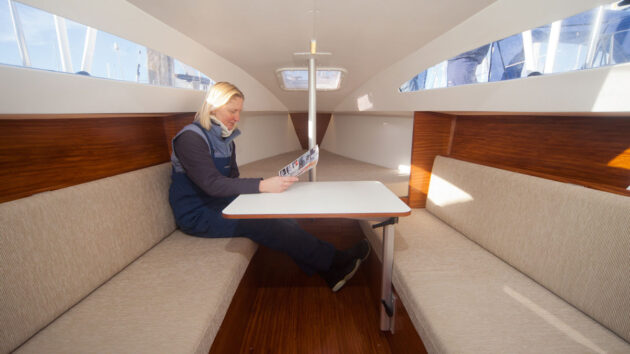
A simple layout below decks, with neat mahogany trim and generously-sized berths. Credit: David Harding
As a sporty cruiser rather than a sportsboat, the Sunbeam 24.2 has a cockpit that’s geared more towards sitting inboard than to sitting on the coamings. I favour the coamings when possible, not that it was particularly comfortable here because, as on so many boats, the width of the cockpit means that the guardwires are too close to the coamings.
Unable to lean back, you end up fighting gravity as soon as the boat heels. At least you still have a reasonable view forward from down on the seat. Otherwise, the ergonomics worked well. There’s just room for three people on the weather side in the cockpit if the helmsman sits right aft.
In racing mode you would have just the helmsman and trimmer in the cockpit on upwind legs; the rest of the crew can enjoy a comfortable perch on the weather rail. On deck, the aforementioned non-slip finish is the star feature. Combined with the orange spinnaker, its bright-sandy colour really made this the sunshine boat even after the weather turned grey.
Practical features
Forward of the mast are a forehatch, an anchor locker and a couple of fairleads (but no bow roller as standard – just a ring through which the bowsprit passes). A full-length solid wooden toerail looks nicer and is easier to repair than the more common aluminium alternative. Detailing throughout is generally good and the finish neat, among very few lapses on the test boat being a slightly sharp corner to the stainless steel surround to the companionway.
Stowage is in the form of a full-depth locker each side in the cockpit. As the boat doesn’t have an inboard engine, the space beneath the cockpit, reachable via a hatch abaft the companionway steps, is also available for stowage. Our test boat came from Austria with a Torqeedo electric outboard, which has been replaced for use in the UK with a 2.5hp Tohatsu on a transom bracket. It’s fine as a get-you-home engine and will push the boat along happily in flat water. Some prospective buyers are bound to ask about an inboard engine.
Sunbeam felt the boat wasn’t designed to carry the weight of an inboard engine, but I think a lightweight inboard would probably have less of a detrimental effect on the boat’s trim and performance than the sort of over-sized outboard that some owners might otherwise be tempted to put on the stern.
Accommodation on the Sunbeam 24.2
Neat and simple is the theme below decks, where the emphasis is on open space for day-sailing or weekending. If you’re looking for a separate heads compartment, an aft cabin, standing headroom and anything more than the most basic galley facilities, this isn’t your boat.
What you get is a light, welcoming, open layout with minimal clutter: just a V-berth in the bow, from beneath which a chemical toilet can be pulled out, and a 2m (6ft 8in) settee berth each side with backrests that hinge up so you can store light kit such as bedding behind them.
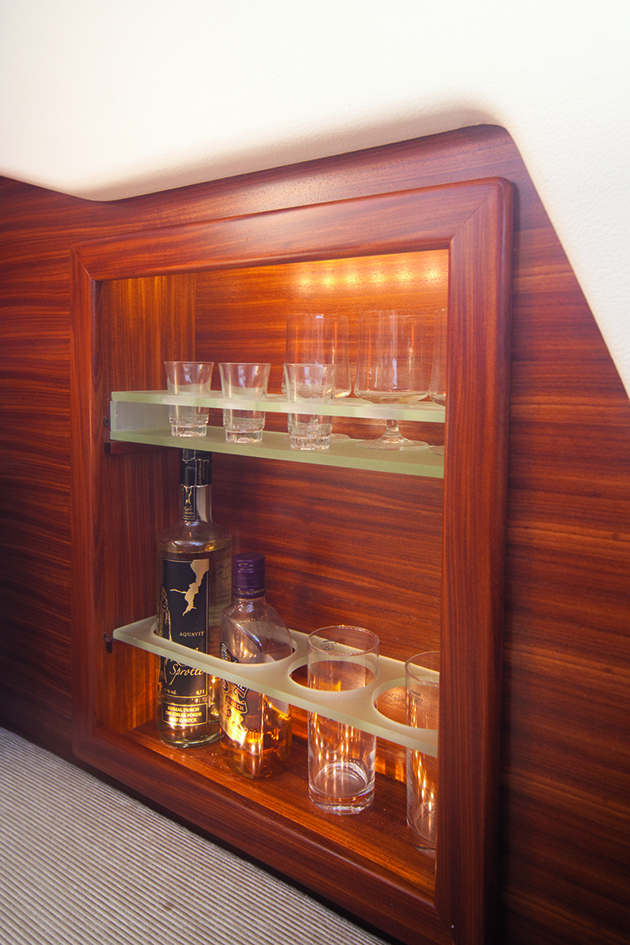
Schnapps! Whatever your tipple, it can be found a home on the Sunbeam. Credit: David Harding
As standard, there’s no galley. In its place, set into the bulkhead to starboard and perhaps more important to some, is an open-fronted drinks locker with room for a bottle or three of Schnapps and a few glasses. A slide-out galley unit is an option. To port, you can fit a fridge in the form of a large drawer. Total headroom is 1.47m (4ft 10in) and there’s 1m (3ft 4in) of sitting headroom above the bunks.
Unusually on modern production boats, the Sunbeam 24.2 has no internal mouldings. The bulkheads are bonded directly to the hull and deck, and the mahogany-veneered timber forming the bunks is bonded to the hull as well.
Vinyl is used to line the hull-sides and for the headlining, into which is set a minimal amount of lighting. A neat feature down here is the table. Fixed to a removable bracket on the starboard bunk-front, it can be swivelled every which way and also taken out into the cockpit.
PBO’s verdict
This is an attractive little boat that’s well designed, carefully thought out, nicely built and fun to sail. Her lakesailer pedigree is reflected more in the way she’s fitted out than in the fundamental design. While she comes with a pretty basic specification, the builders appear to have decided to put the money into the quality of the structure and finish rather than into add-ons and window-dressing.
With a slippery hull, generous rig, plenty of low-down ballast and a healthy righting moment, the Sunbeam has the makings of a handy coastal cruiser-cum-club racer and is the sort of boat that’s likely to appeal to owners moving down from larger craft as well as to those on the way up.