



Looking for a reasonably-priced and solidly-built second-hand cruising yacht, Richard Reed was smitten by the Trapper 500
Trapper 500: a head-turning beauty
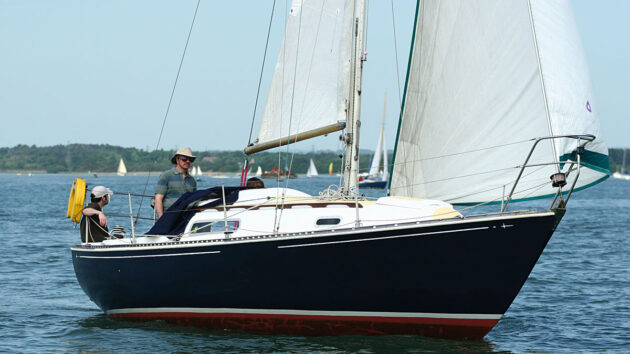
My search was several months old when I first saw her: sleek, graceful, dainty – the Trapper 500 was everything I had been looking for. I carried on checking out other models for a while, just to make sure, but nothing else compared to this svelte beauty.
And so it was that I made that fateful trip to Brighton for our first date. I say fateful because once having met Dragonfly, a Trapper 500, face to face, I was totally smitten. All the books on buying boats say you should leave your heart at home when making a viewing, but I just found it impossible to do that.
She met all my criteria, and more. First, and most important, she was within my price range of £5,000 to £7,000. She was very pretty – call me superficial if you like, but this was very important to me. She was spacious for her size, with a good-size forecabin, roomy heads, a big saloon, acres of stowage space, and wide side-decks.
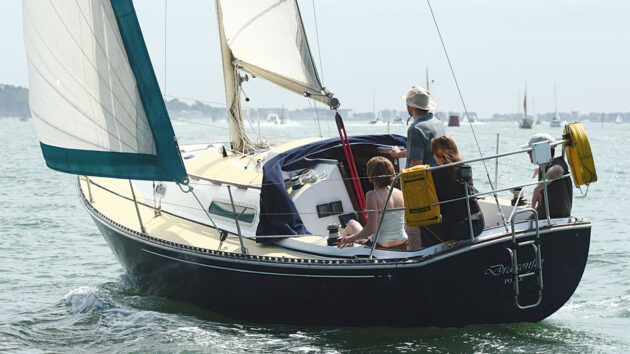
Richard Reed’s Trapper 500 Dragonfly has proved the perfect budget cruiser for outings with friends and family. Editor’s note: it is a good idea to wear a lifejacket when sailing
There was also just under 1.8m (6ft) of headroom near the companionway, which meant I could stand upright while preparing a meal. Now I wouldn’t call myself a gourmet, but I do enjoy good food, and I don’t see why this should stop the moment you set foot on a boat.
Granted, the galley area itself was a little cramped, but having installed several kitchens over the years, my mind was already working on ways to improve that.
Following some research, I was pleased to find that the Trapper 500 had been considered a fast boat in her day, with good sailing characteristics. She was originally designed in Canada (as the C&C27) and was built to take rough weather if necessary. Just as important, the class had no history of osmosis – unlike the Westerlys of her day.
Dragonfly was my first boat, so I had a full survey before making a formal offer. At the surveyor’s suggestion, I was on site for the inspection, and it proved a very useful exercise for me as a beginner.
One of his first observations was that she had both a nice, thick hull and a beautifully slippery underwater profile – something others have also commented on, and which no doubt accounts for her ability to hit six knots very quickly in just 15 knots of wind.
Worth a haggle
Dragonfly was given a reasonably clean bill of health. The surveyor mentioned a problem with the genoa furling mechanism, which I later had to replace, and noted that the engine was a bit smoky – although he assured me it was normal for an engine of that age (she still had the original 8hp Yanmar fitted).
The boat was up at £8,950, but I pitched in a much lower offer, and we ended up agreeing on just under £6,500 – which shows it pays to haggle in the current climate.
Shortly after New Year, I took her on a short hop to Littlehampton and experienced my first hiccup. It was a lovely sunny winter’s day, but there was no wind, so I motored the whole way. Since daylight hours were short, I pushed her up to full revs, but soon afterwards there was a nasty noise from the engine and clouds of black fumes issued from the exhaust. I quickly switched off, and peering over the stern was horrified to see an oil slick that would have done the Amoco Cadiz proud.
I felt a little nervous – my first day at sea as skipper of my own boat, and here I was adrift and quite literally powerless. Before radioing for help I thought I’d try to restart the engine and see what happened. After a few splutters she caught, and was soon running normally, so somewhat nervously I continued on my way.
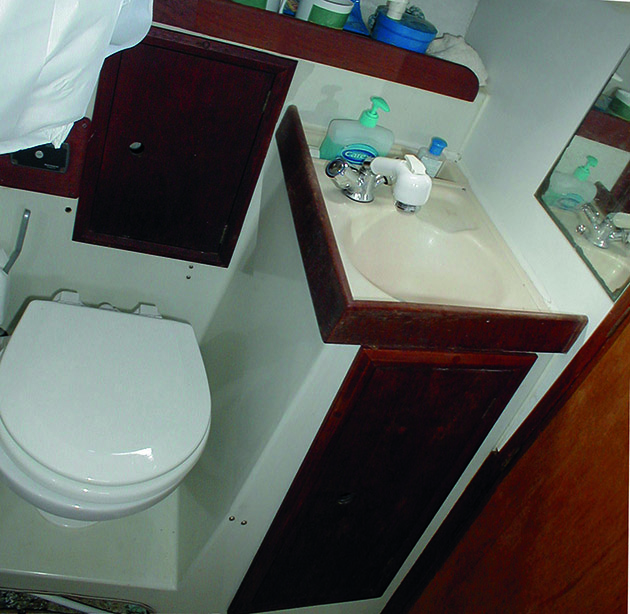
A new loo and shower mixer tap in the spacious heads
We changed the oil in Littlehampton (I suspect it had been overfilled), and although there was no repetition on the next leg to Portsmouth, trying to motor against the ebbing spring tide almost proved too much for the ageing Yanmar. At one point the GPS was reading zero knots over the ground, and it must have taken half an hour to travel the few hundred yards up to Haslar Marina.
When Andy Weeks from Lynx Engineering in Bembridge picked up Dragonfly to take her over to the Isle of Wight for the rest of the winter, he commented with a grin that she ‘smoked a bit’. Andy is a main agent for Nanni, but it didn’t take much persuasion that it was time for a new twin-cylinder, 14hp engine, particularly when he offered to supply and fit it for just £3,000 – well below the £4,500 my surveyor thought a replacement was likely to cost.
Still, it was a big hole in my budget for ‘extras’, but as a relatively new sailor my concern for safety was paramount, and after a season of faultless running, sometimes against very strong tides, I don’t regret it for a moment.
Having sorted the engine, my mind turned to other issues. To me, sailing is about the whole experience – skimming through sun-kissed waters, the joy of moving with the wind, the stopovers and late nights with friends in pretty coves and harbours. Not for me the spartan, cramped living quarters so common on boats of Dragonfly’s 1976 vintage.
The interior had obviously been renovated and was in excellent condition. The dinette layout, with a gangway to one side, had been criticised as ‘old-fashioned’ by some commentators, but to me that’s nonsense. The layout is ideal for a boat of this size, allowing you to eat, drink and be merry without hindering progress to the heads or the cockpit.
Too many berths
However, when Dragonfly was built the emphasis was on squeezing in as many berths as possible – she would sleep six, including a settee berth opposite the dinette and a quarter-berth under the cockpit. Six people on an 8.5m (28ft) boat is rather too many for my liking, and I needed more galley space – in the original there was no worktop, unless you count putting the lid on the sink.
My plan, then, was to shorten the settee berth and extend the galley by moving the cooker along (similar to the later Trapper 501 design), creating a new worktop where the cooker had been, complete with a nice, large drawer beneath.
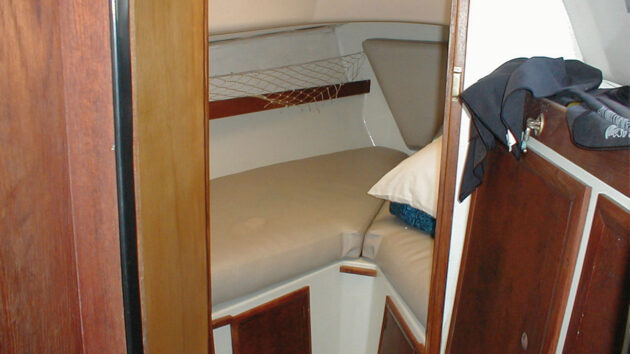
A new full-length door closes the heads off from the forecabin
This proved relatively easy to accomplish. Since there had been a locker access under that end of the berth, I first cut a piece of board from an old kitchen unit to fit under the cooker and seal the locker hole, carefully sealing the edges with varnish. This has the advantage of being an easy-to-clean surface.
I then created a basic U-shaped stove support in 2×1 timber using L-brackets, which I bolted to the board below and the glassfibre moulding on the right-hand side, then attached a section of 12mm plywood to the left-hand side of the frame, both to screen the cooker from the seat next to it and give extra structural rigidity. Further L-brackets in the glass moulding below secured the ply firmly in place, and the weight of the new stove hanging in its gimbals has made the whole structure rock solid.
I cut a curved section out of the existing ply galley divider so you can easily lift pots and pans across to the new stove, and to create the new drawer I simply used a drawer assembly from the old kitchen unit.
Installing water
My next job was to install some hot and cold running water to replace the existing hand and foot pumps. The pipework was a relatively simple task using domestic Speedfit plumbing, which was easy to run through the bilges, under the rear-facing dinette seats and into the heads.
The obvious place for the calorifier was on the bulkhead in the starboard cockpit locker, just the other side of the galley. The only obstacle was the existing rather small fuel tank, which I removed. A bigger 75l tank has been placed in the centre of the boat behind the engine.
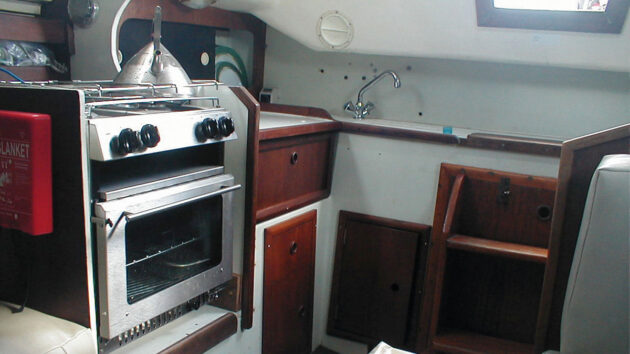
The new-look galley, complete with extended worktop and drawer
I now had a nice expanse of hefty ply on which to fit both the calorifier, and below it the compressor for the refrigeration unit I was installing in the coolbox. There is ample space to climb down into the cockpit locker, and fitting both units was easier than expected.
There is now a maze of pipework under the sink, running to the calorifier, the new Jabsco Parmax 1.9 water pump and the two flexible watertanks installed under the dinette seats.
The only problem I encountered was mating the Speedfit system to the braided water pipes from the pump and cold water tanks, but I overcame this by clipping the braided pipe over a length of 15mm copper tube, which slips straight into the Speedfit couplings
The other major alteration below decks was to fit a new door between the heads and the forecabin – the existing half-length folding door simply offered no privacy. This project was beyond my modest woodworking skills, but luckily Bembridge boasts an excellent boatbuilder by the name of Will Squibb, who did the job to a very high standard for just over £600. He also fitted a new drawer-front in the galley to match the existing drawers and cupboard doors in the boat.
Updated electrics
I have also updated the electrics, putting in new AC and DC control panels, and installed a wind-speed instrument, depth sounder and tiller pilot. To cope with the extra demand from the fridge unit and the new 12V loo, I have installed a second 100Ah leisure battery in series with the original.
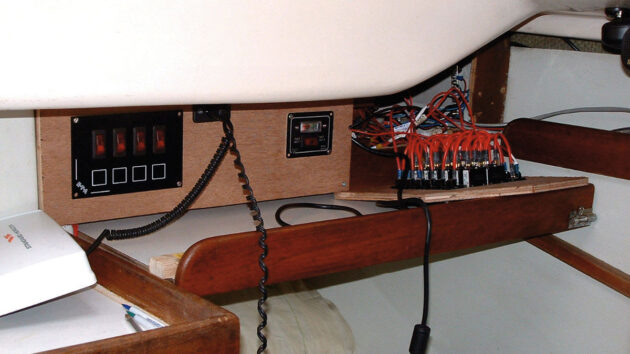
The replacement AC and DC control panels during installation
I now have beautiful, solidly-built British boat, full of character, and resplendent in her new midnight blue livery, with all the mod-cons of a modern cruiser.
Despite last summer’s weather I had a wonderful time exploring the beautiful coastline around Poole where Dragonfly is now based – and where she was originally built by Anstey.
For me, the pretty Trapper 500, with her excellent sailing abilities, offers huge value for money. Dragonfly turned a few heads last season and will no doubt do the same again this year; she has certainly turned mine.
Trapper 500 facts
■ The Trapper 500 is based on a 1970 design by the Canadian partnership of Cuthbertson and Cassian, the C&C27.
■ Anstey Yachts in Poole started to build the design under licence in 1972, and Anstey later changed the company name to Trapper Yachts, building several other designs under the name.
■ In 1980 the Trapper 500 underwent a slight redesign to become the 501, with an extended galley and a modified keel and rudder (the original 500’s rudder can be heavy to handle, especially under power).
■ The Trapper is a spacious design, well suited to family cruising, with a quick turn of speed that can embarrass some modern yachts. With unrestored examples fetching less than £7,000, they represent great value for money.
■ Altogether 499 Trapper 500s were built, and many more 501s before production of the Trapper brand finally ceased in the late 1980s.
Details
LOA:8.3m (27ft 4in)
LWL:7.0m (23ft 0in)
Beam:2.8m (9ft 2in)
Draught (fin keel):1.5m (5ft 0in)
Draught (bilge keel):1.1m (3ft 6in)
Displacement:2,347kg (5,175lb)
Sail Area:29.5sq m (317sq ft)
Headroom:1.8m (6ft)