



Picking up a fore-and-aft mooring in a strong tide doesn't have to end in tangled lines or a fouled propeller thanks to this DIY setup. David Cornes describes a simple, easy-to-use system for picking up a river mooring
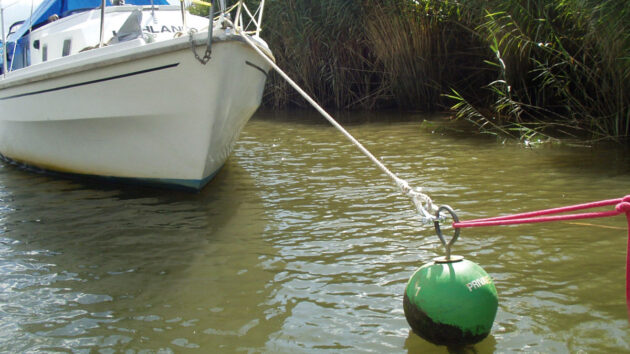
Head and stern mooring buoys are often found in river settings: they provide an efficient method of in-line holding where lack of space means swinging moorings are not practical.
Where these moorings differ is in the manner of securing to the buoys and the ease with which the mooring can be picked up.
Some boat owners take their mooring lines with them, which means they then have to be rove through the buoy eye on their return – not easy with a tide running and a crosswind.
Others drop their mooring lines on departure, hoping they’ll not find them tangled around the buoy on their return – or worse, risk fouling their own or someone else’s propeller.
The system I’m describing here does away with these two problems: it works well for me, and may be of assistance to others.
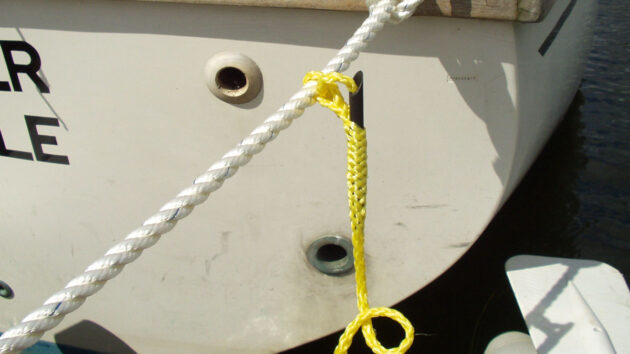
Here a hollow fid is being used to splice the floating line through the lay of the pendant and then back through the fid so the end is buried inside the floating line. Credit: David Cornes
At each end of the boat I have a rope mooring pendant, eyespliced around a thimble which is shackled to the buoy. At the inboard end a bowline is looped around the mooring cleat. I considered a spliced eye, but the bowline gives me the option to alter the pendant length if I am moved to another mooring.
The tail of the bowline is looped around the mooring cleat to help secure the eye. As an alternative, the eye could be omitted and the pendant just made up around the mooring cleat.
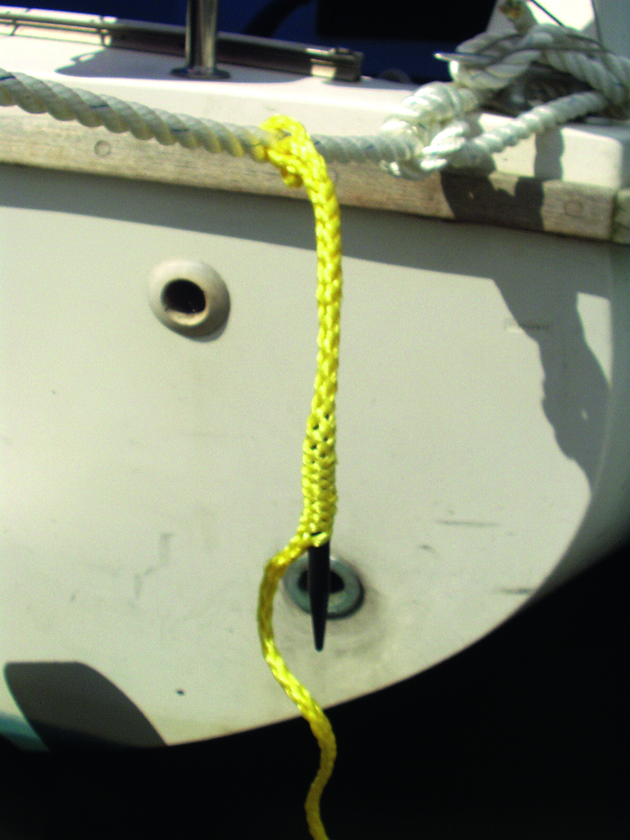
Splice complete, the hollow fid is removed from the floating rope. Credit: David Cornes
One end of a length of floating line is fastened through the lay of the forward mooring pendant, and the other end through the aft pendant, so the two pendants are joined by the floating line. I attached mine just outboard of the mooring fairleads, and the floating line is long enough to drop loosely inside the guardrail stanchions while on the mooring. At the centre of the floating line I’ve attached a small pickup buoy – there because the weight of the pendants tends to drag most of the floating line under the surface.
With tide on the bow, to depart I drop the downstream mooring and walk the upstream mooring down the side deck. This enables the boat to swing ready to proceed downstream, and at the same time moves the boat away from the mooring before I engage the propeller. The same principle applies when leaving with tide astern, but there’s no need to walk the line down the boat as the stern will naturally swing away from the mooring.
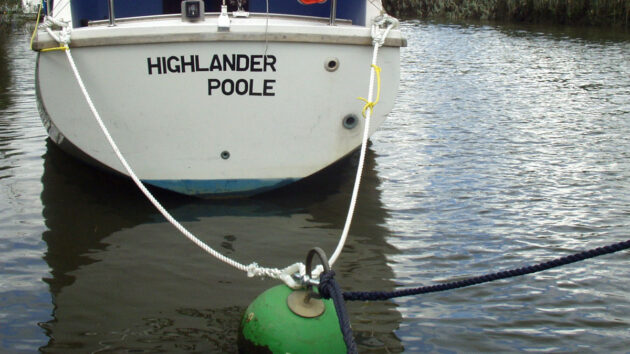
The stern moorings (two pendants in this case) shackled to the stern buoy, with bowline eyes dropped over the stern mooring cleats and secured with a turn of the pendant after the bowline. The floating line leads around the port quarter. The short length of floating line secured to the outboard pendant is for securing it to the inboard pendant when letting go, so it is readily available when you pick up the river mooring on return. Credit: David Cornes
On return the pickup buoy is easily grabbed with a boathook and the floating line enables the upstream mooring pendant to be retrieved and passed through the fairlead and over the mooring cleat. The floating line enables the downstream mooring pendant to be recovered at leisure, and is then dropped inside the guardrail stanchions: the pickup buoy sitting on the deck keeps it inboard.
If two stern pendants are required, attach a short length of line to the offshore pendant and, on departure, let go this pendant first and tie it to the other with the length of stray line.

Tips and tricks for sailing on rivers
Expert advice for tricks and tips for better sailing on rivers
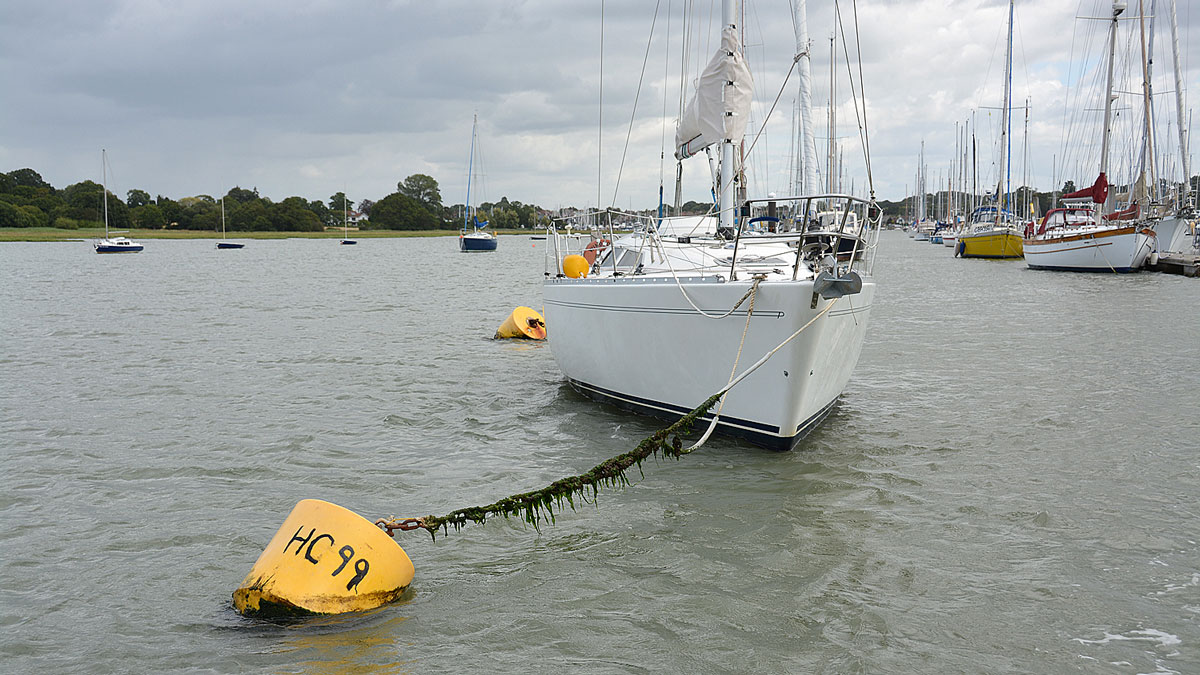
Safe mooring practices for winter gales
Numerous steps can be taken to reduce the likelihood of your moored boat sustaining – or causing – serious damage…
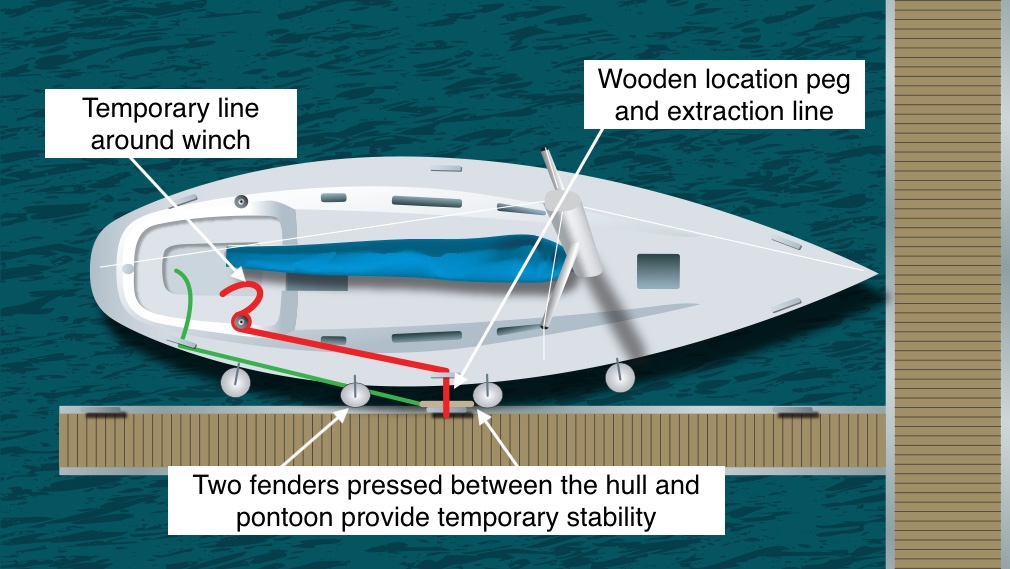
Solo pontoon mooring: How to slip a line from the cockpit
Slipping a pontoon mooring alone can be tricky, but this clever peg release system makes departure safe and effortless. Colin…
Laying ground tackle for swinging moorings
Sam Longley explains his yacht club’s DIY approach to setting new ground tackle for moorings on the River Blackwater
Want to read more seamanship articles like River mooring made easy: how to pick up fore and aft buoys?
A subscription to Practical Boat Owner magazine costs around 40% less than the cover price.
Print and digital editions are available through Magazines Direct – where you can also find the latest deals.
PBO is packed with information to help you get the most from boat ownership – whether sail or power.
-
-
-
- Take your DIY skills to the next level with trusted advice on boat maintenance and repairs
- Impartial, in-depth gear reviews
- Practical cruising tips for making the most of your time afloat
-
-
Follow us on Facebook, Instagram, TikTok and Twitter
PBO web categories