


Facing an Atlantic crossing with broken shrouds and two young children onboard is the ultimate test of seamanship for Vicky Ellis.
One teddy in the grab-bag, that’s the deal…
“But I can’t leave Stinky.”
“Yes, but we need space for the EPIRB.”
“Two, or I’m not coming!”
Not the negotiation a parent wants to have with their five-year-old in the middle of the Atlantic… but Vicky Ellis is not your ‘average’ parent. The professional round-the-world sailor is used to leading a crew through emergencies at sea, though admits being skipper to her own children is something she’s still grappling with.
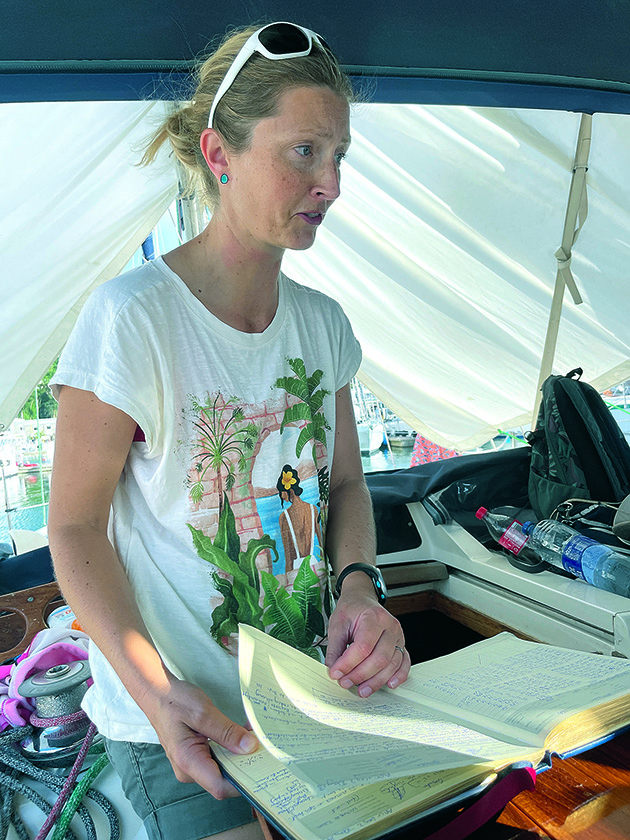
The failure of the port shroud was recorded in the ship’s log. Credit: Ali Wood
“I’ve skippered for the Ocean Youth Trust and the Ellen MacArthur Cancer Trust; I’ve taken so many kids to sea,” she says. “It’s lovely to be sailing with my own, but what I didn’t expect was how different it would be as a mother.”
An operations director and RYA Ocean Yachtmaster, Vicky has lots of tricks up her sleeve for managing crew, but being skipper to her husband and two children as they sail halfway around the world is a whole new challenge.
“When something comes up on a professional boat, you discuss it. You have goals, you have a crew charter, shared values you put in place and you bring people back to these and recentre that chaos,” says Vicky. “But with a family, you’re starting with a history of chaos. You have so much baggage you can’t start afresh. I think that’s been the big challenge; I know what a good boat team feels like, but what does a good boat-family feel like?”
Transatlantic emergency: Grenada arrival
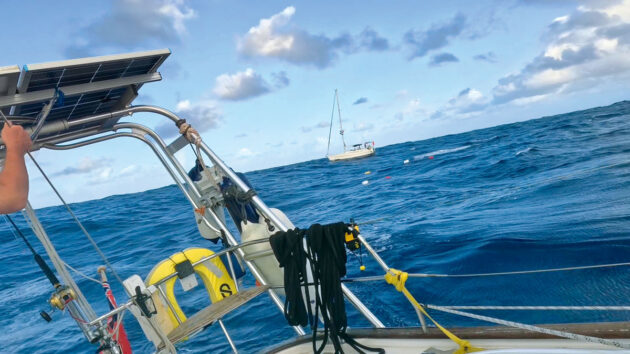
The family were recuperating on board their Moody 44 in Grenada’s Port Louis Marina where, less than 24 hours earlier, they docked to a rum punch and an enormous round of applause. Canopus has been the talk of the ARC+ rally ever since Vicky messaged the group on WhatsApp to tell them about their transatlantic rigging failure. The first leg, from Las Palmas to Cape Verde went smoothly, but the second – characterised by strong winds and squalls – proved to be a challenge for the newly-rigged monohull, which lost two shrouds.
It was the first transatlantic crossing for the Hampshire family, but not for Vicky, a commercial skipper who’d previously won an ARC rally on a Swan 53 and helmed in the Clipper round-the-world race. Her husband Laurie did his RYA Day Skipper and Jasper is a keen Optimist sailor. However, Canopus is the first yacht they’ve owned.
“I’ve managed to borrow other people’s boats my whole life, but then the kids got to a certain age and the invitations dried up,” says Vicky. “When we were planning the ARC+ we considered a catamaran, but that would be a big financial commitment, or we could go for an older monohull and make things a bit easier.”
A good, solid boat for a transatlantic crossing
Having previously worked for the ARC as a safety inspector, Vicky had a good idea of the kind of ‘solid boat’ she was after. It didn’t have to be top of the range, and so the Moody was a great fit for a transatlantic crossing. Having looked at several boats in the UK, Vicky went to Greece in January 2024 to look at the Moody 44 Canopus. She confirmed happily to Laurie that the keel was well bolted on.
“And what else is great about the boat?” he enquired.
“Well … I may have found us a bit of a project,” she replied.
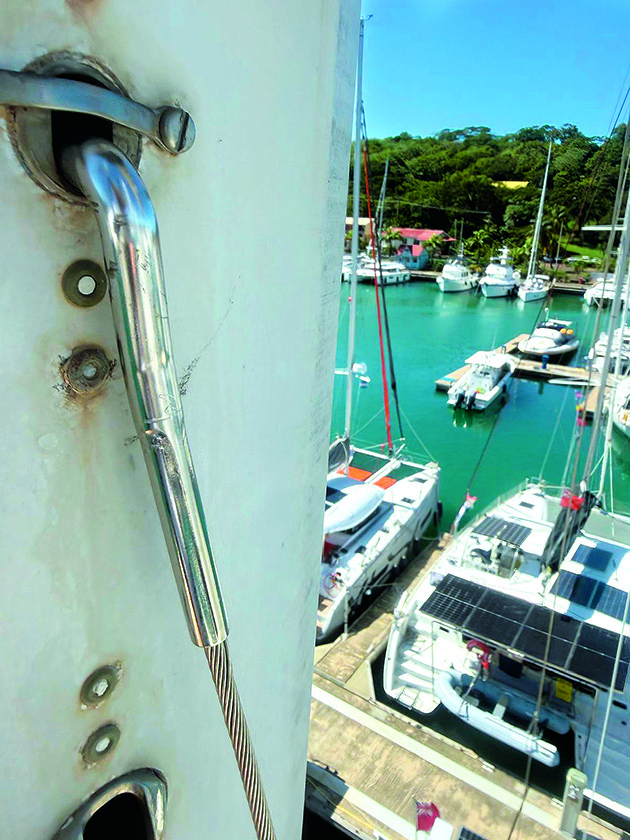
The damaged rigging of the mast of Canopus, photographed after completing the transatlantic crossing. Credit: Vicky Ellis
Among other things, the engine room was a ‘bit of a disaster’ but being engineers, Vicky and Laurie weren’t phased. The Perkins M60 was a decent engine and so the pair got to work on the boat, treating the Perkins to a full service and new cambelt and then fitting Canopus out for bluewater sailing with a Hydrovane, hydrogenerator, watermaker, satcoms and Garmin electronics. They also replaced all of the standing and running rigging, through-hull fittings and the steering cables.
By summer the following year, the kids had finished school, and Vicky and Laurie had taken sabbaticals. It was nearly time to set off. During a last burst of work before leaving Greece, Vicky switched her focus to preparing the children.
“We blew up the old liferaft in the back yard of the Airbnb, and I was playing in it with them. We got the oars out, they hit each other over the head. We chucked in some of the emergency kit and discussed what it would be like to be in here for real.”
Little did Saskia and Jasper know that they would later revisit this conversation in earnest.
Transatlantic safety first
Before departure from Las Palmas, Gran Canaria, the ARC+ yachts were inspected by World Cruising Club staff to ensure they had all the right safety equipment. Vicky got the kids to sketch the safety equipment and where it was on the boat. When it came to the final check (a job she used to do herself), she insisted that Jasper help his dad show the rally inspector around.
“It put a little bit of pressure on them to get it all sorted,” she says. “If we need one of the kids to get us the rig-cutting equipment, I want them to know where it is.” During the first leg to Mindelo, Cape Verde, they hugged the African coast, following the 200-mile contour to keep hold of the wind. It was a long voyage, but they did well.
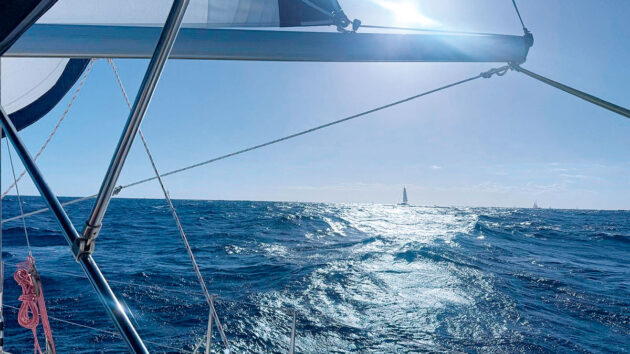
Chasing the horizon after the race start. Credit: Vicky Ellis
On the second leg, however, the tradewinds picked up. With just over 500 miles to go, conditions were, in Vicky’s words, “stellar: 20-knot winds, gusting 30 knots, and 3m to 5m breaking waves”.
They were sailing downwind with no main, and just a ‘handkerchief’ of a jib.
“We did 15.3 knots surfing, and covered 166 miles in 24 hours. We broke two records in a day.”
Unfortunately, the third thing to break was the port shroud, an incident recorded in the ship’s log as ‘Things that go bang in the night’.
It was 1am, an hour before Vicky was due to go on watch, when she was woken by Laurie with this grave news.
“I very much doubt it,” she replied from her bunk. But when she got as far as the companionway steps and saw her husband, ‘like a Greek mythological character wrestling with a snake of wires,’ she realised he was right.
“I’m like, this really is a shroud isn’t it!” she laughs. “I thought as long as we don’t lose the cap shrouds, we just need to keep going and we’ll be fine.”
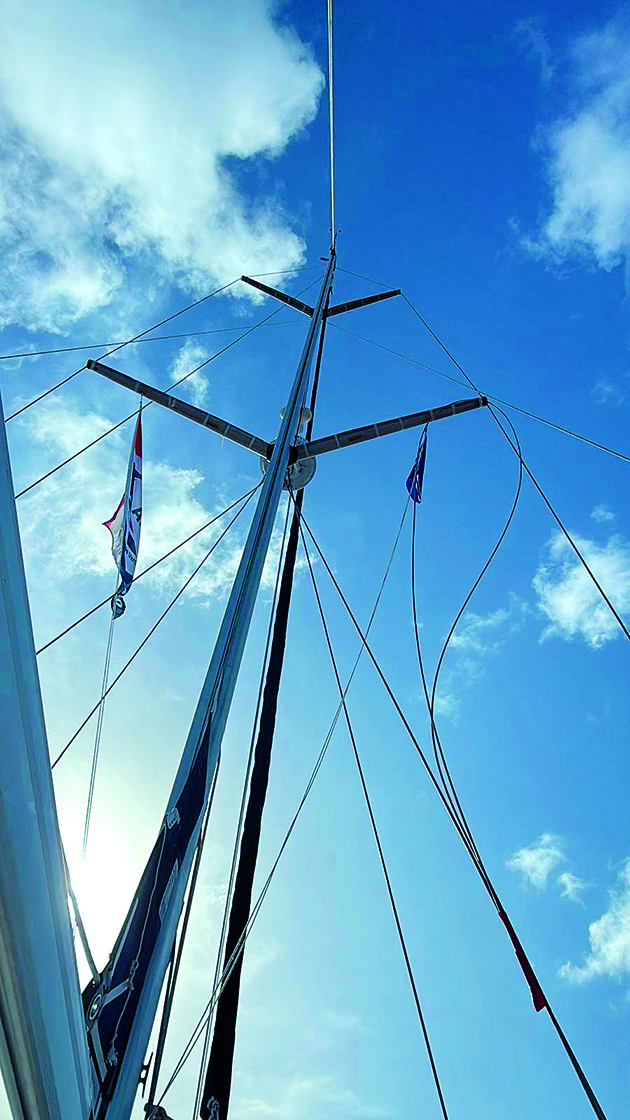
The snapped starboard shroud on Canopus’s mast. Credit: Vicky Ellis
Securing the rig
The next step was to secure the rig. Most spinnaker halyards run outside the mast, but on the Moody the Dyneema halyard runs inside to about 12in from the top.
“It’s a really good rope to have, so I ran that down to the chainplate where the shroud had snapped off. I ran everything else out, and I got the running backstays into commission. Because we don’t use our inner forestay, the backstays are lashed to the mast the rest of the time, so I got these up and running.”
Interestingly, at this stage, she didn’t consider dropping the sails. “It’s sometimes best to leave the sails where they are and get everything secure first. Racing in Antigua once, a boat careered into the back of us and took the backstay off. Your instinct is to take down the sails, but you’ve got to stop and think about the mechanics of it. The only reason the rig stayed up that time was because we had the mainsheet tight on. Sometimes the sails might be the only thing keeping the mast up.”
Remaining unfazed
An hour or so later, once the rig was secure, they rolled away the last bit of jib and switched to engine. Vicky wasn’t sure if the top shrouds had fatigued in the same way the lowers had. Were the engine to fail, she would run the mainsail to the first set of spreaders, which were fully supported.
When the sun came up, Jasper staggered on deck, asking why there was a coil of wire poking through the companionway hatch. Vicky and Laurie explained to him what had happened, which he viewed with interest, and then asked if maybe, once it was all fixed, they could sail ALL the way around the world and not just half?
Vicky inspected the mast but was concerned the lateral movement was still too much, so they moved the backstays to the midship cleats and applied a healthy amount of Dyneema lashing.
Even so, Vicky knew it would be a temporary fix. “I couldn’t stay it properly. I knew the other shroud was going to go eventually because the section of the mast it supported was panting, and the sea state was hideous.”
What it did do, however, was buy them time, during which Vicky made a WhatsApp call to the Martinique MRCC to inform them of the situation, and messaged the rest of the ARC+ fleet. The MRCC asked to be updated twice daily via text message. They prepared the kids for the worst – a de-masting – but hoped that the fixes would see them through.
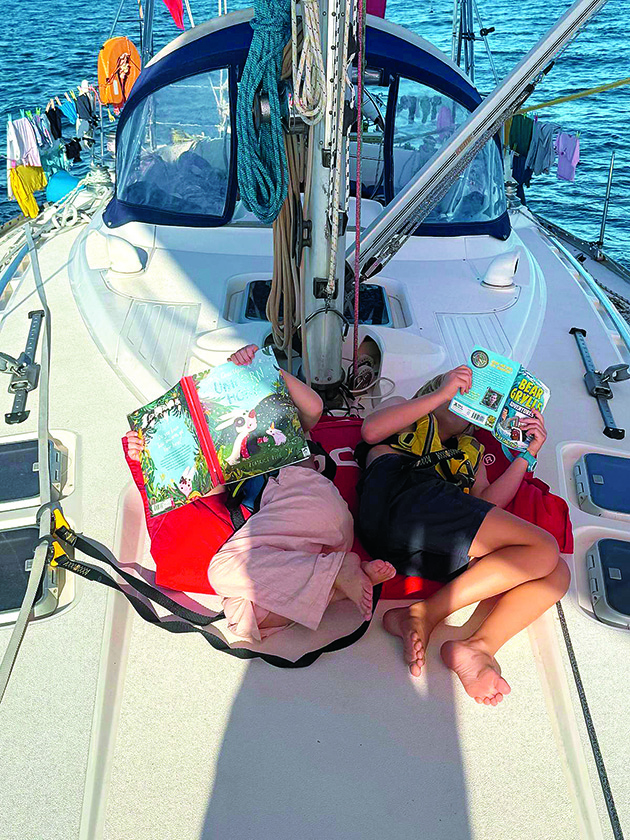
Jasper and Saskia took the transatlantic crossing and the emergency all in their stride. Credit: Vicky Ellis
Two British boats: Watergaw, a Southerly 135, and Fortuitous, a Moody 42, both offered to take the children. Vicky and Laurie had the conversation, but there was no way they were putting the children in the water.
“It was far too dangerous, but it was a lovely offer,” says Vicky. “We’re a safe boat, and we’re a solid boat, and we’re better as a family unit. I’m happy with the kids under my watch, and we kept them down below most of the time.”
The next step was to think about fuel. Did they have enough to motor all the way if needs be?
“I’ve run out of something on every ocean crossing; fuel, power, water, food, you name it,” says Vicky. “The year I skippered Girls for Sail in the ARC, an Elan 37, there were six of us, and we ran out of loo roll!”
It looked like they might be using more fuel than planned due to the barnacles and weed they’d picked up between Greece and Cape Verde.
“I looked over the front and we had this green beard. I hadn’t noticed it growing in the Med, and probably should have cleaned the hull,” says Vicky. “That and a combination of Sargassum weed was taking our speed from 5.5 knots to 4.8.”
By now it was 5pm, and they’d been running the engine for 12 hours. With 500 miles to go, they gratefully accepted the four cans of fuel offered by Chip and Sue Ogilvie, owners of Fortuitious, but decided to wait until the next morning to transfer them safely.
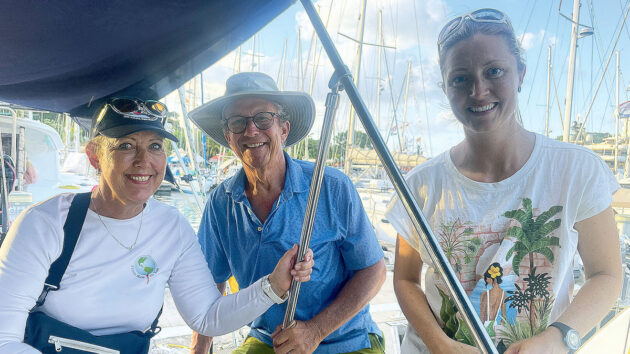
Vicky (right) with Sue and Chip Ogilvie in Grenada. Credit: Vicky Ellis
With Fortuitous standing by, there was nothing to do but put the music on and dance to Christmas songs.
“For the kids, it was a normal day. I’d say to them, ‘okay, I’m just going to check the rig is still up,’ then I’d come back and do some more dancing. I’d check the rig again, then we’d do a jigsaw.”
At first light, Chip and Sue prepared a 100ft floating line, attaching four diesel cans with two empty water cans at either end for floats. Jasper got to work on Canopus, lashing netting between the guardwires so the cans wouldn’t fall overboard once brought onto the boat.
With the boats in position, the Ogilvies threw the line of cans off the transom into the rough ocean. Vicky tried a couple of different approaches but ended up reversing upwind to the line of cans in the water. Laurie, standing on the transom, caught hold of the downwind float with the boat hook and hauled the line and cans on board. Rather than put the fuel straight into the tanks, they kept the cans stowed in the cockpit until the Ogilvies were close enough to land that they wouldn’t need them back.
Second shroud
As Vicky predicted, the opposite shroud went later that afternoon at 3pm. Again, they secured it. While careful not to worry the children, they did have clear conversations about safety; not just which teddies to take in the liferaft, but what Mum and Dad would need to do if the mast came down, and how they would have to put their lifejackets on.
“It would have been really stupid if the mast came down and punctured a hole in the boat, and we had last spoken about the liferaft in Las Palmas.”
Downstairs on Canopus is a whiteboard where Vicky and Laurie record all the boat concerns to be checked every couple of hours, along with the regular dawn and dusk rig check for wear and tear. By now the whiteboard was full, and the subsequent issue – which Jasper spotted – was that the snapshackle pins from the running backstays were coming loose. Not used to that level of load, they needed to be tapped back in with a hammer every 20 minutes. The following morning, Laurie secured the pins further with seizing wire.
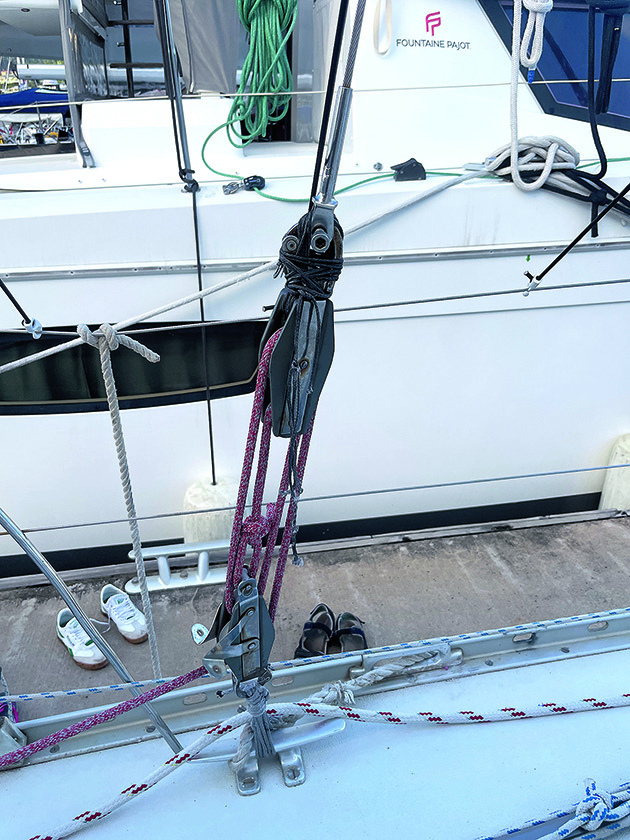
The running backstay was used to support the shroud for the remainder of the transatlantic crossing. Credit: Ali Wood
Fortunately, the rig stayed up for the remainder of the transatlantic voyage, but understandably, the magic of the transatlantic – the stargazing, movie nights and beanbags in the cockpit – was now a thing of the past. Unperturbed, the kids put on a nativity play and listened to audiobooks on their Yoto player.
“Jasper is at that age where he’s just absorbing everything. He had such a positive, constructive attitude, and Saskia too didn’t falter in her patience and resilience. We were so lucky,” says Laurie.
At the ARC+ prize giving ceremony in Grenada, the Ellis family won the Adversity award for overcoming their significant challenge during their transatlantic crossing, and Fortuitous, who had stood by and transferred fuel, received the Spirit of the ARC+ Rally award.
Vicky’s short time in Grenada so far has been centred on fixing the boat and the warranty discussions ahead with the riggers. The family plans to continue cruising up through the Caribbean to Florida, where they’ll ship Canopus back to the Mediterranean in the spring.
Laurie, meanwhile, has been reflecting on their transatlantic achievement. “I’m personally very proud of what we accomplished and how we did it together. Knowing what we know today, would we do it differently? I don’t think so – we chose our path, prepared well and have got this far together. We wanted a family bluewater trip to broaden ourselves and have adventures together – this was just the lot that we were handed. Maybe sometimes we need to be careful what we wish for!”
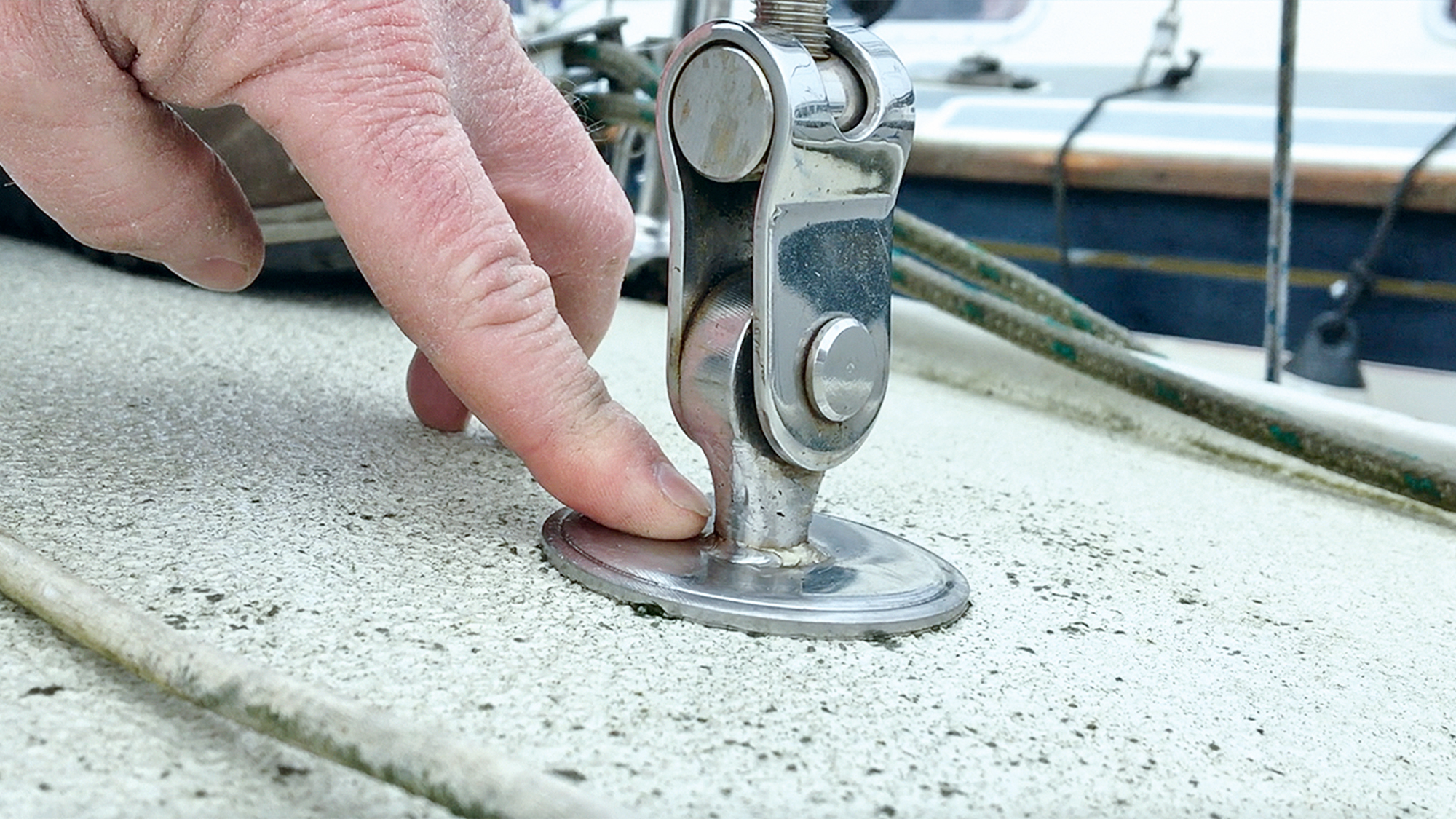
Fend off rigging failure: the most common problems and how to prevent them
Most sailors will probably have seen or experienced a stranded wire, or a failed swage, or the catastrophic resulting from…
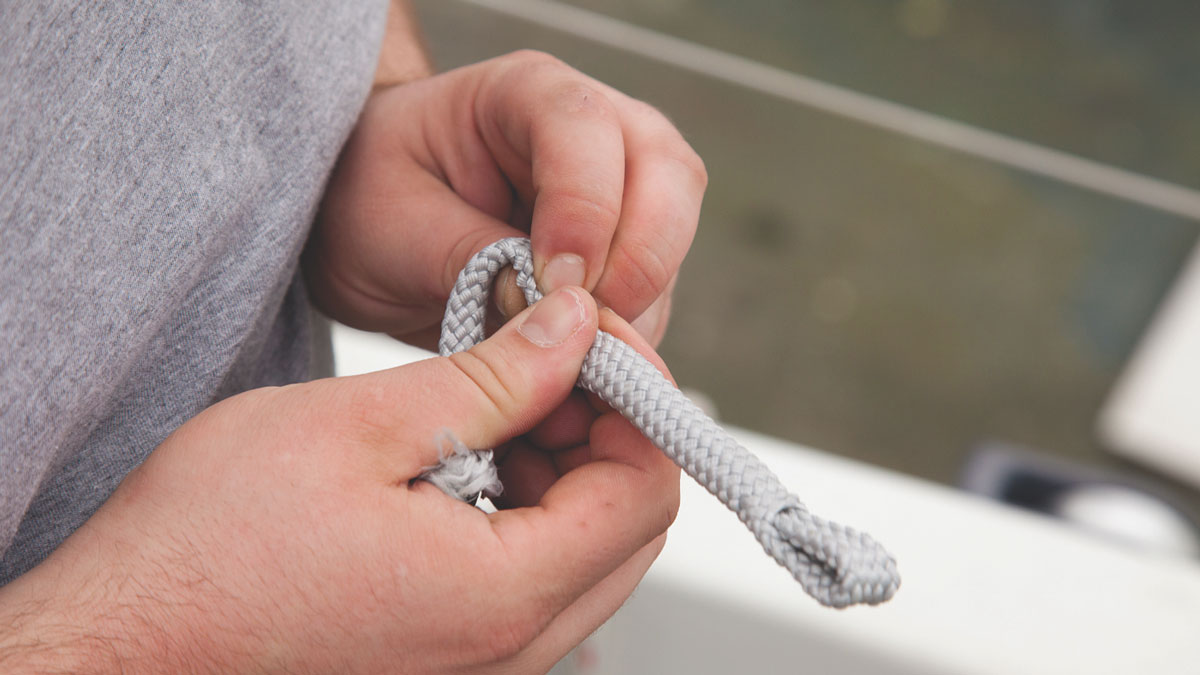
How to replace your running rigging: The essential DIY guide for older cruising yachts
Replacing old, tired lines is a critical job for any sailboat owner. Follow this step-by-step process for a full running…
Understanding metal fatigue: What causes rigging and engine failures?
Do you know the difference between a sudden fracture and a fatigue fracture? Understanding the characteristic 'beach marks' is the…
Understanding and mastering boat rigging
Your yacht’s rig remains upright thanks to the right balance of compression and deflection, as Owen Brown explains
What kit have you been impressed with while sailing your boat?
Follow Practical Boat Owner on Facebook, Instagram, TikTok and X