



Richard Thomson’s love letter to the original multipurpose inflatable dinghy - the Tinker

When I first set foot on a yacht, or rather crawled, I was just a matter of months old, writes Richard Thomson. There’s a picture of the occasion, but I was a little young to remember it. Instead, my first defining memory of sailing was a few years later, when I was probably around four or five.
That was on board the quirkily-named Tinker Traveller, with my father and younger brother, who was presumably around two or three at the time. It was on a freshwater loch in Scotland, the muted slate-grey waters and brown hilly backdrop offset by the bold red, yellow and blue primary colours of the little dinghy and its Bermudan rig. If falling in love is a process, then that rose-tinted day was surely the beginning of it all.
Tinker dinghy: Jack of all trades
The Tinker dinghy was conceived in the 1970s by Fred Benyon-Tinker and built in the UK by Henshaw Inflatables. It was a pioneering, multipurpose inflatable boat, designed to be rowed, motored, sailed and (with the addition of a survival pack) even used as a lifeboat with an inflatable canopy, though it was never certified as a liferaft. With solid, folding floorboards, it rolled up and would go in the boot of a reasonably small car. For those unfamiliar with the design, it sounds like a mad combination, I know.

Richard spent his childhood messing about in a Tinker dinghy. Credit: Richard Thomson
Having surely spent several hundred hours in the Tinker over three decades, I can testify that it did the first three remarkably well. I have no experience of the lifeboat modification, but there are accounts of it having saved lives. Geoff Hales, winner of the 1976 OSTAR and once-upon-a-time the technical editor of Yachting World, was certainly convinced. It saved the lives of him and his companion when they lost their keel in the Azores and Back Race in the 1990s. They spent six days inside a Tinker dinghy before being rescued, and I have read of a handful of other success stories (and no fatalities that I am aware of).
To return to my rose-tinted experience of carrying, rowing, motoring and sailing the Tinker Traveller: with solid, folding floorboards as well as inner and outer tubes, the Tinker is fairly heavy, but was just about manageable for teenage me to lug around rolled up. Blowing up first the inner and then outer tubes, she becomes remarkably stiff, with a distinctive low bow and sprayhood under which you could stuff a picnic and gear for adventuring or camping trips ashore.
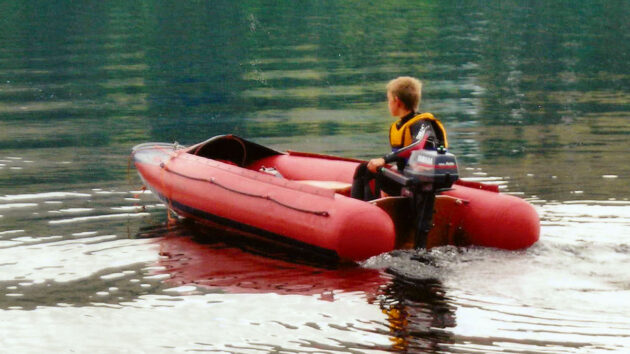
Under power, the Tinker Traveller could reach speeds of up to 14 knots. Credit: Richard Thomson
The oars have a locking rowlock mechanism, and there is a comfortable, integral wooden seat. The tubes extend slightly lower than the floor which provides surprisingly good directional stability, running almost straight from stern to bow to provide a long, uninterrupted waterline. With the long wooden oars, she rows faster and more easily than any other inflatable I have rowed since.
With a little 3hp Yamaha outboard engine on the back, the Tinker planes happily – almost too easily. With one person inside and at high revs on flat water she can hammer around like a drag racer. At 12ft long, the Traveller was the largest of the four variants built, and was specced for up to 5hp motors.
The easy to rig Tinker dinghy
To convert for sailing, the seat has a slot through which the plywood daggerboard passes. A step in the floor takes the mast, assembled from sections, with the upper and lower shrouds running to eyes on the tubes. The forestay extends down to an eye in the sprayhood. It sounds like it shouldn’t last, but the Tinker I know is around 30 years old and the eyes, fabric and seams are still going strong.
The plywood rudder has pintles and hangs securely from the transom, with a folding mechanism to lift it in shallows. To my memory this was always sticky, so you were reaching to fold it down by hand on shoving off, and lifting it by hand when returning to the shore.

The classic style Star Traveller was made from 1978 to 2001. Credit: Richard Thomson
The main runs up a track in the mast, and the little jib is hanked on, though I believe a performance version was sold with a miniature furler for the jib along with ties and a reefing pennant for shortening the main. The whole set-up for sailing takes perhaps 20-30 minutes with the hull already inflated.
Solid handling
How does she sail? Well, I began this article by saying the Tinker is my first memory of sailing, so of course I’m biased. That said, over the 30 years I’ve sailed her, I have also enjoyed sailing several dozen other craft from cruising dinghies up to teaching on board 50ft keelboats and catamarans, so I’ll try to claw back some of the bias by claiming a frame of reference. The Tinker Class Owners Association (TCOA) is still going strong and I’m sure would be equally biased.
So here goes: I think the Tinker sails remarkably well. She’s not a racer, but makes reasonable, dogged progress to windward, has two sails to play with, responds nicely to trim and weight distribution and steers easily. She’s very difficult to capsize (though it can be done and is surprisingly easy to right). Off the wind, she clips along nicely and will run goosewinged downwind.
She gives a pleasing hum when up to speed, and can be sailed solo or with crew. I have a separate memory of my father, brother, two dogs and myself sailing off on a camping trip, with all manner of stuff shoved under the sprayhood. I can’t think of many other 12ft sailing dinghies where you could cram in five living beings, a tent and provisions.
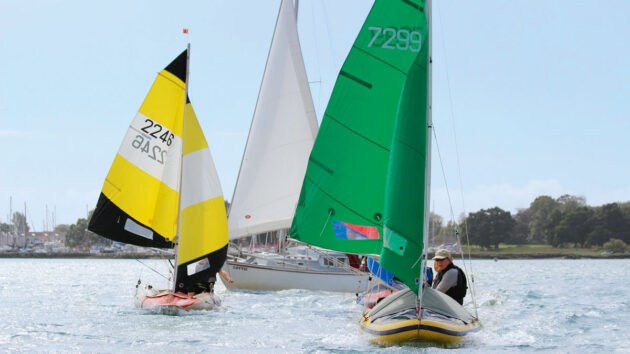
The Tinker Class Owners Association has six rallies a year. Courtesy of Tinker Class Owners Association
Rose-tinted glasses or not, I still happily come back to her in adulthood as she approaches her 30th year. Henshaw is still building inflatables but the Tinker brand sadly ended in 2010 after 35 years in production. I believe they’d become uneconomical to produce– too often a factor with extremely well-made, expensive products that last a long time.
For a young family looking to get out on the water together, for introducing very young children to sailing, or for packing in a car and taking on weekend adventures where you could choose to row, motor or sail, the Tinker ticked a lot of different boxes in one boat.
For those looking for a comparable option in today’s market, the Dutch-designed DinghyGo is perhaps the closest thing to the Tinker. Maybe in a few decades someone will look back nostalgically on their first memories of sailing one of them. Let’s hope so.
Tinker Class
The Tinker Class Owners Association (TCOA) has been bringing owners together for over 45 years, organising social sailing rallies and promoting the Tinker boats. Today the focus of the rallies is still on socialising and sailing, but also on preservation.
Six rallies are held annually at various venues to increase the boat’s presence and, through the website marketplace, help the boats to find new owners. To find out more visit: tinkerowners.uk
Dinghy launching tips from a prolific small boat owner
Keep a very long rope handy and, if launching single-handed, find a bystander to help... preferably one without a Rottweiler,…

Cornish Crabber 12: the dinghy that combines gunter rig tradition with surprising stability and space
Dinghy design is a complex balancing act, but the Cornish Crabber 12 manages to be roomy, stable, and fun to…
Repairing an inflatable dinghy: fixing holes
Paul Diamond repairs a dinghy that was chewed by rodents

Dinghy cruising: 30 ways to experience the ultimate small-boat adventure
Ben Lowings shares his tips for dinghy cruising around the UK and further afield
Want to read more articles like Tinker dinghy: the inflatable boat that could do it all!
A subscription to Practical Boat Owner magazine costs around 40% less than the cover price.
Print and digital editions are available through Magazines Direct – where you can also find the latest deals.
PBO is packed with information to help you get the most from boat ownership – whether sail or power.
-
-
-
- Take your DIY skills to the next level with trusted advice on boat maintenance and repairs
- Impartial, in-depth gear reviews
- Practical cruising tips for making the most of your time afloat
-
-
Follow us on Facebook, Instagram, TikTok and X