


From the humble Optimist to the offshore Mini 6.50, Saša Fegić shares his pick of the legendary designs that shaped sailing history.
The history of sailing is not just a story of wind and water – it is also a story of boats. Of six boats in particular: the Optimist, the Hobiecat 16, the Folkboat, the Swan 36, the J/24, and the high-performing Mini 6.50.
The sea has a way of separating the merely good from the truly legendary.
Some boats are just tools – floating concoctions of glassfibre and wood – while others etch themselves into the soul of sailing, rewriting the rules and leaving wakes that never fade.
From humble trainers to ocean-conquering racers, these designs didn’t just sail – they revolutionised sailing and inspired generations of sailors.
Optimist: Where sailors are born
Every sailor remembers their first love.
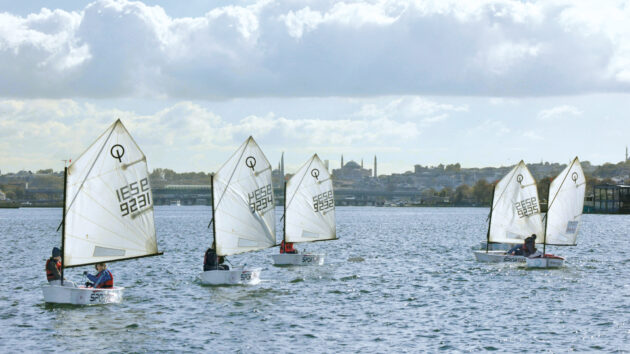
For most, it was an Optimist, a blunt-nosed plywood pram that felt like a bathtub but sailed like a dream.
It looks like a wooden box with a sail, and that’s precisely the point. It’s simple, cheap and legendary.
Designed in 1947 by Clark Mills as a simple, affordable trainer for children, the Optimist has introduced more children to sailing than nearly any other boat. It became the gateway drug for generations of sailors.
Its genius lies in its crude simplicity – three sheets of plywood, a single sail, no complications.
The story of the Optimist begins in Clearwater, Florida.
A spirited group of boys was hurtling down neighbourhood hills in wooden soapbox racers. The local Optimist Club saw promise in their reckless speed and boundless courage.
The club asked Clark Mills to design a sailboat that any child could build, sail, and afford. Mills sketched out what looked like a carpenter’s toolbox with a daggerboard, rudder, and a single sprit-rigged sail.
He called it the Optimist Pram.
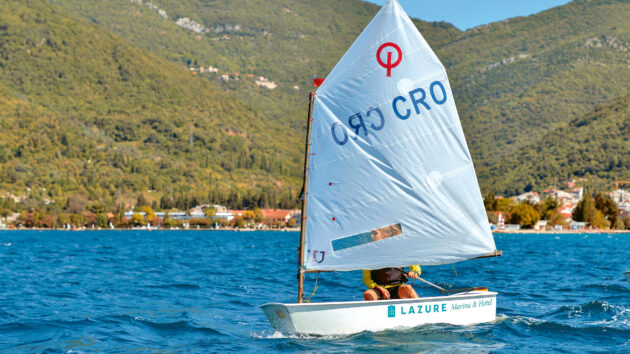
Getting competitive in an Optimist. Photo: Bratislav Stefanovic / Alamy.
Mills built the prototype from cheap plywood and nailed-together planks.
It was 7ft 9in long and 3ft 8in wide. Its sail, originally cut from bed sheets or surplus canvas, was as square as a postage stamp. But it floated. And it sailed.
In Denmark, a naval officer named Axel Damgaard refined Mills’ plans and translated them into metric measurements.
The result was the International Optimist, which quickly earned the approval of the International Yacht Racing Union (now World Sailing) in 1962.
From there, it spread like wind-borne seed. Yacht clubs, sailing schools, and Olympic committees took note. Within a few decades, the Optimist became the global training vessel for young sailors.
It was cheap to build, impossible to capsize without some considerable determination, and handled like a dream at the windward mark.
Today, over 150,000 certified Optimists are sailing in more than 120 countries. It is the most popular sailboat in the world.
The square-rigged paradox
The Optimist sails extraordinarily well.
The flat hull planes early, and the spritsail rig, while ancient in appearance, is powerful and easy to trim. The boat responds with immediacy to every twitch of the tiller or trim.
That is because it was designed with pure purpose: a wide, flat bottom that lifts onto a plane with surprising ease, and a bluff bow that punches above its weight in a breeze.
The short waterline and hard chines give it stability without sacrificing speed, making it both forgiving and fast.
The spritsail, simple and efficient, keeps weight low, and the sail shape is adjustable with a single line.
Who sails the Optimist?
There are plenty of Olympic medallists who started in an Optimist: Ben Ainslie, Robert Scheidt, Hannah Mills, Peter Burling, Santiago Lange – all are former Optimist sailors. It is the kindergarten of champions.
The Optimist is typically sailed by children aged eight to 15. At 16, they tend to move on to 420s, Lasers, or other high-performance youth boats. But many carry their skills and their reverence for the craft for life.
Who builds Optimists?
Today, certified Optimist boats are built by a small cadre of licensed manufacturers, including Winner (Denmark), Far East Boats (China), Nautivela (Italy), and BlueBlue (Poland).
These builders comply with strict International Optimist Dinghy Association (IODA) rules, which ensure uniformity for racing.
A new race-ready Optimist will cost between £2,500 and £3,800, while a used training Optimist can be bought for £380-£1,500.
Like the Mini 6.50, you could also build your own.
Plans, which cost between £110 and £150, are widely available from the Optimist Class Association or from Clark Mills’ original blueprints, now held in maritime archives and hobbyist sites.
However, to race in class events the boat must be measured, registered, and certified by the International Optimist Dinghy Association (IODA) to ensure it meets strict specifications.
Optimist specifications
Hull weight: 35kg/77lb
LOA: 2.36m/7ft 9in
LWL: 2.18m/7ft 2in
Beam: 1.12m/3ft 8in
Draught: 130mm-
0.84m/5in-2ft 9in
Mast length: 2.26m/7ft 5in
Mainsail area: 3.3m²/35ft²
Hobie Cat 16: the beach catamaran that started a revolution
Before the Hobie 16, catamarans were exotic beasts, rare, expensive, and confined to the elite.
Then, Hobie Alter unleashed this banana-hulled, daggerboard-free revolution. With 135,000 built, it turned beach cats into a global phenomenon.
The Hobie Cat 16 was born in 1969 in Dana Point, California. Its creator, Hobie Alter wanted to bring the thrill of surfing to sailing.
What he came up with was part Polynesian outrigger, part backyard experiment, and all rebellion.
It had asymmetrical hulls that eliminated the need for daggerboards, letting sailors blast off sandy beaches without tearing out their undercarriage.
The boat had kick-up rudders, a trapeze harness for outboard acrobatics, and a curved mast that flexed like a whip when the wind came alive.
It wasn’t a yacht. It was a catamaran in board shorts.
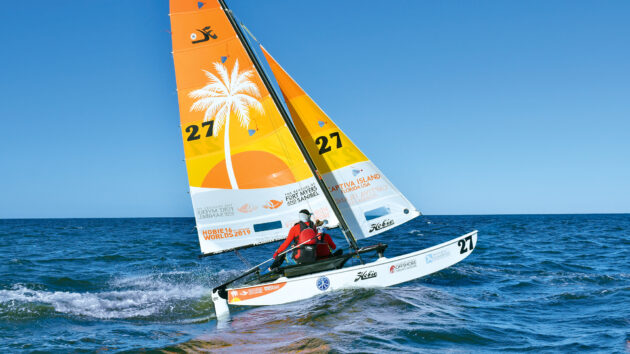
The Hobie 16 has no daggerboards, so it almost skims over shallow water. Photo: International Hobie Class Association (hobieclass.com).
Hobie Cat 16 sail performance
In light airs, the boat is gentle and quick.
It planes early. It hums across chop. It carves through waves. And when one hull rises out of the water – the classic Hobie ‘flyer’ – you realise this boat was built not just to sail, but to perform.
Capsizes are common. Pitchpoling, when the bow digs in and flips the stern over, is a rite of passage. The mainsheet requires constant vigilance. The trapeze is both a marvel and a menace.
But for all its instability, the Hobie 16 teaches you balance. It teaches you how to read the wind, how to trim with instinct, how to trust your crew and your own courage.
Much of it comes down to the design: asymmetrical hulls mean no need for daggerboards, so the boat skips over shallow water and turns on a dime.
The hulls are narrow and light, built to plane, not plod. The tall, fully battened mainsail powers the rig like a slingshot, and the wide beam adds just enough leverage to keep you on the edge without falling off, most of the time.
It is a boat with no keel, no ballast, and no interest in forgiveness. But that is the point.
It is not about comfort; it is about flight.
Who built Hobie 16s?
Today, Hobie 16s are still built and supported by Hobie Cat Europe (La Rochelle, France) and Hobie Cat Australasia, with standardised parts and class-legal specifications.
The Hobie 16 class remains tightly regulated. Any boat intended for official International Hobie Class Association (IHCA) racing must meet precise design specs.
A ready-to-race Hobie 16 will cost in the region of £9,800 to £12,000, while a used example can be bought for £1,500-£7,500, depending on the condition.
Who sails on Hobie 16s?
The Hobie 16 is one of the world’s most widely raced catamaran class. It has World Sailing international status and a fiercely loyal following.
There are continental championships, youth series, world regattas, and a legendary culture of camaraderie and chaos. Hobie sailors are a tribe.
The Hobie 16 endures because you can learn to sail it in an afternoon, but spend a lifetime mastering it.
It rewards boldness but punishes arrogance. It is a great equaliser: fast enough for racers, forgiving enough for beach bums, simple enough for children.
Hobie 16 Specifications
LOA: 5.05m/16ft 7in
Beam: 2.41m/7ft 11in
Hull weight: 145kg/320lb
Mast length: 8.08m/26ft 6in
Mainsail area: 13.77m²/148ft²
Jib/genoa area: 5.12m²/55ft²
Spinnaker area: 17.5m²/188ft²
Folkboats: the timeless people’s yacht
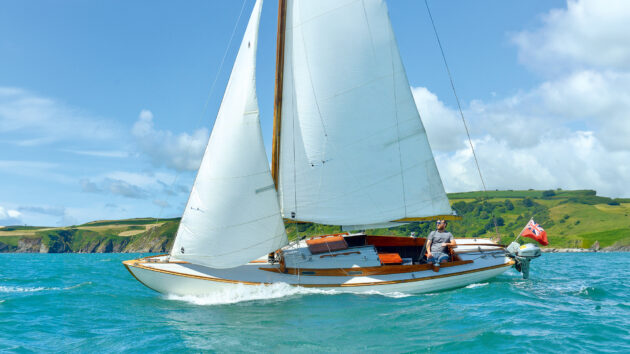
The Folkboat’s sharp bow deflects the waves, helping to cement the boat’s reputation for excellent all-round performance. Photo: Nic Compton.
Born from wartime scarcity, the Nordic Folkboat was designed to be simple and affordable.
Tord Sundén stitched together the best ideas from a failed design competition, and what emerged was a tough, no-nonsense keelboat that refused to die.
Over 4,000 still sail today, proof that true legends are not about speed alone, they are about endurance, simplicity, and a kind of stubborn grace.
The Folkboat taught us that great design is not about complexity, it is about getting the fundamentals right.
During World War II, the Royal Swedish Sailing Association held a design competition: build an affordable, seaworthy cruiser-racer for amateur sailors. Dozens of plans were submitted, but none were quite right.
So the association members took the best features of several, handed the rough idea to naval architect Tord Sundén, and asked him to design a boat.
What he produced was the Folkboat: clinker-built, gunter-rigged, long-keeled, and so honest in her lines she looked like she had always existed.
How the Folkboat sails
With a full keel and transom-hung rudder, the Folkboat tracks beautifully.
At 2.2m wide, the yacht is narrow, but what it lacks in interior space, it makes up for in balance.
The Folkboat sails best at a lazy heel, with helm so light it feels like thought.
In light airs, she is patient. In a blow, she doesn’t flinch. She doesn’t pound, but knifes through chop, and that is no accident. Her long, narrow hull slips easily through the water with minimal resistance, even when the breeze barely stirs.
Her full keel and low centre of gravity keep her on her feet when the wind pipes up, and the fine entry forward, combined with modest displacement, lets her slice through steep waves instead of slamming into them.
There is no gimmickry, no flash – just the kind of honest, balanced shape that lets the boat and the sea work together, not against each other.
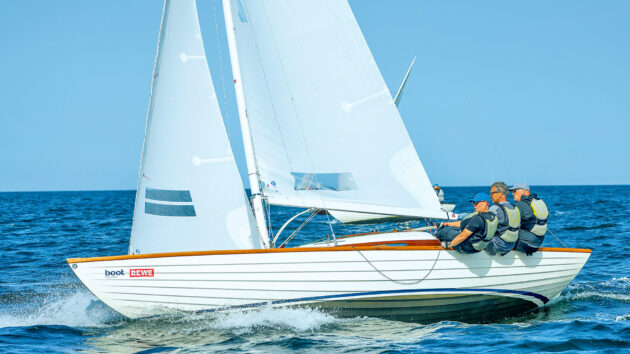
The Folkboat’s sharp bow deflects the waves, helping to cement the boat’s reputation for excellent all-round performance. Photo: ChristianBeeck.de / Nordic Folkboat Class Association (folkboat.com).
Who sails folkboats?
The Folkboat has an almost monastic following. In Scandinavia, the boat is treated like a national treasure. In Germany, she is revered.
The Gold Cup, the unofficial world championship of Folkboat racing, is held annually and draws boats from all over Northern Europe.
She is sailed by old salts and young idealists, by weekend dreamers and hardcore racers.
For many, a Folkboat is their first ‘real’ boat, and often their last – they just stick with them.
Who built folkboats?
Originally built in Sweden, Denmark, and Finland, the Folkboat’s construction was strictly wood: clinker-planked mahogany over oak ribs, with a certain reverence for the craft.
The International Folkboat emerged in 1967. This was a glassfibre version with slightly more freeboard, built under license in Sweden and later Germany.
Today, you can still buy a brand-new GRP Folkboat from Folkeboat Centrale in Denmark, or commission a wooden one from a handful of master builders in Scandinavia or the UK.
If you have the tools (and the time), you can even build your own with plans, which cost around £170 to £435 from the Nordic Folkboat International Association.
A new wooden Folkboat will set you back between £60,000-£90,000, and used examples can be picked up for £4,500-£9,000.
Folkboat specifications
LOA: 7.68 m/25ft 2in
LWL: 6.00m/19ft 7in
Beam: 2.20m/7ft 2in
Draught: 1.19m/3ft 11in
Displacement: 1,930kg/4,255lb
Ballast: 1,000kg/2,205lb
Mainsail area: 14.80m²/159ft²
Jib/genoa area: 5.63m²/61ft²
Swan 36: the birth of a legend
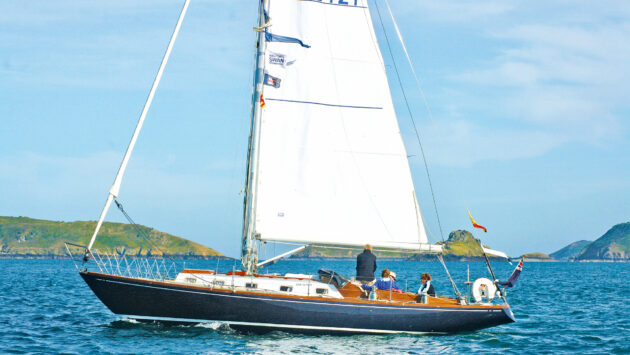
The Swan 36 was a race winner when first launched – and still performs today. Photo: Peter Poland.
When Nautor’s Swan launched its first boat, nothing was the same again.
The Swan 36 wasn’t just fast: it was ruthless, ditching the full keel for a fin-and-rudder setup that left competitors choking on its wake.
When Casse Tete II swept Cowes Week in 1968, winning every race, the world took notice. This was the boat that established Swan’s reputation for building elegant and fast boats that lasted.
The Finnish company Nautor was founded by Pekka Koskenkylä.
He partnered with the legendary naval architects Sparkman & Stephens, and together, they designed the Swan 36; hull number one splashing in 1967. She was the first production yacht from Nautor’s and the first S&S design to be mass-produced in glassfibre.
Everything was overbuilt. Laminates were thicker than needed, hull-deck joints bolted and glassed, and chainplates through bulkheads. She was stiff. She was balanced. And she was fast in a way people did not expect.
A knife through history
Light at the helm, poised upwind and lithe downwind, when the breeze came on, the 36 did not flatten and cower; instead, she leaned in and asked for more.
She carried full sail when others reefed, and she did it without drama.
In her first major outing, the 1968 Cowes Week, Swan 36s placed 1st, 2nd, and 4th in their class. The Royal Ocean Racing Club took note; everyone did.
By the early 1970s, Swan had become synonymous with excellence, and it started here.
Beneath the waterline she was radical: a fin keel with a separate skeg-hung rudder – a configuration that would become standard for decades.
The fin keel gave her lift and agility, letting her tack with a snap and point higher into the wind than her full-keel rivals.
The separated rudder, tucked behind the skeg, added control without the drag of a barn door. Together, they made her lighter on her feet, more responsive, and faster through the water. She didn’t just sail well; she danced.
Today, Nautor’s still builds Swans, bigger, sleeker, and more advanced, but many old hands still swear by the 36.
Who owns Swan 36s now?
Swan 36s have aged like old scotch: you won’t find many on the market, and the ones you do find are rarely cheap.
They are labours of love, kept by sailors who can quote sail numbers like wedding anniversaries.
Depending on the condition and upgrades, a used Swan 36 will cost in the region of £35,000 to £90,000.
Despite her age, the Swan 36 still qualifies for classic yacht regattas, still sails across oceans, and still races under ORC and IRC rules in local fleets.
She is a living reminder that quality isn’t a luxury; it is a philosophy.
Swan 36 specifications
LOA: 11.00m/36ft 0in
LWL: 7.77m/25ft 6in
Beam: 2.95m/9ft 8in
Draught: 1.80m/6ft 0in
Displacement: 7,000kg/15,400lb
Mainsail area: 21.3m²/229ft²
Jib/genoa area: 27.7m²/299ft²
Spinnaker area: 101m²/1,088ft²
J/24: The everyman’s racer
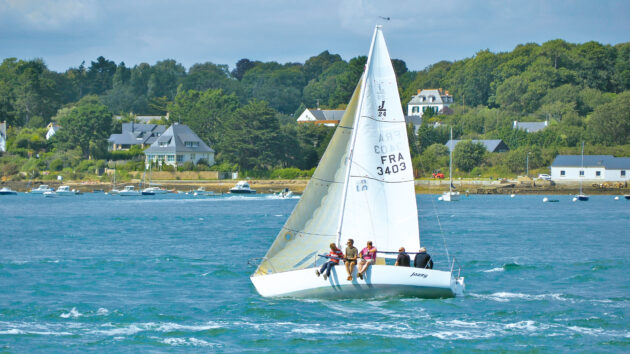
The J/24’s narrow waterline and generous sail area means she heels early. Photo: pxhere.com.
The J/24 is one of the world’s most popular keelboats, with over 5,500 hulls and a one-design class in 27 countries. It’s not the fastest, and not the flashiest, but it is accessible, and that is why it endures.
The secret? Brilliant one-design racing that puts the focus on skill rather than budget. The J/24 proved that great sailing doesn’t require deep pockets, just good design and great competition.
In 1975, Rod Johnstone did what a lot of disillusioned sailors dream about: he ignored everyone and built his own boat. He designed the J/24 in his garage in Stonington, Connecticut, and built the yacht there, too.
Called Ragtime, this prototype was fast and won often; people began to take notice, and a year later, Johnstone and his brother Bob launched J/Boats.
In 1977, the first production J/24 slid down the ramp. By 1980 the brothers had sold 1,000 boats.
The J/24 was, and still is, a creature of blunt purpose. She looked less like a boat and more like a torpedo with a spinnaker.
Down below, it was sparse: two bunks, a sink, and a portable potty if you were lucky. But no one bought a J/24 to go cruising. They bought one because they wanted to go faster than everyone else for less money.
Sail handling on the J/24
The J/24 is tender in light air, grippy upwind, and an absolute riot downwind in pressure.
At speed, you steer with your fingertips. She is not forgiving, not docile – but she is honest.
Sail her well, she rewards. Sail her badly, she tells everyone on the racecourse. And that is why the J/24 is still one of the most competitive one-design classes on earth.
The secrets are in the hull and rig.
With a narrow waterline and generous sail area, she heels early – but that heel locks in the long, fin keel and low-aspect rudder, giving her bite when pointing.
The displacement is moderate, just enough to carry momentum through a lull, but light enough to surf when the breeze fills in. Her fractional rig keeps power down low and manageable – until it is not – and demands sharp trim and constant attention.
Who sails the J/24?
J/24s are the Volkswagens of the sailing world: cheap, reliable, and raced by everyone from Olympic hopefuls to amateurs.
The class is strict. Every boat is the same, which means the only real advantage you might have over the other racers is your seamanship and skill.
The J/24 is one of the most successful keelboat classes in history. Boats were produced in the USA, Italy, France, Argentina, and Japan.
Today, they are still made by J/Composites and licensed builders. A second-hand race-ready example will cost in the region of £7,500-£30,000.
J/24 Specifications
LOA: 7.32m/24ft 0in
LWL: 6.10m/20ft 0in
Beam: 2.71m/8ft 11in
Hull weight: 1,406kg/3,100lb
Draught: 1.22m/4ft 0in
Mainsail area: 12.68m²/136ft²
Jib/genoa area: 11.6m²/125ft²
Spinnaker area: 41.7m²/449ft²
Mini 6.50: Offshore punk rock
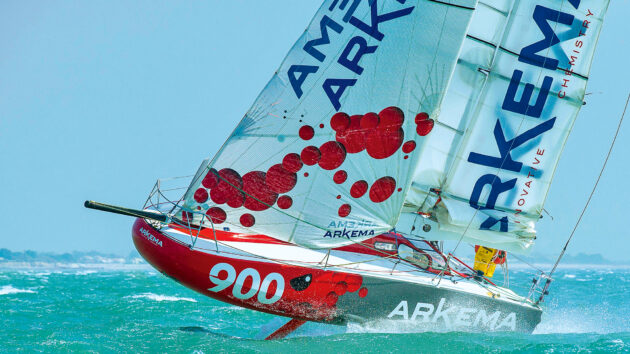
A scow-bowed Mini 6.50 provides sailing right on the limit. Photo: DPPI Media / Alamy.
The Mini 6.50 is one of the most influential designs in modern sailing.
Short, beamy, and brutally unforgiving, the Mini 6.50 is where solo sailors and offshore racing’s future is forged. These pocket rockets hit 25 knots, testing sailors and innovations in ways no other class dares.
Conceived as an affordable proving ground for solo ocean racing, these boats push sailors and technology to their limits and serve as a testing ground for innovations that later appear on grand prix ocean racers.
Racing on the Mini 6.50
The Mini Transat remains the ultimate trial by fire. What works here ends up in the Vendée Globe. They are proof that big things really do come in small packages.
The idea for the Mini Transat started in Britain during the late 1970s. Bob Salmon took a long, hard look at the burgeoning offshore racing scene, and an idea for a boat which could be cheaper to race began to germinate.
The first Mini Transat race took place in 1977, from Penzance, England, to Antigua, with a stopover in Tenerife.
The rules were cunningly simple: the boat must be 6.50m/21ft 3in long, and sailed solo with no outside assistance.
It was not long before sailors across the Channel wanted to take part, and in 1985, the race start was moved from the UK to Brest.
What emerged from those early races was the Mini 6.50 class, which is now dominated by the French.
The Mini 6.50 is the punk rock of offshore racing. And like punk rock, it is loud, violent, and does not care what you think about it.
There are two types: Production Mini 6.50s with a fixed keel, simpler rig, and limited experimentation, and Protos, which are built with full carbon, canting keels, twin rudders, water ballast, retractable bowsprits, scow bows, and sometimes things even the designers can’t explain.
The hull is blunt, beamy and flat-bottomed. It does not slice waves; it hammers them. The newest boats are scow-bowed, riding their own bow wave like over-caffeinated dolphins.
Sail performance on the Mini 6.50
The Mini 6.50 is light, twitchy, and brutally responsive. The sail area is so oversized that in 15 knots of wind, you are already thinking about a reef. Downwind, they are surfing at 14-18 knots.
The hull is ultra-short and ultra-wide, with hard chines that let it pop up and surf rather than dig in and drown.
Twin rudders stay buried even when wildly heeled, giving you control when you least deserve it. The towering mast and oversized sail plan are about raw horsepower.
With so little weight and so much canvas aloft, even a modest puff can launch the boat onto a plane.
Downwind, the huge sail area pushes the boat forward like a rocket sledge. It is a power-to-weight ratio most racers only dream of – and one that turns breeze into adrenaline.
But that power comes with a catch.
The ballast ratio is minimal, just enough to keep you upright if you’re paying attention. There is no deep keel to save you, no heavy bulb to bail you out. The boat relies on hull form, speed, and sheer nerve for stability.
When things go wrong, the Mini 6.50 doesn’t gently round up. It bolts.
Who makes the Mini 6.50?
A dozen small yards are turning out Mini 6.50s across France, Italy, and even Poland.
Famous builders include Pogo Structures, IDB Marine, Ofcet and Raison Designs, which is responsible for the infamous scow bows.
Foiling has also been embraced, such as the Sam Manuard Mini 6.50 Xucia, which could be an indication of how the design will go.
Many sailors build their own, stitching together carbon panels in farm sheds, garages, or shipping containers.
Every few years, someone shows up to the Mini Transat in a boat they built entirely themselves.
Held every two years, the Mini Transat starts in France, hops to the Canaries, then flings these pocket rockets across the Atlantic to the Caribbean.
Who sails the Mini 6.50?
Most entrants are French, often aspiring Vendée Globe skippers, and the occasional Kiwi or Brit, and they are not allowed satphones, tablets, chartplotters or weather routing, just charts, SSB radio and a weather fax.
The cost of a new Proto is between £105,000-£160,00, while a new Production is £52,000-£80,000.
Used boats are available from £8,650-£44,000, depending on the age, scars and trauma level.
Mini 6.50 specifications
LOA: 6.50m/21ft 4in
LWL: 6.20m/20ft 4in
Beam: 2.70m/8ft 9in
Displacement: 1,150kg/2,535lb
Draught: 1.36m/4ft 6in
Sail area upwind: 30-40m²/
323-431ft²
Downwind with kite: 80m²-90+m²/861-969+ft²
Saša Fegić began sailing in his teens, worked as a deckhand, charter and delivery skipper, sailing school operator and boatbuilder. He spent months restoring the 10m/32.8ft HIR 3 before circumnavigating the world.
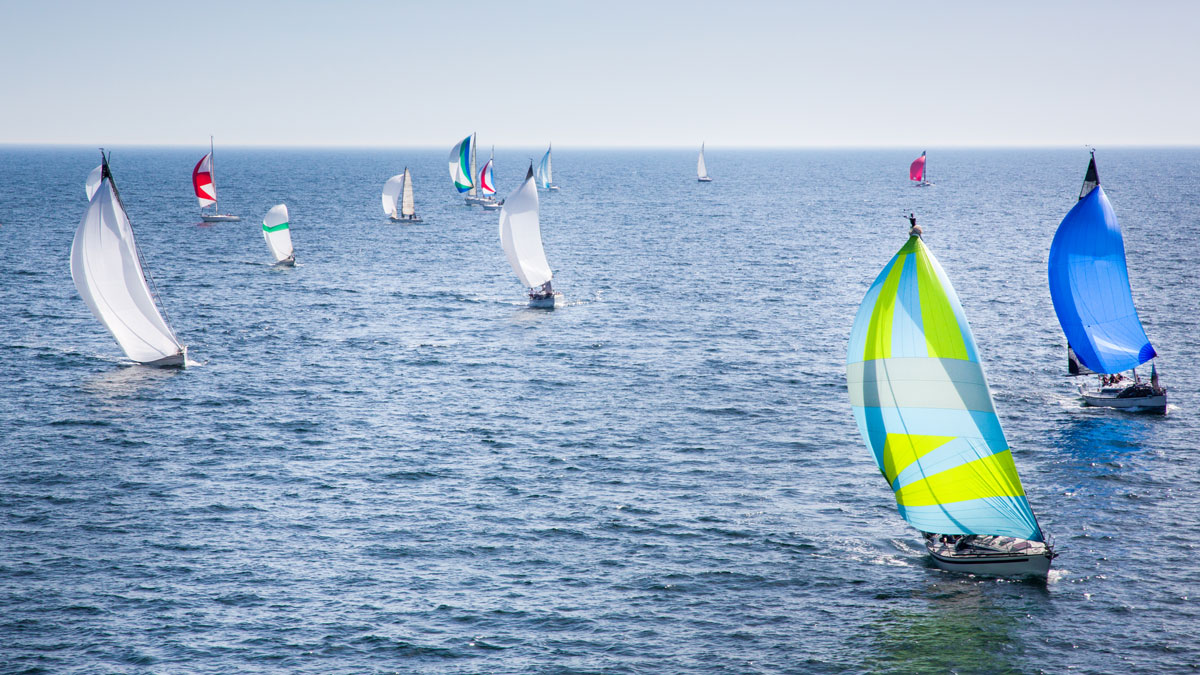
Why you should race your cruising boat
Ben Meakins finds out why – and how – PBO readers from around the UK go racing in their cruising
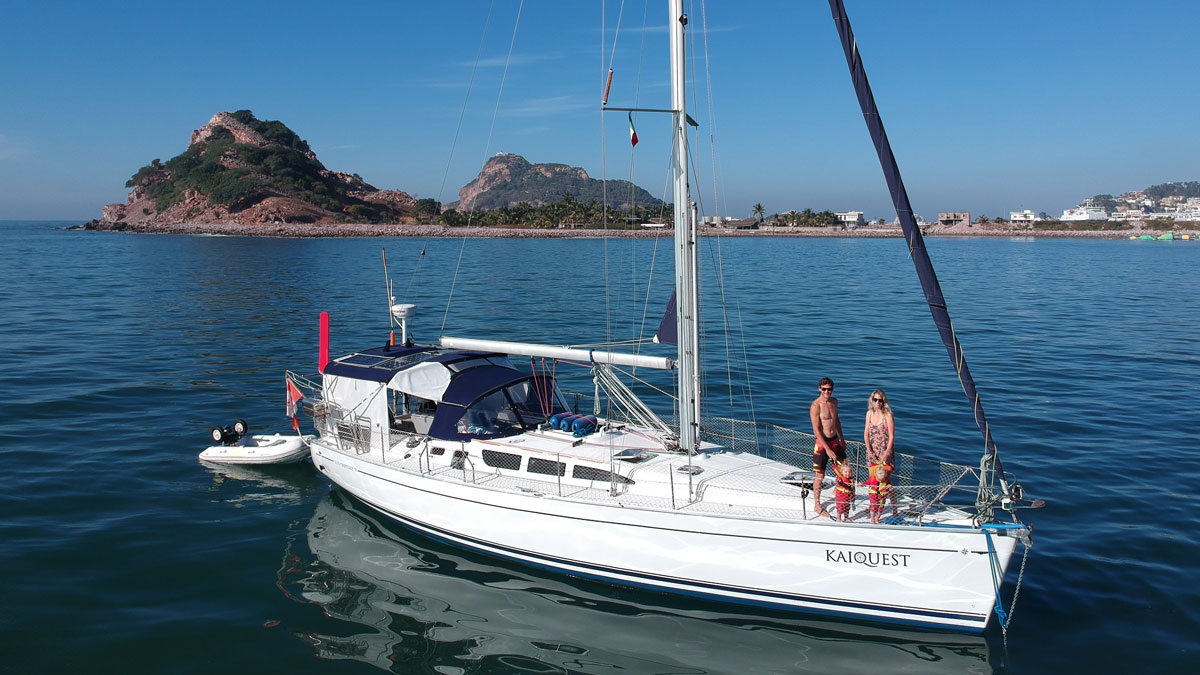
How we live the dream: sailors share their routes into bluewater sailing
There are many paths to bluewater cruising. Here boat owners share their stories with Ali Wood ahead of their transatlantic…

Baltic Sea sailing: the best boats under 40ft for cruising adventure
Duncan Kent picks the best second-hand sub-40ft sail and power boats for crossing the North Sea and exploring a Baltic…

Best boats for sailing around the UK: sail & power
Duncan Kent chooses the best sail and motor boats under 40ft for circumnavigating the islands of Britain and Ireland
Want to read more articles about the Mini 6.50?

A subscription to Practical Boat Owner magazine costs around 40% less than the cover price.
Print and digital editions are available through Magazines Direct – where you can also find the latest deals.
PBO is packed with information to help you get the most from boat ownership – whether sail or power.
-
-
-
- Take your DIY skills to the next level with trusted advice on boat maintenance and repairs
- Impartial, in-depth gear reviews
- Practical cruising tips for making the most of your time afloat
-
-
Follow us on Facebook, Instagram, TikTok and Twitter