



Small boat sailor Webb Chiles talks to Katy Stickland about the lure of solo sailing, preparation and why he has sailed around the world six times
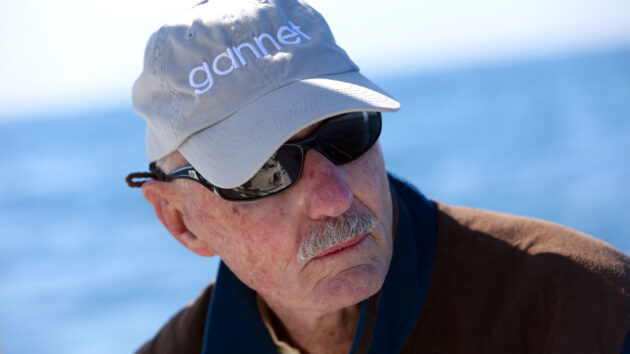
“The first wave knocked us down; the masthead was level with the water, and the gunwale was way beneath the water. The second one broke over us and held us there. I’m watching the water level, knowing that I hadn’t had time to put in the washboard and it’s getting very close to the cockpit. If it gets into the cockpit, it’s probably going to come down below, and if it starts to come down below, we’re going down.” Webb Chiles was 77 when he finished his last circumnavigation aboard his Moore 24, Gannet, having sailed through freak waves, 55 knot storms, been becalmed and endured a shoulder injury…he also did the voyage with limited sight as he is blind in his right eye.
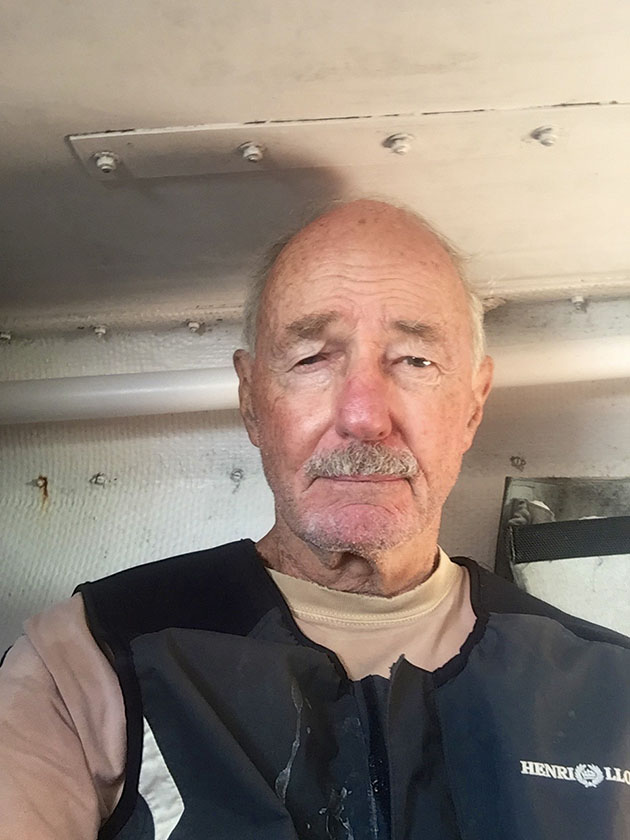
Webb Chiles on his 39th day at sea during his longest passage – 6,000NM. Credit: Webb Chiles
But this is a sailor who is no stranger to passages alone or battling extremes, having completed six circumnavigations – some via Cape Horn; others via the Panama Canal – over his 85 years in boats ranging from an 18ft Drascombe Lugger yawl to a 37ft Ericson cutter, She 36 and a 37ft Heritage Morgan One Ton. Chiles has also survived being falsely imprisoned as a spy in Saudi Arabia, where everything he owned, including his Drascombe Lugger, Chidock Tichborne I, was taken from him by the authorities and the sinking of his She 36, Resurgam off the Florida coast; he floated and swam for 26 hours and was carried more than 125 miles by the Gulf Stream before rescue thanks to an anchored fishing vessel.
As a result of these experiences, Chiles is philosophical and almost poetic when he recalls his sailing voyages. He has just published his latest book, Gannet 6: You’re Not Too Old about his last 30,000NM circumnavigation, which he sailed; the Torqueedo Travel 1003 electric outboard was only used for 15NM during the voyage.
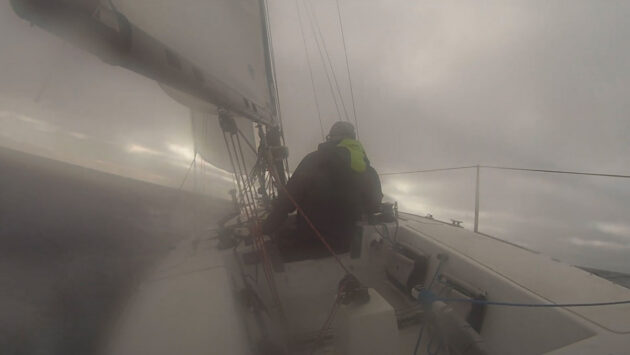
Most of the controls on Gannet are within reach of the companionway or cockpit. Credit: Webb Chiles
Chiles spent two years living aboard the George Olson-designed Gannet; in total he estimates he has spent 10 years living at sea alone and even with the advent of satellite communications, still prefers to sail disconnected from life on land.
“The defining responsibility of the artist is to go beyond the edge of human experience and send back reports. I have written about going out into the monastery of the sea. You can’t really totally experience the sea if you’re talking to the land every day or playing to an audience every day. When I go to sea I disconnect; you can’t have a conversation in a monastery; I just have my Yellowbrick (YB) tracker and send a short email once a week to my wife, Carol to tell her I am OK. And that’s it.”
Why Webb Chiles prefers small and simple
Webb Chiles chose the ultra-lightweight Moore 24 due to its simplicity and its sail performance. Designed to race around buoys in harbour, Moore 24s are fast. During the first leg to Hawaii, Chiles sailed just over 1,000 miles in a week; Gannet’s sail wardrobe is an asymmetrical spinnaker, fully battened mainsail, and a furling jib.
“What’s impressed me is how quickly she accelerates. You’ll be going along at six or seven knots, and you get a little more wind or a wave, and you’re doing double digits. All my boats were good sailing boats, but they didn’t accelerate like that. I’ve never seen double digits as often as I have on Gannet, even on 37-foot race boats that were one-tonners.”
While Gannet was “a joy to sail”, living conditions were more of a challenge.
“I have said that there is waterproof, and there is Gannet-proof, which is only exceeded by submarines, one of which she often resembles. She has about two-thirds of a metre of freeboard—say, two feet. She’s flush-decked, she moves fast, and a lot of water comes over,” explains Webb Chiles.
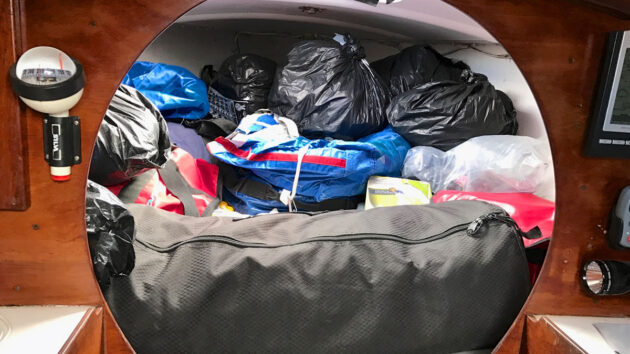
Gannet in passage mode; everything is in waterproof bags. Credit: Webb Chiles
Originally he started the circumnavigation with no sprayhood as he likes to sail from the companionway and it would have got in the way; by Durban he decided to have one made, based on a design sent to him by one of his many fans.
“That made a lot of difference. Less water came down below, but there was still water. Everything on Gannet that can be damaged by getting wet, like computers and laptops, has to be in a waterproof container. Everything still gets wet, including me.”
Sleep was often in a sodden sleeping bag, a plastic bag over a wet pillow; Webb Chiles suffered saltwater sores.
Water problems were not confined to down below. He went through ten Raymarine ST1000 tiller pilots during the course of the voyage; the weak part – where the piston connects to the housing – is difficult to fully waterproof and was the Achilles’ heel. All were under warranty and sent back to Raymarine for repair.
“At one point, I kind of expected an email back saying, “What in the hell are you doing with our autopilots?” and I would have simply said, “Well, I actually sailed.”
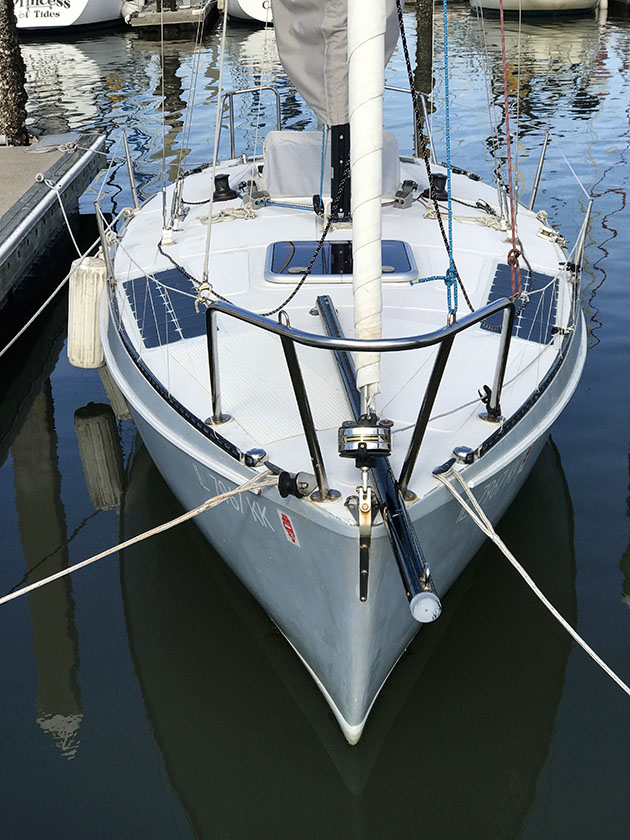
A small bow roller was installed on Gannet along with a bolt-on carbon fibre bowsprit for the asymmetrical spinnaker. Credit: Webb Chiles
He had considered fitting wind vane self-steering, but Gannet’s transom would have needed reinforcing at a cost of $5,000 and he had only paid $10,000 for the yacht. Instead he used sheet-to-tiller self-steering as it is “simple and costs almost nothing”.
Webb Chiles also changed Gannet’s mainsheet traveller. Originally, it was on a bridge across the cockpit which was “awkward and sometimes dangerous” to step over; instead he moved it to the cockpit sole.
Gannet has never been plugged into shore power; power comes from four 50-watt Solbian solar panels routed through a Blue Sky Solar Boost 2000e regulator to two parallel-wired Group 24 AGM batteries. Electronics on board are sparse – a Velocitek ProStart race computer and GPS, Raymarine wind with a masthead transducer, a mobile solar-charged display, a depth finder which is permanently mounted meaning Gannet has no through-hull fittings, a handheld VHF radio and YB Tracker which transmitted his position every six hours. Chiles still carries a sextant and paper charts as back up to GPS. His iPhone and iPad are his chartplotters and he uses the iSailor navigation app.
Offshore ready
Gannet was fitted with a new mast and boom and the standing rigging was replaced to be one size larger than standard. A small bow roller was also installed along with a bolt-on carbon fibre bowsprit for the asymmetrical spinnaker. Plates were added at the stern to attach a Jordan drogue, which was never needed.
Webb Chiles says freak waves in the Pacific, around 400NM from Apia in Samoa, were the biggest danger he faced as they were “ very close together, very steep. I had no idea where they were coming from.” In comparison, sailing through two 55-knot gales – one on approach to New Zealand, the other 7NM from Durban Harbour – was easier. “ It wasn’t life-threatening; I simply lay a-hull, and Gannet is a cork. You could still get in trouble then, but not likely.”
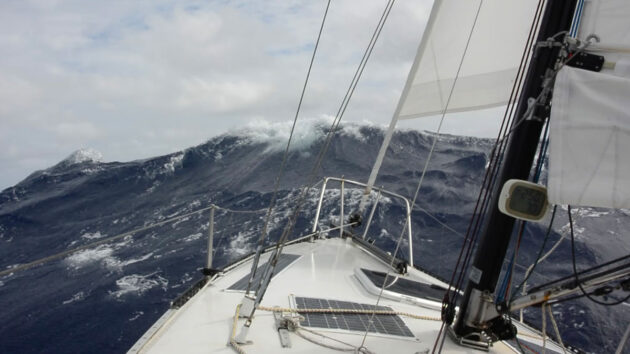
Gannet was knocked down several times during the circumnavigation, but freak waves were the biggest threat Webb Chiles faced. Credit: Webb Chiles
Apart from reefing the mainsail (which involves Chiles going to the mast) and setting the asymmetrical spinnaker, Gannet can be sailed from the cockpit.
He never wears a lifejacket while solo sailing as “there’s no point” but does have a safety harness with a short line that can be clipped onto the toe rail.
“You’re very vulnerable at the moment you come up on deck,” said Webb Chiles. “On approach to New Zealand it was 55 knots and I realised I had too much sail up. I went up on deck quickly as I had to get it down and take the helm and then realised I couldn’t leave the cockpit to get my safety harness. So I reached down to a bag with sail ties, tied one around my wrist, and tied the other end to the toe rail along the side. At that point, I knew as long as my arm remained attached to my body, I was going to remain in the boat; and some of those knockdowns meant I was at times parallel to the ocean for a few seconds before the boat came back up. I would have worn the safety harness then, but I didn’t.”
Before offshore passages, Gannet is prepared for “passage mode”. Underway, Chiles sleeps on the windward pipe berth: “I only weigh about 153 pounds; it’s not much, but it’s better to have it on the windward rail.” The leeward berth is used to store the Avon Redstart dinghy, along with the breakfast and lunch food bags. Meals were generally freeze-dried and made edible with a JetBoil.
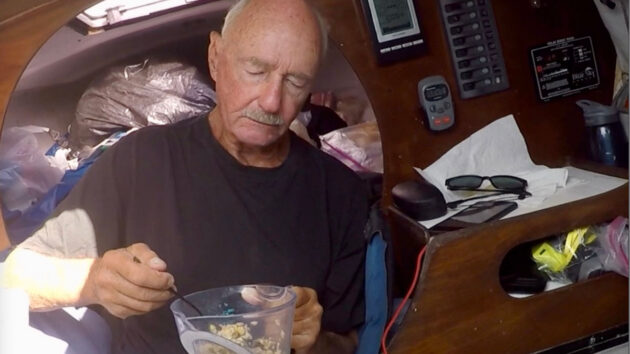
Most of his meals during his circumnavigation on Gannet were freeze-dried. Credit: Webb Chiles
If he wanted to tack at night, Chiles would have to move the contents of the leeward berth to the windward one.
“It would be desirable to have weight always on the windward rail. One thing Gannet will not do: she doesn’t have the weight to make her way through certain waves. When they are raced with a crew of four, there’s a rule about maximum crew weight around 830lbs. If you’ve got three guys adding 600 or 700lbs to the windward rail on a boat where that’s a third of the boat’s displacement, it makes a lot of difference. But I can’t do that, and I’m not going to sit up there myself on an ocean passage. There are situations you can’t get yourself into—you can’t get onto a lee shore that you can’t get off of. That threshold is going to happen a lot quicker than it is on a bigger boat that has more weight to carry through waves,” explained Webb Chiles.
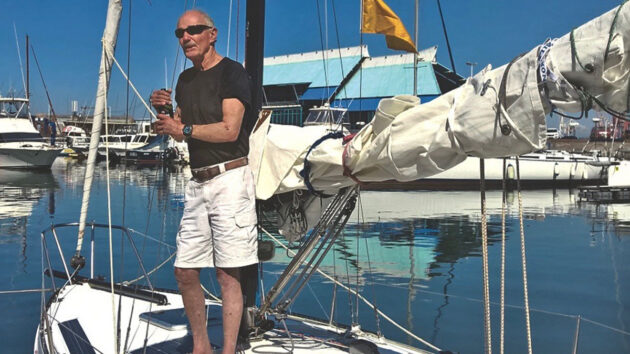
Webb Chiles in Durban after his longest passage of 6,000NM. Credit: Chris Sutton
At sea, the V-berth is used for storage. The main bulkhead has a circular cutout, and there’s a partial bulkhead at the forward end of the V-berth.
“I’ve put pad eyes in both of those and run a line along it. Everything is in waterproof bags. My water is in four or five 5-gallon jerrycans. One of them is tied to that eyebolt. The duffel bags along the sides are tied in, so if we take a knockdown, everything doesn’t shift. Another 5-gallon bag is tied to the forward side of the main bulkhead.”
Webb Chiles on company
Solitude appeals to Webb Chiles; being an only child was good preparation for life as a solo sailor. But he also sees the appeal of company; he has been married six times and to his current wife, Carol for 32 years.
“I am a much married monk,” he says. “Obviously I like having a woman in my life, but I was never a herd animal.”
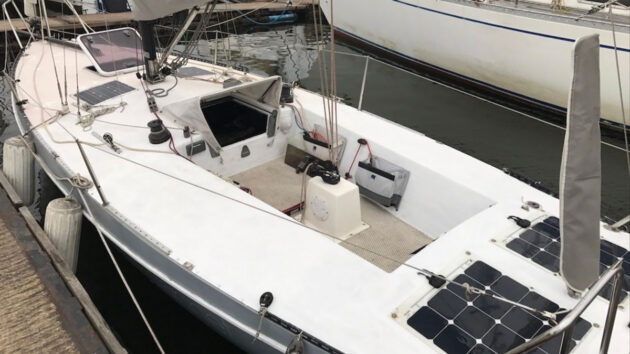
Being flush-decked, Gannet is a wet boat to sail. Credit: Webb Chiles
Does he prefer sailing alone or with company?
“I have an answer to that, though I hesitated whether to give it to you. There has only been one person I actually enjoyed sailing with, and that was my late wife, Jill. This is a vain thing to say, but it was because she didn’t make me lower my game: she was willing to go anywhere. During the Resurgam days, she and I made a passage from Auckland around Cape Horn to Punta del Este, Uruguay – 6,000 miles. She was up for it, always up for it.
“Carol is a very good sailor, but she doesn’t like ocean passages. She never complained, but there was always a feeling of “are we there yet?” On one passage, we sailed from Dakar to Salvador, Brazil. It was an easy passage: trade winds down, almost no doldrums, trade winds across. She spent almost all of that time down below reading; that boat had upper and lower berths in the main cabin, and we slept on the lower berths with lee cloths. All I saw was this rather elegant bare leg above the lee cloth, and yet somehow when we got in, she had a tan! By and large, I’m happy sailing alone. It also reduces the chance of mutiny.”
Now 85, I ask what he is planning next. He would love to sail from California to the Bay of Islands in New Zealand, but as Carol is a generation younger than he is and is likely to face a long widowhood, he doesn’t want to be away from her for too long; he also enjoys living at Skull Creek on Hilton Head Island in South Carolina, where Gannet is moored.
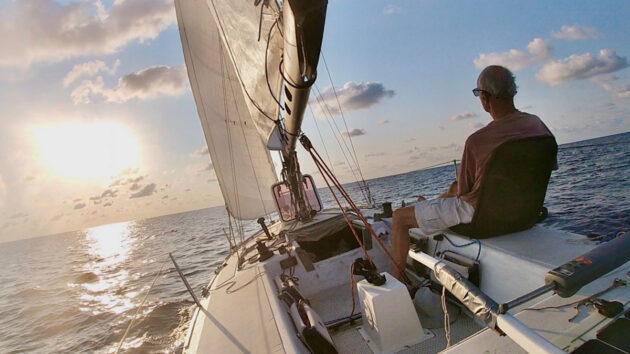
Webb Chiles is happiest sailing alone. Credit: Webb Chiles
He has in fact done a seventh circumnavigation – but just around Hilton Head which took two days.
“I’m not really a daysailer; I like ocean passages. Maybe I’ll find something. I have some thoughts about what I might do next summer,” he says. Whatever he decides to do, it will be executed with perseverance in true Webb Chiles style. “If you quit, you’ve lost, you’ve failed,” he says.
It took him three attempts to round Cape Horn solo during his first circumnavigation, becoming the first American to do so and claiming the record for the fastest circumnavigation in a monohull, beating Sir Francis Chichester’s record in Gipsy Moth IV by more than three weeks.
“For me early on, it was a matter of life and death: I was going to succeed. In my book Storm Passage, I wrote it would be “victory or death.” I wouldn’t say “victory” anymore. People talk about conquering mountains and capes; we don’t conquer these things, we merely transit them. So I would say “completion” instead of “victory,” because I have no victory over Cape Horn. But I was out there giving everything I had in my 30s. At 85, you’re not risking a lot, but back then I was risking it all.”
The six circumnavigations of Webb Chiles
1975-1976: Start/finish port: San Diego, California. East via Cape Horn and Southern Ocean with two stops in Auckland, New Zealand and Papeete, Tahiti aboard the Ericson 37 cutter, Egregious. The first American to sail solo around Cape Horn, breaking the record for the fastest circumnavigation in a monohull.
1978-1984: Start/finish port: Nuku Hiva, Marquesas Islands.West via Suez and Panama Canals aboard the 18ft Drascombe Luggers, Chidock Tichborne I and Chidock Tichborne II and the She 36, Resurgam. Imprisoned for several weeks in Saudi Arabia.
1984-1990: Start/finish port: Nuku Hiva, Marquesas Islands. West via Panama Canal and the Cape of Good Hope aboard the She 36, Resurgam.
1991-2003: Start/finish port: Sydney, Australia. East via Cape Horn and Cape of Good Hope aboard the She 36, Resurgam and the 37ft Heritage Morgan One Ton, The Hawke of Tuonela.
2008-2009: Start/finish port: Opua, New Zealand. West via northern Australia, Cape of Good Hope and Panama Canal aboard the 37ft Heritage Morgan One Ton, The Hawke of Tuonela.
2014-2019: Start/finish port: San Diego, California. West via Hawaii, New Zealand, Australia, South Africa and Panama Canal aboard the Moore 24, Gannet.
Sir Robin Knox-Johnston: sailing with a legend
Sir Robin Knox-Johnston talks to Ali Wood about self-steering, plum duff and why he was told to ‘slow down’ for…

Sailing Uma: ‘How we built an electric sailboat to take us around the world’
Katy Stickland talks to Sailing Uma’s Dan and Kika Deckert about the three year refit of their 1972 Pearson 36…
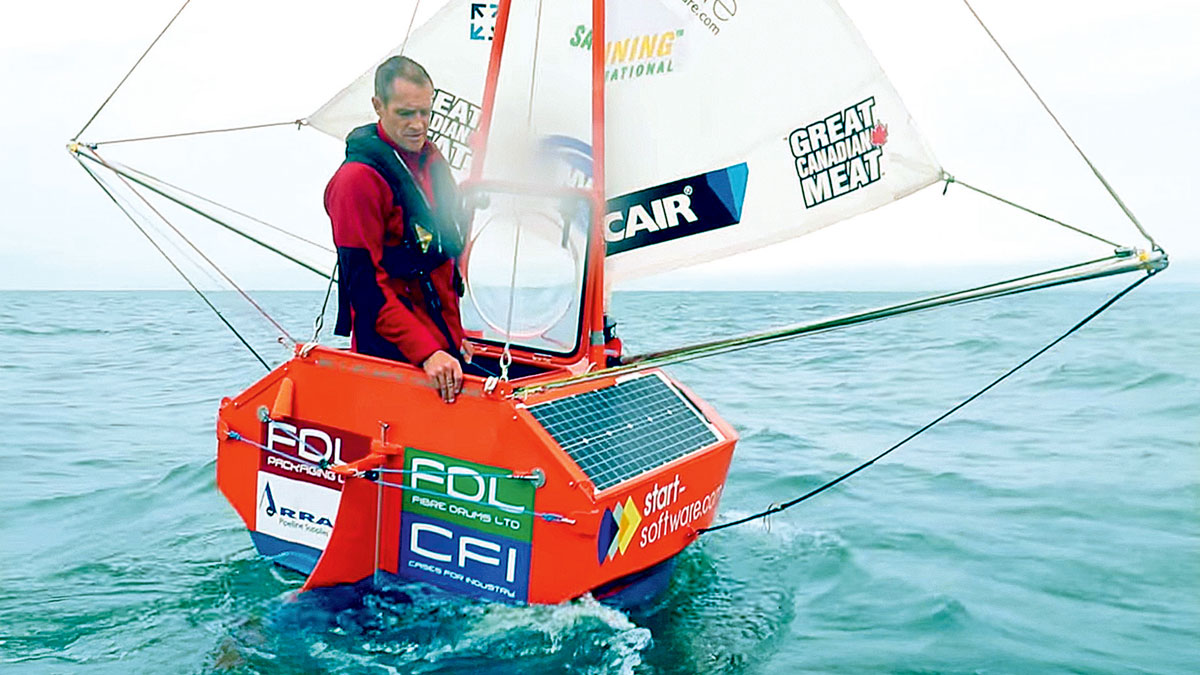
The World’s Smallest Boat? How Andrew Bedwell built his 100cm boat to sail across the Atlantic
Microyacht adventurer Andrew Bedwell tells Katy Stickland how he resurrected his Atlantic ocean world record challenge

Sailing the 3.3m Jack de Crow from the Black Sea to Venice
Sandy Mackinnon sailed the 10.8ft Jack de Crow across the Black Sea and the Mediterranean Sea to fullfil his dream…
Want to read more articles like Six circumnavigations, freak waves and imprisonment: Inside the extraordinary life of Webb Chiles?
A subscription to Practical Boat Owner magazine costs around 40% less than the cover price.
Print and digital editions are available through Magazines Direct – where you can also find the latest deals.
PBO is packed with information to help you get the most from boat ownership – whether sail or power.
-
-
-
- Take your DIY skills to the next level with trusted advice on boat maintenance and repairs
- Impartial, in-depth gear reviews
- Practical cruising tips for making the most of your time afloat
-
-
Follow us on Facebook, Instagram, TikTok and Twitter
PBO web categories