


Herb McLeod explains how he designed and built his flat-bottomed 3.6m Omakayas
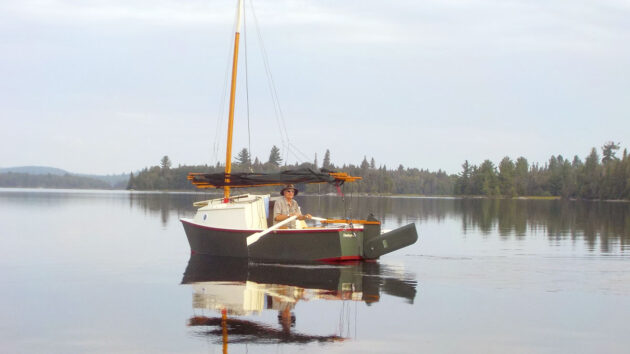
Being 75 years old I wanted a trailer-sailer I could use for camp cruising in protected waters near my home, something that I could easily handle. I was finding that the weight of the mast, sails and hull of my previous 15ft (4.5m), 550lb (250kg) boat pushed me to the limit of what I could comfortably handle by myself.
When I was young, I was privileged to enjoy backcountry trekking and camping in and around Canada’s Jasper National Park. As a result of that experience I’m happy to travel with minimal gear.
In the end, I decided to design a trailer-sailer for myself that would fit my needs like a custom-made suit. My goal was to make the boat small and light yet keep it comfortable. The boat was designed with an enclosed cuddy where I could sleep, and tall enough for comfortable upright seating.
I drew the plans in metric, as I find it much easier to work with than the imperial system. I like flat-bottom boats because they’re easy to build, there is a nice, flat sleeping surface, you can anchor in less than knee-deep water in small, protected sites, and navigating around underwater hazards is easier with a 15cm draught, as you can see underwater obstacles.
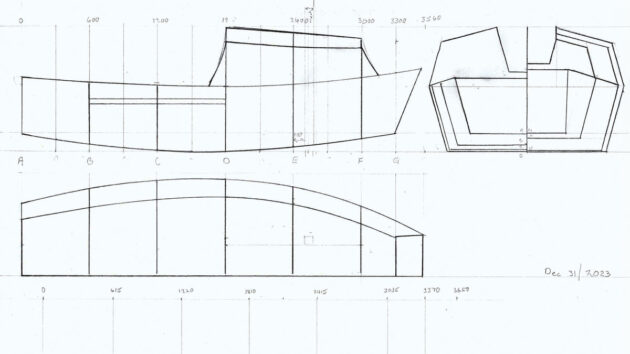
Herb’s plans for his trailer-sailer Omakayas. Credit: Herb McLeod
Flat-bottom boats are also easier to launch and recover at marginal launch sites. Of primary importance to me was to have a trailer-sailer that I could easily launch and recover from sites that are often shallow, due to fluctuating water levels on local reservoirs.
The design Omakayas is named after the heroine in the novel The Birch Bark House by Louise Edrich. It means ‘little frog’ in the Algonquin language (the major indigenous language group where I live in Canada). Unlike traditional sharpies, modern sharpies and flatiron skiffs carry their bow well above the waterline.
Before Omakayas, I built and sailed a Michalak AF3 and a Michalak OliveOyl. Both boats sailed with the bow out of the water. In fact, the boats really functioned as scows and, as far as I’m concerned, the pointy part on the front of the boat was nothing more than a gargoyle nodding to the past when designers kept the bow immersed.
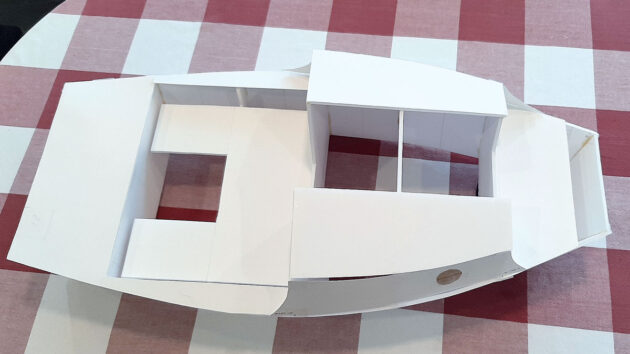
Herb built a model of his trailer-sailer design before starting the build. Credit: Herb McLeod
Omakayas is built mostly from 6mm (¼in) plywood with 12mm (½in) plywood on the bottom. The boat was designed to be economical when it came to building materials. The two sides are made from one-and-a-half sheets of 1,219mm x 2,438mm (8x4ft) plywood, and the cuddy at 1,200mm in length uses half-sheet lengths of plywood. The bottom is cross-planked with plywood, and the plywood off-cuts were used for the seats in the cockpit.
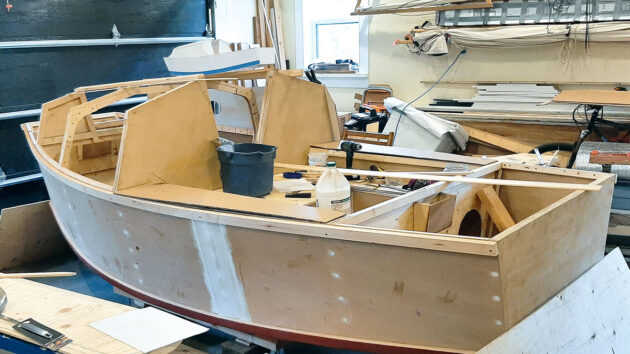
Omakayas was built from marine plywood. Credit: Herb McLeod
Hull weight is estimated as somewhere between 160-190kg (350-420lb). I did a ‘sum of the parts’ by weighing each piece during construction, and then I weighed the hull after construction with a couple of bathroom scales. This is only a rough estimate. I usually sail the boat with an additional 140-180kg (300-400lb) of crew and gear.
I designed it to carry 68kg/150lb of water ballast in demijohn plastic bottles, but I’ve since found I don’t need the ballast so no longer carry any.
Shallow launch for my trailer-sailer
Omakayas can be launched and retrieved from its trailer in water that is 200mm (8in) deep. The trailer wheel bearings need never be immersed, which saves on bearing maintenance and wading around, crotch-deep in cold water. This is possible because the rollers on the trailer support the boat. There is a roller on the rear of the trailer that is mated to a rail on the bow transom, which allows the boat to be raised and lowered on and off the trailer, using this guide and the hand winch.
My design goal was to have little to no water remaining in the boat after capsize recovery. Omakayas was designed so that when lying on its side, the cockpit side decks are above the water, thus keeping water out of the seating area and footwell. The trailer-sailer has been capsized with the electric outboard motor and all gear in place.
These tests have demonstrated that when the boat is righted after a capsize, only a couple of litres of water are in the cockpit footwell.
Capsize test
So far I have only been able to capsize Omakayas towards starboard by standing on the leeboard guard. At the Bark Lake Messabout in 2024, I was unable to capsize her to port; my weight of 79kg/175lb was not enough to pull the boat over. After my capsize tests it was noted that ‘the capsize test was a failure because you failed to capsize the boat’! Next time I carry out a capsize test I’ll have another person aboard, so there’ll be enough weight to capsize the boat to port.
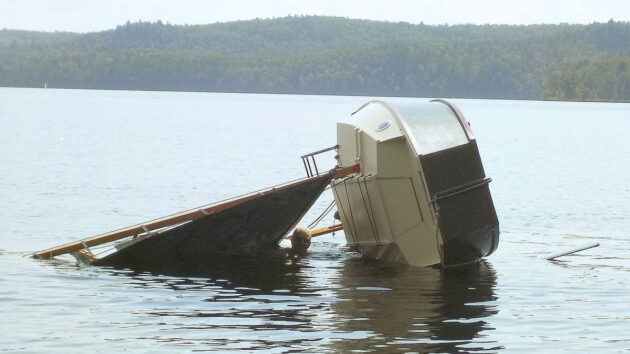
Omakayas is designed so minimal water enters the boat after a capsize. Credit: Herb McLeod
When designing Omakayas, I considered two rigs for the boat: a balanced lug rig and a Chinese balanced lug rig. I chose the Chinese balanced lug rig (junk sail) as it can be reefed while sailing, with no need to stop sailing.
I’ve found the junk rig to be the more forgiving rig in gusty conditions, and with no flogging when the sail is allowed to weathervane. Raising and lowering the junk sail is also more controlled in gusty conditions compared to the balance lug rig (when raising a balanced lug sail I once had an experience where it billowed outward and inflated like a spinnaker, almost pulling the boat over).
The way I have the trailer-sailer rigged I don’t have to duck my head to avoid the boom when tacking – an important safety feature for an older sailor who’s not as flexible as he once was and moves more slowly. All sail control lines are accessible from the cockpit.
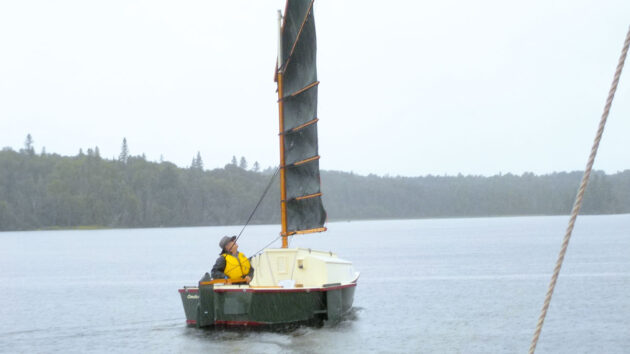
The boat has a junk sail, which can be easily reefed. Credit: Herb McLeod
The sail is sewn in barrel-shaped sections from soft nylon broadcloth to give form, and then attached to the spars with electrical quick ties. The panels have a 7% camber, placed 30% aft of the leading edge. The same edge curve was used on all sail sections.
Trailer-sailer mast
The mast weight is 10.6kg/23.4lb. The unstayed mast is easily stepped from the walkthrough cuddy and is offset to port. The boom, yard and battens weigh 7.5kg/16.5lb. Again, the components are not overly taxing for this ageing sailor to lift. I also plan to install a lightning grounding system on the mast.
Accommodation
Headroom is 1.10m/3ft 7in in the cuddy, with the hatch in place. This height allows the use of a bucket during the night without raising the hatch (old fellows will appreciate this feature!) The bunk size is 0.75m x 2m (2ft 6in x 6ft 6in). This is more spacious than the pilot berth on a friend’s 36ft boat that I crewed a couple of times while sailing from Midland to Perry Sound.
The mast is offset from the midline to the port side of the trailer-sailer. This keeps the sleeping platform almost in the middle of the hull. The advantages are that you don’t have to remove or take down the mast and sail to sleep overnight on the berth in the cuddy. And in the morning, when the hatch is raised, the off-centre mast keeps the morning dew from dripping off the spars into the cuddy.
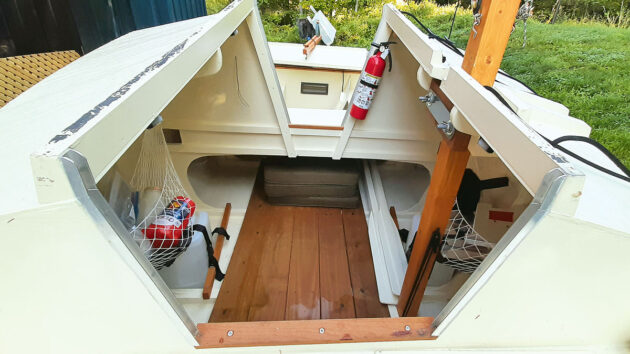
The enclosed cuddy is big enough so Herb can sleep on the boat and has enough headroom so he can sit up. Credit: Herb McLeod
The offset mast also provides more room for rowing and makes it easier to use the walk-through slot-top. The walk-through cuddy allows easy exit from the boat via the bow when beached. The hatch cover can be used as a sliding hatch or may be removed and stored inside the cuddy. Net hammocks are used in the interior to stow gear so that it is kept off the floor, items are easily retrieved, and all remains in place in a capsize.
The seat position in the cockpit was determined by measurements from a folding IKEA chair that I find comfortable. I’m a retired dentist and like to have a comfortable seating position that I can live with all day long.
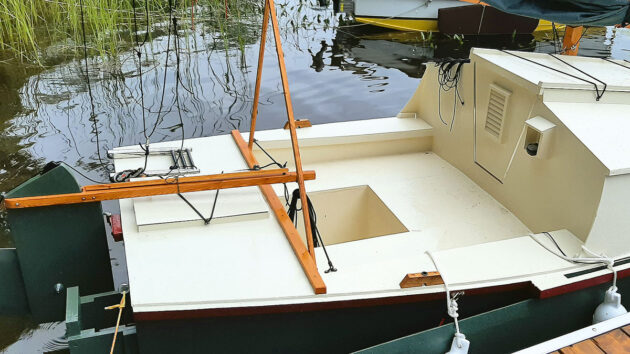
The cockpit was designed to accommodate a folding IKEA chair. Credit: Herb McLeod
A galley box is planned, but not yet built. It will double as a step to assist entry into the cuddy and will stow on the starboard side of the bunk under the raised deck.
There are three vents, all on the midline of the boat, and air can circulate freely from bow to stern. Excellent flow-through ventilation ensures the boat is never stuffy inside. The vents and all hatches are on the midline so that the boat will float on its side and not take in any water.
There are no sealed buoyancy chambers. I have never liked airtight buoyancy chambers or an airtight cuddy. When you remove a hatch from a sealed buoyancy chamber, you’re greeted with a whiff of stale, stinky, humid air. In my estimation, this is not healthy.
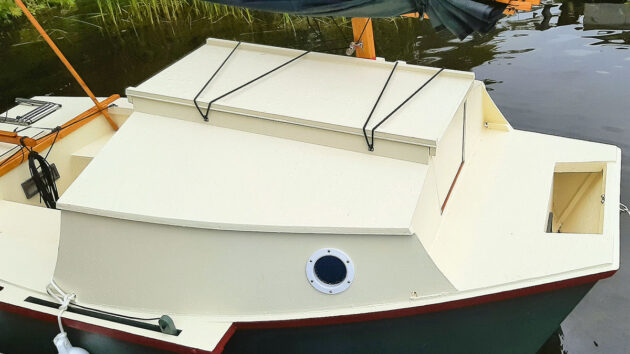
Anchor well in the bow is self-draining. Credit: Herb McLeod
Omakayas is a wooden boat with no ballast. As such it could not sink, even if every nook and cranny of airspace were filled with water. (As previously mentioned, the boat is designed to float on its side and, when righted, little to no water remains in the cockpit footwell). The boat is easily rowed, and the 2.4m/8ft oars can be stowed inside on the port side where they do not impinge upon the space for the bunk.
Powering the trailer-sailer
I have a motor bracket and have used a 14kg/30lb thrust electric trolling motor. It’ll push the boat at about the same speed as my maximum rowing speed. I find that the motor on the rear transom tends to clutter up the stern area, so most of the time I prefer to leave the motor at home and row – although with shoulder injuries
I try to do as little rowing as possible.
I also have a 2hp Yamaha 2-stroke outboard, but I have yet to try it on the boat. The problem with a gasoline motor is how to store extra petrol and still live in the boat without having to breathe fumes.
Rudder and off-centre board Hinged centreboards were first recorded for use on shallow-draught craft in 1828 and have been causing problems ever since. By using a Michalak-designed off-centre board, there is no hole in the middle of the boat that will develop leaks; no space taken up on the inside of the cuddy cabin by a centreboard trunk and no bracing which would be needed to stop the board from functioning like a lever that’s trying pry the boat apart.
There is no jamming of the board in its trunk by small stones and other debris. The off-centre board is not weighted, and the geometry keeps it down – until it touches bottom, when it pops up to clear an obstruction. At this point, it remains deep enough to allow some manoeuvrability.
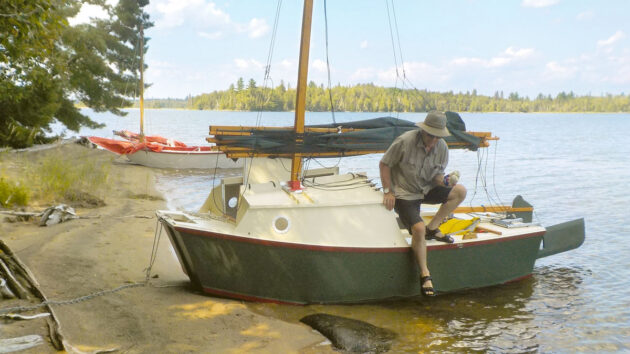
Herb can access shallow cruising grounds, as Omakayas draws just 0.15m/6in with the centreboard up. Credit: Herb McLeod
The off-centre board is easily removed for maintenance. I use it as a buffer between the dock and the fenders, so any damage to the paint over the summer is easily touched up. The rudder is also Michalak-inspired, with a lead weight cast into the retractable blade. The blade sinks automatically and is easily raised by tugging on a line.
There is a self-draining bow anchor well. The anchor line may be attached to the bow at the bottom of the hull, greatly increasing the scope compared to attaching it to the deck top.
In 2024, in addition to day sailing from our camp North of Ottawa, I completed a four-night, five-day cruise on the Cabonga reservoir, a large labyrinth of channels, bays and islands covering 677 square kilometres with 484 square kilometres of water. This is a wilderness area, and once past the Lac Rapide, the shoreline is undeveloped.
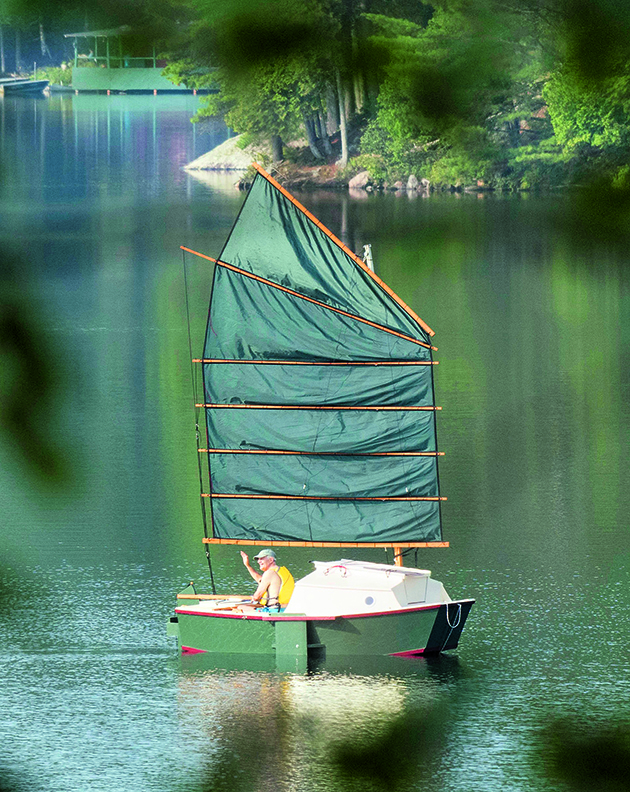
Herb has built over 20 boats – his trailer-sailer Omakayas is the latest. Credit: Herb McLeod
Power boats are permitted on the lake for day trips only. Overnight camping (for a fee) is only permitted for those who travel in craft without motors (including no electric motors). There are a lot of uncharted underwater hazards in the lake, so the power boats seem to stay on the defined power boat routes. We venture with our slow-moving shallow-draught craft into all parts of the reservoir and do sometimes ‘locate’ some of those underwater hazards. Once out of the main channels, we never saw any other watercraft. Much of the shoreline is rocky, but there are some lovely beaches. Mobile phone service is limited to Lac Rapid and non-existent for much of the lake.
In 2024, I also spent two nights out with the Can-Am Sailing Association Bark Lake Ontario Messabout. I did the same again attending the Messabout in 2025, but this time I spent four nights on board.
The Junk Rig Association
Formed in 1979 at the Southampton Boat Show by a group of junk rig enthusiasts, the Junk Rig Association (JRA) aims to promote the use of the junk rig by encouraging members to organise rallies and junkets, encouraging the development of junk and related rigs, the building or conversion of boats to the junk rig, and the use of vessels with the rig or its derivatives; create an international community of people who’ve already ‘junked’ their boat, are thinking of doing so, or are just interested in learning what it’s all about.
About the author

Herb McLeod
Herb McLeod is a 75-year-old retired periodontist and serial watercraft builder (23 and counting). He ran the website Herb’s Boat Pages from 1995 to 2002 featuring several Jim Michalak’s designs as well as his own One Sheet Skiff.
How to get started with a trailer-sailer: Everything you need to know
Ever considered getting a trailer-sailer? Some think they might just be for pottering around harbours, but they couldn’t be more…

Pocket cruisers: the best boats between 17-20ft
Whether you’re moving on from dinghies, or downsizing to a boat that’s fun without being a financial millstone, here’s a…

Dinghy cruising: 30 ways to experience the ultimate small-boat adventure
Ben Lowings shares his tips for dinghy cruising around the UK and further afield
Which is the best cruising dinghy?
Clive Marsh explains what he looks for in a lightweight cruising dinghy
Want to read more articles like How I built my dream minimalist pocket cruiser to navigate dense Canadian wilderness reservoirs?
A subscription to Practical Boat Owner magazine costs around 40% less than the cover price.
Print and digital editions are available through Magazines Direct – where you can also find the latest deals.
PBO is packed with information to help you get the most from boat ownership – whether sail or power.
-
-
-
- Take your DIY skills to the next level with trusted advice on boat maintenance and repairs
- Impartial, in-depth gear reviews
- Practical cruising tips for making the most of your time afloat
-
-
Follow us on Facebook, Instagram, TikTok and X