


After sailing thousands of miles offshore, the Mini Globe Race 2025 skippers share exactly how the Globe 5.80 and the gear on board stands up with Stephanie Jones.
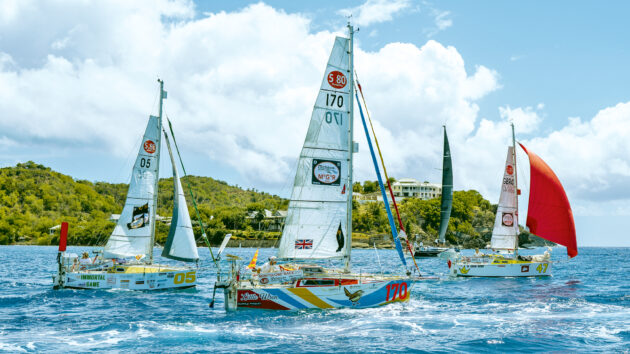
For decades, practical boat owners have built yachts in their gardens and gone on to sail them safely offshore. On Globe 5.80 micro-yachts, many of the skippers in the 2025-25 Mini Globe Race are following in their footsteps.
So far, 13 of the entrants have now sailed their Globe 5.80s across the Atlantic and almost halfway across the Pacific Ocean, but how have these homebuilt, plywood 19ft boats stood up to the rigours of racing offshore?
During the race’s layover in Fiji, I caught up with some of the skippers who were busy replacing standing rigging, renewing antifouling, power-washing, repainting the inside to deal with mould after weeks of sailing in damp Pacific air, and making more handholds for safety, in preparation for Leg 3, from Fiji to Cape Town.
Globe 5.80 performance review
Most skippers were impressed by the Globe 5.80s hull and rig design, and were positive about the boats’ performance, praising their seaworthiness.
“80% of the first two legs were downwind sailing, and 90% aft of the beam”, explained Adam Waugh, who built his Globe 5.80 Little Wren in his barn in Northumberland. “In 17 knots of wind, we can do over six knots – good for a 19ft boat! – and did over 125 miles per day, except through the Doldrums and dealing with the headwinds from Tonga to Fiji.”
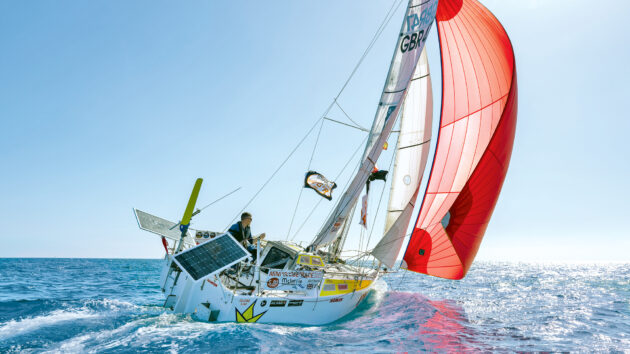
The design of the Globe 5.80 has been praised by many of the skippers; 80% of the sailing has been downwind. Photo: Rob Havill / G580Transat / MGR2025.
Many of the Globe 5.80s are very light and beamy compared with their length.
Keri Harris aboard Origami was knocked down “to a capsize position” off Colombia in Leg 1, which flooded his boat with 600lt of water (it filled the interior to the level of the bunks, which he bailed out with a bucket), destroyed two solar panels and damaged electronics.
He later said that it can be hard to keep the Globe 5.80s on a straight course in heavy weather, and controlling the yaw can be difficult as every wave potentially changes the boat’s position.
American Joshua Kali built Skookum, favouring heaviness and endurance for safety, rather than building a lighter boat for speed. At 1.25 tons, the boat needs a good blow of 15-20 knots for speed, but can carry more sails and keep a straighter course.
Australian Gary Swindail on Question 2 noted the boat pounded a lot sailing upwind in 10-15 knots of wind, and then shudders and even momentarily stops, due to its flat bottom.
But all agree they can take a lot of punishment, especially Dan Turk, who survived a knockdown in 70-knot winds aboard Little Bea; he escaped with minimum damage and no injury.
The watertight compartments were praised, especially as big waves come right over the boats, and leaks – such as from the mast – can be contained.
One sailor had 10lt of water in the forepeak on arrival in Fiji from Tonga, but the watertight compartments meant it didn’t get into the rest of the boat.
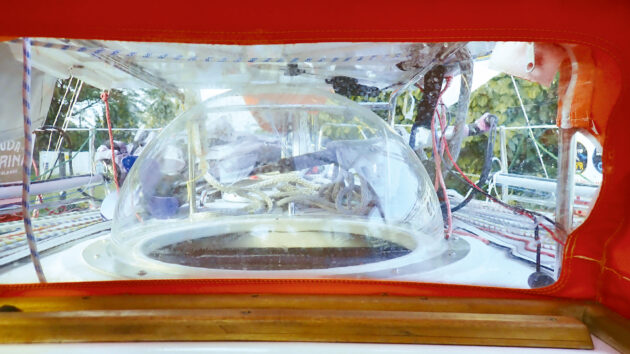
A 60cm bubble replaces the traditional hatch on Argo, which allows 360° lookout for tall skipper Christian Sauer. Photo: Kelly Blundell.
German Christian Sauer shortened the cockpit on Argo to make a mini bimini-protected cockpit area, built flaps for his cockpit drains to reduce water ingress and constant wet feet, and created a 60cm bubble to replace the traditional hatch; he is 1.86m/6ft 1in tall and needed more headroom; it also allows him to have a 360° lookout when underway, even when the weather turns.
All of the skippers were making repairs and carrying out maintenance work at Fiji’s Vuda Marina ahead of Leg 3, including strengthening their transoms to install the heavier Hydrovane wind vane self-steering, filling gel coat cracks, replacing chafed sheets and halyards and making leaking hatches watertight.
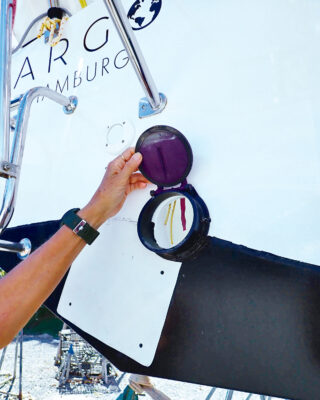
Cockpit drain flaps on Argo to reduce water ingress and constant wet feet, although they need to stay open in heavy seas. Photo: Kelly Blundell.
Sail wear and tear on the Globe 5.80
Five Quantum sails came with the Globe 5.80 kit, with two spares. Everyone manages their sails differently, constantly experimenting and tweaking to achieve optimum performance.
Several sailors found small holes in their asymmetrical headsails, mended on passage with 3M double-sided tape.
Unexpected accidental gybes can mean the spreader pierces the mainsail, and batten pockets can wear out due to the constant pressure of sailing 24/7 for months.
There’s always a danger of downwind sails going in the water and then snagging when being retrieved, and sails were lost overboard. Dan Turk lost his A7 spinnaker after a knockdown.
Some sailors put out as much canvas as they can; others sail conservatively and don’t use the largest asymmetrical sail – it is hard work when the small, light boat is constantly moving.
Not having in-mast furling was seen as an advantage – it was felt to be too risky when racing solo without an engine.
Australian Dan Turner replaced his headsail furling gear during the Leg 2 Tahiti stopover after the turnbuckle on the forestay came undone during Leg 1, forcing him to sail with a jury-rigged forestay to Panama; he had hoped to fix it after Leg 1 but was unable; this left him racing part of Leg 2 with a hanked jib.
Catalan sailor Pilar Pasanau on Peter Punk has rearranged her reefing lines to operate from the cockpit, to avoid going on deck in bad weather.
She replaced her jackstays and guardrails with Dyneema to slide through the Seago clips more easily and make it less hard on her hands.
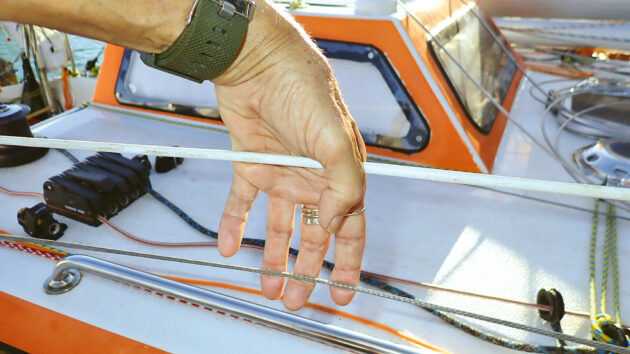
Pilar Pasanau has used Dyneema for guardrails and jackstays to make it less hard on her hands. Photo: Kelly Blundell.
Many of the skippers were working on their standing rigging in Fiji, including renewing forestays, due to the extreme punishment of the winds.
The masts are under a lot of pressure, especially when carrying full sail, and most of the skippers did rig inspections during the layover.
Decks and winches
Much of the fleet have opted for either SeaDek or KiwiGrip for the deck surfaces on their Globe 5.80s.
The former is soft and spongy, and less hard on your feet; the KiwiGrip is popular and was praised for its effectiveness and affordability.
No one reported problems with their winches; Antal winches were seen as smooth, requiring minimal maintenance and easy to use, especially for a smaller person.
Electrics on the Globe 5.80
Globe 5.80s can be subject to water ingress, which has caused problems with the electrics.
Keri Harris lost his sat phone and other electrical equipment after his knockdown on Leg 1.
The entrants are limited to power restrictions as part of the race rules – 200W of solar and 200Ah of batteries; as a result, flat batteries are not uncommon, particularly if you factor in the draw of the Starlink Mini, which has no inbuilt battery.
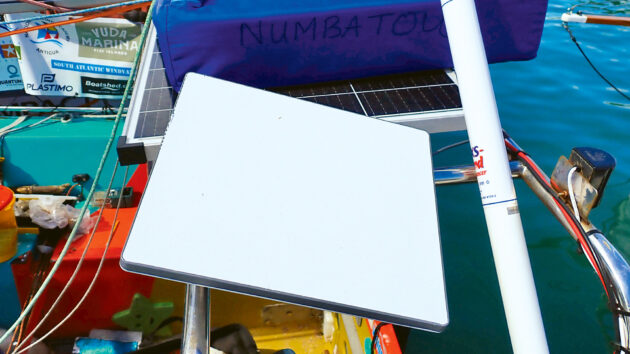
Most entrants, including Jasmine Harrison, have mounted the Starlink Mini on the boat’s transom. Photo: Kelly Blundell.
Most skippers have fitted a Mini on their Globe 5.80, so they can use satellite wifi to keep in touch with family and friends, as well as download GRIB and weather files.
All of them found it easy to install themselves, most mounting it on the transom to be able to have a clear view of the sky for satellite connection.
Canadian Dan Turk says the Starlink Mini is “a game changer, because you can video call. It is probably faster internet than I have at home. Sometimes coverage is a bit spotty because our boats are moving a little bit, and it has a little bit of trouble connecting. I use it every four hours, check out the tracker, check out the weather and get updates from family and friends. It is really good.”
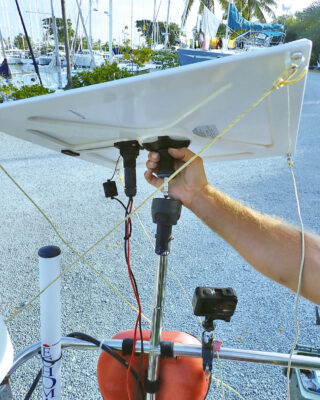
Pivoting ball joint mount allows the Starlink Mini to be moved to get the best signal. Photo: Kelly Blundell.
For Ertan Beskardes aboard Trekka, it has enabled him to keep up to date with business affairs as well as family in the UK and Turkey.
Christian Sauer reported that the Starlink Mini “is 10 times faster” than other portable satellite wifi hotspot devices he has used.
Chartplotter choices include Raymarine, Garmin, Zeus and B&G. Navionics was favoured by some, and paper charts were also in use, but only for entering ports.
Self-steering the Globe 5.80
The choice of self-steering gear was optional but had to be without linked twin rudders or an autopilot. Mechanical links between the Hydrovane and the main Class 5.80 rudder are banned.
For many, self-steering gear meant more sleep and less hand-steering.
Transom brackets for the self-steering gear suffered a lot of wear and tear during the first two legs, with some skippers resorting to welding them in stopovers, but South Atlantic Windvane was praised for its speedy response in delivering replacements.
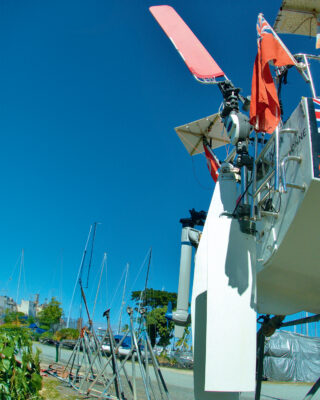
Many of the skippers, like Ertan Beskardes on Trekka, have opted for Hydrovane self steering believing it to be ‘safe, strong and high performing’. Photo: Kelly Blundell.
Most of the sailors started with a South Atlantic, but all but a few now use the ‘bulletproof’ Hydrovane.
Keri Harris is sailing with an Aries, and Dan Turk with a Sailomat; Christian Sauer is using a Windpilot.
The Hydrovane has a reputation among the fleet of being safe, strong and high performing; it can support putting more sail up but, as with all equipment, you have to know when you can use it, and when you can’t.
Skippers report that the cheaper South Atlantic may need more tweaking and adjusting (although with wind vane steering, it often comes down to a correct setup in the first place).
Outboard gear
All of the Globe 5.80 yachts are powered by an electric outboard engine, which many of the skippers remove and keep down below while sailing to avoid wear and tear on the outboard brackets.
However, many have reported running problems due to wet terminals and water ingress. In some cases, the remote control and lithium battery have been replaced.
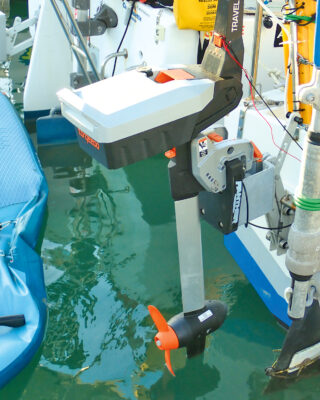
Electric outboards tend to be removed from their brackets and stowed below while underway. Photo: Kelly Blundell.
To avoid this, Christian Sauer has removed the battery from the top of the outboard and wired it into a docking station under the squabs, to keep water damage at a minimum, but it does vibrate a lot.
Performance was also an issue, with many skippers struggling to enter a harbour against a strong current after running for 90 minutes at three-quarters throttle, with 20 minutes of full power. Most agree that it is only useful for manoeuvring in smallish harbours.
Steering
Handling the tiller was challenging, but the Hydrovane wind vane self-steering gear, as well as the rudder, has made many of the boats more stable and enabled a straighter course.
Many entrants felt the Globe 5.80’s rudder was undersized to get sufficient purchase through the water, and some have put their tiller on the Hydrovane.
The short transom-hung rudder is part of the design of the Globe 5.80, so the boat can be shipped in a container and keep production costs low, but more importantly, it can help reduce drag and be more responsive at low speeds.
Twin running daggerboards on either side of the rudder help improve directional stability, serving as an additional safeguard against broaching, but they are small.
The skippers who have fitted a Hydrovane have removed one daggerboard; the Hydrovane is to one side of the rudder, and a daggerboard on the other.
Two entrants have removed the rudder completely, keeping it as an emergency spare, and have replaced it with the Hydrovane, with the tiller attached, and kept both daggerboards.
Putting solar panels on the Globe 5.80
Given the entrants are limited to a maximum of 200W of solar, most skippers said the solar panels were inadequate for heavy power use; the Starlink Mini used for two hours a day challenges their power limits.
The panels are fitted on pivots to help angle them to capture more sun, especially on the transom, and to prevent them from being blocked by the mainsail; some of the skippers have multiple mounts so the panels can be moved around the boat.
The panel mounts tend to come loose, so they need to be secured in a ‘belt and braces’ fashion with extra safety lines.
Antifouling
Several boats have been hauled out for work on the hard, for antifouling and power washing; Australia is the next port of call, and there are strict rules around fouling.
Some sailors have used Coppercoat, but most have favoured brands like International, with the race leader, Renaud Stitelmann, opting for International Micron 350. No one has reported excessive fouling.
Adam Waugh aboard Little Wren has been impressed with the Coppercoat on the boat’s bottom, but has found that it couldn’t key onto the steel bulb keel, which began showing rust bubbles. He has now taken it back to the primer and applied hard antifouling.
Only one, Christian Sauer, has used silicone antifouling – FLOW Silikon. He has also made his own lifting strop, so a crane’s heavy lift straps do not damage the silicone antifouling during lift-out.
Made from spliced 10mm Dyneema, it is attached to three points on Argo – to the keel via a small hatch on the deck, and on the two chainplates on either side of the transom – and connects to the hook or shackle of the crane via a single eye.
Clever ideas from Mini Globe Race skippers
Both Eric Marsh on Sunbear and Christian Sauer on Argo have built a swing-arm plotter holder out of laminated plywood on hinges so they can see the chartplotter in both the saloon and cockpit.
Sauer has also glued a Dyneema link to the back of his Starlink Mini, so he can secure it to the stern guardrail with 5mm line.
Rather than traditional gas, some skippers, like Jasmine Harrison, Dan Turk, and Christian Sauer ( his galley was converted into his chart table) have opted for JetBoil, believing it to be safer than gas. Harrison also uses an Origo alcohol burner stove.
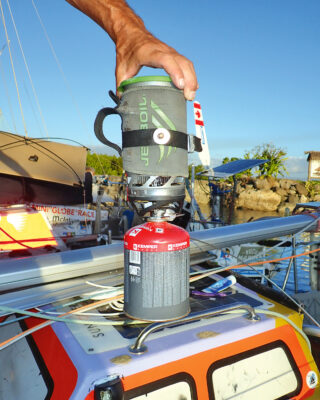
Some have ditched traditional gas in favour of JetBoil systems. Photo: Kelly Blundell.
Comfort, as well as speed and safety, is important for long-passage solo sailors.
Pilar Pasanau on Peter Punk has rigged hammocks above her folded-up bunk after she kept waking up when being thrown into her lee cloth when the weather got rough.
Pasanau also applies Vaseline to the rubber seals of her hatches to prevent them from going brittle, which could then cause them to leak.
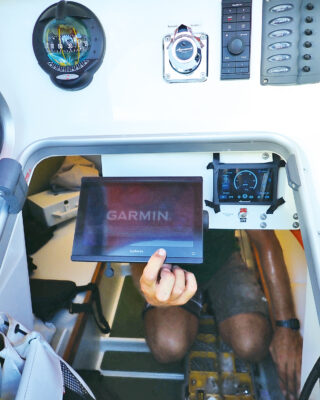
Christian Sauer’s plotter is on a swing arm, so it can be seen more easily. Photo: Kelly Blundell.
You don’t have to be rich to race yachts (although it does help!), and you can still do your bit for the planet.
Polish Jakub Ziemkiewicz, flying the flag for Ireland on Bibi, formerly a cruiser rather than a racer, is into sustainability and being budget-conscious; he built nearly everything himself, getting much of his equipment second-hand.
You also don’t necessarily need bright ideas to be fast, safe, comfortable, and happy during the race.
Current race leader Renaud Stitelmann aboard Capucinette, follows the sound, time-honoured practice of checking everything on his boat three times before each start, and constantly thereafter, plus weather-watching and passage planning constantly to choose the most optimum route. He cooks a hot meal every day, and even makes bread and bakes cakes to keep his mood up.
With thanks to all 13 sailors interviewed for this article. The Mini Globe Race can be followed at pbo.co.uk/minigloberace.
Stephanie Jones is a semi-retired university professor and author of dozens of books. She bought her first boat, a Granada 37.5 in 2008 and lived aboard in Malta. In 2014, she bought the Ocean 60 schooner Happy Spirit II and spent 10 years cruising around New Zealand before sailing to Fiji, where she’s currently based.
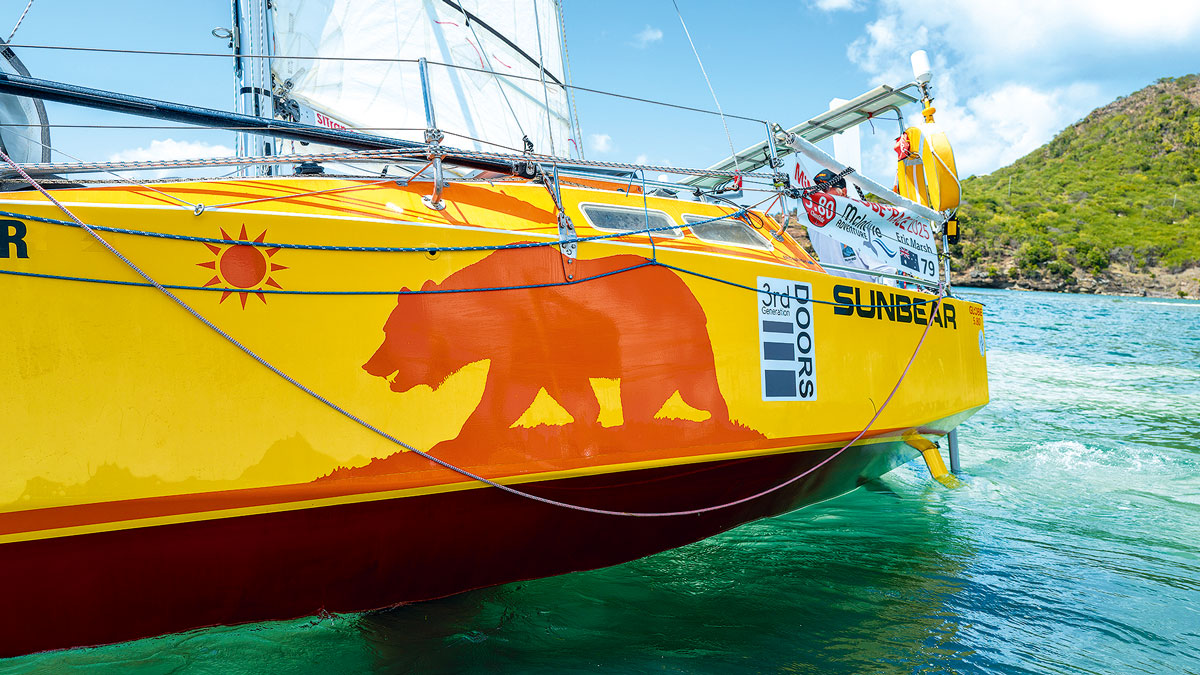
Saved by the safety line: How solo sailor Eric Marsh got back onboard his boat after falling overboard in the Mini Globe Race
Sailor and author Graham Cox talks to Mini Globe Race skipper, Eric Marsh about his man overboard incident and how…
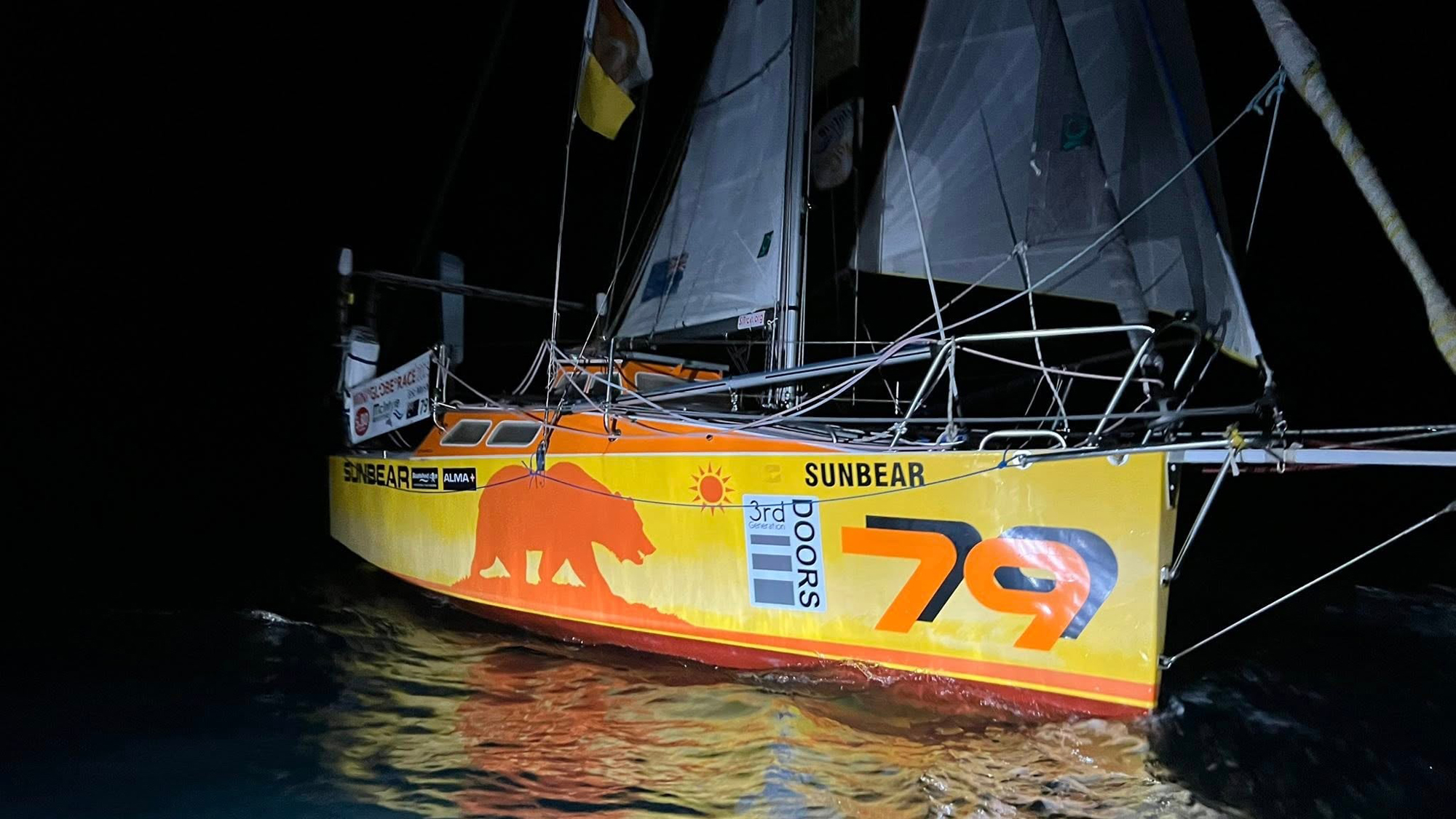
‘I thought it was all over’: man overboard drama hits Mini Globe Race 2025
Overnight (17 October), Eric Marsh of Sunbear took a chilling tumble. It was the first man overboard in the Mini…

Countdown to the Mini Globe Race 2025
15 skippers are expected to leave Antigua to sail around the world in the Mini Globe Race 2025, aboard 5.8m…

Globe 5.80: the home-built ocean racer
What’s it like to build your own plywood 19-footer to race solo across the Atlantic? David Harding sailed with Keith…
Want to read more articles about the Globe 5.80?
A subscription to Practical Boat Owner magazine costs around 40% less than the cover price.
Print and digital editions are available through Magazines Direct – where you can also find the latest deals.
PBO is packed with information to help you get the most from boat ownership – whether sail or power.
-
-
-
- Take your DIY skills to the next level with trusted advice on boat maintenance and repairs
- Impartial, in-depth gear reviews
- Practical cruising tips for making the most of your time afloat
-
-
Follow us on Facebook, Instagram, TikTok and Twitter