


Jeanneau’s Sun Dream 28 is a popular choice among sailors looking for good performance and roomy accommodation. David Harding reports
Jeanneau Sun Dream 28: a capable coastal cruiser

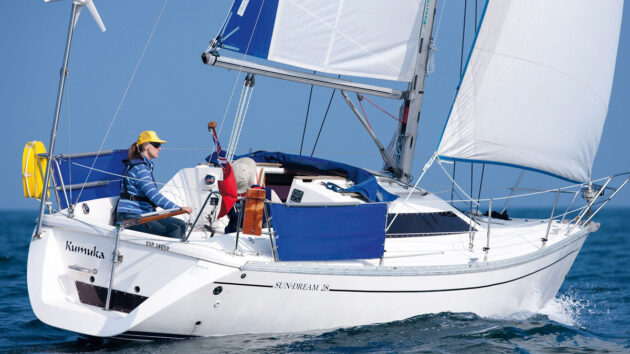
Ask any potential buyer what he or she is looking for in a cruising yacht and the answer will typically include good sailing performance, easy handling and plenty of space below decks. The priority placed on each will vary, of course, but that’s the combination people often look for – and with good reason.
It was certainly what Mike Stewart was after when he decided to move up from his Caravela 22. Having retired, and with the time to go cruising, Mike and his wife Deirdre fancied something around 8.5m (28ft) in which they could explore the West Country from their base in Brixham.
Since the traditional British layout with a quarter berth and forward heads didn’t appeal, boats like the Sadler 29, Moody 29, Westerly Konsort and Mirage 28 were never on the list. It was the French boats with their aft cabins and light and airy interiors that were the focus of Mike and Deirdre’s attention, and one soon came to the fore: the Jeanneau Sun Dream 28.
The Feeling 286 had attracted their attention during visits to several of the autumn boat fairs, but Mike had reservations about the position of the engine amidships, over the keel. The Sun Dream, on the other hand, seemed to have pretty well everything they were looking for without any question marks. The presence of several on the market suggested that they were reasonably popular boats, so the only question was that of finding a suitably tidy example.
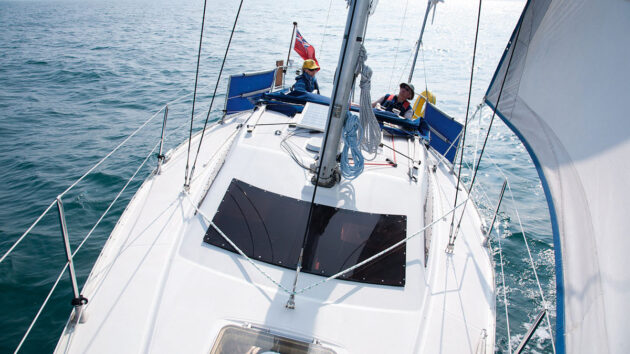
Distinctive features of the Jenneau Sun Dream 28 include the near-flush foredeck and the large forward window. Credit: David Harding
After a brokerage boat in the West Country turned out to be in disappointing condition, a trip to see a privately-advertised one in Brighton (a fin keeler, like most Sun Dreams) was more fruitful. It had been lived on, lightly sailed and well maintained, and was equipped with a wind generator, solar panel, autopilot and diesel heater, among other goodies.
A deal was done and Mike and Deirdre sailed Kumuka to her new home. Since that was in February and into the prevailing westerlies, both the heater and her windward ability were given a thorough testing.
It was only a month later, on an unseasonably warm and sunny day in late March, that I headed to Brixham to meet the Stewarts and their new acquisition. By this time Mike had already replaced the heads with a new Jabsco unit and had also been forced to fit a new main halyard. Kumuka came with an Easyreef behind-the-mast mainsail reefing system and a MaxiRoach vertically-battened mainsail which, on one outing, made an unscheduled descent from aloft when the halyard broke. Even in light conditions, bundling it up and keeping it aboard with the boat out at sea was no easy job.
Fully functional Jeanneau Sun Dream 28
By the time I went sailing everything was working and we set off across a slightly lumpy Torbay, the tops of whose waves were ruffled by a mere 8-or-so knots of north-easterly breeze. The one bit of rig tweaking I had to do straight away was to lower the tack of the genoa on the drum of the roller-reefing system by removing the enormous and unnecessary shackle and shortening the tack-strop as much as possible. The problem, as on so many boats, was that the high tack led to a clew that was too high to allow the correct sheeting angle even with the genoa cars right at the aft end of the tracks.
In this case it might well have been because the Sun Dream was launched at a time when roller-reefing genoas weren’t normally supplied as standard: hank-on headsails were still widely used. I imagine that the original headsail had simply been modified to fit the headfoil’s luff-groove without being re-cut, so it was never going to set properly when fully open.
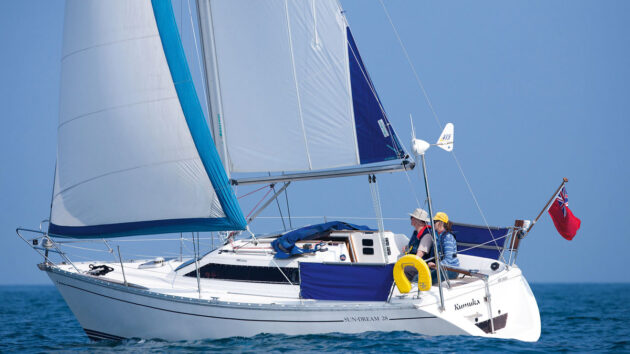
The behind-the-mast mainsail reefing system is a non-standard feature. Credit: David Harding
It set better with the tack lowered by several inches, and our tacking angle was reduced from around 95° to 90°. We could undoubtedly have improved it further with a headsail that hadn’t lost most of its shape. When you take on a second-hand boat there’s often scope to spend money on sails.
With the sails tweaked as best we could, Kumuka slipped along happily making around 3 knots until, close to the cliffs at the northern end of the bay, we found gusts up to 15-20 knots and appreciably flatter water. Here we clocked an average of around 5 knots on the wind, nudging closer to mid-5s on occasions, the boat proving to be nicely balanced and with a helm that loaded up progressively as she heeled to around 30° but never became uncomfortably heavy.
Reassuringly, the semi-balanced rudder on its partial skeg never lost grip, even if we bore away with sheets pinned in. Bearing right away and gybing round, the boat hove to comfortably and could then be persuaded to gybe back the other way, still with the sheets pinned in, and carry on sailing.
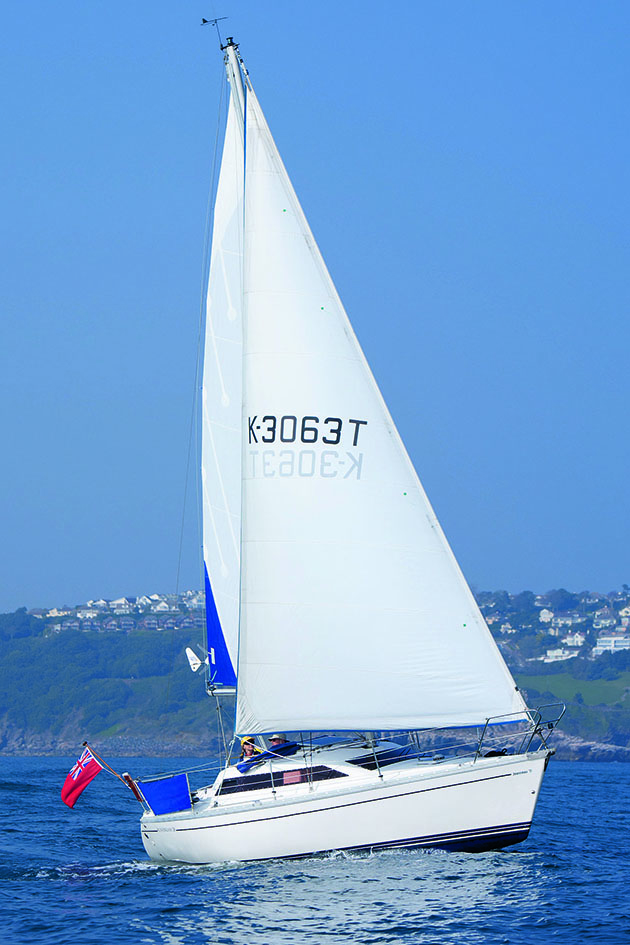
The Jeanneau Sun Dream 28 handled well in the sloppy seas of Torbay in an easterly. Credit: David Harding
While it was hard to find fault with general obedience or responsiveness, she’d have moved up at least a couple of gears with a properly-shaped headsail and a folding prop instead of the fixed two-blader – which, later in the season, was found to be covered in a thick layer of barnacles that had probably been there for some time.
Mike’s only reservation about her sailing qualities was that the flat forefoot might make her prone to slamming in a seaway – a characteristic for which the Jeanneau Sun Dream 28 is known. He hasn’t found it anything like as bad as he expected, largely (he suspects) because of the fine entry. More traditional boats of this size, such as the Sadler 29 for example, might have an easier upwind motion but they’re very different types of design and would probably struggle to keep up on downwind legs.
Comfortable helming on the Jeanneau Sun Dream 28
An essential quality on any boat is a comfortable helming position, and here the Sun Dream scores more highly than most cruisers. It’s a reasonable perch on the coamings even if they are slightly too close to the guardwires to allow the helmsman to lean back far enough. If you can’t angle your torso beyond the vertical you end up fighting gravity when the boat heels. I’d give the Sun Dream 8 out of 10 here.
For the crew and/or helmsman sitting inboard, there’s a good leg-bracing width between the seats. Useable fore-and-aft cockpit space is generous because the tiller is well aft. In fact, the rudder post is outside the hull moulding, on the transom that’s extended by a sugar scoop to draw out the waterline and smooth the wake. Provided the helmsman doesn’t sit right aft, it’s easy enough to reach the mainsheet traveller across the bridge-deck. Having the track here keeps the centre of the cockpit clear and allows unrestricted access to the full-depth locker to starboard. Right in the stern is space for a liferaft beneath a removable full-width seat. Any water runs straight out on to the sugar scoop through drains in the stern. As is inevitable in a boat of this size with an aft cabin, the cockpit is shallower than on boats with quarter berths, but it’s more protected than some.
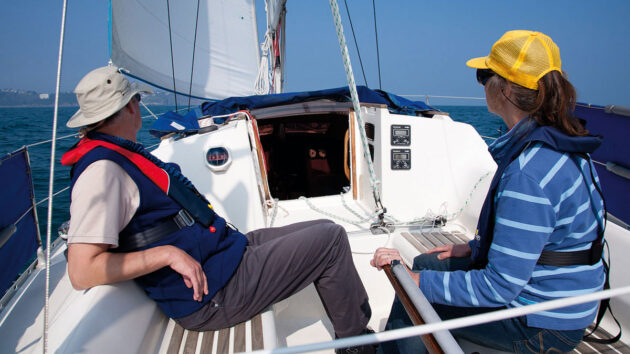
The cockpit can’t be deep because of the aft cabin, but it is well proportioned with comfortable coamings and a good leg-bracing width between the seats. Credit: David Harding
Handling the headsail sheets is a pair of Harken Barbarossa 32 self-tailing winches. Mounted on plinths outboard of the coamings, they seemed man enough for the job. A single-speed winch on the port side of the coachroof looks after the mainsail inhaul and outhaul lines with the help of a pair of Spinlock clutches. If spinnaker gear was fitted, and the halyards were led aft instead of on the mast, more clutches and another winch would be needed to starboard.
Moving forward from the cockpit is made relatively simple by the sensibly wide side decks, edged on their outboard side by the ubiquitous slotted aluminium toerail. The moulded diamond non-slip finish typical of French production boats helps feet to stay where they’re planted, but the forward-facing window ahead of the mast is a slippery trap for the unwary. If you do slip here, at least the babystay provides something to grab hold of. Joining the deck between the window and the vented forehatch, it’s a useful handhold and not so far forward as to be a serious nuisance during tacks. Whatever the slip risk, the trip risk is reduced by the near-flush foredeck that also provides a convenient sunbathing space – as the original brochure illustrates. Right in the bow is an anchor locker that, on Kumuka, accommodates both a plough and a Danforth.
The finish of hull and deck was good: mouldings were fair and fading, crazing and discolouration minimal for a boat now into her third decade.
Looking aloft gave no cause for concern. Cap and lower shrouds are swept aft a few degrees and taken to a pair of U-bolts just outboard of the coachroof, with twin backstays providing aft support for the single-spreader masthead rig.
Accommodation
It’s easy to see why boats like the Sun Dream gave British builders a hard time when they were introduced in the 1980s. The interior is exceptionally light and airy thanks to the large window forward – although it’s at too shallow an angle to give good visibility directly ahead – and one each side that runs almost the full length of the saloon.
With vinyl linings above the windows and timber trim below, the finish is much less plasticky than on many production boats. The neatly-finished joinery has a substantial feel, as do the handholds each side.
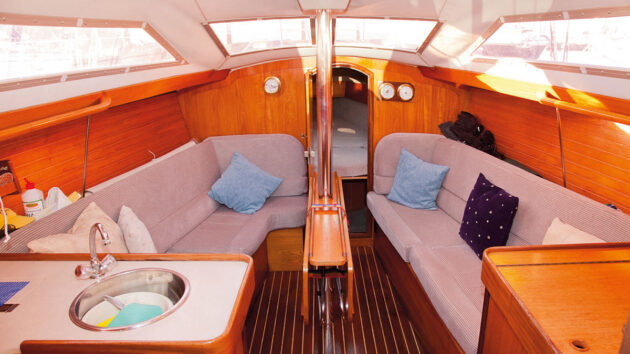
A large window area makes for an especially light and airy saloon. Credit: David Harding
Forward of the main bulkhead is the forecabin with its 2.03m berth. There’s no room for anything else up here without impinging on the saloon, where the berths are 1.85m. Lifting the saloon’s bunk-boards reveals the plastic water tank to port; otherwise the space is devoted to stowage, and nothing is lost to internal mouldings because the joinery is bonded directly to the hull. Headroom is just over 1.83m.
Beneath the sole boards are transverse stiffening members and keel bolts that have been glassed over. It leaves a neat finish, but you wonder how the bolts might ever be – or have been – tightened. Abaft the bolts is a mini sump for the bilge pumps and drains from the shower and coolbox.
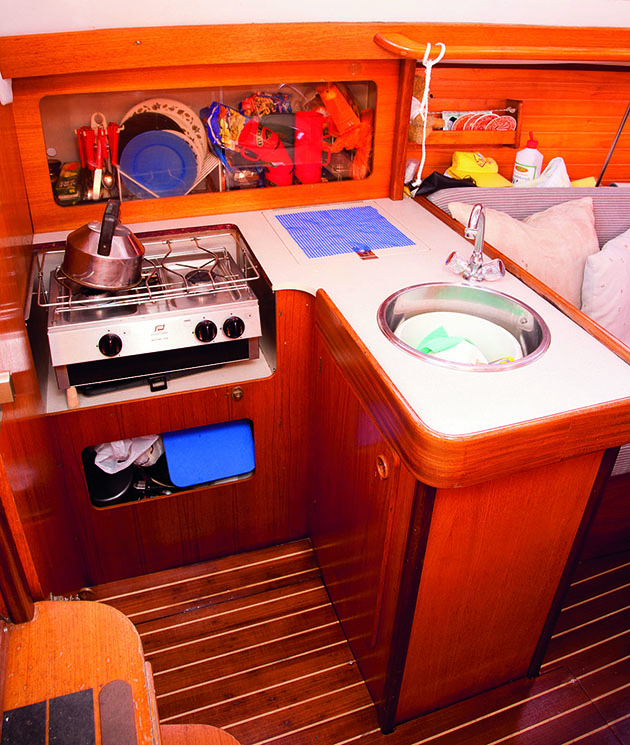
No oven in the galley as standard, but a fair amount of stowage space. Credit: David Harding
To port by the companionway the galley has a single sink, enough stowage for coastal cruising and, in typical French style, a cooker with two burners, a grill and no oven. Opposite is the chart table. At 56 x 84cm it’s big enough for chart work and reflects the fact that the boat was designed before the days of push-button navigation. Space for instruments is generous too, and Jeanneau’s original brochure makes proud reference to the ‘sheathed electrics’. At least it suggests that the electrical system has been given some thought.
Moving aft from the chart table we enter the heads, which contains the only interior mouldings on the boat – though once again the headlining is in vinyl. Seacocks are accessible and there’s even space to hang a couple of sets of waterproofs.
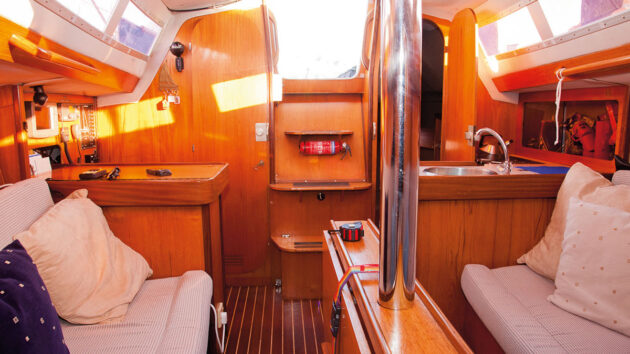
My modern standards, the chart table is big for a boat of this size. Credit: David Harding
In the port quarter, the aft cabin features a berth that, unusually, is longer on its inboard than its outboard side (the measurements are 1.93m and 1.87m respectively). There’s a reasonable amount of roll-over room and a low-level window in the stern that makes it quite a bright little den.
In the usual place beneath the companionway is the engine, a Yanmar 2GM that drove the boat along happily and, now that the propeller has been cleaned of its barnacles, apparently stops her in impressively short order.
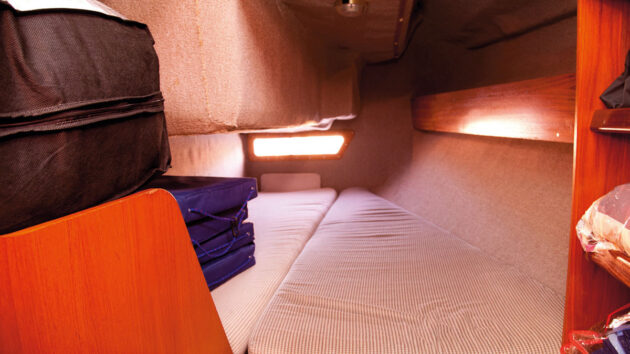
A low-level window in the transom lets extra light into the aft cabin. Credit: David Harding
All told it’s a pleasant and functional layout that makes good use of space and reveals what looks like good practice in the construction. Access to plumbing and electrical systems appears to have been considered and the absence of internal mouldings means few wasted corners.
Verdict on the Jeanneau Sun Dream 28
When I was working for Sadlers in the 1980s, boats like the Jeanneau Sun Dream 28 were a thorn in the side: there we were trying to sell our tough offshore cruisers and pointing out the benefits of generous displacement, modest beam, high ballast ratios, deep cockpits and sea-friendly quarter berths among a multitude of tried-and-tested features. But while many potential buyers understood our philosophy, we lost some sales to what we saw as these Continental lightweights with their beamy, flat-sectioned hulls, fancy interiors, wide sterns and shallow cockpits over double aft cabins.
These boats were lifestyle accessories for Johnny-come-latelies, we decided; not what experienced seafarers would buy. I have since discovered that plenty of boats are more deserving of that slightly dismissive epithet than the Sun Dream which is, in fact, quite a capable little cruiser. A British owner sailed one to Iceland and plenty of French owners have also covered a fair few miles. Closer to home, the Stewarts have been impressed with Kumuka’s handling following some lively outings this season.
To those not planning serious offshore cruising – and that’s most owners of 28-footers – the approach developed by builders across the Channel in the late 1980s often seemed more inviting than the traditional British alternative. A roomier, lighter, brighter interior, a separate aft cabin, a lower price tag and lashings of Gallic style clearly did the trick, especially for those with young families. I’m still not sure that the Jeanneau Sun Dream 28 would be my first choice for passages of any distance, but whatever her offshore potential there’s no denying that she’s a great little coastal cruiser. It’s easy to see why so many people bought her new and why she’s still such a popular second-hand buy today.
Details
LOA:8.64m (28ft 4in)
LWL:7.50m (24ft 7in)
Beam:3.15m (10ft 4in)
Draught (fin keel):1.64m (5ft 41 ⁄2in)
Draught (centreplate up):1.02m (3ft 4in)
Draught (centreplate down):1.90m (6ft 3in)
Displacement:2,850kg (6,283lb)
Ballast:1,070kg (2,359lb)
Sail Area (main and foretriangle):35.5sq m (382sq ft)
Sail area/displacement ratio:17.93
Displacement/length ratio:188
Engine:Yanmar 1GM/2GM or Volvo 2002 diesel
Headroom:1.83m (6ft 0in
Designer:Tony Castro
Builder:Jeanneau
Second-hand price:£15,000-£25,000