



Bruce and Vicki Carter were sailing near Lizard Point, Cornwall, when a persistent fire in the cabin of their Sadler 29. Elektra led them to abandon ship
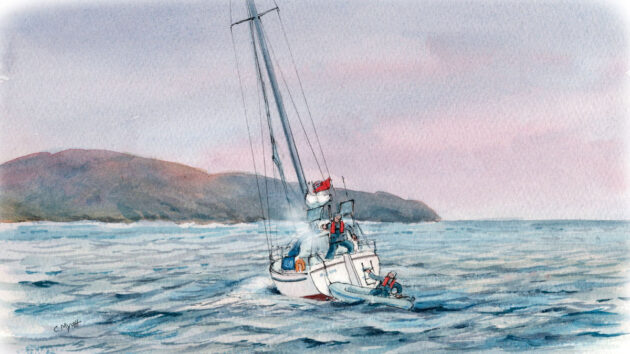
Following a wonderful holiday to the Isles of Scilly, we were on passage to our home port of Gillan Harbour on the Helford River. We were motorsailing to cover as much ground as possible before dark, as I was worried about not seeing pot markers in the dark on the east side of the Lizard Peninsula.
At 2020, my log records that the wind was south-westerly Force 3-4, slight sea; we were 3.25 miles west of our waypoint off Lizard Point and we had covered 42 miles. Ten minutes later, at 2030, the chartplotter went blank. I leaned forward to see what had happened to it, only to spot smoke rising from the cabin.
My wife, Vicki, who was down below, hadn’t noticed it. I stopped the engine and quickly went to investigate. I opened the engine box and could see burning wires. I shut the box and grabbed the Fire Safety Stick (a compact fire suppression device) that I’d bought over the winter. I’d read the instructions then but couldn’t remember them and now, somehow, I couldn’t make sense of the words. I needed to put the fire out!
Fighting an electrical fire
So I grabbed the 1kg powder extinguisher in the cabin, pulled the safety clip, opened the engine box and pressed the lever. Almost instantly, the fire was out. I leaned on the chart table, trembling.
I noted in my log about the fire and called Falmouth Coastguard on Ch16 to report that we’d had an electrical fire, which I had put out. The coastguard duty officer asked me if l was declaring an emergency. At the time, I didn’t know if we had a working engine, but we were still logging 4.5 to 5 knots under sail.
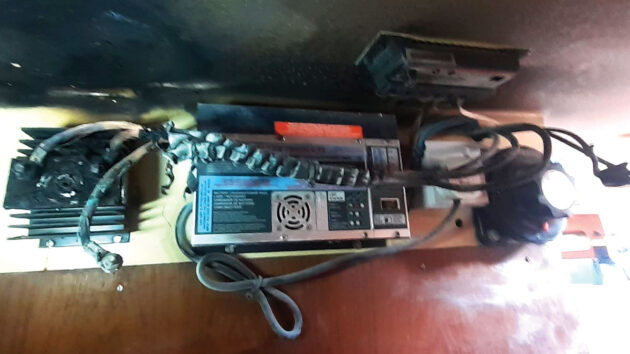
The alternator diode which Bruce couldn’t extinguish completely – it reignited several times. Credit: Bruce Carter
Would our lights work when we needed them later? As I was thinking about how best to respond, I noticed more smoke and told the officer I was investigating. Pulling items out of the quarter berth, used for stowage, I could see more fire, and picked up the extinguisher again. This fire was halfway down the quarter berth and up against the ceiling on the engine side; I gave it a blast of powder, and again it was out. But it started burning again, so another blast and it was out. Now, the extinguisher was empty.
By this time, Vicki had put on a jumper and a lifejacket and was sitting in the cockpit. I have always worn a lifejacket while sailing, as in an emergency you don’t have time to put it on. I asked Vicki to find the 2kg extinguisher in the cockpit locker, which she did while I was inspecting again. The fire was alight again; I can’t remember how many times I tried to put out the electrical fire but it was lots.
Abandon ship
All this time I could hear on Ch16 the coastguard officer tasking the Lizard lifeboat and knew help was coming. When the extinguisher was finally empty the cabin was full of powder in the air, yet through this I could still see an orange glow. The coastguard officer asked, “Do we have a liferaft?” I said, “No, but we have a dinghy.” He suggested we abandon ship. With the centre of the electrical fire only 18-24in from the gas locker and the fact that I didn’t think I’d put the fire out, I didn’t need telling twice!
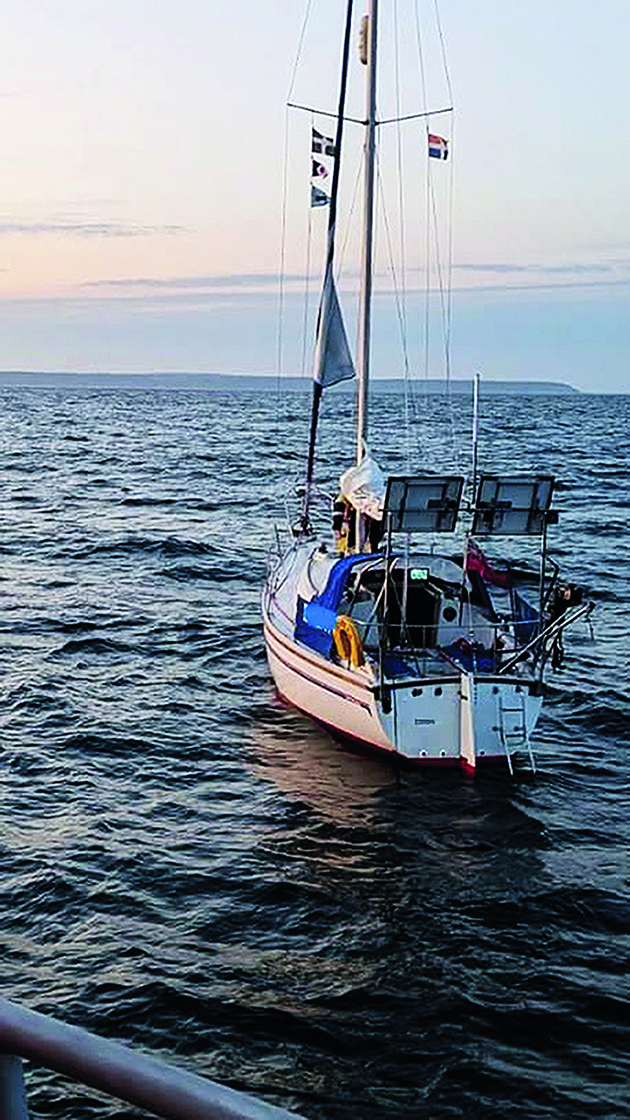
With no lights and night approaching the stricken Sadler 29 Elektra was deemed a hazard to navigation. Credit: The Lizard RNLI
In the cabin I was coughing from the powder and needed to get out, so I grabbed the handheld VHF radio, took it up to the cockpit and switched it on. My next task was to lower the dinghy, which was on davits, into the water and climb in to release the tackle and hold the dinghy while Vicki climbed in.
By this time, the tide must have pushed us into the unsettled water of the Lizard Point, for one second I was standing up, arms outstretched hanging onto the rail, the next I was sitting down with the rail at eye level. Somehow we both got aboard without getting wet. I then untied the dinghy, and, expecting an explosion, I let Elektra go.
Lifeboat heroes
About five minutes later, Lizard RNLI crew contacted me on Ch16 to confirm we were in the dinghy and ask how many were aboard; two to three minutes after their call, Vicki saw the lifeboat. We were in our 2.7m inflatable RIB, lying low on the floor, Vicki on the starboard side with her head at the stern and me the opposite with my head at the bow. It was very snug!
When the lifeboat arrived (being local to the area we know some of the crew and there was a bit of light-hearted banter), there was a lot of slop and getting the lifeboat close was difficult. Vicki had a rebound wave dump onto her, but the RNLI crew managed to get the dinghy alongside and tied on. I stood up and climbed aboard the lifeboat. One of the RNLI crew got in the dinghy to help Vicki from below, while I and another crewmember helped her from above.
We were given medical checks in the lifeboat cabin. By this time, knowing Vicki was safe, I began worrying about Elektra, but I was told by one of the crew, we were the important ones! So I put Elektra out of my mind and went with the flow. The lifeboat crew dropped us off at their station at about 2130 for the station crew to look after us, and then they went back to Elektra.
Aftercare after experiencing an electrical fire
At the RNLI station, an ambulance crew attended to check us over, as a precaution. We’d abandoned Elektra with just the clothes we were wearing. I had my wallet and mobile phone in my pockets and the handheld VHF radio, but we didn’t have our house keys. The ambulance crew took us home and I broke a window to get in.
The Lizard lifeboat returned to Elektra and found her without a fire. It seemed I’d done enough to put out the blaze but hadn’t realised it. As Elektra was floating without lights, she was considered a hazard to shipping, and so was taken under tow to Helford River and placed on a mooring.
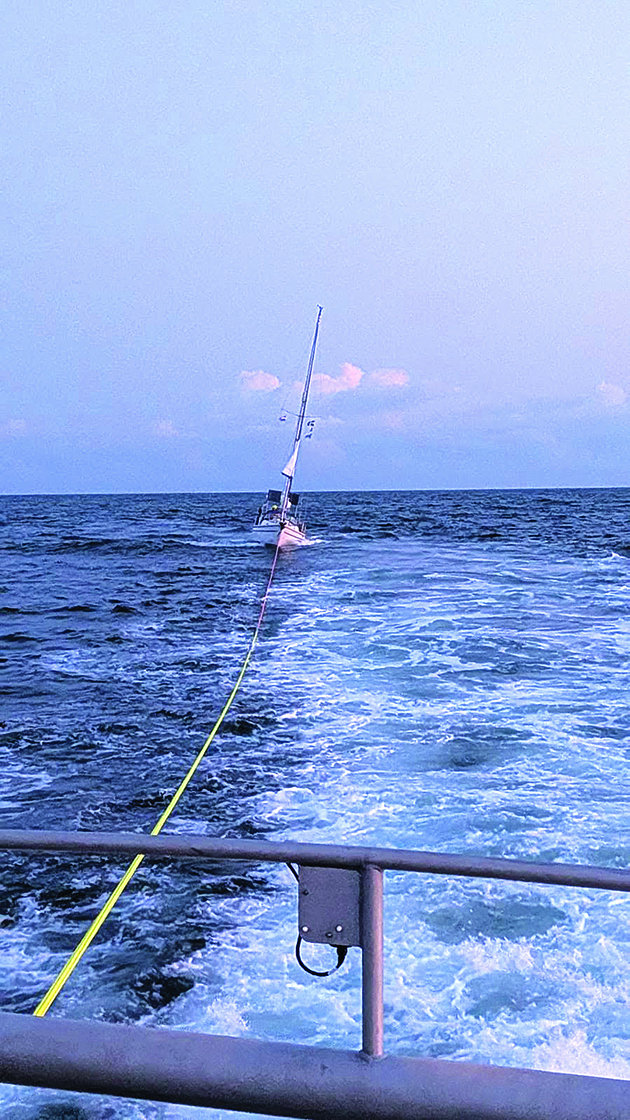
Elektra taken under tow by the Lizard RNLI lifeboat. Credit: The Lizard RNLI
That night I couldn’t sleep! Eventually, I drifted off for two hours before waking up coughing due to the powder from the extinguishers. After updating our shore contact, Patti, with the full story, at 0720 I walked down and located Elektra on the river mooring, her foresail flapping in the increasing wind.
Boatyard owner Anthony helped me to organise a tow of Elektra from Helford River to the waiting mooring at Gillan Harbour where she dried out on the receding tide. Only then did I have a chance to look in the cabin of the yacht we’d abandoned around 15 hours before.
White powder covered everything. It would all need to be removed and cleaned before use again. I packed some bags to take home, cleared the fridge and picked up Vicki’s tablet and phone, and the house keys. I didn’t have long because the tide was going out and it’s difficult to move bags from the cockpit to the dinghy alone; I took what I could, locked up and drove home.
Paperwork
After brunch, I phoned my insurance broker to report and start the claim process. I also phoned my engineer and told him about the fire. He promised to have a look. I returned to Elektra, now dried out, with more bags to fill.
This time I started to remove the items from the quarter berth; the powder was about an inch deep in there! We’d always used this area for stowage as the berth was difficult to get in and out of because of the chart table. It housed all my tools and spares, the rolled up cockpit enclosure, a bag of recycling which we still had from the Isles of Scilly, spare lifejackets, a plastic folding box, a folding sack trolley, a new 30lt rucksack, and a new empty grab bag, all of which were covered in a thick layer of white powder.
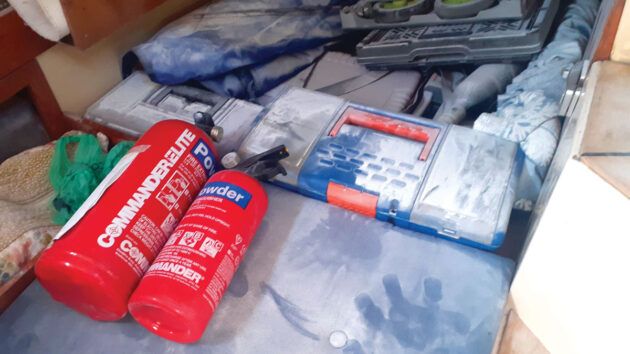
Bruce’s first look in the cabin after the fire – white powder coated everything! Credit: Bruce Carter
As I moved this out into the cockpit, the powder blew away in the wind. My friend asked if I was OK. By now I was grouchy with lack of sleep and the powder was really awful stuff to deal with, so I don’t think my answer was very nice. I loaded the bags into my pick-up and drove home, putting most of it in the shed to deal with later.
After a shower, I noticed a WhatsApp message from another friend, asking what had happened. It was surprising how much it helped to talk about it. The rest of the week continued with much of the same.
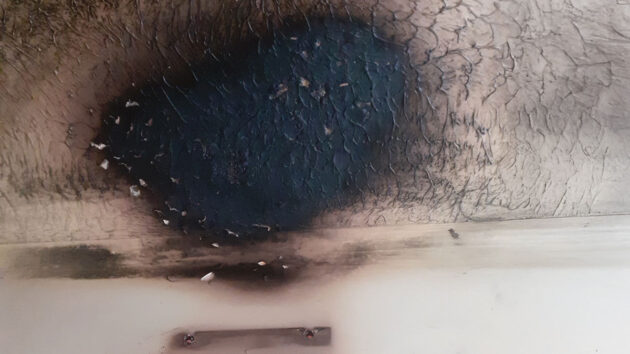
Scorching of the GRP above the alternator diode revealed during the clean-up. Credit: Bruce Carter
My engineer had a look at Elektra’s engine and said the engine harness was good; only an earth cable from the lead-acid batteries (gel) needed replacing.
The damage seemed to be mainly burnt wiring and a burnt alternator diode. The fire had spat into a new rucksack stowed in the berth, but that had saved everything else under it. The cockpit enclosure was rolled up and stowed in the berth, the canvas was fine but the plastic windows were damaged.
The electrical fire had also blackened the ceiling above the alternator diode. There was powder everywhere and the cabin needed to be emptied and totally cleaned. The only other damage was external; the bow navigation light was broken.
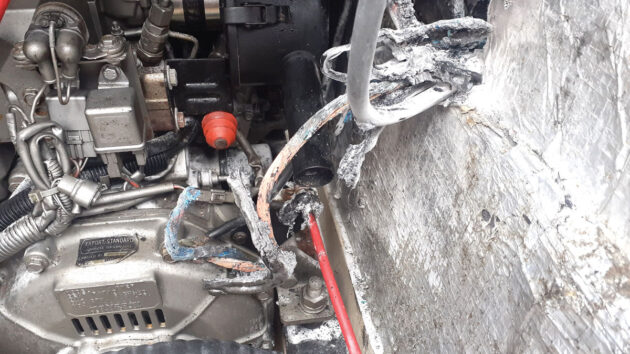
Negative leads between engine and batteries completely gone – and everything covered in fire extinguisher powder. Credit: Bruce Carter
All in all, we had a lucky escape and I’d especially like to thank the coastguard duty officer. When you have an emergency, you need someone to react and the duty officer certainly reacted on our behalf. I’m also indebted to the Lizard RNLI lifeboat crew for their quick response. They were paged at 2035 on a Sunday, and after transporting Vicki and I back to the lifeboat station at 2125 to be checked over by an ambulance crew, the crew returned to tow Elektra.
They got her onto a mooring just after midnight, and didn’t return to the station until 0116. Everyone was so helpful; I’m very grateful.
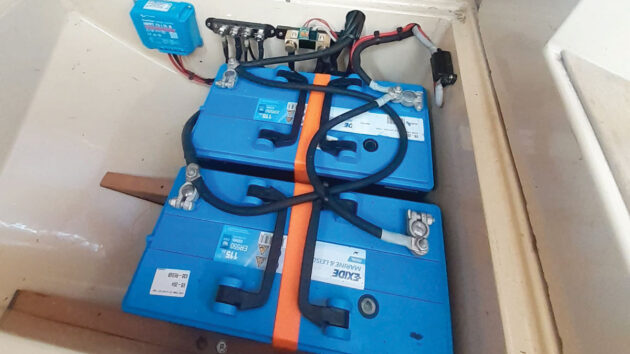
Elektra’s new battery and electrics installation. Credit: Bruce Carter
Elektra was rewired, with a new switch panel and new lead-acid batteries, within three weeks of the fire, and we were sailing again within a month. We continued our season and logged another 300 miles.
Lessons learned after an electrical fire
- Contact the local coastguard station at the first sign of a problem. We had a fire which I had extinguished, and I was talking to the coastguard duty officer when I discovered the second fire. I didn’t send a Pan-pan or a Mayday; the duty officer could hear I was in trouble and declared an emergency on my behalf, tasking the Lizard lifeboat.
- Simple is best. In an emergency, you need to know how emergency equipment works before you pick it up.
- Put all your personal items in a grab bag before every passage.
- I’ve since been told a shut-off gas bottle can’t explode unless in a major fire; the fear of explosion was my reason for leaving the boat. In a similar situation I wouldn’t abandon the boat as we didn’t have a major fire, although many emergency workers have since said I acted correctly.
Expert comment
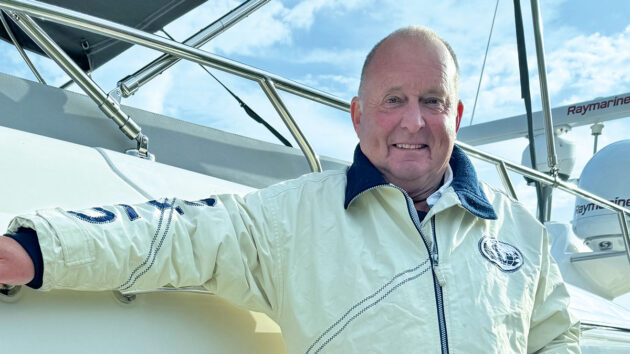
Stuart James
Stuart James, founder of Predator Batteries says:
It’s always sad to hear of such experiences. Trying to assess the cause of the electrical fire isn’t easy. It sounds like Bruce did take care and it’s just ‘one of those things’ that shouldn’t happen when you spend your money trying to keep safe. It appears the wiring in the engine room caught fire and spread through the bulkhead into the cabin quarter berth, where the batteries were.
There’s a remark about the alternator diode – could the alternator regulator have failed and started overcharging? But then the red charging cable would have shown signs, unless of course the black negative wire had an issue (corroded connection or even cut). Bruce mentions that the earth wire was the only thing on the loom that needed replacing – so perhaps it was simply a poor connection that overheated.
If there was an old or faulty battery, the alternator could have been working flat out, overheated, and put the system under stress. That’s why batteries should be checked annually. These were gel batteries, which are the safest. The older, cheaper flooded battery, when worn out or if there’s an issue, can create fumes which can be flammable unless there is significant ventilation. In this case, the battery cases were covered with ’stuff’, so ventilation was questionable. But it didn’t matter as they were gel.
My recommendations regarding batteries for marine is:
- Always fit the best you can afford – either AGM or gel.
- Have them tested every year – especially at the season start.
- Ask an electrician to check the connections. Corrosion over the winter can affect them.
- Run the engine at medium revs. Switch on all the electrical equipment for at least 10-15 minutes to test the alternator temperature and wires leaving it.
This incident could have resulted in a more serious fire. If the batteries fitted were lithium, this could be catastrophic. That’s why lithium battery installations must be done by fully qualified electricians. The latest lithium batteries have fire suppression valves or internally-fitted aerosol fire extinguishers.

Boat fire prevention: tips to stay safe
For sailors, there is no hotter topic than fire on board. Sticky Stapylton looks at methods of prevention – and…

‘I didn’t know what was going to explode’. Family escape boat fire
A man and two children have been rescued off the Dorset coast after the motor of their RIB caught fire,…

“It’s alarming how quickly the fire grows” – Warning over camping stove use on boats
A quick brew turned into a frightening fire aboard a classic wooden boat for PBO contributor Max Liberson.

Lessons learned from devastating yacht fire
‘Flames were licking out of the companionway’: yachtsman watched his beloved boat burn following two-year restoration
Want to read more articles like Why we abandoned ship off Lizard Point after an electrical fire got between us and the gas locker?
A subscription to Practical Boat Owner magazine costs around 40% less than the cover price.
Print and digital editions are available through Magazines Direct – where you can also find the latest deals.
PBO is packed with information to help you get the most from boat ownership – whether sail or power.
-
-
-
- Take your DIY skills to the next level with trusted advice on boat maintenance and repairs
- Impartial, in-depth gear reviews
- Practical cruising tips for making the most of your time afloat
-
-
Follow us on Facebook, Instagram, TikTok and Twitter
PBO web categories