


Yann Quenet stands out as much for the philosophies behind his self-designed and built 13ft Baluchon as for his sailing exploits. Rupert Holmes reports on one of today’s most inspirational sailors
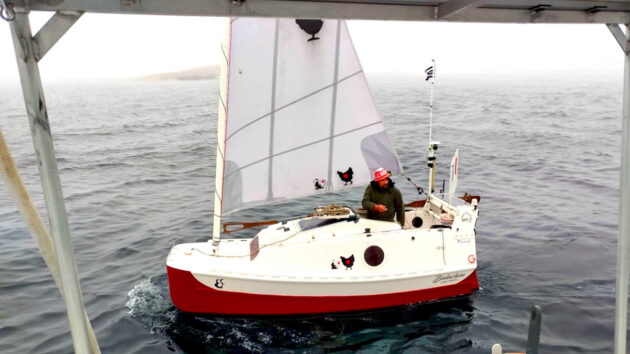
Given our increasingly complex world it’s all too easy to lose sight of the benefits that simple, yet elegant design solutions can bring. Breton sailor Yann Quenet has long espoused “less is more” philosophy and is now halfway through a second circumnavigation on his self-designed and built 4m (13ft 1in) long Baluchon.
“The general philosophy was to design the simplest and least expensive long-distance cruising boat possible,” he told me, while also acknowledging that, “It can sometimes be very complicated to make things simple.
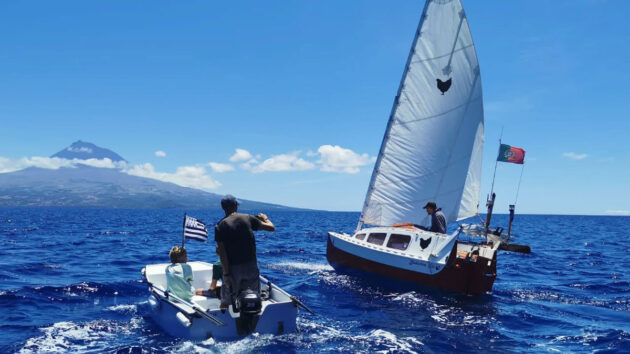
Baluchon originally had large panoramic windows, but they were removed to improve insulation. Credit: Yann Quenet
“The aim was to have a boat that could be financed very easily and quickly, and repaired anywhere in the world without needing specialist tradespeople or complicated equipment,” he adds. Baluchon was built for around €4,000 (£3,422) in 2017, though Quenet reckons that with inflation that figure would now be closer to €5-€6,000 (£4,278-£5,134), even if a lot of secondhand materials are used.
Simple sailing for Yann Quenet
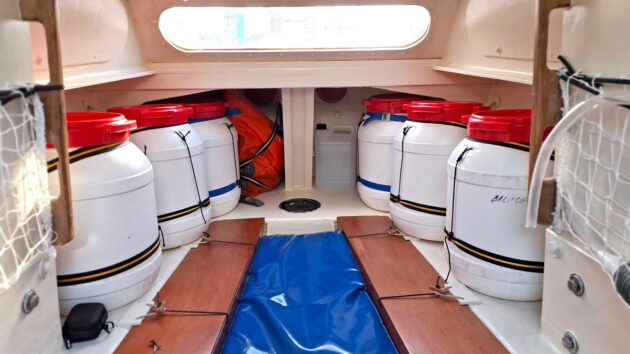
Efficient stowage is critical on any small boat, without placing weight near the ends. When on passage water containers are strapped in place each side of the mattress on the cabin sole. Credit: Yann Quenet
Of course, there’s nothing new about voyaging extensively in small boats. Shane Acton circumnavigated on his 18ft plywood Caprice – a boat identical to one I owned as a teenager. Equally Swede Sven Yrvind has completed countless long-distance passages, including 10 Atlantic crossings on boats of 4-6m/13-19ft 6in length, including a 78-day voyage aged 82, while in 1959 John Guzwell famously completed a 33,000-mile circumnavigation via Cape Horn in his 6.2m/20ft 6in home-built Trekka.
By contrast, it now feels as though we have all moved well away from that kind of philosophy and today’s world-girdling boats tend to be extremely complex. Almost all have extensive refrigeration, pressurised hot and cold water, shower pumps, anchor windlasses, diesel engines, complex sailing handling systems and deck hardware.
Yet all are costly items that can be a huge – and expensive – headache to fix, especially in far-flung parts of the world. Equally, delays while waiting for spares – or busy technicians – can leave you with a race to exit a cruising area before the start of winter, or the onset of a cyclone season.
Strip all those so-called luxuries, and you can have a more relaxed voyaging life that doesn’t need a big financial buffer to fall back on should a big-ticket item need to be replaced.
Yann Quenet’s determination to create a boat with minimal dependencies on external factors therefore delivers a level of freedom and autonomy that confers a level of relaxed, worry-free luxury denied to owners of larger and more complex vessels that depend on a host of complex systems.
The lessons Yann Quenet learned
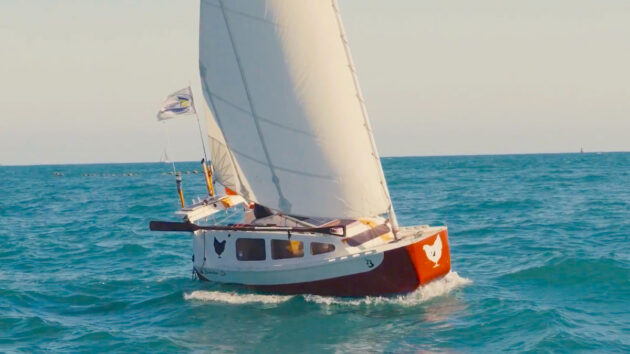
Baluchon in her original configuration before embarking on her first circumnavigation. Credit: Yann Quenet
However, it hasn’t always been plain sailing. While Quenet has long experience of repairing, building and designing small boats, disaster struck early in his first circumnavigation in 2015.
He was forced to abandon his previous boat, Skrowl, after being inverted in severe weather 450 miles from Madeira. He was rescued by a cargo ship, jumping across and clinging to the pilot ladder as the two vessels came together on a wave, in what sounds like a horrifyingly scary operation.
Yann Quenet subsequently said he came close to abandoning the project and never sailing again, but later reframed the loss as a learning experience. That decision was fortuitous for the wider sailing community, as we now have the benefit of extensive validation and further refinement of his ideas.
While in French Polynesia, halfway through his second circumnavigation on Baluchon. Yann Quenet told me the most important lesson from the loss of Skrowl was that, “You cannot apply the same methods of calculating capsize recovery and self-righting to a miniature sailing boat as you would to a larger boat.
“The boat needs a system, in addition to the ballast, to help it right itself. That’s why I fitted Baluchon with a foam arch above the cockpit to help the boat come upright again.”
The principle behind this is well established. RNLI RIBs, for instance, have auto-inflate buoyancy bags on their overhead arches. These are designed to deploy instantly and right the vessel immediately should a giant wave capsize and invert the boat.
Yann Quenet also says he learnt that with a miniature boat you have to pay very careful attention to the distribution of weight while sailing. More on that aspect later.
Many other lessons from that incident are now embedded in both the concept and design of Baluchon and in Quenet’s approach to handling heavy weather.
The desire for a new boat to behave more like a lifeboat – or a self-righting roly-poly toy – informed the self-righting configuration. Equally, having initially been trapped in the cabin of Skrowl when she inverted he subsequently paid more attention to creating a viable escape route. He also shaped the cabin top of the new boat to help it self-right more readily when inverted.
On reflection, Yann Quenet also thinks he had become complacent about Skrowl’s capabilities, so another key lesson arising from her loss is that a sailor must remain suspicious of everything, especially himself. As a result of this complacency, the boat was overwhelmed by a big wave and inverted, with the main hatch open, and she didn’t readily self-right.
Building on experience
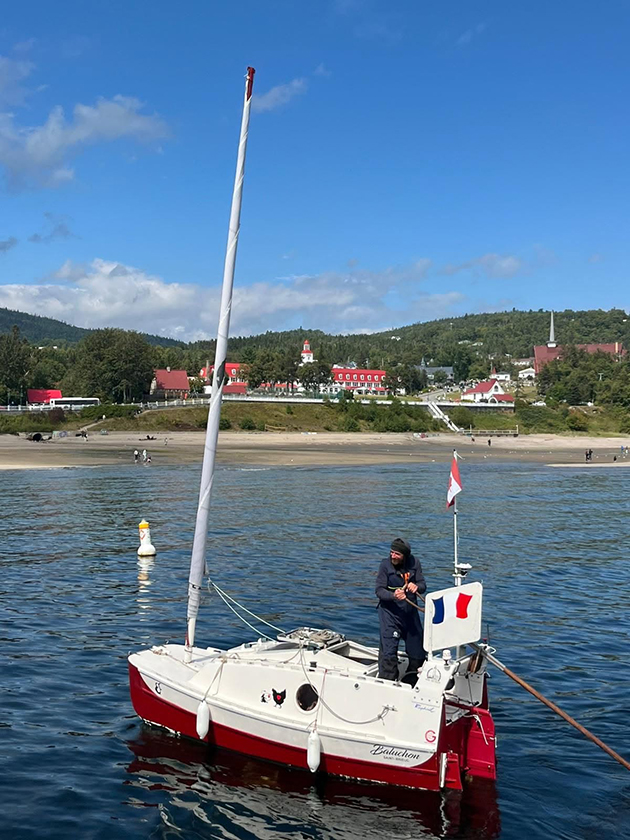
A simple sculling oar is used for propulsion in port when the wind is too fickle to sail. Credit: Yann Quenet
The outcome of these learning experiences was Baluchon, a tiny 4m cruiser with a single 11m2/118sqft sail on an unstayed and minimally complicated rig made from industrial carbon tube. It’s an arrangement with almost nothing to break, while reefing and furling are achieved by rotating the mast, enabling quick and easy adjustments of sail area. Yann Quenet can step and unstep the mast himself, without assistance and a single sculling oar serves for propulsion in harbours where the wind is too flukey to sail. He also has a small secondhand spinnaker from a 420 dinghy for very light winds, but says this is rarely used in the open sea.
Happily Quenet’s first circumnavigation on Baluchon, in which he covered 30,000 miles over three years, was an unquestionable success, so the boat and the underlying concepts are well proven. At the time of writing he was in French Polynesia, halfway through a second lap of the planet.
His longest leg at sea to date was 77 days, from New Caledonia to Reunion Island in the Indian Ocean, when COVID-19 restrictions prevented a stop anywhere in Australia. Impressively, he was able to carry sufficient stores for this voyage, including 110lt/29gal of freshwater, which he supplemented by catching rainwater, plus occasional use of a hand-operated backup watermaker.
“To cross oceans in a small boat,” he says, “you have to be self-sufficient, be able to make do with very little and not be demanding when it comes to comfort. “Above all, however, you must be able to marvel at the smallest things: sunrises and sunsets, marine mammals playing in front of the boat, birds flying over the sea, distant islands appearing on the horizon. You probably need to have retained a childlike, poetic and contemplative spirit.”
What does he find to be the most difficult aspects of living aboard such a small vessel? “You simply have to be accustomed to discomfort and happy to be sailing,” he replies. “You must also accept the solitude. It is not very physically demanding, because very little effort is required.”
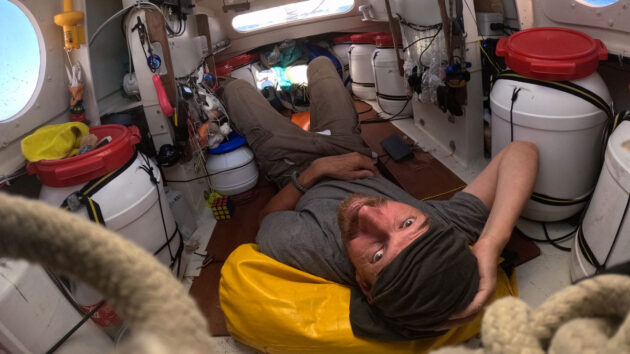
Everything is within arm’s reach in the cabin. Credit: Yann Quenet
It’s possible to sit and lie down in the cabin, but not to stand up and everything is comfortably arranged within arm’s reach. Baluchon has a small gas burner of the kind used for mountain hiking, but this is only used when conditions allow to heat a little water for tea and Chinese noodles or ramen.
When asked about the most important lessons from his first circumnavigation aboard Baluchon his answer focuses on the experience, not the technical aspects of the boat or sailing: “What I learnt most from my first circumnavigation was how to meet people. When I first set off in my little boat, I thought other sailors would make fun of me because it looked more like a toy than a real boat.
“But everywhere I went, people were surprised and came over spontaneously to meet me.
I am a solitary and shy person, but thanks to that voyage I made many friends all around the world.”
Improving design
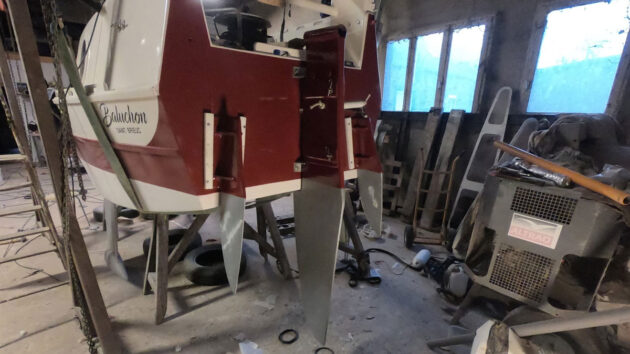
The refitted Baluchon has two retractable 100kg ballasted daggerboards on each side of the centreline berth on the cabin sole rather than the original fixed keel. Credit: Yann Quenet
During the whole of the first circumnavigation, the only significant problems he reported with the boat were issues with battery charging, which forced adoption of a very low energy mode at times, and that the cloth used for the mainsail was a little lighter than ideal, although the sail still made it around the globe.
Nevertheless, based on this experience he had a list of modifications and improvements to make, mostly to further increase the level of independence the boat provides and to improve safety, thus making the whole expedition more autonomous, whether at sea, in port, or even for transporting the boat by land.
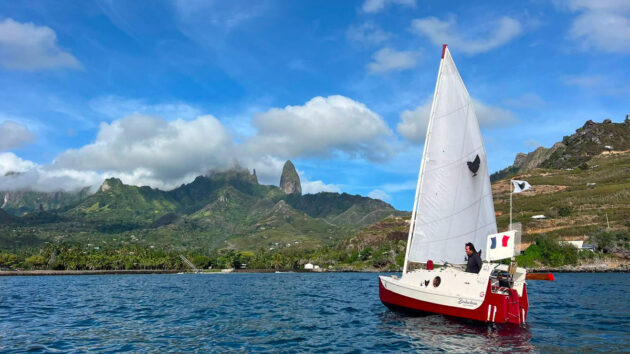
The mast is made of industrial carbon fibre tubes and rotates to reef – or entirely furl – the small 11m2 sail. Credit: Yann Quenet
These factors were addressed in a big 2023–24 refit, much of which was driven by the philosophy that a pocket boat ought to be pulled ashore without a crane or other special equipment. Even though it had performed well offshore, the original fixed keel didn’t meet those objectives and was replaced by two retractable ballasted daggerboards of approximately 100kg each, one on each side of the centreline berth on the cabin sole.
Other changes in this refit were of a more minor nature, including modifications to the mast box/step to simplify stepping and unstepping without assistance. Yann Quenet also replaced the self-righting rollover hoop, tweaked the rudder, size and shape, renewed the internal buoyancy material, improved the companionway hatch arrangement and had a new sail made from a heavier cloth. He also reduced the size of windows, trading a panoramic view for better insulation in preparation for sailing at higher latitudes.
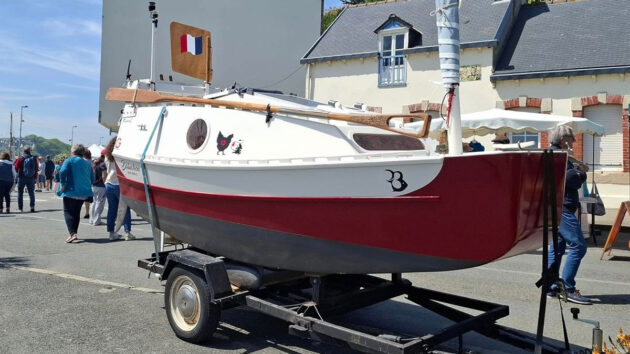
Baluchon in her home port of Saint Brieuc before leaving on the second circumnavigation. Credit: Yann Quenet
While this may look like a long list, these are all small, incremental changes that if anything underline the broad success of the original concept and design. In addition to documenting his adventures, Quenet’s many YouTube videos give expert demonstrations of epoxy preparation, wet laminating and structural filleting on a plywood/epoxy boat. They also show fabrication of the rollover hoop, casting lead ballast, filling aft buoyancy compartments with polyurethane foam and a trial inversion.
The latter was a key element in verifying the new boat’s self-righting capabilities. Outside of the dinghy cruising community, capsize tests are rarely performed in the UK, with naval architects relying on calculations instead. However, it’s a much more common practice in France, where offshore and world-girdling race boats, from 21ft Mini 650s, through Class 40s and even the 60ft IMOCAs that compete in the Vendée Globe are all routinely subjected to a 90° incline test to measure stability.
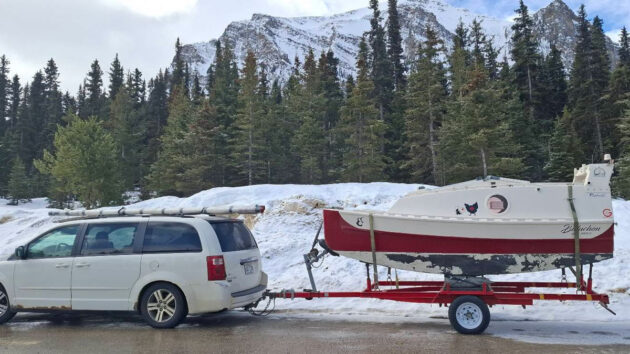
Yann Quenet towed Baluchon across Canada to British Columbia to restart his circumnavigation. Credit: Yann Quenet
Despite her now well-proven ocean-crossing capabilities, Baluchon is too small to transit the Panama Canal, so was transported across the isthmus by road on her first circumnavigation.
In 2024 Baluchon set off again on an Atlantic crossing to Martinique. However, after spending the winter in the Caribbean they headed 1,800 miles north on a 39-day passage to Saint-Martin–Saint-Pierre, a French territory near Quebec. This was followed by a voyage up the St Lawrence River to Quebec City, a two-month phase Quénet says he “greatly enjoyed.”
He then acquired a car and trailer, and took Baluchon to a remote mountain cabin in Abitibi, in northern Quebec, where he spent the winter of 2025/6 – another enjoyable experience. He then drove 3,000 miles across Canada to Crescent Marina, south of Vancouver, in British Columbia, where he relaunched Baluchon in preparation for sailing across the Pacific Ocean. From there he negotiated the 80-mile-long Strait of Juan de Fuca before heading for Hiva Oa in the Marquesas, a 3,700-mile passage that took 52 days.
This proved to be a much more difficult passage than his 2020 crossing from Panama, with a leak from a bolt associated with one of the lifting keel mechanisms, a storm that saw Baluchon submerged at times, damage to the rudder and extended periods of light airs and headwinds.
He also underestimated the time the passage would take and had to ration food for the last 20 days. Nevertheless when I spoke to him there he was in remarkably good spirits, describing the islands as “the most beautiful in the world.”
From there he had a comparatively fast eight-day passage for the 780 miles to Papeete, Tahiti. This far surpassed his average trade wind speed of around 90 nautical miles a day. Over the rest of the first circumnavigation, this dropped to an average of 70-75 miles a day. Even if it’s very slow by the standards of today’s larger yachts, it’s not so far removed from the average of 100 per day that was typical for traditional heavy displacement cruising boats of around 30-32ft a few decades ago.
Minimal gear
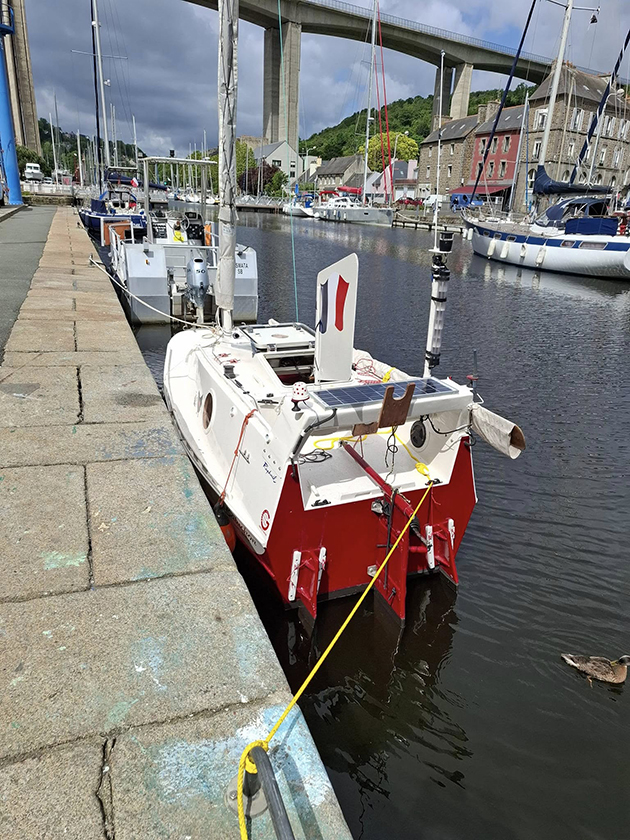
The wind vane is homemade and acts directly on the rudder with no mechanical gearing. Credit: Yann Quenet
For self-steering, Yaan Quenet uses a large homemade windvane that acts directly on the rudder, without any form of mechanical gearing. He says it’s rudimentary, but “works very well on my little boat, which does not require much force to steer. However, the boat must be perfectly balanced and the sail properly trimmed.”
He also carries a small electric autopilot connected to the tiller inside the boat, where it’s protected from the elements, but hardly ever uses it, except when there is very little wind.
One of the big things that’s changed for long-distance cruisers over the past few decades is that, even before Starlink, it was feasible for even quite modest boats to download basic weather data via a slow satellite link. However, during the first circumnavigation Baluchon had no means of communication, so Yann Quenet couldn’t receive weather forecasts and didn’t even carry a barometer.
This may sound risky, but he points out, “I arrange my passages so that I am sailing during the favourable seasons: outside the tropical cyclone season, and only during the summer when I am north or south of 25° latitude.”
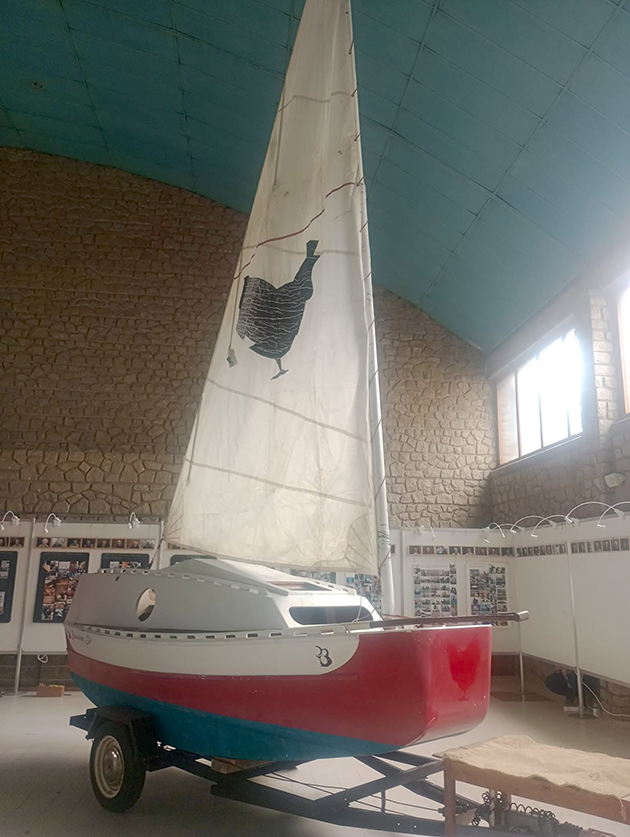
The refit of Baluchon means the boat can now be easily pulled ashore and onto a trailer. Credit: Yann Quenet
In addition, he now has a Garmin inReach satellite messenger, which allows very short text messages to be sent or received and he has a friend ashore who pings a message if a storm is forecast along Baluchon’s route.
What about storm tactics? Beyond the key plank of being in the correct part of the world for each season, Quenet’s philosophy is not to compete with the sea, but to behave almost like a floating coconut or ping-pong ball, while safely secured inside the boat with all hatches closed and waiting for conditions to moderate.
“In bad weather, I continue running downwind for as long as possible, in winds of up to 40–45 knots,” he told me. “Beyond that, I roll away the entire sail and let the boat do what it wants, like a little cork floating on the sea. During my two circumnavigations, I have not yet encountered winds of more than 50 knots.”
What does Yann Quenet enjoy most about voyaging with Baluchon? “I really enjoy watching my little boat make its own way across the ocean, guided only by the windvane self-steering system,” he says. “The people I meet during stopovers also provide some very special moments.”
What advice would he give to someone considering an ocean crossing in a small boat on a limited budget? “You need a light, unsinkable and self-righting boat with a watertight hatch,” he advises, “and the load must be distributed properly.
“You should not leave an outboard motor hanging on the transom, or keep the anchor and ground tackle at the bow while sailing. That’s the main mistake made by sailors who put to sea in very small boats.”
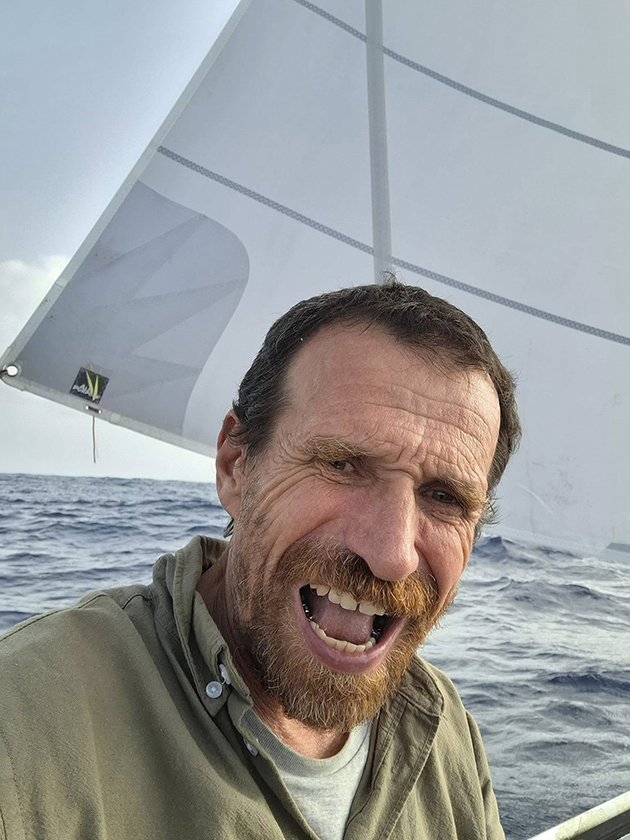
For Yann Quenet, his circumnavigations not only allow him to get closer to nature, but to people too. Credit: Yann Quenet
Beyond that, Baluchon’s most radical feature is arguably not that the boat is only four metres long, but lies in Yann Quenet’s rigorous attitude of treating every dependency as a design defect. The keel, mast, sailplan, electrics, shore handling and so on are all designed so that one person with little money and limited time can understand, repair and operate them without external support. This enables him to voyage on a budget of only €600-800/£513-£685 per month.
What are his plans after completing this second circumnavigation? “A third circumnavigation, I hope. I really enjoy sailing around the world. Everyone has something they enjoy doing. Some people like cooking, others like hiking. I like sailing my little boat.”
Yann Quenet: From France to Canada in a 4m boat
French micro voyager Yann Quenet is currently transporting his home-built 4m boat across Canada ahead of a Pacific crossing in…

Shipwrecked in a 14ft keelboat then rescued by a cargo ship
Yann Quenet is a genius from Brittany I would love to meet. He is an inventor, designer, and builder of…
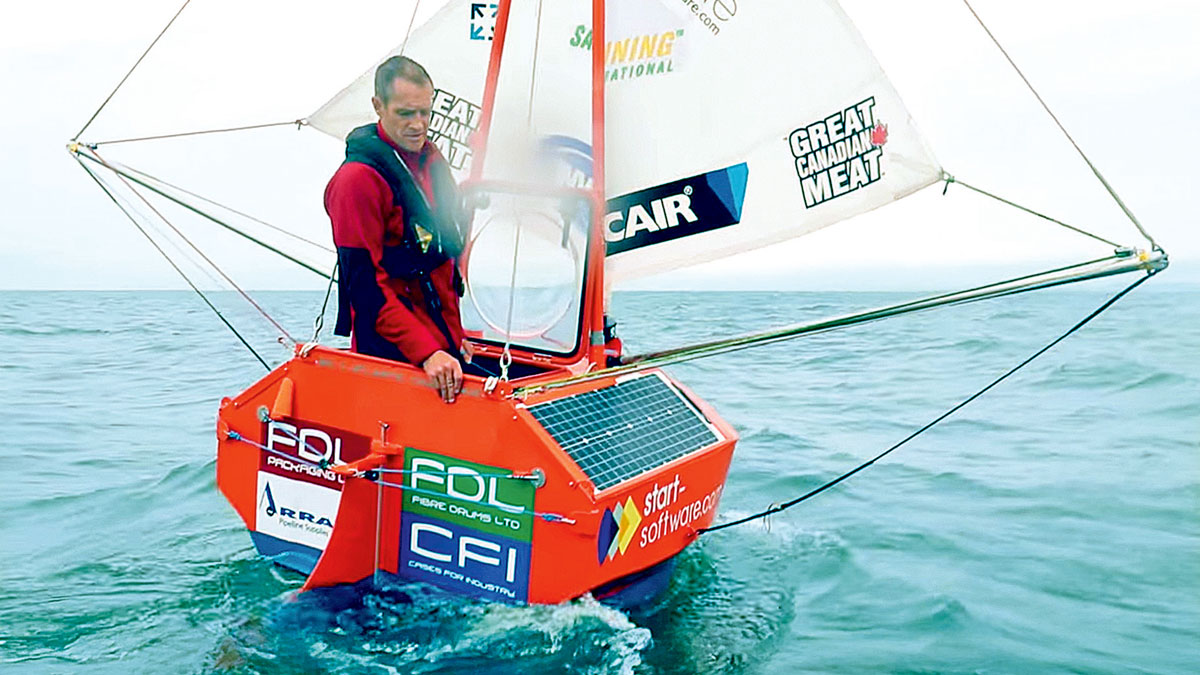
The World’s Smallest Boat? How Andrew Bedwell built his 100cm boat to sail across the Atlantic
Microyacht adventurer Andrew Bedwell tells Katy Stickland how he resurrected his Atlantic ocean world record challenge

Tributes to small boat legend John Guzzwell
Fair winds to trailblazing John Guzzwell, who in 1955 completed an unprecedented circumnavigation, aged 29, in a 21ft wooden yawl…
Want to read more articles like Yann Quenet: Why this solo French sailor rebuilt his micro-yacht to sail the globe again?
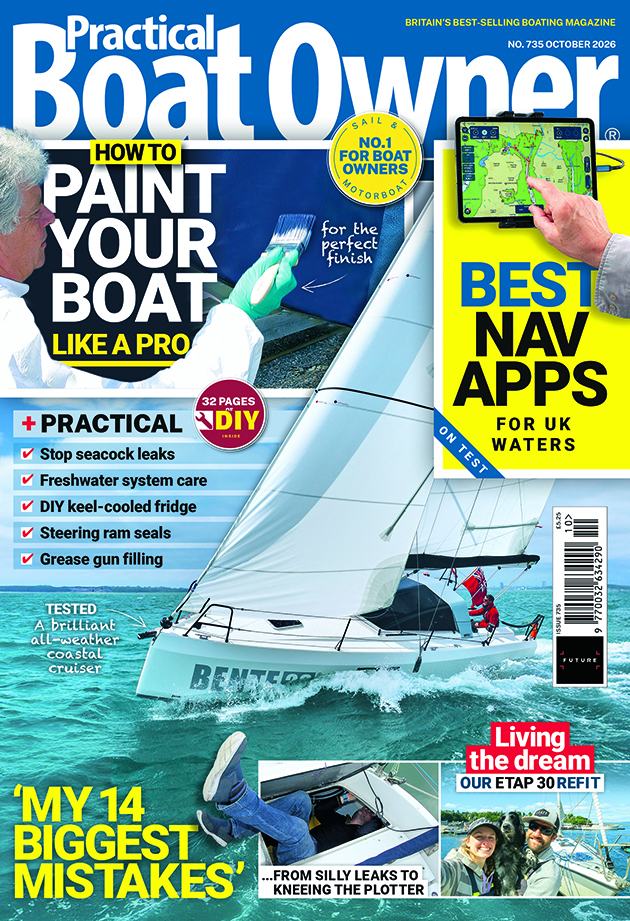
A subscription to Practical Boat Owner magazine costs around 40% less than the cover price.
Print and digital editions are available through Magazines Direct – where you can also find the latest deals.
PBO is packed with information to help you get the most from boat ownership – whether sail or power.
-
-
-
- Take your DIY skills to the next level with trusted advice on boat maintenance and repairs
- Impartial, in-depth gear reviews
- Practical cruising tips for making the most of your time afloat
-
-
Follow us on Facebook, Instagram, TikTok and X