

Tim Stickley meets the crew of Hanuman which suffered hull damage from an unidentified floating object 150 miles from land
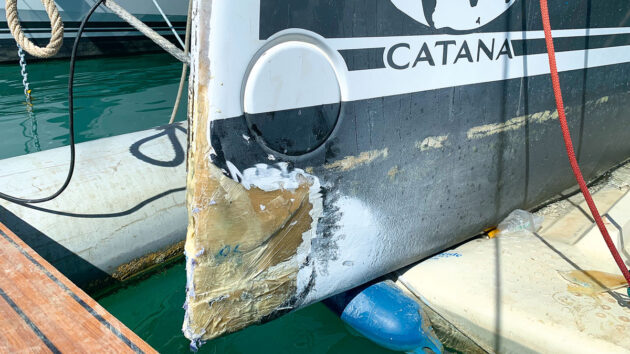
“We’ve hit something! Get up here!” This was the cry skipper Steve May heard from his crew, Kurt, who was on night watch when the Catana 53 Hanuman hit an unidentified floating object (UFO). The catamaran was 425 miles south-west of Gran Canaria heading for Grenada as part of the ARC+ Rally.
Although he’d been off-watch and asleep at the moment of impact, Steve was quickly awake, having heard the sound of objects falling that wouldn’t usually fall. The spinnaker was flapping, which meant the boat had slowed from the cruising speed of 9 knots and changed direction rapidly without time to trim the sails. Steve thought the boat had just taken a wave at the wrong angle which had pushed it around. He was making his way up on deck to check everything was okay when Kurt had shouted down his warning.
Steve was still waking up at this stage, and Kurt was already in motion, making a plan in his head.
Immediate action after the UFO collision
Kurt was, of course, already a step or two ahead of Steve and the other two crew who were sleeping when the UFO collision happened. He told them to check the bilges and then, with Karen, who was also on night watch, went down below and started pulling up floorboards to check for water in the compartments; there was none.
While the rest of the crew took a minute to appreciate still being afloat, and the autopilot had brought the boat back on course and sailing again, Kurt opened up the engine compartments on the deck, and looking into the starboard compartment, shouted: “We’ve got water in here!” Under the beam of Steve’s hastily grabbed spotlight they could see water sloshing around and underneath the engine block.
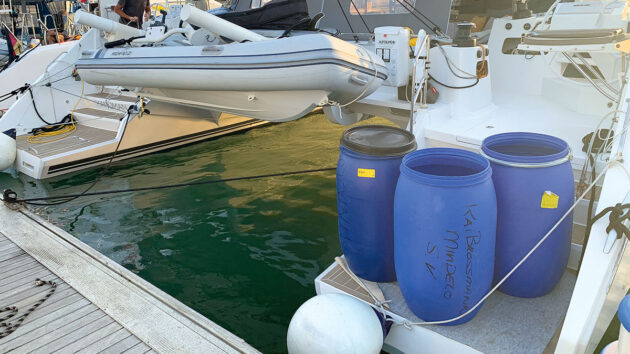
Once Hanuman made it to port, 100lt barrels filled with water were initially used to raise the port bow, but didn’t provide enough lift to clear the water. Credit: Tim Stickley
Kurt told Karen to find the through-hull softwood bungs that had been mandatory as part of their ARC+ Rally safety inspection in Las Palmas. She had noted where to find them during their safety inspection and was back in a jiffy with a selection of sizes. Kurt climbed into the compartment armed with a couple of bungs and manoeuvred himself around the engine to find the source of the water ingress: a through-hull fitting that had broken off to leave a perfect round hole in the laminate, so he plugged it with a bung. The auto bilge pumps immediately started to have more of an effect and Karen helped to empty the compartment using the manual bilge pump.
Later on, Karen told me: “Had we not gone through the safety inspection, I’d not have known where the bungs were. Everyone on board needs to know where all the safety equipment is and how to use it. The other thing that needed to happen – and did – was the understanding that when something hits your boat, you’ve got to check your bilges immediately. If you wait too long, you can’t see where it’s coming in.”
Assessing the impact of the UFO collision
After the initial emergency had passed the crew continued to assess the situation and found there was still some water coming into the engine compartment. Using a hand pump, Kurt and Steve emptied the well under the engine; they could then see that water was still coming in around the bung. They found a rubber mallet and a piece of wood to use as a drift as the bung’s position made it very awkward to use the mallet. After a few taps, the water ingress was reduced to almost nothing.
It was now 0400 and Kurt decided that the engine compartment was a little too salty and oily for his liking, so he set about scrubbing the entire space to make it cleaner than ever before.
Communications
Once the crew were content that the water had stopped coming into the boat, Steve then wanted to alert other crews nearby about the UFO and that Hanuman had sustained damage. Kurt hailed the boats in their vicinity on VHF Ch16 with no success; strangely, it seemed that the closest boats had their radios turned down, but two vessels 35 miles behind listened in to Kurt’s Securité call and got back in touch to offer reassurance and gratitude for the UFO warning. Steve then contacted Rally Control, based in Cowes, and shared Hanuman’s position, explaining they didn’t need assistance and would continue to Mindelo in Cape Verde for repairs.
In response, Rally Control updated the frequency of the transmission from the catamaran’s YB Tracker from every four hours to every 30 minutes, which the crew found reassuring.
The aftermath of the UFO collision
At this stage, the adrenaline was starting to subside, and at sunrise, a Rally Control email informed the crew of Hanuman that engineers in Mindelo were on standby to assess the boat for repair. As Steve explained, this was a huge relief as he’d been considering other ports of refuge, like Mauritania, for repairs. The rest of the ARC+ fleet was also informed about Hanuman’s situation.
“As you know very well, it’s kind of a big ocean, and it gets really big when you’re out there and when stuff starts to happen all of a sudden, you feel pretty isolated,” said Steve. “So that was very powerful to me to go ‘okay, people know’, but also just to take it in; it was almost like reading [the email] about someone else’s boat, and going ‘woooah…’, which I think is the reaction a lot of people had when they read it.”
For the next few days, they slightly modified their sail plan, adjusting from flying a Parasailor spinnaker at night and main/asymmetric spinnaker during the day to a more casual full-time Parasailor, steering the rhumb line. The crew tried to evaluate the damage to the rudder; they could see it a little from the port hull, and could identify torn glassfibre, but wanted to investigate further to assess any damage to the saildrives.
A day out from Cape Verde in lighter winds, Kurt donned mask and snorkel and after tethering himself to the catamaran, slipped into the water to have a look at the damage caused by the UFO. The saildrives looked fine, so they tentatively started the engines and put them into gear to test.
Safely in the harbour
Once in Mindelo Marina, Kai Brossmann from the local marine engineering company BoatCV took the reins and prioritised the work on Hanuman. The crew had arrived at night and by 0900 the following day the team had already dropped the starboard rudder and assessed the damage. It was completely delaminated with chunks of GRP and foam missing. It was transported back to the workshop for drying and repair.
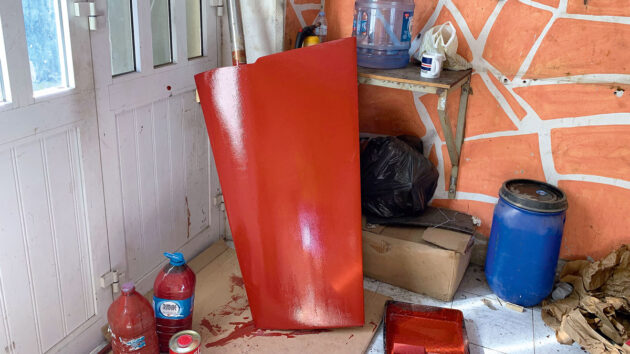
The starboard rudder was delaminated during the collision; it was repaired with new foam and rebuilt with epoxy and glass mat. Credit: Tim Stickley
The damaged section of the port bow also needed drying out, not easy with no facilities for lifting out. To overcome this, Kai and his team decided to work on the catamaran in its berth. They started by trialling airbags but this didn’t provide enough lift. They then decided to lift the port bow by weighing down the starboard quarter using five 100-gallon barrels filled with water on the aft deck; this approach helped, but not enough.
Finally, one bright spark thought that if the airbags were under something solid, they’d lift the bow higher. A jet-ski pontoon was found and winched into position under the bow before airbags were deployed underneath it. This lifted the port bow 15cm clear of the water, allowing it to be rinsed with fresh water and dried out.
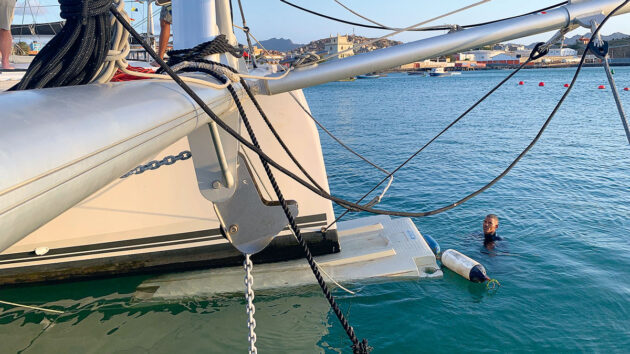
To dry out the damaged port bow, a jet-ski pontoon was put under the boat and airbags were deployed to raise the bow from the water. Credit: Tim Stickley
A few days later, Kai’s team were back on board, grinding out the loose material in the bow and filling the void with thickened epoxy resin. Once dried, the surface was smoothed and GRP was laid over the top. The starboard rudder was bonded back together with new foam, rebuilt with epoxy laminate and given a new coat of paint, and it was lifted back into position the following day. The failed skin fitting was also replaced. Kai Brossmann, of BoatCV said: “Our motto is ‘If it’s man-made, we can fix it’.”
Be a first responder
So, what did Steve and his crew learn from the experience? “Probably the two most important takeaways for me are that even when I’m off watch, in settled conditions, be ready at a moment’s notice 24 hours a day to respond,” said Steve. “It’s important to be able to respond immediately to a situation, so have all of your gear at the ready, whether it’s clothes or boots or gloves or a headtorch or flashlight or a knife or whatever it is you need, even when you’re off watch.”
“Another thing I learned was about plugging holes! Until I actually experience something, it’s just a concept to me, but I now feel like if there was a bigger, more gnarly hole in the boat, I would have a better shot at solving that problem than I would have before this incident, because I saw: ‘just MacGyver it, just find something you can shove in there that will slow it down’.”
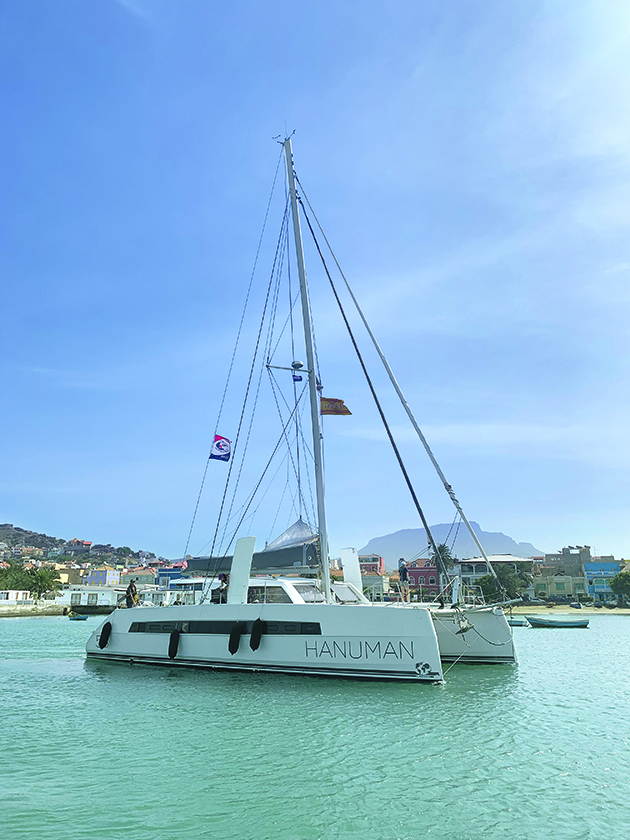
Hanuman after the hull was repaired in Cape Verde. Credit: Tim Stickley
But Steve stresses that this should not put people off from making a transatlantic crossing. “Under no circumstances should the fact that there are some dangers stop you from getting on your boat and going sailing. Go… go!” stresses Steve.
“It’s so easy to contract and try and protect yourself. My biggest fear is not drowning because I sailed into a container, but dying sitting on the couch watching Judge Judy and eating Cheetos; that’s the worst fate that could befall someone.
“You’ve got to do all the prep, and I have been sailing for many years, and I don’t feel like a beginner, but I feel like I have so much to learn, and I feel like everything I’ve learned from being a participant in the ARC with all the safety focus has been super important and helpful, and I’m still continuing to learn.”
“You take all of the steps to mitigate problems, dangers, and be prepared…and you GO.”
ARC Rally Stopover Survival Guide: The boatyard at the crossroads of the world
How do you fix a boat in the middle of the Atlantic? BoatCV, beloved by generations of ARC Rally cruisers,…
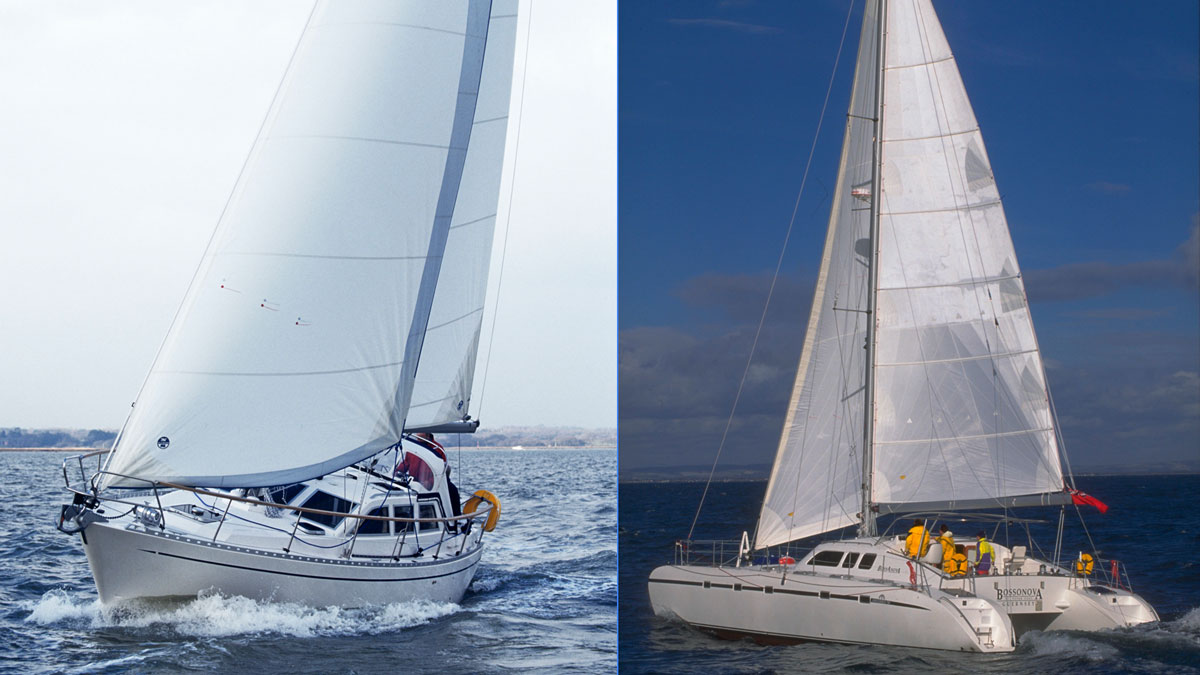
Monohulls vs Multihulls: which is best?
Ben Lowings looks at the pros and cons of multihulls and monohulls, covering handling, sailing performance and accommodation
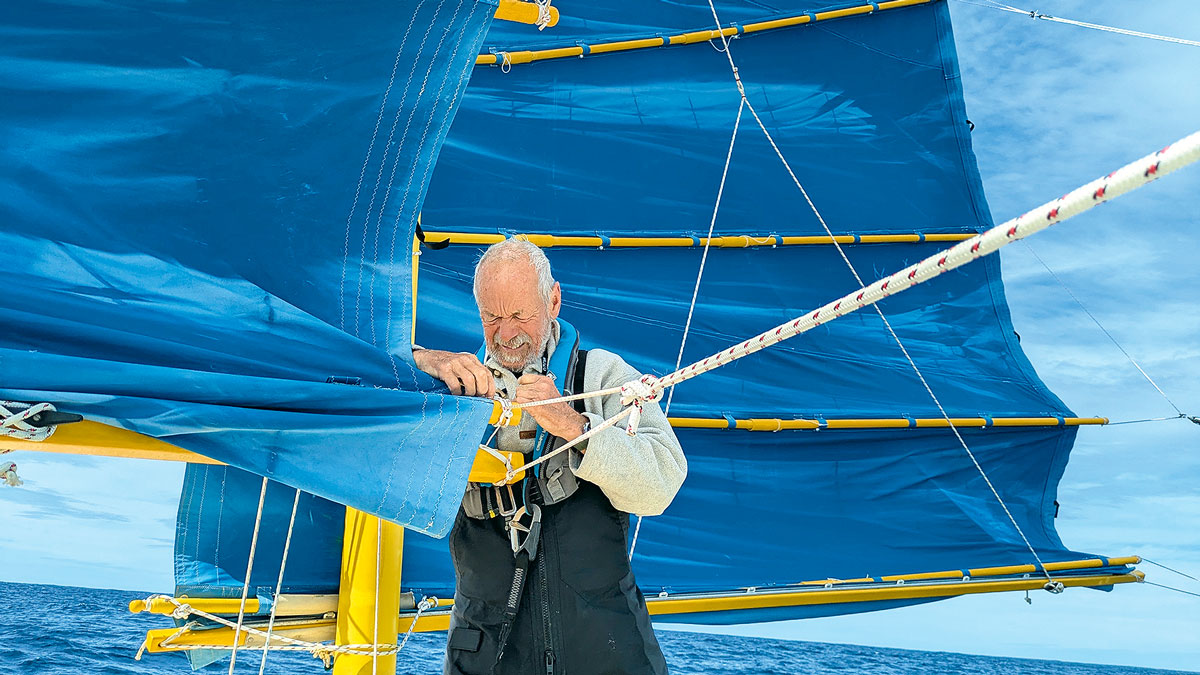
Pete Hill on sail repair, damaged steering and two lost drogues while battling storms in the Tasman Sea
Pete Hill faced damaged steering and lost two drogues while battling extreme conditions in the Tasman Sea. Graham Cox tells…

How a rogue water bottle led to a Mayday in a storm
Learning from experience: Steven Copeland reflects on how a rogue water bottle led to a stormy rescue off the coast…
Want to read more articles like UFO encounter mid-Atlantic: how one boat crew saved their catamaran?
A subscription to Practical Boat Owner magazine costs around 40% less than the cover price.
Print and digital editions are available through Magazines Direct – where you can also find the latest deals.
PBO is packed with information to help you get the most from boat ownership – whether sail or power.
-
-
-
- Take your DIY skills to the next level with trusted advice on boat maintenance and repairs
- Impartial, in-depth gear reviews
- Practical cruising tips for making the most of your time afloat
-
-
Follow us on Facebook, Instagram, TikTok and X